
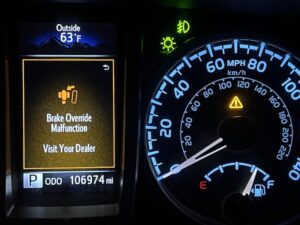

Few dashboard warnings will get your heart rate up faster than seeing “Brake Override Malfunction” flash across the screen. Brakes are the one system on your car that absolutely cannot fail. Everything else is secondary. If the engine dies, you coast to a stop. If the A/C quits, you roll down the windows. But if the braking system has a problem, you’ve got a genuine safety issue on your hands.
The brake override system is one of those features most drivers never think about until it stops working. It runs quietly in the background, ready to step in during a panic situation. When it malfunctions, you lose that safety net, and that’s not something you want to ignore or push off until next week.
Let’s go through what the brake override system actually does, what causes it to malfunction, and what your options are when the warning shows up.
What Does the Brake Override System Do?
The brake override system exists to handle a very specific and dangerous scenario: what happens when both the gas pedal and brake pedal are pressed at the same time.
This might sound like something that would never happen, but it does. Maybe a floor mat gets jammed under the accelerator. Maybe a driver panics during an emergency and stomps on both pedals simultaneously. Maybe the throttle sticks due to a mechanical issue. Whatever the cause, the result is the same: the engine is being told to accelerate while the driver is trying to stop.
The brake override system resolves this conflict automatically. Sensors on both the brake pedal and gas pedal constantly feed data to the vehicle’s computer. When the system detects that both pedals are being pressed at the same time, it overrides all acceleration commands and prioritizes the brakes. The engine’s throttle gets cut, and the car slows down.
Think of it as a referee that always sides with the brakes. No matter what the accelerator is doing, if the brakes are engaged, the brake override makes sure the car decelerates. It’s an automatic system, and on most vehicles, it can be toggled on or off by the driver.
This feature became widespread after the high-profile Toyota unintended acceleration incidents in the late 2000s. It’s now standard on most modern vehicles, and it’s saved countless drivers from situations that could have ended very badly.
What Does “Brake Override Malfunction” Actually Mean?
When you see a brake override malfunction warning, it means the system can no longer do its job. It can’t automatically prioritize the brakes over the throttle if both pedals are engaged. The safety net is gone.
This doesn’t necessarily mean your regular brakes aren’t working. You can probably still press the brake pedal and stop the car normally. What it means is that the automatic override function, the one that cuts the throttle when it detects a conflict between the gas and brake pedals, is offline.
In normal, everyday driving, you might never notice the difference. But in an emergency situation where the throttle sticks or you accidentally hit both pedals, you’d be relying entirely on your own foot pressure to overpower the engine. That’s a fight your brakes will eventually lose at higher RPMs.
This is why the warning shouldn’t be treated casually. Even if the car drives fine, the system that’s supposed to protect you in a worst-case scenario isn’t functioning.
3 Common Causes of a Brake Override Malfunction
The good news is that this warning usually traces back to one of a few specific issues, and all of them are fixable. Here’s what typically goes wrong.
1. A Faulty Brake Pressure Sensor
The brake pressure sensor measures how much force you’re applying to the brake pedal and communicates that information to the vehicle’s computer. The brake override system depends heavily on this data. It needs to know when the brakes are being applied, and how hard, to make its decisions.
When a brake pressure sensor starts sending inaccurate signals, things get unpredictable. In one scenario, the sensor tells the system the brakes are being applied when they’re not, which could trigger the override and cut throttle at random times. In another scenario, the sensor fails to report brake application, which means the override system doesn’t activate when it should.
Either way, the vehicle’s computer recognizes the sensor data is unreliable and flags the brake override as malfunctioning.
The fix: A mechanic needs to test each brake pressure sensor in the system individually. Once the faulty one is identified, it gets replaced. The sensors themselves aren’t terribly expensive, and the labor is usually straightforward since they’re accessible components.
2. A Malfunctioning Airbag Sensor
This one surprises a lot of people. What does an airbag sensor have to do with the brakes? More than you’d think.
Modern vehicles share data between safety systems. The braking system and the airbag system communicate with each other because they’re both part of the car’s crash avoidance and crash response network. If the airbag system detects a fault and shuts itself down, it can pull the brake override system down with it as a precaution.
You’ll usually know the airbag system is involved because there will be a separate airbag warning light on the dashboard alongside the brake override warning. If you see both lights at the same time, the airbag system is very likely the root cause.
The fix: The airbag sensors and the wiring connecting them to the control module need to be tested. There could be a single bad sensor, a corroded connector, or a wiring fault somewhere in the circuit. A mechanic should also run a full diagnostic on the entire airbag system to catch any secondary faults that haven’t triggered their own warning yet. If a sensor is damaged, it needs to be replaced.
3. A Defective Key Fob
This is the one that really catches people off guard. Your key fob does a lot more than lock and unlock the doors. On modern push-button-start vehicles, the key fob communicates with the car’s computer to authorize engine startup and transmit various status signals.
When a key fob malfunctions, it can send garbled or incorrect signals to the vehicle’s systems. In some cases, it may tell the braking system that someone has their foot on the brake pedal when nobody is even in the car. This phantom brake signal confuses the override system and can trigger the malfunction warning.
A faulty key fob can also prevent the engine from starting altogether, which is usually the more obvious symptom. But the brake override interference can happen even when the car starts and drives normally.
The fix: Start simple. Replace the key fob battery and clean off any grime or residue from the fob’s contacts. A dying battery is the most common cause of key fob signal issues, and a fresh CR2032 battery costs about $3.
If a new battery doesn’t solve the problem, the key fob itself may need to be replaced. This requires a visit to a dealership or a mechanic who works directly with your vehicle’s manufacturer, since the new fob needs to be programmed to your car. Expect to spend somewhere between $50 and $100 for a replacement, though some luxury brands charge significantly more.
Can You Temporarily Disable the Brake Override System?
Yes, but understand what you’re giving up. Turning off the brake override means the system won’t intervene if the gas and brake pedals are pressed simultaneously. You’re removing a safety feature designed to protect you in an emergency. Only do this as a temporary measure while you’re getting the car to a mechanic.
Here’s the general procedure on most vehicles:
- Start the engine and let the car run
- Sit in the driver’s seat
- Press and hold the brake pedal down
- While holding the brake, also press and hold the gas pedal
- Hold both pedals down for a full 15 seconds
There may not be a dashboard indicator confirming the system is off. If you held both pedals for the full 15 seconds, it should be deactivated.
After disabling the system, drive cautiously. Keep your speed low, increase your following distance, and get to a mechanic as soon as possible. This isn’t a permanent fix. It’s a band-aid to get you from point A to the repair shop safely.
How to Keep Your Braking System Healthy Long-Term
Most brake override malfunctions trace back to sensor failures, and sensors fail faster when the broader braking system isn’t maintained properly. Corroded components, contaminated brake fluid, and worn pads create an environment where sensors and modules degrade prematurely.
Staying on top of basic brake maintenance won’t just prevent override issues. It’ll keep your entire braking system performing at its best. Here are the three fundamentals.
- Service your brakes and replace pads every 12,000 miles. Brake pads wear down gradually, and waiting until they’re metal-on-metal causes rotor damage, caliper stress, and sensor exposure that leads to bigger problems. A pad replacement costs a fraction of what a full brake overhaul runs.
- Replace your brake fluid every 25,000 miles. Brake fluid is hygroscopic, meaning it absorbs moisture from the air over time. That moisture lowers the fluid’s boiling point and accelerates corrosion inside the brake lines, calipers, and ABS module. Fresh fluid keeps the entire system clean and responsive.
- Ask about braking system upgrades if your car is over five years old. Manufacturers regularly improve their braking systems with updated components, revised software, and better materials. A quick conversation with your dealership’s service department can tell you whether there are any applicable upgrades or technical service bulletins for your specific model.
The brake override system is designed to save your life in a situation you hope never happens. When it tells you something is wrong, treat it with the urgency it deserves. Get the warning diagnosed, fix the underlying cause, and make sure that safety net is back in place before you need it.