
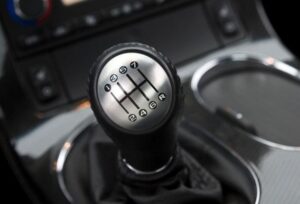

Most drivers know the difference between “automatic” and “manual.” But the world of car transmissions goes well beyond those two categories. There are actually six distinct types of transmissions used in modern vehicles, and each one takes a fundamentally different approach to solving the same problem: how to get power from the engine to the wheels as efficiently as possible.
Every vehicle powered by an internal combustion engine needs a transmission. The engine produces rotational energy, but it can’t deliver that energy to the wheels at a useful range of speeds on its own. The transmission acts as the middleman, adjusting the gear ratio so the engine can operate efficiently whether you’re crawling through a parking lot or cruising at highway speed.
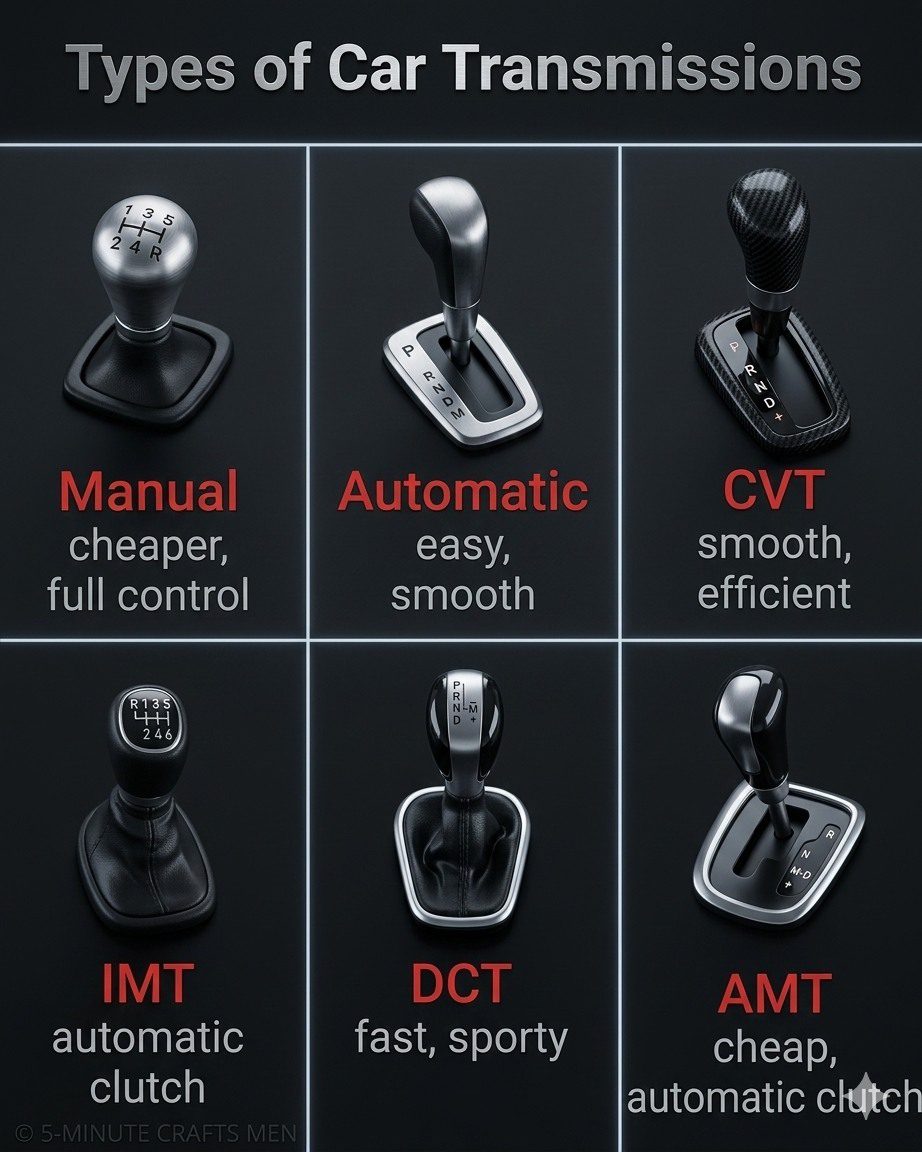
Understanding how each transmission type works helps you make a smarter decision when buying a car, and it helps you understand why your car behaves the way it does behind the wheel.
1. Manual Transmission: The Original, and Still the Simplest
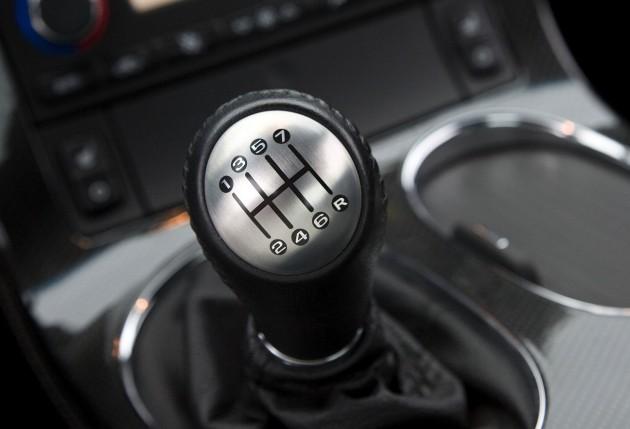
The manual transmission is the oldest type of gearbox still in use, and mechanically, it’s also the most straightforward. You’ve probably heard it called a “stick shift,” “standard,” or simply described by its gear count: five-speed, six-speed, and so on.
Here’s how it works. A friction clutch, controlled by a pedal under the driver’s left foot, connects and disconnects the engine from the transmission’s input shaft. When you press the clutch pedal, you’re temporarily breaking the connection between the engine and the gearbox. That’s what allows you to move the gear lever into a different position. Release the clutch, and the engine’s power flows through the selected gear to the wheels.
The driver is doing all the decision-making here. You choose when to shift, what gear to select, and how quickly to engage the clutch. That level of control is exactly why driving enthusiasts love manuals. You’re directly involved in the mechanical process of making the car move.
Why Manuals Are Disappearing (But Still Have Loyal Fans)
In the United States, the manual transmission is becoming increasingly rare. Fewer new models offer one, and a growing number of drivers have never learned to use a clutch pedal. But the manual still has real advantages that keep a dedicated following.
Simplicity and cost: Because there are fewer complex components, manual transmissions are less expensive to repair and replace than any other type. When something does go wrong, the fix is usually simpler and cheaper.
Driver engagement: For people who enjoy the act of driving, a manual provides a connection to the car that automatic systems can’t replicate. There’s a reason nearly every race car and high-performance vehicle used a manual for decades.
Fuel efficiency: A skilled manual driver can often match or beat the fuel economy of a traditional automatic, though modern automatics and CVTs have largely closed this gap.
That said, dual-clutch and modern automatic transmissions have surpassed manuals in raw shifting speed. In a straight performance comparison, the best automatics are now faster than any human can shift a manual. But for many drivers, the experience of rowing through gears is the whole point.
2. Automatic Transmission: The One Most People Drive
The traditional automatic transmission has been around since the 1940s, and it’s by far the most common type on the road today. The concept is simple from the driver’s perspective: put it in “D” and go. The transmission handles all the gear changes without any input from you.
Behind the scenes, though, an automatic is significantly more complex than a manual. Instead of a clutch pedal, it uses a torque converter, a fluid coupling device that transfers the engine’s rotational energy to the transmission. The torque converter allows the engine to keep spinning even when the car is stopped (which is why an automatic doesn’t stall when you’re sitting at a red light in gear).
The transmission’s internal hydraulic system and electronic controls determine when to shift based on factors like vehicle speed, throttle position, and engine load. Modern automatics use sophisticated computer programming to optimize shift points for performance, fuel economy, or both.
How Automatics Have Evolved
Early automatics had just two or three gears. Today’s versions commonly have eight, nine, or even ten speeds. More gears means the transmission can keep the engine in its most efficient RPM range across a wider variety of driving conditions. That translates to better fuel economy and smoother acceleration.
Modern automatics have also gotten dramatically faster at shifting. The best units today can change gears faster than any human could with a manual, which is a big reason why automatics have taken over even in the performance car world.
Many current automatic transmissions also include a “manual mode” or paddle shifters on the steering wheel, giving drivers the option to select gears themselves when they want more control. It’s the best-of-both-worlds approach that appeals to people who want convenience most of the time but occasional engagement when the mood strikes.
For vehicle types like SUVs and pickup trucks, automatics are practically standard. The torque multiplication from the converter and the ability to handle high-load situations make them ideal for towing and hauling.
3. Continuously Variable Transmission (CVT): Maximum Efficiency, Minimum Drama
From the driver’s seat, a CVT feels a lot like a regular automatic. There’s no clutch pedal, and you just select “D” and drive. But under the skin, it works on a completely different principle.
A CVT has no fixed gears at all. Instead, it uses a system of belts and pulleys that can continuously adjust the gear ratio to any point along a seamless range. The car’s computer constantly calculates the ideal ratio for the current driving situation, whether that’s maximum acceleration, cruising efficiency, or climbing a hill, and adjusts the pulleys accordingly.
The result? The engine always operates at or near its most efficient RPM, regardless of vehicle speed. That’s why CVTs consistently deliver the best fuel economy numbers of any transmission type. If you see a car advertising exceptional MPG figures, there’s a good chance it’s equipped with a CVT.
The CVT’s Biggest Strength Is Also Its Biggest Weakness
Because there are no gear changes, acceleration in a CVT-equipped car feels completely smooth and uninterrupted. There’s no shift shock, no momentary pause between gears. From a pure efficiency standpoint, this is ideal.
But for a lot of drivers, that smoothness feels strange. When you press the gas pedal hard, the engine revs up to a fixed RPM and just stays there while the car gradually accelerates. It’s effective, but it can make the car feel more like an appliance than a machine. Enthusiasts often describe it as “rubber band” acceleration, and it’s a legitimate turnoff for people who enjoy the sensation of gears clicking through.
CVTs are also mechanically simpler than traditional automatics, which means they’re generally less expensive to maintain. They’re not quite as simple as a manual, but they have fewer components that can fail compared to a conventional automatic gearbox.
You’ll find CVTs in a huge number of economy cars, hybrids, and compact crossovers where fuel efficiency is the top priority.
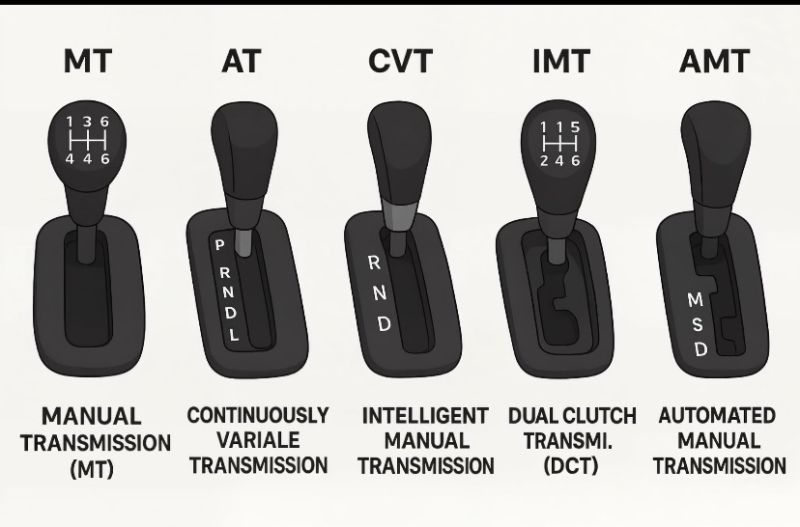
4. Dual-Clutch Transmission (DCT): Race-Bred Speed for the Street
Think of a dual-clutch transmission as a manual transmission that shifts itself, and does it faster than any human ever could. It’s essentially two manual gearboxes packed into one housing, each with its own clutch. One clutch handles the odd-numbered gears (1st, 3rd, 5th), and the other handles the even-numbered gears (2nd, 4th, 6th).
Here’s why this design is so fast: while you’re driving in, say, 3rd gear on one clutch, the other clutch already has 4th gear pre-selected and ready to engage. When it’s time to shift, the system simply disengages one clutch and engages the other. The transition happens in milliseconds, with virtually no interruption in power delivery.
Most DCTs operate as fully automatic transmissions under normal driving conditions. But they also offer manual control through paddle shifters mounted on the steering wheel, letting the driver take over gear selection when they want to.
The Tradeoffs of Lightning-Fast Shifts
DCTs deliver performance that a traditional manual simply can’t match. The shift speed is so fast that it eliminates the power gap you feel in a manual when the clutch is disengaged. For lap times and acceleration runs, this matters enormously.
The downside? Complexity and cost. DCTs have significantly more components than a standard manual or a conventional automatic, and when something goes wrong, repairs are expensive. They’re also less smooth at low speeds compared to a torque converter automatic. In stop-and-go traffic, some DCTs can feel jerky or hesitant because the clutches are mechanically engaging and disengaging rather than using fluid coupling.
You’ll find DCTs primarily in performance-oriented vehicles and sports cars from manufacturers like Porsche, BMW, Volkswagen, and Ford. They’re brilliant on a track or a winding road, but for everyday commuting, a conventional automatic or CVT is usually a smoother experience.
5. Sequential Manual Transmission: Built for the Track
Sequential manual transmissions are rare in passenger cars, but they’re the standard in professional motorsport. They take the mechanical layout of a manual gearbox and add a critical restriction: you can only shift one gear at a time, either up or down. No skipping from 2nd to 5th. No “kick down” like an automatic. Just one gear at a time, in order.
A clutch is present, but it’s only used to get the car moving from a standstill and select first gear. After that, the driver shifts using a gear lever or paddle shifters without touching the clutch. The mechanical system handles the clutch engagement during each shift, allowing the driver to focus entirely on driving while gear changes happen in fractions of a second.
This design is ideal for racing because drivers on a track are almost always shifting sequentially anyway, going up through the gears on a straight and back down through them approaching a corner. The sequential layout eliminates the risk of accidentally selecting the wrong gear under pressure, which is a real concern in a traditional H-pattern gearbox at 150 mph.
The reason you won’t find these in your daily driver is cost. Sequential gearboxes are expensive to build, expensive to maintain, and don’t offer any real advantage in normal driving where you might want to skip gears or benefit from automatic shift logic. They’re purpose-built for competition, and that’s where they stay.
6. Semi-Automatic Transmission: The Hybrid That Never Quite Caught On
Semi-automatic transmissions represent one of the automotive industry’s attempts to blend the best qualities of manual and automatic systems into a single unit. The idea was compelling: give drivers the efficiency and control of a manual with the convenience of not having to operate a clutch pedal for every single gear change.
Different manufacturers approached this concept in different ways. Some semi-automatics use a clutch only for starting, then shift automatically after that. Others, like the Porsche Sportomatic, eliminated the clutch pedal entirely but still required the driver to move a gear lever to initiate shifts. The transmission would handle the actual clutch engagement mechanically or hydraulically.
In theory, this sounds like the perfect compromise. In practice, the results were mixed. Semi-automatics often felt awkward compared to either a pure manual or a fully automatic. The shift quality wasn’t as smooth as a conventional automatic, and the response wasn’t as direct as a proper manual. They occupied an uncomfortable middle ground that didn’t fully satisfy either camp.
Semi-automatics aren’t widely used in today’s consumer vehicles. The dual-clutch transmission essentially took the semi-automatic concept and executed it at a much higher level, delivering the automation of shifts with dramatically better speed and refinement. For most practical purposes, the DCT is what the semi-automatic was trying to be.
Which Transmission Type Is Right for You?
There’s no single “best” transmission. The right one depends entirely on what you prioritize.
If you want maximum fuel economy, a CVT is hard to beat. If you care about driving engagement and want the most direct connection to the car, a manual is still king. For everyday convenience with strong all-around performance, a modern automatic with eight or more gears is the default choice for good reason. And if you’re chasing track performance, a dual-clutch transmission delivers shift speeds that nothing else in a road car can match.
The transmission landscape has changed dramatically in just the last decade. Automatics have gotten faster than manuals. CVTs have gotten smoother. Dual-clutch systems have trickled down from exotic supercars into relatively affordable sports cars. And the manual, while endangered, refuses to die completely because the experience of driving one is something no computer can replicate. What matters most to you when you’re behind the wheel?