
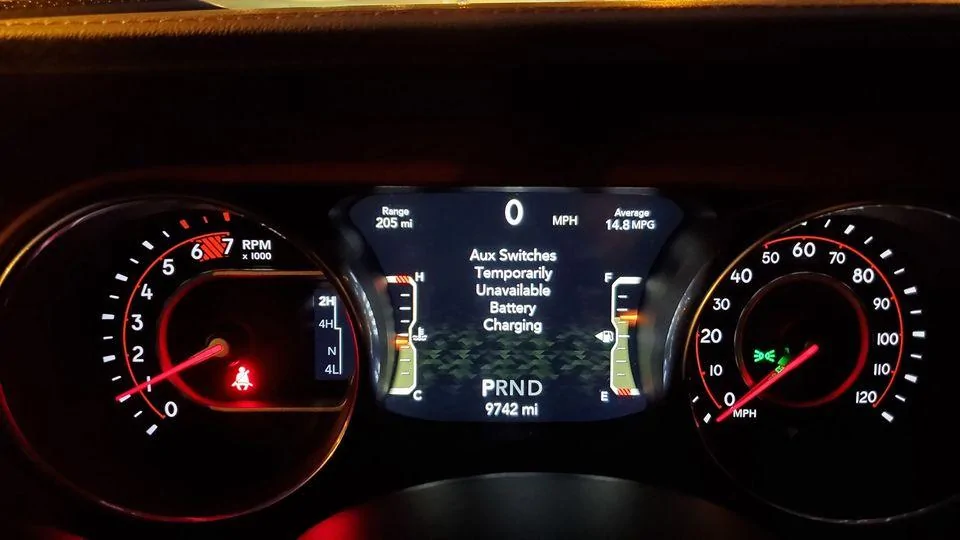
If you own a Jeep and you have recently seen the message “Aux Switches Temporarily Unavailable Battery Charging” pop up on your dashboard, you are probably wondering what it means and how worried you should be. The good news is that this warning does not mean your Jeep is done for. The less-good news is that it does mean something needs your attention relatively soon, and ignoring it can lead to bigger problems down the road.
This guide covers everything you need to know about this warning, what is causing it, what happens to your Jeep while it is active, and exactly what you need to do to fix it.
What the “Aux Switches Temporarily Unavailable Battery Charging” Warning Actually Means
This is a Jeep-specific warning message, and it is tied directly to the vehicle’s dual battery system. Most people do not realize their Jeep is running two batteries simultaneously, but it is. Understanding how that system works makes the warning message make a lot more sense.
Your Jeep has a main battery, which is the larger of the two. This is the one responsible for starting the engine and powering the ignition process. Then there is an auxiliary battery, which is smaller and handles the power demands of your electronic accessories and auxiliary systems, including things like the aux switches themselves.
When either battery drops below the required voltage threshold, typically around 12 volts or below, the Jeep’s computer steps in to protect the remaining charge. It does this by automatically shutting down non-essential electrical systems to conserve power. The auxiliary switches fall into that non-essential category, so they get cut off first. The warning message is the system telling you that this has happened and explaining why.
In practical terms, this means your aux-powered accessories will stop working until the battery situation is resolved. You might also notice the stop/start system behaving sluggishly or not working at all, since that system is particularly sensitive to battery voltage levels.
Why This Specific Warning Matters for Jeep Owners
Jeep owners tend to use their vehicles hard. Off-road trips, overlanding setups, winches, roof lights, air compressors, refrigerators, the list of accessories that get plugged into a Jeep’s electrical system can be extensive. All of that additional draw puts real strain on both the main and auxiliary batteries, and it makes proper battery health more important in a Jeep than it is in most other vehicles.
The aux switch system in models like the Jeep Wrangler and Gladiator is designed to manage up to eight configurable switches that control various accessories directly from the dashboard. It is a convenient feature, but it adds another layer of electrical demand on top of everything else the batteries are already managing. When voltage dips, the system protects itself by disabling those switches first, and the warning tells you it has done so.
If this warning appears and then disappears on its own after driving for a while, the alternator has likely brought the battery back up to an adequate voltage. That is normal behavior in certain situations. But if the warning keeps coming back, or if it stays on persistently, something in the charging system needs to be diagnosed and addressed.
Every Cause Behind This Warning and What Is Really Happening
1. Cold Weather Draining Battery Voltage at Startup
Cold temperatures and car batteries have a difficult relationship. When the temperature drops significantly, battery chemistry slows down and the battery’s ability to deliver electrical current decreases. At the same time, cold engines require more power to turn over during startup. So the battery is being asked to deliver more power right when its capacity to do so is temporarily reduced.
In freezing conditions, it is not unusual for a significant portion of the battery’s available charge to be consumed during a single cold start. This voltage dip can be enough to trigger the aux switches warning, even on a battery that is otherwise in good health.
The key thing to watch here is what happens after you drive for 10 to 15 minutes. Once the engine is running and the alternator has had time to recharge the battery, the warning should clear on its own. If it does, cold weather was the culprit and no repair is needed. If the warning persists even after the alternator has had plenty of time to do its job, the battery may no longer be capable of accepting and holding a full charge, and that is when you need to dig deeper.
2. A Worn-Out Battery That Can No Longer Hold a Charge
This is one of the most common causes of a persistent aux switches warning. Car batteries do not last forever. Auxiliary batteries in Jeeps typically have a usable lifespan of three to five years under normal conditions. If you are pushing your Jeep hard with a lot of accessory load, expect that lifespan to be toward the shorter end of that range.
As a battery ages, its internal capacity degrades. The battery plates deteriorate, and the battery loses its ability to hold a full charge. Even if the alternator is working perfectly and pumping full voltage into the battery, the battery cannot retain it. It drains faster than normal between uses, and under electrical load it drops in voltage quickly. The vehicle’s computer detects this and triggers the aux switches warning.
The way to know for certain whether the battery is the problem is to perform a battery load test. This is different from simply measuring voltage with a multimeter. A load test applies a simulated electrical load to the battery and measures how well it holds voltage under that stress. A battery can show 12.6 volts at rest and still fail a load test completely, because the test reveals how it performs when it actually has to deliver current to something.
Most auto parts stores offer free battery load testing. Take advantage of it. If the auxiliary battery fails the test and it is three or more years old, replace it. Trying to nurse a failing battery along only leads to more warning messages, potential damage to other electrical components from voltage instability, and eventually a vehicle that will not start when you most need it to.
3. Wiring Faults and Connection Problems
The batteries in your Jeep are connected to the rest of the electrical system through a network of wires, connectors, and ground points. Any fault in this network can disrupt the flow of current and cause voltage readings that trigger the warning, even if the batteries themselves are in good condition.
Common wiring-related issues that cause this warning include:
- Corroded battery terminals adding resistance to the circuit and reducing effective voltage delivery
- Loose or disconnected connectors in the wiring between the auxiliary battery and the aux switch module
- Damaged or chafed wiring insulation causing partial shorts that drain current away from the batteries
- Corroded ground connections creating an unstable electrical reference that confuses the vehicle’s monitoring system
- Pest damage from rodents that have chewed through wiring, which is a more common issue than people expect in vehicles that spend time off-road or parked in rural areas
Visually inspect all accessible battery wiring starting at the terminals. Look for corrosion (the white or bluish-green powdery buildup), exposed copper wire where insulation has worn away, or connectors that look pulled apart or damaged. Pay particular attention to the ground straps, which connect the negative terminal to the chassis. These are frequently overlooked but are absolutely critical to a stable electrical system.
When wiring needs to be repaired, replace the damaged section rather than patching it by cutting and rejoining wires. Spliced connections introduce additional resistance points and can fail again down the road, often in a more unpredictable way than the original damage.
4. A Failing or Damaged Alternator
The alternator is the engine-driven generator that keeps your batteries charged while the Jeep is running. If the alternator is not doing its job, the batteries drain steadily during operation and never get adequately replenished. Eventually they drop below the threshold that triggers the aux switches warning. And if the situation continues without being addressed, both batteries can be permanently damaged by deep discharge.
A failing alternator can present in different ways. It might stop charging entirely, charge intermittently, or charge at the wrong voltage level. The serpentine belt that drives the alternator is also a common failure point. If the belt has snapped, slipped off, or become so worn and glazed that it is slipping on the alternator pulley, the alternator cannot spin fast enough to generate adequate power.
Here is how to check the alternator output:
- Start the engine and let it idle.
- Connect a multimeter across the main battery terminals.
- The voltage should read between 13.5 and 14.8 volts with the engine running. This confirms the alternator is charging the battery.
- Turn on headlights, air conditioning, and other high-draw accessories. The voltage should stay within that same range. If it drops below 13 volts, the alternator is struggling under load.
While you are at it, look at the serpentine belt. Check for cracks, fraying, glazing on the contact surface, or any sign that it is not sitting squarely on all its pulleys. A visually worn belt should be replaced regardless of whether it is the cause of the current problem, because a belt failure at the wrong moment can leave you stranded with no charging, no power steering on some models, and potentially no cooling depending on how the system is configured.
5. Parasitic Battery Drain
This one often gets missed during initial troubleshooting. A parasitic drain is when something in the vehicle’s electrical system continues drawing current from the battery even after the Jeep is turned off and locked. Over time, this slowly depletes the battery, and by the time you start the vehicle again, the voltage has dropped enough to trigger the aux switches warning.
Common sources of parasitic drain in Jeeps include:
- Aftermarket accessories that were not wired through a properly fused switched circuit
- A failing relay that stays energized when it should switch off
- Interior lights that stay on due to a faulty door switch
- A malfunctioning module that fails to enter sleep mode properly after the vehicle is turned off
If your Jeep sits overnight and starts fine in the morning, parasitic drain is less likely the cause. But if the battery seems to lose charge quickly when the vehicle sits for more than a day or two, a parasitic drain test is worth performing. A mechanic can do this by connecting an ammeter in series with the battery and monitoring current draw after the vehicle enters sleep mode.
Step by Step: How to Troubleshoot This Warning Yourself
Work through this process in order before spending money on parts or professional diagnosis. Starting with the simplest explanations saves both time and money.
- Drive for 15 to 20 minutes and see if the warning clears. If it appeared immediately after a cold start in freezing temperatures and then disappeared on its own, cold weather was the likely cause. No repair needed. Monitor it over the coming days.
- Check both battery terminals visually. Look for corrosion, looseness, or damage. Clean corroded terminals with a wire brush and a baking soda and water solution. Ensure both the positive and negative connections are tight and solid.
- Test battery voltage with a multimeter. With the engine off, both the main and auxiliary batteries should read between 12.4 and 12.7 volts. Below 12.2 volts indicates a significantly discharged battery. Below 12 volts suggests a battery that can no longer hold adequate charge.
- Have both batteries load-tested. Take the Jeep to an auto parts store for a free load test. This tells you the actual condition of each battery under real electrical demand, which a resting voltage reading cannot reveal.
- Test the alternator output. With the engine running and a voltmeter across the main battery terminals, check for 13.5 to 14.8 volts. Lower than 13.5 means the alternator is undercharging. Higher than 15 volts suggests a regulator problem causing overcharging.
- Inspect the serpentine belt. Look at the belt running across the front of the engine. Check for cracks, glazing, fraying, or misalignment on the pulleys. Replace it if any wear is visible.
- Inspect accessible wiring. Look at wiring connected to both batteries, particularly ground straps, for corrosion, damage, or loose connections. Check the connector at the aux switch module if accessible.
- Run an OBD-II diagnostic scan. An OBD-II scanner will pull any stored fault codes from the vehicle’s computer. Look for codes related to battery voltage, the charging system, or the auxiliary battery specifically. These codes give you a much more targeted starting point for the repair.
How to Fix Each Cause
Charging or Replacing a Depleted Battery
If the battery voltage is low but the load test passes, the battery simply needs to be fully charged. Use a quality battery charger set to the appropriate mode for your battery type. Standard flooded lead-acid batteries, AGM batteries, and EFB batteries all have different optimal charging parameters. Using the wrong charging profile can actually damage the battery. Check the battery label for the type before connecting a charger.
After a full charge, retest the voltage and perform another load test. If the battery holds up this time, it was simply deeply discharged rather than failed. Monitor it going forward. If the load test fails again or if the battery drains quickly between uses, replacement is the only reliable fix.
When buying a replacement battery, match the specifications for your specific Jeep model. Battery group size, cold cranking amps (CCA), and reserve capacity all matter. Using a battery with lower specs than the original can lead to repeated warning messages and shortened lifespan. If your Jeep has a heavy accessory load from aftermarket equipment, consider upgrading to a higher-capacity AGM battery, which handles deep cycling and high demand significantly better than a standard battery.
Fixing Wiring Issues
If you find corroded terminals, clean them thoroughly. For connector pins that are corroded, use an electrical contact cleaner spray and a small pick to remove oxidation from individual pins. Apply dielectric grease after cleaning to prevent moisture from causing future corrosion.
For damaged wiring, replace the affected section with wire of the same gauge and insulation rating. Patch repairs using wire nuts or tape are not an adequate long-term solution in a vehicle environment, where vibration, temperature swings, and moisture exposure will break down makeshift connections over time. If the damage is extensive or involves wiring deep within the harness, a professional auto electrician is the right call.
Addressing Alternator Problems
If the serpentine belt is loose, slipping, or damaged, address that first. On many Jeep models, belt replacement is something a mechanically inclined owner can do at home with basic tools. If the belt is intact and the alternator is still not producing adequate voltage, the alternator itself needs professional attention.
Do not attempt to drive the Jeep extensively with a confirmed alternator failure. Without the alternator charging the batteries, you are running purely on stored battery charge, and once that is depleted the vehicle will die. Drive it directly to a repair shop or have it transported if the alternator has failed completely.
Alternator replacement on a Jeep Wrangler or Gladiator typically runs between $300 and $700 including parts and labor, depending on whether a new or remanufactured unit is used and whether you go to a dealer or independent shop.
Repair Cost Summary
| Issue | Estimated Cost |
|---|---|
| Battery terminal cleaning | Free to $20 |
| Auxiliary battery replacement (standard) | $80 to $200 |
| Main battery replacement | $120 to $280 |
| AGM battery upgrade (recommended for heavy accessory loads) | $180 to $350 |
| Serpentine belt replacement | $75 to $200 |
| Wiring repair (minor connector or ground repair) | $50 to $200 |
| Wiring harness repair (major damage) | $300 to $800 |
| Alternator replacement | $300 to $700 |
| Parasitic drain diagnosis and repair | $100 to $400 |
What Happens If You Keep Driving with This Warning On?
If the warning appears and then clears after a short drive, you have a window to properly diagnose the issue without an emergency. But if the warning stays on persistently and you keep driving without addressing it, here is what can happen:
- The auxiliary battery continues to drain until it reaches complete discharge
- Repeated deep discharge cycles permanently damage the battery’s internal structure, shortening its remaining usable life significantly
- If the main battery is also affected, you risk the vehicle dying mid-drive or failing to start
- Consistent undervoltage can damage sensitive electronic modules that rely on stable voltage to operate correctly
- You may find yourself stranded, particularly if the situation deteriorates while you are away from home or in an area with limited cell service
Once you reach your destination when this warning is active, avoid unnecessary driving until you have had the system properly diagnosed. The convenience of aux switches is not worth the risk of getting stranded or causing deeper electrical damage that turns a straightforward battery replacement into a multi-component repair.
Preventing This Warning from Appearing Again
A few straightforward habits keep the dual battery system in a Jeep healthy and reduce the likelihood of seeing this warning again:
- Test both batteries annually once they are two years old. A free load test at an auto parts store takes five minutes and can tell you well in advance when a battery is approaching the end of its useful life.
- Wire aftermarket accessories properly. Any additional electrical equipment added to your Jeep should be wired through a properly fused, switched circuit so it does not draw power when the vehicle is off. Improperly wired accessories are one of the most common causes of parasitic drain in modified Jeeps.
- Inspect the serpentine belt at every oil change. Look for wear and replace it at the manufacturer’s recommended interval, typically every 60,000 to 100,000 miles, before it fails unexpectedly.
- Keep terminals clean. Check battery terminal condition every few months, particularly if you live in a region with high humidity or road salt use during winter. Clean corrosion as soon as you see it.
- Consider an AGM upgrade if you run heavy accessories. If your Jeep is equipped with a winch, a roof light bar, a refrigerator, or other significant electrical loads, a standard flooded battery may not be the right tool for the job. AGM batteries handle deeper discharge cycles and high-demand situations far more gracefully and last longer under those conditions.
Your Jeep’s dual battery system is one of its most capable features, giving you the power to run serious accessories without sacrificing starting reliability. Keep both batteries healthy, the charging system maintained, and the wiring clean, and this warning should be a rare sight rather than a recurring headache.