
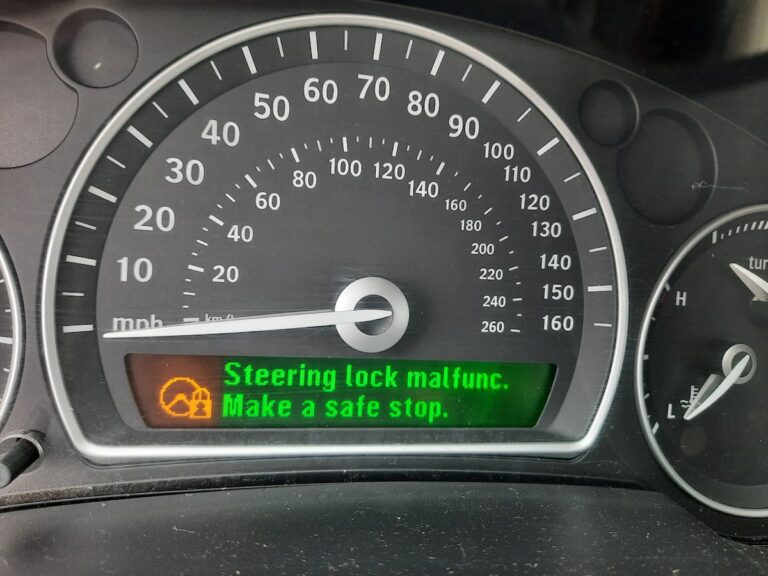
Few dashboard warnings are as unsettling as a message that involves the words steering and malfunction in the same sentence. If your Saab displays a “Steering Lock Malfunction” warning, especially on a Saab 9-3, it is natural to assume the problem is serious, expensive, or both. In some cases, it can be. In many others, though, the issue starts with something far more manageable, such as a weak battery, a glitch in the ignition switch module, a problem inside the column integration module, or a fault in the center console switch system.
As someone who has spent years studying and diagnosing electronic steering and ignition problems in European vehicles, I can tell you that Saab’s steering lock warnings often look more mysterious than they really are. Saab engineers built a clever but somewhat sensitive network of electronic modules that must all agree with one another before the car starts normally. When one part of that chain becomes unreliable, the car does not stay quiet about it. Instead, it throws a message on the Saab Information Display and forces you to sort out what the system is trying to say.
This guide is designed to make that process much easier. I will explain what the steering lock malfunction warning actually means, the most common symptoms that accompany it, and the real causes behind it. I will also walk you through the quick checks and temporary fixes that can get you moving again, along with the more permanent repairs that may be required if the warning keeps returning. By the end, you will have a clear understanding of when a simple reset may be enough, when you should inspect the battery and charging system, when the ignition switch module or column integration module becomes the likely culprit, and when it is time to stop troubleshooting and hand the job to a Saab specialist with the proper diagnostic equipment.
The goal here is not to overwhelm you with technical language. It is to help you make sense of an issue that often feels intimidating at first. If your Saab is warning you about a steering lock malfunction, there is a reason. The sooner you understand it, the sooner you can restore reliability and drive with confidence again.
What the Saab Steering Lock Malfunction Warning Really Means
To diagnose this warning correctly, you first need to understand what Saab is actually monitoring. In simple terms, the steering lock system is part of the vehicle’s anti-theft and start authorization setup. On Saab 9-3 models, the car wants confirmation that several parts of the ignition and steering system are working together correctly before it allows normal starting and operation. If one of those parts reports a problem, loses communication, or behaves inconsistently, the vehicle may trigger the steering lock malfunction message.
That message does not always mean the steering wheel is about to lock while driving. In fact, when the warning appears during driving, the issue is more often an electronic fault or communication problem than an immediate mechanical lock-up of the steering column. That distinction matters, because many drivers imagine the wheel physically freezing mid-turn. While any steering-related message should be taken seriously, Saab’s warning usually indicates that the electronic locking or unlocking sequence has failed, is unreliable, or could fail during the next key cycle.
In Saab’s system, the steering lock is tied into a group of electronic components rather than being just a simple mechanical lock and key arrangement. Depending on the exact model year and configuration, the warning may be triggered by a failure in the Ignition Switch Module, the Column Integration Module, the steering lock actuator itself, related wiring, or the battery voltage that powers these systems. In some cases, a problem in the center console ignition area can create symptoms that look like a steering lock fault even when the lock mechanism itself is not the original source of the trouble.
That is why this warning can be so confusing. A message about the steering lock does not necessarily mean you need a new steering column lock immediately. It means the car has detected an abnormal condition somewhere in the chain of modules and components responsible for recognizing the key event, unlocking the column properly, and confirming that the system is safe to proceed. Think of it as a disagreement between several electronic gatekeepers. If even one of them stops cooperating, the car becomes cautious and throws the warning.
Once you view the issue that way, the troubleshooting path becomes much more logical. You stop assuming a catastrophic steering failure and start checking the modules, power supply, connections, and switches that allow the entire sequence to happen in the first place.
Why This Problem Shows Up So Often on the Saab 9-3
The Saab 9-3 is a clever car. It is also a car that relies heavily on electronic communication between modules. That is part of what gives it its distinctive feel and advanced features for its era, but it is also part of why certain electrical and start authorization faults become familiar to owners over time.
The steering lock malfunction warning appears frequently on the 9-3 because the system depends on a chain of components that all need to behave correctly at the same time. The ignition switch module in the center console has to recognize your input. The column integration module has to process steering-column-related data and communicate with the rest of the car. The steering lock actuator has to report that it moved when commanded. The battery has to provide clean voltage. The car’s network has to pass messages back and forth without interruption. If any of that chain becomes erratic, the message can appear even if no single part has failed completely yet.
Age makes that more likely. Many Saab 9-3 cars now have years of heat cycles, vibration, battery replacements, moisture exposure, and repeated use behind them. Tiny bits of wear that once would have been insignificant in a simple analog system can create noticeable faults in an electronically coordinated one. A small amount of oxidation on contacts, a battery that no longer holds voltage as strongly as it should, or a tired switch in the center console can suddenly produce a warning that sounds dramatic.
This is why Saab steering lock warnings should be treated as important, but not as a reason to panic. The system is sensitive. Sensitivity is what allows it to notice faults early. Your job is to figure out whether the warning is pointing to a minor electrical hiccup, a common wear item, or a deeper module problem that needs professional repair.
Common Symptoms of a Saab Steering Lock Malfunction
Not every Saab with this warning behaves exactly the same way. Some cars refuse to start. Some start intermittently. Some display the message while driving and then appear normal again later. Still, there are several symptoms that appear often enough to be considered typical warning signs.
One of the most common symptoms is difficulty starting the car. You may insert the key or try to activate the ignition, only to find that the car hesitates, refuses to crank, or throws the warning immediately. Sometimes the key event is recognized only after several tries. In other cases, the dashboard lights up normally, but the system does not proceed through the usual start sequence.
Another frequent symptom is that the steering wheel does not seem to unlock normally. This may feel like the wheel is stiffer than usual or that the lock mechanism is delayed. Be careful with this description, because some drivers interpret any steering resistance as a lock issue when it may actually be power steering or simply tension in the wheel position. The more specific clue is whether the wheel behaves differently right when the warning appears or when you insert the key and expect the normal unlock sequence.
You may also hear a clicking or repetitive ticking noise from the steering column or nearby dashboard area. That sound often suggests that the lock actuator or related electronics are trying to complete a cycle but not doing so successfully. A single click is not always alarming. Repeated clicking, especially paired with a warning message, usually means the system is struggling to confirm the lock or unlock position.
On many vehicles, the Saab Information Display, often called the SID, will plainly show the fault. The message may read “Steering Lock Malfunction” or a closely related variation. That display is your first and most direct clue that the fault is not random. It is being recognized by the vehicle’s electronics, which means diagnosis should focus on the modules and their communication.
Some owners also report that the issue appears intermittently. The car may start fine for several days, then suddenly display the warning in the morning, then act normal again later that afternoon. This kind of pattern often points toward weak voltage, dirty contacts, early module wear, or a connection problem rather than a completely failed component.
Finally, there is the symptom that causes the most stress: the warning appears while driving. In many cases, the car will continue driving normally, but the message indicates that the system has noticed a fault it may not be able to ignore the next time you shut the vehicle down and attempt a restart. That means a driving-time warning should never be dismissed just because the car still moves. It may be functioning now, but it is warning you that reliability is slipping.
Error Messages You May See on the Saab Information Display
The Saab Information Display is more useful than many owners realize. When the steering lock problem begins, the SID usually gives the first direct hint that the issue is not just a dead battery or a random no-start event. The message may appear exactly as “Steering Lock Malfunction”, or it may show up in a related form depending on the vehicle’s software and the nature of the fault.
That wording matters because it narrows the problem to a known subsystem. Saab is not simply saying that the car will not start. It is telling you that the sequence involving the steering lock and its supporting electronics is not completing correctly. This immediately points the diagnostic process toward the ignition switch module, the column integration module, the steering lock hardware, related fuses and wiring, or the power supply feeding those components.
Some drivers make the mistake of clearing the message, disconnecting the battery, getting the car started again, and then assuming the matter is settled. The warning may indeed disappear for a while after a reset, but that does not guarantee the root cause has been fixed. A disappearing message can still mean a weak connection, low-voltage event, or failing module that has only been temporarily revived.
As a general rule, if the SID displays a steering lock warning more than once, you should assume the issue is real and worth investigating properly. The vehicle is telling you that its anti-theft and start-authorizing electronics are not fully confident in what they are seeing. That is not the sort of warning to ignore just because the car behaves itself once or twice afterward.
If possible, write down exactly what the message says and when it appears. Did it show up during startup, after turning the key, while shifting, while already driving, or right after a battery-related event? Those details are surprisingly helpful when diagnosing the issue later.
The Most Common Causes of Saab Steering Lock Malfunction
Once you understand the system, the next step is to understand where it usually fails. In real-world diagnosis, a few causes come up repeatedly. Some are simple. Some are more expensive. The important thing is knowing which ones are most likely so you can investigate them in the right order.
Ignition Switch Module Problems
The Ignition Switch Module, often shortened to ISM, is one of the most common sources of Saab 9-3 steering lock complaints. Saab’s center-console ignition layout is distinctive, but it also means the switch module in that location plays a larger role than many drivers realize. It is not just a simple place to insert a key. It is an electronic participant in the entire startup sequence.
Over time, the contacts inside the module can wear, become dirty, or lose consistency. When that happens, the signals sent from the ISM may become unreliable. The car then struggles to decide whether the correct ignition sequence has been initiated. Since the steering lock system is part of that chain, the result can be a steering lock malfunction warning even though the actual steering lock hardware is not the first part to fail.
This is why some owners report that wiggling the key, trying again, or temporarily resetting the car can make the warning disappear for a while. Those small changes alter the contact conditions just enough for the module to behave normally once more. That is a clue, not a cure. If the ISM is wearing out, the symptom will usually return.
In some cases, the module can be opened and its internal contacts cleaned by someone who knows what they are doing. In other cases, replacement is the better route. The correct choice depends on the module’s condition, the experience of the technician, and whether the fault is clearly isolated to that part.
Column Integration Module Faults
The Column Integration Module, or CIM, is another major suspect. The CIM is essentially a communication hub around the steering column area. It handles and relays information related to several steering-column functions and communicates with other parts of the vehicle network. When the CIM begins to fail, symptoms can appear in multiple systems at once.
In a Saab with a steering lock malfunction warning, the CIM matters because it is deeply involved in the logic and confirmation chain around the steering column. If it cannot communicate correctly, loses internal reliability, or starts dropping signals intermittently, the vehicle may believe the steering lock sequence has failed or become unsafe.
One reason CIM problems can be tricky is that they may mimic other issues. A weak CIM might look like an ignition switch problem, a wiring problem, or even a lock actuator problem until the car is scanned with a proper Saab diagnostic tool. That is why guessing can get expensive. Replacing a CIM is not the same as replacing a fuse, and it often requires programming or matching. The diagnosis needs to be correct before anyone reaches for parts.
If your Saab has multiple unusual electronic symptoms at the same time, such as steering lock warnings along with erratic steering-column-related behavior, the CIM deserves serious attention.
Center Console Switch or Ignition Area Faults
Saab’s center-console ignition design is one of the brand’s most recognizable features, but it also gives the ignition area more responsibility than a traditional steering-column key slot would have. In some cases, the fault behind the steering lock warning is not the lock itself and not even the column integration module, but a related problem in the center console switch assembly or ignition interface.
Because the ignition process begins there, any inconsistent input from that switch system can confuse the rest of the chain. The car expects a clean, specific sequence. If the input is weak, intermittent, or partially lost, the steering lock may not receive or confirm the correct command. The resulting message points to the steering lock because that is where the process ultimately appears to fail, but the origin may be upstream.
This is why experienced Saab technicians often want to scan the car rather than just replace the lock. The visible error is not always the actual starting point of the problem. Sometimes the lock is merely the first component honest enough to complain.
Weak Battery or Low System Voltage
Low voltage causes an astonishing number of electronic warnings in modern and semi-modern cars, and Saab is no exception. If the battery is weak, recently discharged, or struggling to maintain stable voltage under load, the steering lock system may lose confidence in its ability to complete the lock or unlock cycle correctly. The result can be a steering lock malfunction warning that looks dramatic but is actually a symptom of poor power supply.
This is especially common in colder weather, after the vehicle has been sitting for a while, or after a battery that is near the end of its life begins to sag during startup. A battery can still have enough strength to illuminate the dashboard and even crank the engine inconsistently while still dropping voltage low enough to upset sensitive modules. That is why “the car turns over, so the battery must be fine” is not always a valid conclusion.
Some owners temporarily clear the issue by disconnecting and reconnecting the battery. That can work for a moment because it resets the electronics, but if the root cause is a weak battery or unstable voltage, the warning often returns. A proper battery test is far more valuable than repeated resets.
Alternator and Charging System Problems
Closely related to battery issues is the condition of the alternator and charging system. If the alternator is not maintaining proper voltage while the engine runs, the battery may slowly weaken and the vehicle electronics may begin behaving unpredictably. In some cases, a Saab that displays steering lock warnings during or after driving is really suffering from a charging problem rather than a lock problem.
A failing alternator can create low-voltage events, fluctuating system behavior, and inconsistent module communication. That unstable environment is exactly the kind of thing that can trigger warnings across the car, especially in systems that depend on precise electronic confirmation. If the steering lock fault comes and goes alongside dim lighting, weak starting, or other odd electrical behavior, the charging system needs to be tested before more specialized parts are blamed.
Ignoring the alternator is a classic diagnostic mistake. The car may seem to point toward the steering lock, but the electrical environment may be the real villain behind the message.
Dirty or Damaged Circuit Boards
Another cause, especially in aging Saabs, is contamination or wear on the circuit boards inside the affected modules. Heat, moisture, dust, aging solder joints, and ordinary electrical wear can create conditions where the module functions most of the time but begins failing intermittently. This is one reason why some steering lock warnings appear sporadically and then become more frequent over time.
Dirty contacts and worn brushes inside certain modules can create weak electrical connections that confuse the system. In a few cases, careful cleaning and repair work can bring the module back to life. In others, visible corrosion or damaged traces make replacement more realistic. This is not beginner-level work, but it is an important part of the diagnosis because it explains why a module can look fine externally while failing internally.
If a Saab specialist mentions internal contact cleaning or circuit board repair, they are not inventing exotic theories. They are addressing a very real failure pattern in older electronic control units and switch assemblies.
Fuse, Harness, or Wiring Issues
Sometimes the problem is more straightforward than a failed module. A blown fuse, weak ground, damaged harness, or loose connector can interrupt the steering lock sequence just as effectively as a bad control unit. Wiring issues are especially important if the fault began after other repair work, battery service, interior trim removal, or previous electrical modifications.
Harness faults can also be deceptive because they may create intermittent behavior. A connector might lose contact only when the cabin is cold, only when vibration reaches a certain level, or only when the steering column is in a certain position. That means the warning can appear inconsistent even though the underlying problem is entirely physical.
Fuses are easy to overlook because people tend to assume that a blown fuse would disable the system completely and permanently. Often that is true, but partial voltage issues, poor fuse contact, or harness damage can create more subtle symptoms. A proper inspection of power and ground feeds is always worthwhile before condemning expensive modules.
Steering Lock Actuator Wear or Failure
Yes, sometimes the actual steering lock mechanism or actuator really is the problem. The lock can wear, stick, hesitate, or fail to confirm its position correctly. When that happens, the warning is accurately describing the failing component. However, this should be seen as one possibility among several, not as the default answer every time the message appears.
A failing actuator may produce repeated clicking, delayed unlock behavior, or an inability to complete the normal startup sequence. If diagnostics and other inspections rule out the ISM, CIM, voltage issues, and wiring faults, then the lock assembly itself becomes a much stronger suspect. Replacement and proper verification may then be necessary to restore reliability.
The important point is sequence. Diagnose first. Replace second. Saab steering lock warnings punish guesswork.
Quick Fixes You Can Try First
Before you assume the worst, there are several sensible steps you can take that often restore operation or at least help narrow the fault. These are not miracle cures, and they are not substitutes for proper diagnosis if the problem persists. Still, they are practical first actions because they address the most common real-world causes.
- Shut the car down fully and try a clean restart after a short wait.
- Check battery voltage and inspect the battery terminals.
- Perform a brief battery disconnect reset if the fault appears stuck.
- Inspect related fuses and obvious harness issues.
- Listen carefully for clicking from the steering column or ignition area.
- Have the car scanned with a Saab-compatible Tech 2 diagnostic tool if the message returns.
Those steps are arranged deliberately. Start with what is simplest and least invasive. Move to more technical checks only if the warning remains. This approach saves time and prevents unnecessary parts replacement.
Step One: Do a Full Shutdown and Restart
The first thing to try is a proper full shutdown rather than an immediate repeat attempt. Turn the car off completely, remove the key, wait for the electronics to go to sleep, and then try again. On cars with flaky module communication or a momentary voltage hiccup, a clean restart can reset the chain of events enough for the system to behave normally again.
This works because many automotive control modules retain short-term fault states until the ignition cycle fully ends. If you rush the process, you may be asking the same confused modules to repeat the same mistake. Giving the car a minute or two to fully shut down allows those modules to reset. It is a very basic step, but it is worth trying because it costs nothing and occasionally resolves the warning outright.
Be realistic, though. If this trick works once and the warning comes back the next day, you have not solved the fault. You have only confirmed that the problem may be intermittent or reset-sensitive. That information is useful, but it should prompt further inspection rather than complacency.
Step Two: Try a Temporary Battery Disconnect Reset
A temporary battery disconnect is one of the most widely used quick fixes for Saab steering lock faults. It does not repair a bad module or worn component, but it can clear electronic confusion and restore normal communication long enough to help you determine whether the issue is transient or persistent.
To do it properly, shut the vehicle off, remove the key, and disconnect the negative battery terminal. Leave it disconnected for a short period, usually several seconds to a few minutes, depending on how thorough a reset you want to perform. Then reconnect it securely and try the car again.
If the warning disappears and the car starts normally, that tells you the system responded to a reset. It does not prove the system is healthy. In expert diagnosis, a successful reset is not the end of the story. It is evidence. It suggests that at least part of the problem may involve unstable communication, weak voltage, or a control module that temporarily recovers after being power-cycled.
Be aware that disconnecting the battery may reset other vehicle settings. Radio presets, clock settings, and certain memory functions may need to be restored. More importantly, repeated battery disconnects should not become your permanent ownership strategy. If you need to “reboot” the car every few days to keep it happy, something is truly wrong and should be diagnosed properly.
Step Three: Check the Battery Before You Blame the Modules
If you want to be efficient, test the battery early. Too many owners skip this because they are drawn toward the more dramatic explanation. In reality, voltage problems are a frequent trigger for Saab steering lock warnings.
Use a multimeter to measure the battery with the engine off. A healthy battery should generally sit around the mid-twelve-volt range. If it is clearly below that, especially after the car has been sitting, the battery may be weak. Then test charging voltage with the engine running. If the alternator is not providing healthy charging voltage, the battery may be the victim rather than the root cause.
Also inspect the terminals and grounds. Corrosion, looseness, or weak cable connections can create the same kind of instability as a worn battery. Clean, tighten, and retest. This is one of the rare situations in car diagnosis where the least glamorous step is often one of the smartest.
When the electrical system becomes stable again, some steering lock warnings disappear completely. When they do not, you have at least eliminated one of the most common triggers.
Step Four: Inspect Fuses and Power Supply Circuits
If the battery and charging system appear healthy, the next practical check is the fuse and power distribution side of the system. Use your Saab owner’s manual or service information to locate fuses related to ignition, steering lock, start authorization, or the modules involved in the steering-column electronics.
A blown fuse is easy to spot when it is obvious. The harder cases are fuses with poor contact, harnesses with minor damage, or connectors that look seated but are not making a reliable electrical connection. If you are comfortable inspecting basic wiring, look for loose plugs, pin damage, chafed wiring, or signs that the area has been disturbed during previous repairs.
This is especially important if the warning appeared after another unrelated repair. Sometimes the true cause of a steering lock warning is not component wear at all, but a connector that was not fully latched or a harness that was stressed during work in the interior or battery area.
If you find obvious damage, do not ignore it just because the warning says “steering lock.” The car is reporting a system failure, not providing a perfect roadmap to the first broken wire. That is your job.
Step Five: Listen for the Clues the Car Gives You
Saab diagnostics do not begin and end with scan tools. Your ears matter too. If the steering lock warning appears, pay attention to whether you hear a click from the steering column, the ignition area, or both. The timing of that sound matters. Does it happen once when the key is inserted? Repeatedly when you try to start the car? When you shut the ignition off?
Repeated clicking usually means that a module or actuator is trying to complete a mechanical or electronic action but is not receiving proper confirmation. That can happen with a failing steering lock actuator, a confused ignition switch module, unstable voltage, or a communication delay between components. While the sound alone does not identify the faulty part, it tells you that the system is attempting to work and failing mid-process. That is useful diagnostic information.
A car that makes no sound at all may point you more toward power supply or communication failure. A car that clicks repeatedly may push the suspicion more toward the actuator or a module that keeps retrying the command. These distinctions are not perfect, but they are valuable when combined with the rest of the evidence.
Using a Tech 2 Diagnostic Tool the Right Way
At some point, especially if the warning keeps returning, a proper scan becomes the smartest move. For Saab, the most useful tool in this area is the Tech 2 diagnostic device. This is not just a generic code reader. It is the factory-style tool that communicates with Saab systems at a much deeper level.
With Tech 2, a technician can read faults from the modules involved in the steering lock sequence, see whether the column integration module is reporting communication trouble, check the ignition switch module status, and determine whether the car is failing due to a recognized lock fault, switch problem, or another network-related issue. That level of precision matters. Without it, you are often reduced to educated guessing.
One of the biggest advantages of Tech 2 is that it helps separate symptoms from causes. A generic scanner might tell you very little or nothing relevant. Tech 2 can often tell you whether the problem lies in the CIM, the ignition switch module, the lock confirmation logic, or a different part of the chain altogether. That is how you avoid replacing a perfectly good component simply because it was the easiest one to reach.
If you own a Saab long-term, access to a Saab-capable diagnostic tool is one of the best investments you can make, even if you do not perform all your own repairs. If you do not own one, a local Saab specialist often will. The key is not just reading codes. It is interpreting them correctly in the context of the car’s behavior.
When a technician says they want to scan the car before talking about repairs, that is not delay. That is professionalism.
Cleaning and Repairing Circuit Boards
There are times when the fault can be traced to dirty contacts or damaged internal electronics within a module. This is most commonly discussed around the ignition switch module and related assemblies. If you or your technician open the module and find contamination, oxidized contacts, worn brushes, or visible damage on the board, careful cleaning and repair may restore normal operation.
This is delicate work. It is not the sort of repair that rewards impatience. The components involved are small, and a mistake can easily turn a partly recoverable module into a dead one. Proper cleaning products, careful disassembly, and attention to static safety all matter. If solder joints are cracked or traces are damaged, precision repair may be possible, but only in experienced hands.
Why mention this at all if it is an advanced task? Because many Saab steering lock faults are not caused by dramatic catastrophic failures. They are caused by ordinary wear inside electronic parts that have simply aged. A dirty contact can create the same warning as a failing actuator. That is why module cleaning sometimes succeeds where random parts replacement fails.
If you are not comfortable handling electronic boards, do not force it. This is exactly the kind of repair where a Saab electronics specialist can save you money by preserving an original module instead of replacing everything around it blindly.
Replacing Fuses, Harnesses, and Related Wiring
When the problem turns out to be a fuse or wiring issue, the solution is often more straightforward than module repair. A blown fuse should be replaced only with the correct rating. A damaged harness should be repaired or replaced properly, not twisted together as a temporary shortcut. Connectors should be checked for bent terminals, looseness, or corrosion.
Harness-related repairs matter because steering lock warnings often return if the underlying power or communication path remains marginal. It is not enough for the car to start once after you move a wire around. The connection needs to be stable under heat, vibration, and repeated use. That is why professional harness repair often involves more than just reconnecting a plug. It may involve repinning, cleaning terminals, repairing insulation, and verifying that the connection holds under load.
On older Saabs, wiring integrity deserves respect. Age affects more than mechanical parts. Electrical systems age too, and they often do it in ways that create frustrating intermittent faults rather than obvious failures. When a harness or connector is the real cause, a proper repair can feel like a miracle because the warning simply stops and never returns.
How to Tell Whether the ISM, the CIM, or the Lock Itself Is More Likely
This is one of the questions Saab owners ask most often, and it is a fair one. If the car says steering lock malfunction, how do you narrow it down before spending money? There is no perfect answer without diagnostics, but there are patterns that can guide your thinking.
If the problem seems strongly tied to key insertion, ignition recognition, or inconsistent start authorization from the center console, the Ignition Switch Module becomes more likely. This is especially true if repeated tries, key movement, or a reset seems to temporarily improve things.
If the car has multiple strange steering-column-related behaviors, inconsistent electronic communication, or faults that point toward steering-column data handling, the Column Integration Module becomes a stronger suspect. This is even more likely when a Tech 2 scan shows CIM-related communication trouble.
If the system repeatedly clicks at the steering column, struggles to unlock mechanically, or behaves like the lock is being commanded but not completing its movement, the steering lock actuator or mechanism deserves closer attention. Still, even then, it is wise to confirm the surrounding electronics first, because a good actuator can appear bad if it is being fed inconsistent commands or unstable voltage.
If the warning appears most often in cold weather, after the car sits, or after battery drain, voltage moves higher on the list. If the warning disappears after addressing charging issues, then the steering lock system may never have been the true problem at all.
These patterns are useful, but do not let them turn into blind confidence. Saab steering lock diagnosis rewards evidence, not instinct alone. Use the patterns to guide your next test, not to skip it.
When the Warning Appears While Driving
This is the scenario that scares people most, and understandably so. If your Saab displays a steering lock malfunction message while you are already driving, the immediate fear is that the steering may lock suddenly. In most cases, that is not how this particular fault behaves. The message is more often warning of an electronic problem detected within the steering lock system rather than announcing an imminent physical lock-up of the steering wheel.
That said, you should not ignore it. A warning that appears while driving may indicate that the next time you shut the car off, the lock or start authorization sequence could fail. It may also indicate unstable voltage or module communication that could affect other electronic systems later. The practical advice is simple: continue driving cautiously to a safe destination if the vehicle otherwise behaves normally, but do not brush it off and forget it. Investigate the issue before trusting the car for repeated key cycles and daily use.
If the warning appears together with other major electrical symptoms, such as dimming lights, repeated restart warnings, or obvious charging trouble, stop treating it like an isolated steering issue. At that point, the electrical system as a whole may be under stress and the car deserves immediate inspection.
In short, a driving-time steering lock warning is often less dramatic than it sounds, but it is still a serious message. The car is telling you that something in the system is no longer stable enough to be ignored.
When a Temporary Fix Is Not Enough
Temporary fixes have value. They can get you home, help you avoid a tow, and reveal whether the system responds to a reset. But they become a problem when they turn into habit. If you are repeatedly disconnecting the battery, trying the key several times every morning, or hoping the warning will stay away if you wait a little longer before starting the car, then the issue has moved beyond the temporary-fix stage.
A pattern of recurrence usually means one of three things. First, a module or switch is deteriorating and will continue to do so. Second, the car has an electrical stability issue that keeps upsetting the same system. Third, the actual steering lock hardware is becoming inconsistent. None of those conditions improve with wishful thinking.
This is the point where the smartest money is often spent on diagnosis rather than repeated experimentation. A Saab specialist with Tech 2 and experience with 9-3 steering lock faults can often narrow the problem quickly. That is far cheaper than randomly replacing the battery, then the ignition switch module, then a fuse, then the CIM, only to discover later that the true fault was a different part entirely.
One or two temporary recoveries can be useful diagnostic clues. A whole season of them is just delayed repair.
When You Should Stop Driving and Get Professional Help
Not every steering lock malfunction means the car is unsafe to move, but some situations do justify immediate professional attention. If the car repeatedly refuses to start, the steering wheel feels genuinely abnormal, the warning appears alongside major electrical symptoms, or multiple control systems begin behaving erratically, do not keep experimenting indefinitely. At that point, you risk being stranded or creating a more difficult diagnostic situation later.
You should also seek help quickly if the fault appears after previous repair work, battery replacement, or water intrusion into the cabin or dashboard area. Those events can create wiring and module issues that are better handled with proper electrical diagrams and scan tools.
And of course, if you are not comfortable working around batteries, circuit boards, fuses, or steering-column electronics, there is no prize for forcing it. Saab systems are not impossible, but they do reward careful, informed work. A qualified Saab mechanic or experienced independent specialist can save you time, stress, and money by taking a direct path to the answer.
There is wisdom in knowing which jobs are truly yours and which jobs belong to a technician with the right tools.
Preventing Future Steering Lock Problems
You cannot prevent every electronic fault in an aging Saab, but you can reduce your chances of seeing the steering lock warning again by paying attention to a few simple maintenance habits.
Start with the battery. Keep it healthy, clean, and fully charged. If your car sits for long periods, use a quality battery maintainer rather than allowing repeated low-voltage events. Many Saab electrical quirks begin with weak battery performance, so this is one of the most useful preventive steps you can take.
Keep the charging system in good condition. If you notice dim lights, weak starts, or unusual electrical behavior, test the alternator early instead of waiting for a more dramatic failure. Stable charging protects far more than just the battery.
Be gentle with the ignition process. Do not force the key or rush repeated startup attempts when the system is acting oddly. If the car hesitates, pause and let the electronics fully reset before trying again. Repeated frantic attempts can make diagnosis harder and place unnecessary stress on worn components.
Address minor electrical oddities early. Intermittent warnings, occasional no-start behavior, and inconsistent switch responses often begin before a full steering lock malfunction develops. Cars frequently whisper before they shout. Saab is no different.
Finally, use Saab-aware service when possible. General repair shops can be excellent, but a technician familiar with Saab’s logic, modules, and Tech 2 diagnostics will often spot patterns that others miss. Experience matters with these cars.

Final Thoughts
A Saab steering lock malfunction warning can feel intimidating because it sounds like a direct threat to one of the most important systems in the car. In reality, the message usually points to an electronic problem somewhere in the start authorization and steering lock chain rather than an immediate steering disaster. That distinction is important, because it changes the way you approach the problem.
The most common causes are not mysterious once you know where to look. The Ignition Switch Module is a frequent offender. The Column Integration Module can absolutely be involved. Weak battery voltage and charging-system faults can trigger the warning more often than many owners expect. Dirty circuit boards, failing contacts, damaged wiring, and the lock actuator itself are all valid possibilities too. That is why the correct process matters: start with the simple checks, verify battery and charging health, inspect power and connections, and then move into deeper module-level diagnosis with the proper tools.
A temporary battery disconnect can sometimes get you moving again. Cleaning internal contacts can sometimes revive a module. Replacing a fuse or repairing a harness can sometimes solve the issue completely. But when the warning persists, repeats, or behaves unpredictably, the best path is a professional Saab diagnosis with Tech 2 rather than a parts cannon approach.
The good news is that this warning is often manageable. It does not always mean the car is finished. It means the car wants attention before the issue worsens. If you respond promptly and methodically, you can usually restore safe, reliable operation without letting the problem spiral into unnecessary frustration.
Your Saab is telling you that something in the steering lock and ignition communication chain needs help. Listen early, diagnose smartly, and you will usually stay ahead of the problem.