

If you own an Audi Q5, especially one built between 2008 and 2012 with a 1.8 or 2.0 TFSI engine, there is a good chance you have already noticed your oil disappearing faster than it should. You check the dipstick, and the level is noticeably lower than it was just a few weeks ago. No puddles under the car. No obvious leaks. Just… less oil.
This is one of the most widely reported complaints among Audi Q5 owners from that era, and it is not something you want to shrug off. Excessive oil consumption is more than just an inconvenience. Left unchecked, it can quietly destroy an engine that would otherwise last for hundreds of thousands of miles.
The good news? There are real, proven solutions. Some are simple and affordable. Others require more significant work. But understanding what is actually going on inside your engine is the first step toward fixing it the right way.
Why the Audi Q5 Has an Oil Consumption Problem in the First Place
It Is Not Just Normal Wear. There Is a Known Design Issue.
All engines consume some oil over time. That is normal. But Audi Q5 owners with the early TFSI engines were reporting consumption rates that went well beyond what any manufacturer would consider acceptable. We are talking about owners needing to top off oil every 1,000 miles or less. That is not wear. That is a problem.
According to widespread owner reports, technical service bulletins, and independent mechanic feedback, there appears to be a genuine design flaw in the early 1.8 and 2.0 TFSI engines used across the Audi lineup during that period. This is not limited to the Q5 either. Owners of the A4 and A5 with the same engine generation reported identical issues.
The core of the problem comes down to the piston rings. In these early TFSI engines, the piston rings were not always providing an adequate seal between the piston and the cylinder wall. When that seal is compromised, oil from the crankcase can slip past the rings and into the combustion chamber, where it gets burned along with the fuel. You might not see big clouds of smoke, but that oil is quietly disappearing with every combustion cycle.
Engine Wear Makes It Worse Over Time
Even in engines without a manufacturing defect, components wear over time. Piston rings lose their tension. Cylinder walls develop microscopic scoring. The gaps that oil needs to find its way into the combustion chamber get just a little bit wider with every mile. In a well-designed engine, this happens so slowly that it takes a very long time to become noticeable.
But when you combine gradual engine wear with a design that was already borderline in terms of ring sealing, the consumption problem accelerates. What might have started as “slightly higher than normal” oil usage at 50,000 miles can become a genuinely serious issue by 80,000 or 100,000 miles.
The encouraging thing is that Audi has acknowledged the issue and made design revisions in later engine generations. If you are shopping for a used Q5, looking for models produced after 2012 significantly reduces your risk of inheriting this specific problem. But if you already own one of the affected models, this guide is for you.
What Excessive Oil Consumption Actually Does to Your Audi Q5
Before we get into the fixes, it is worth spelling out exactly why this matters so much. Because a lot of owners think, “I will just keep topping it off and deal with it later.” That logic gets very expensive very fast.
Here is what is happening to your vehicle while you wait:
- Accelerated engine wear. Oil is your engine’s lifeblood. It lubricates every moving metal surface inside the engine. When the level drops below what the engine needs, those surfaces start running with less protection than they were designed for. Bearings wear faster. Camshafts wear faster. The damage is cumulative and not always visible until something actually breaks.
- Reduced fuel economy. An engine that is running low on oil works harder than it should. More internal friction means more energy wasted, and more fuel burned to compensate. If your Q5’s fuel economy has gotten worse over time, oil consumption may be part of the reason.
- Increased emissions output. Burning oil in the combustion chamber produces hydrocarbon emissions that a healthy engine would not generate. In states with strict emissions testing requirements, an Audi Q5 burning excessive oil can fail an emissions inspection even if everything else looks fine.
- Catalytic converter damage. Oil burning creates byproducts that, over time, coat and contaminate the catalytic converter. A contaminated catalytic converter loses efficiency, and eventually fails entirely. Replacing a catalytic converter on an Audi Q5 is not a cheap repair.
- Fouled spark plugs. Oil in the combustion chamber coats the spark plug electrodes with carbon deposits. This leads to misfires, rough running, and reduced engine performance. You may start chasing misfire codes without realizing the root cause is oil consumption.
The point is this: the cost of ignoring the problem grows every single week. What might be a $500 repair today can turn into a $3,000 engine rebuild six months from now. That is not speculation. That is exactly how deferred maintenance on engine wear problems plays out.
How to Tell If Your Audi Q5 Is Actually Burning Oil Excessively
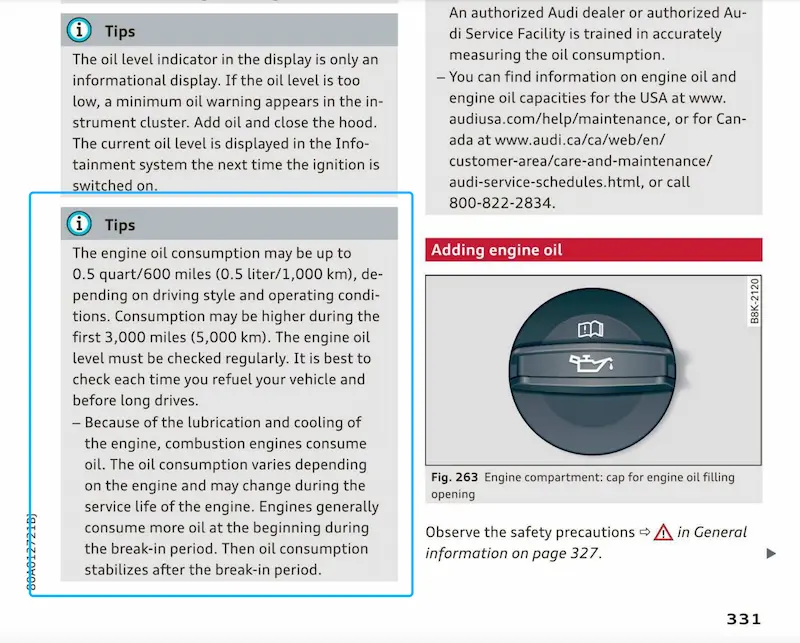
Some oil consumption is perfectly normal. Even Audi acknowledges in its owner documentation that consumption of up to 0.5 quarts per 600 miles (approximately 0.5 liters per 1,000 km) can be expected depending on driving style and conditions. If you are driving aggressively or doing a lot of highway driving at high sustained RPMs, consumption toward the higher end of that range is within spec.
But many affected Q5 owners were reporting consumption rates of 1 quart per 600 to 800 miles, sometimes worse. That is double what Audi considers acceptable, and it is absolutely a problem that needs to be addressed.
Warning Signs to Watch For
You do not always need a formal test to know something is wrong. Your car will usually give you signals. Here are the most common ones:
- Frequent need to top off the oil. If you are adding oil between oil changes on a regular basis, that is a clear sign consumption is higher than it should be. Keep a record of how much you are adding and how often.
- Oil pressure warning light coming on. This light does not illuminate to tell you oil is “a bit low.” It comes on when the oil level has dropped to a potentially dangerous level. If this light is coming on, the situation is already serious. Do not continue driving until you have checked and topped off the oil.
- Blue or gray exhaust smoke. You might notice a subtle blue or grayish tint to the exhaust smoke, particularly on startup or during deceleration. This is burned oil. It is not always dramatic or obvious, but if you watch carefully, it can be visible especially on cold mornings or after sitting at a stop sign.
- The exhaust smells different. Burning oil has a distinct, slightly sweet and acrid smell that is different from normal exhaust. If the car behind you can smell your exhaust, or if you notice it yourself when walking near the rear of the vehicle, oil is likely involved.
- Spark plug appearance. If you pull a spark plug and it is heavily coated with black, oily carbon deposits, that is oil contamination. A healthy spark plug should have a light tan or grayish color on the electrode tip.
The Formal Oil Consumption Test
If you want a definitive, documented answer, the right approach is a formal oil consumption test. This is something Audi dealerships can conduct, and if your vehicle is still under warranty (or you believe it should be covered under an extended warranty or goodwill repair), having this test done officially at a dealership creates the documentation you need.
Here is how the process typically works:
- Schedule an appointment with your Audi dealership and explain your concern about oil consumption.
- The dealership performs a fresh oil change using the correct oil specification for your vehicle. They fill it to the exact specified level and document this.
- You drive the vehicle for a predetermined number of miles, typically somewhere between 1,000 and 3,000 miles depending on the dealership’s protocol.
- You return to the dealership without adding any oil in between.
- The technician measures the remaining oil level, compares it to the starting level, and calculates the consumption rate.
- Based on the results, the dealership determines whether the consumption is within Audi’s acceptable range or whether it qualifies for a warranty repair or further diagnosis.
This test is important not just for diagnosis but also for documentation if you end up pursuing a warranty claim or getting any dealer assistance. Going in with anecdotal concerns is one thing. Walking in with documented test results is another thing entirely.
If your Q5 is out of warranty and you are going to an independent shop, a qualified mechanic can essentially run the same test. The process is straightforward and does not require dealer-specific equipment.
Real Solutions for Audi Q5 Oil Consumption: From Quick Fixes to Full Repairs
Once you have confirmed excessive oil consumption, the next question is obvious: what do you do about it? The answer depends on the severity of the consumption, the overall condition of the engine, and how much you are willing to invest in the repair.
Let’s walk through every option from least invasive to most involved.
Option 1: Oil Additives as a Short-Term Measure
Oil additives like LIQUI MOLY’s engine oil stop leak or similar products work by swelling and conditioning aging seals and piston ring surfaces, helping them seat more effectively. For some owners, particularly those with mildly elevated consumption rather than severe burning, these products have provided noticeable improvement.
Be honest with yourself about what additives can and cannot do. They are not a permanent fix for a mechanical problem. If your piston rings are severely worn or have a fundamental design defect, no additive is going to restore them to new condition. What an additive might do is slow the consumption rate enough to give you more time or more mileage before a major repair becomes unavoidable.
Think of it this way: if you are consuming 1 quart every 800 miles, and an additive reduces that to 1 quart every 1,200 miles, that is genuinely useful. It buys time and reduces the risk of running critically low between checks. But it is not a solution. It is a bandage.
If you go this route, use only products specifically designed for this purpose. Do not use just any random oil additive. LIQUI MOLY’s products have a strong reputation and are frequently recommended in Audi owner communities. Follow the instructions precisely and monitor your consumption rate after treatment.
Option 2: Switching to a Higher Viscosity Oil
This one requires careful thought. Audi specifies a particular oil viscosity for the TFSI engines, typically a 5W-30 or 5W-40 depending on the specific engine variant and market. Some owners with high consumption issues have experimented with slightly thicker oils, like a 10W-40 or even a 15W-40 in warmer climates, with the reasoning that a thicker oil is harder for worn rings to push past.
The results are mixed. In some cases, particularly in older, higher-mileage engines, a thicker oil does reduce consumption somewhat. In others, it makes no meaningful difference.
The risk with going outside Audi’s specification is that a thicker oil may not flow as efficiently to critical engine components, especially during cold starts. If you are going to experiment with oil viscosity, talk to a qualified mechanic who knows the TFSI engines specifically before making any changes. And never use an oil that is significantly outside the manufacturer’s recommended range.
Option 3: Check and Fix the Oil Quality and Change Interval
This sounds basic, but it genuinely matters. Using the wrong oil type or stretching oil change intervals too long both contribute to consumption issues and accelerate engine wear.
The TFSI engines are particularly sensitive to oil quality. Audi recommends a fully synthetic oil meeting VW 502 00 or VW 504 00 specifications. These are not generic standards. Not every oil on the shelf that says “full synthetic” meets these specifications. You need to check the bottle for the specific VW approval code.
Audi’s factory service intervals can stretch to around 10,000 miles or more in ideal conditions. But if your engine is already showing consumption issues, extending oil changes to the maximum interval is the wrong call. More frequent changes keep the oil cleaner, maintain better viscosity stability, and reduce the buildup of sludge that can further compromise ring sealing. For a Q5 with known consumption issues, an oil change every 5,000 to 7,000 miles is a smarter approach.
Option 4: Repair or Replace the Breather Valve (PCV System)
This is one of the more overlooked causes of oil consumption in the TFSI engines, and it is a relatively affordable fix that every owner with consumption issues should investigate before jumping to major engine work.
The breather valve, also called the oil separator or PCV (Positive Crankcase Ventilation) valve, is responsible for managing the pressure inside the crankcase. When combustion gasses blow past the piston rings (something that happens in every engine to some degree), they pressurize the crankcase. The PCV system routes those gases back into the intake manifold to be burned, while separating out any oil mist and returning it to the crankcase.
When the PCV system fails or becomes clogged, two things happen. First, crankcase pressure builds up excessively, pushing more oil past seals and rings than normal. Second, if the oil separator is not working properly, oil mist gets routed directly into the intake manifold and burned in the combustion chamber along with everything else.
Both scenarios contribute directly to the oil consumption symptoms you are experiencing. And the fix, replacing the breather valve and PCV components, typically costs a few hundred dollars in parts and labor. Compared to the thousands an engine rebuild costs, this is an obvious first step to rule out.
Symptoms that specifically point to a PCV issue include:
- Oil mist or residue visible in the intake manifold or intercooler piping
- A rough idle that improves when the vacuum hose to the PCV valve is temporarily disconnected
- An oily film on the inside of the air filter housing
- A hissing noise from the engine bay under load
Have your mechanic inspect the entire PCV system, not just the valve itself. The hoses, separators, and associated components can all degrade over time and should be evaluated as a complete system.
Option 5: Engine Cleaning and Decarbonization
On direct-injection engines like the TFSI, carbon deposits build up on the intake valves over time. Unlike port-injected engines, where fuel spray washes the back of the intake valves clean with every cycle, direct-injection engines have no such cleaning action. The EGR gasses and oil mist from the PCV system deposit oily residue on the back of the intake valves, and that residue bakes into hard carbon deposits over tens of thousands of miles.
Heavy carbon buildup on intake valves affects how cleanly the air-fuel charge enters the combustion chamber, reduces compression, and can indirectly contribute to oil consumption by disrupting combustion efficiency. It can also cause rough idling, hesitation, and misfires.
The fix is a walnut blasting service, where a shop uses a walnut shell media blast to physically remove the carbon deposits from the back of the intake valves. This is a well-established procedure for direct-injection engines and typically costs between $300 and $600 depending on the shop and the extent of buildup.
For a high-mileage TFSI engine, walnut blasting can produce a dramatic improvement in throttle response, idle quality, and overall drivability. It is not going to fix severely worn piston rings on its own, but it is an important part of bringing a neglected TFSI engine back to health.
Option 6: Replacing the Pistons and Piston Rings
This is the definitive mechanical fix for the oil consumption problem when the cause is worn or defective piston rings. It is also the most involved and most expensive repair on this list, but in cases of severe consumption, it is the only real solution.
Here is what the process involves:
- The engine is either removed from the vehicle or accessed from below, depending on the specific repair approach.
- A technician uses an endoscope (a tiny camera on a flexible cable) to inspect the cylinder bores and assess the condition of the existing pistons and rings.
- If the rings are confirmed worn or defective, the pistons are removed and replaced with updated components. Audi has released revised piston and ring specifications for the TFSI engines that address the original design shortcomings.
- The cylinder walls are inspected and, if necessary, honed to ensure proper ring seating.
- The engine is reassembled, refilled with fresh oil to specification, and tested.
This is not a repair to take to just any shop. You want a mechanic who has specific experience with Audi TFSI engines. The technical knowledge required to do this job correctly is significant, and a poorly executed piston ring replacement can create problems that are worse than what you started with.
Cost-wise, you are looking at anywhere from $1,500 to $4,000 or more depending on the labor rates in your area, the specific extent of the work needed, and whether any other components need attention while the engine is apart. That is a significant number, but it needs to be weighed against the alternative, which is eventual engine failure and the cost of either a full engine rebuild or engine replacement.
If your Q5 is still otherwise in good condition and has been well maintained, this repair can give the engine another 100,000 or more miles of reliable service. That makes it a worthwhile investment for many owners.
Comparing Your Options: A Quick Reference Guide
| Fix | Best For | Approximate Cost | DIY Possible? | How Long It Lasts |
|---|---|---|---|---|
| Oil additives | Mild consumption, buying time | $20 to $60 | Yes | Temporary |
| Oil viscosity adjustment | Older, high-mileage engines | Minimal | Yes | Varies |
| Correct oil type and intervals | All affected engines | $80 to $150 per change | Yes | Ongoing maintenance |
| PCV/breather valve replacement | PCV-related consumption | $200 to $500 | Partially | Several years |
| Walnut blasting intake valves | High-mileage direct-injection engines | $300 to $600 | No | 50,000+ miles |
| Piston and ring replacement | Severe or confirmed ring failure | $1,500 to $4,000+ | No | Long-term / permanent |
How to Approach This as an Audi Q5 Owner: A Practical Game Plan
There is a logical sequence to how you should approach this problem, and it saves you from spending money in the wrong order.
Start With a Proper Diagnosis
Do not guess. Perform or request a formal oil consumption test so you have actual data. Measure how much oil your engine is consuming per mile. This number tells you how urgent the situation is and helps guide which repair path makes sense.
At the same time, have the PCV system inspected. This is often the most overlooked component, and fixing a failed PCV system is significantly cheaper than an engine rebuild. Rule this out first.
Address the Low-Cost Items First
If the PCV system needs attention, fix that first and recheck the consumption rate. Consider walnut blasting the intake valves if the engine has significant mileage. Switch to the correct oil specification and reduce your change interval. Give the engine a few thousand miles and measure again.
Sometimes, what looked like a serious engine problem turns out to be a combination of a failing PCV valve, incorrect oil, and carbon buildup. Addressing those items can sometimes reduce consumption to within an acceptable range without any major engine work.
Escalate to Major Repair If Needed
If after addressing the simpler items the consumption is still severe, particularly if you are consuming more than 1 quart per 1,000 miles, a piston and ring job is likely on the table. At that point, get the vehicle properly inspected by a mechanic with TFSI experience, confirm the diagnosis with an endoscope inspection, and get a clear quote before authorizing the work.
While the engine is apart, it is worth having the mechanic inspect and address any other wear items. Replacing timing chain components, seals, and gaskets while everything is accessible can save you significant labor costs compared to having those items done as separate jobs later.
Should You Even Keep the Car? Knowing When It Does Not Make Financial Sense
This is a question worth asking honestly. If your Q5 has very high mileage, has not been well maintained, and needs a $3,000 engine repair on top of other deferred maintenance, the math might not work out in favor of the repair.
Here is a simple way to think about it. Get a rough current market value for your vehicle in its current condition. Then get a quote for the full scope of repairs needed. If the repair cost exceeds 50 to 60 percent of the vehicle’s value, it deserves serious consideration whether that money is better put toward a newer vehicle instead.
On the other hand, if your Q5 is otherwise in excellent condition, has a clean history, and the oil consumption is the primary issue, the repair math often does favor fixing it. A well-maintained Audi Q5 that has had the piston ring issue properly resolved can still have a lot of life left in it, and buying a comparable replacement vehicle costs far more than a $2,000 to $3,000 engine repair.
Maintenance Habits That Prevent This From Getting Worse
Whether you are dealing with active consumption right now or you have just had the repair done and want to protect your investment, these habits matter:
- Check your oil level every two to three weeks. Do not wait for the warning light. By the time that light comes on, the damage is already happening. A quick check with the dipstick takes 60 seconds and gives you peace of mind.
- Always use the correct oil specification. VW 502 00 or VW 504 00 approved fully synthetic oil is not optional on these engines. Using the wrong oil is one of the fastest ways to accelerate the very problem you are trying to fix.
- Do not stretch oil change intervals. With a known consumption issue, more frequent oil changes are a form of protection. Fresh oil maintains better viscosity and lubricating properties than oil that has been cooking in your engine for 10,000 miles.
- Fix the small things before they become big things. A failing PCV valve that costs $300 to fix today can lead to a piston ring job that costs $3,000 if ignored long enough. Stay proactive.
- Keep records of everything. Every oil top-off, every service, every repair. If you ever need to pursue a dealer goodwill repair, have a warranty claim reviewed, or sell the vehicle, documented maintenance history is invaluable.
The Audi Q5 is a genuinely capable, well-engineered vehicle in most respects. The TFSI oil consumption issue is a real flaw, but it is a manageable one. Owners who catch it early, address the root cause properly, and stay on top of maintenance go on to drive these cars well past 200,000 miles. The ones who ignore the warning signs and hope the problem resolves itself are the ones writing off engines that should have had decades of life left in them. So if your dipstick is telling you something is off, listen to it. That small amount of time and money you spend diagnosing the issue today is the difference between a minor repair and a very expensive lesson.