
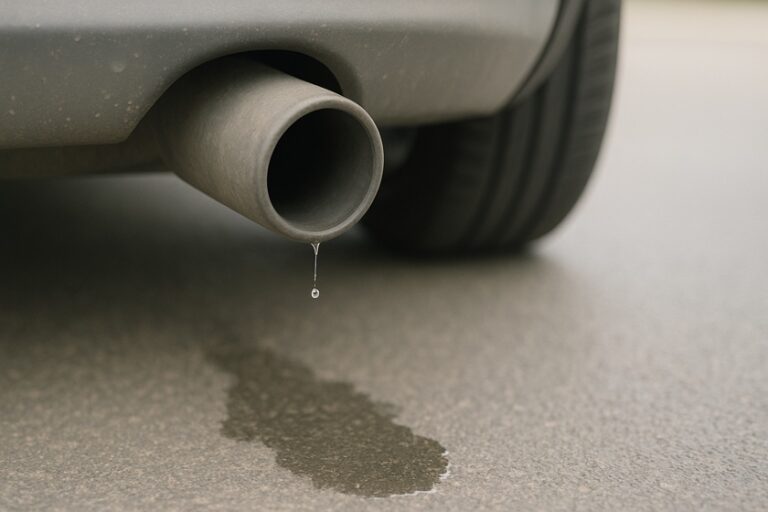
I got a phone call last Tuesday from a friend who sounded genuinely worried. “There’s water pouring out of my tailpipe,” she said. “Is my engine dying?” She’d parked her 2019 Honda CR-V at the grocery store, walked behind it while loading bags, and noticed a small puddle forming under the exhaust tip. By the time I talked her through a few questions — Is the engine overheating? Does the fluid smell sweet? Is there heavy white smoke? — she’d already spent 20 minutes Googling worst-case scenarios and was halfway to calling a tow truck.
Her car was completely fine. It was a 42°F morning, she’d driven less than three miles, and the exhaust system hadn’t warmed up yet. What she saw was plain old condensation — the most common and most harmless reason water drips from a tailpipe.
But here’s the thing: she wasn’t wrong to be concerned. Because while most tailpipe water is perfectly normal, sometimes it isn’t. Sometimes that innocent-looking drip is actually coolant sneaking into the combustion chambers through a failed head gasket, or leaking through a cracked EGR cooler on a diesel engine. And those situations can turn a $0 non-issue into a $1,500–$4,000 repair bill surprisingly fast if you ignore the warning signs.
As an engine and drivability specialist who has diagnosed this exact complaint hundreds of times, I can tell you the difference between “totally normal” and “get this checked immediately” almost always comes down to context — not just whether liquid is present, but what kind of liquid it is, when it shows up, what it smells like, and what else the engine is doing at the same time.
This guide covers all of it. I’ll explain the chemistry behind why healthy engines produce water, walk through every major cause of exhaust moisture (from harmless condensation to blown head gaskets), show you exactly how to tell the difference, break down repair costs, and answer the specific questions real drivers actually ask — including what brown liquid means, whether idling matters, and why short trips make the problem worse.
If you just want the quick answer: clear, odorless water that appears briefly during cold starts and disappears once the engine warms up is almost always normal condensation. However, if the fluid smells sweet, the engine is running hot, white smoke persists after warm-up, coolant is disappearing from the reservoir, or the car runs rough — stop dismissing it as “just water” and get the vehicle inspected. The droplets themselves are only half the story. The full diagnosis comes from everything happening around them.
The 60-Second Expert Answer (Before We Go Deep)
In the vast majority of cases, water dripping from your exhaust pipe is caused by normal moisture condensation inside the exhaust system. This happens most often when you start the engine cold, when outside temperatures are cool, or when the vehicle has been driven only a short distance — not long enough for the exhaust to fully heat up and evaporate internal moisture. Once the system reaches operating temperature, the dripping typically slows down or stops entirely.
The more serious possibilities involve engine coolant finding its way into the exhaust stream. The two most common culprits are a failed head gasket (which allows coolant to leak into the combustion chambers) and a defective EGR cooler (which can leak coolant directly into the exhaust path). These conditions rarely show up alone, though. They’re almost always accompanied by additional red flags: persistent white exhaust smoke that lingers after warm-up, unexplained coolant loss, engine overheating, rough idling, a sweet smell from the tailpipe, or unusual pressure buildup in the cooling system.
One important safety note before we continue: do not taste any fluid coming from your vehicle’s exhaust. A handful of outdated guides suggest this as a way to identify coolant. It’s unnecessary and potentially harmful. Instead, rely on smell, color, texture, coolant level monitoring, smoke behavior, and engine temperature — all of which provide safer and more useful diagnostic information.
| What You’re Seeing | What It Most Likely Means | How Worried Should You Be? |
|---|---|---|
| Clear water dripping only when the engine is cold | Normal exhaust condensation | Not worried — this is expected behavior |
| Water dripping for a few minutes after startup, then stopping | Normal moisture burning off as the exhaust heats up | Not worried — completely typical |
| Persistent thick white smoke with a sweet smell | Possible coolant entering the combustion chambers or exhaust | Very concerned — get this diagnosed promptly |
| Water-like fluid plus engine overheating | Possible head gasket failure or cooling-system breach | Very concerned — stop driving and inspect |
| Greasy residue, blue-tinted smoke, or oily tailpipe | Possible oil burning from worn rings, seals, or PCV issues | Concerned — investigate engine wear |
| Brown or rusty water dripping after many short trips | Rusty condensation collected inside the muffler | Moderately concerned — exhaust may be corroding internally |
Every Reason Water Comes Out of a Tailpipe (Ranked From Harmless to Serious)
The causes below are deliberately arranged from the most common and benign to the most mechanically serious. That order matters, because most drivers instinctively jump to the worst-case scenario the moment they spot liquid under the exhaust. In real-world diagnostics, however, simple condensation explains the overwhelming majority of these complaints. The danger isn’t in assuming the best — it’s in assuming every tailpipe drip is “just condensation” even when the vehicle is clearly showing additional warning signs that something deeper is wrong.
- Normal condensation forming inside the exhaust system
- Additional moisture created by catalytic converter chemistry
- Coolant leaking into the engine through a blown head gasket
- A cracked or leaking EGR cooler allowing coolant into the exhaust
- Worn pistons or piston rings contributing to broader engine problems
Let’s break each one down in detail.
1. Normal Exhaust Condensation — The #1 Reason (And Usually Nothing to Fix)
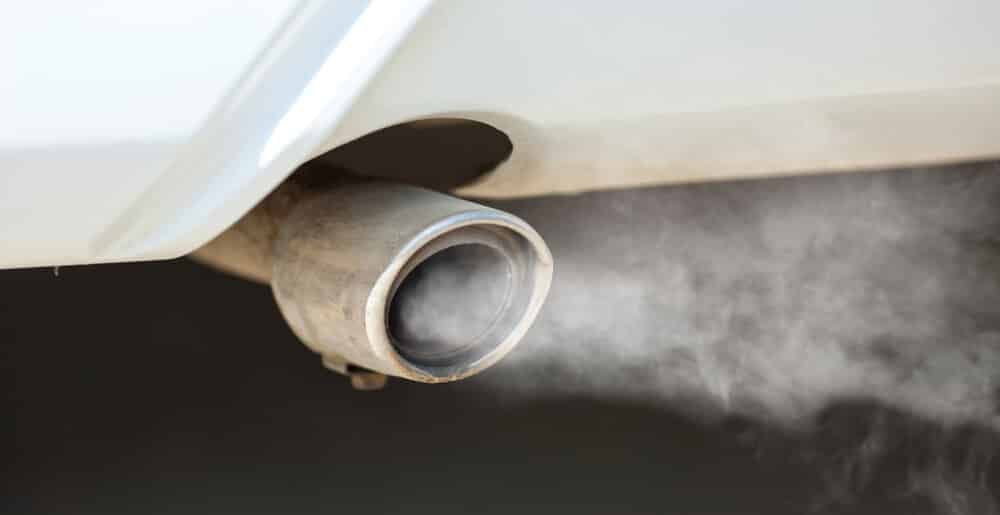
Here’s a fact that surprises a lot of people: every internal combustion engine produces water as a natural byproduct of burning fuel. It’s built into the chemistry itself. When hydrocarbon fuel combusts in the presence of oxygen, the reaction creates energy, carbon dioxide, and water vapor. That water isn’t a flaw — it’s a fundamental result of how combustion works.
While the engine and exhaust are hot, that moisture travels through the system as invisible vapor. But when metal surfaces inside the exhaust are still cool — which happens every time you start a cold engine, especially after it’s been sitting overnight — the hot vapor hits those cooler surfaces and condenses into liquid droplets. Think of it the same way a cold glass of water “sweats” on a humid summer day, or how a bathroom mirror fogs up after a hot shower. Same physics, different location.
The exhaust system is essentially a long network of metal pipes, chambers, resonators, and muffler baffles — all of which start cold and warm up gradually. During those first few minutes of operation, water condenses throughout the system, collects at the lowest points, and eventually drips from the tailpipe. That’s the moisture you’re seeing under your car on a cool morning.
In healthy vehicles, this kind of condensation dripping is most noticeable under specific conditions:
- During cold starts first thing in the morning
- In cool, damp, or rainy weather
- During winter months when temperature differences are greatest
- After the vehicle has been parked for several hours or overnight
- When the car is driven mostly on short trips that never fully heat the exhaust
From a diagnostic standpoint, normal condensation has several recognizable characteristics. The liquid is typically clear and thin — indistinguishable from ordinary water. It doesn’t feel oily to the touch. There’s no heavy sweet smell. The engine runs normally, the coolant level stays stable, the temperature gauge behaves predictably, and the visible dripping tends to decrease or stop entirely once the exhaust system warms up thoroughly. In many cases, drivers only notice it during the first few minutes of driving.
There’s an interesting maintenance angle worth mentioning here, too. While the condensation itself isn’t a sign of engine trouble, repeated moisture cycles can actually damage exhaust components over time. If a vehicle is used exclusively for very short trips — the kind where the exhaust never gets hot enough to fully evaporate internal moisture — that trapped water gradually corrodes mufflers and pipes from the inside out. So the dripping isn’t dangerous in the moment, but it does reveal something about the vehicle’s operating pattern. Cars that only make brief neighborhood runs tend to hold more exhaust moisture and develop rust-related exhaust problems sooner.
My advice to drivers who notice cold-start condensation? If the water appears briefly and the car otherwise runs perfectly, there’s no repair needed. In fact, attempting to “fix” normal condensation would be a misunderstanding of how combustion engines work. The right response is calm observation — not panic. Let the engine reach full operating temperature periodically, take the car on longer drives when you can, and keep an eye on whether the situation changes. If it stays limited to cold-start moisture with no other symptoms, you’re looking at completely normal vehicle behavior.
2. Moisture From Catalytic Converter Operation — Your Emissions System Doing Its Job
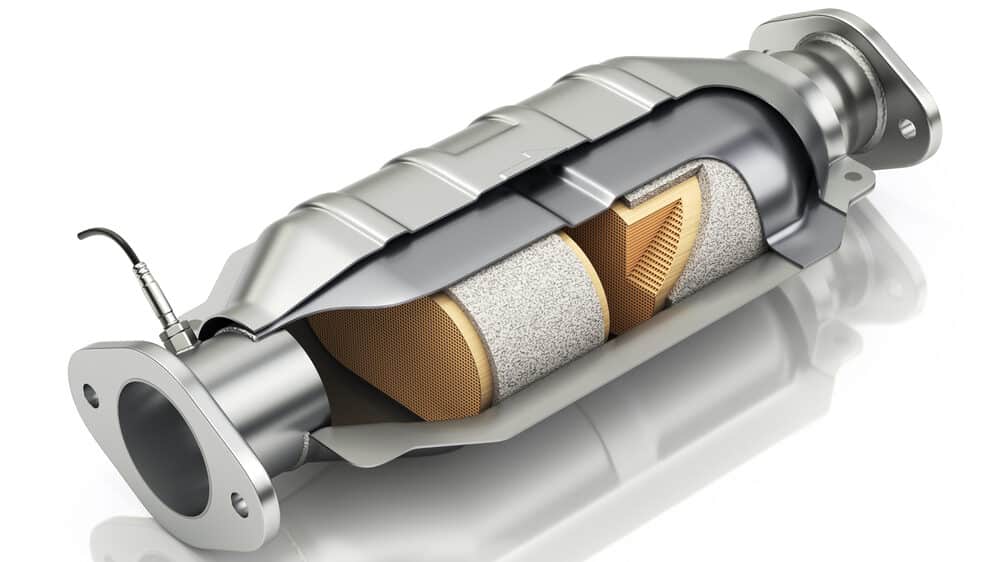
Many drivers think of the catalytic converter purely as an emissions-control device — something that reduces harmful exhaust gases. That’s accurate, but it’s not the complete picture. The chemical reactions happening inside the converter also produce water vapor as a byproduct. This means a properly functioning catalytic converter can actually contribute to visible moisture leaving the tailpipe.
Here’s how it works. Inside the converter, exhaust gases pass over catalyst-coated surfaces where hydrocarbons and carbon monoxide are converted into less harmful compounds — primarily carbon dioxide and water. That additional water vapor mixes with the moisture already present from combustion and travels downstream through the exhaust. If the piping is cool enough (during startup, short trips, or cold weather), this vapor condenses and exits as visible droplets.
This is one reason you might see water dripping from the exhaust even when the engine is running perfectly and the cooling system is completely intact. The converter is simply doing what it was designed to do. On modern vehicles with efficient catalytic converters and clean combustion, converter-related moisture can be quite noticeable — particularly in cool weather or during extended idling periods.
The important distinction is this: moisture associated with normal catalytic converter operation behaves almost identically to standard exhaust condensation. It typically appears:
- Shortly after engine startup
- While the exhaust system is still warming up
- Without any measurable coolant loss
- Without persistent overheating
- Without thick, sweet-smelling clouds that linger after the engine reaches operating temperature
In other words, converter-related moisture is part of the normal chemistry of emissions control — not a leak, not a failure, and not a sign that the catalytic converter is “going bad.” I mention this specifically because some owners interpret every visible tailpipe droplet as evidence of converter deterioration. That’s not how it works. In most cases, the water is actually a sign the converter is functioning as intended.
There’s one more practical point worth understanding. If a vehicle is driven only briefly, the entire exhaust path may stay cool enough for moisture to keep condensing further downstream — even after the converter itself has warmed up. That’s why tailpipe dripping is especially common on vehicles used for school runs, quick errands, stop-and-go commuting, and other short-cycle driving that doesn’t allow the system to fully dry out. Drivers in these patterns often assume their car has developed a leak when the real explanation is simply that the exhaust never spends enough time at full temperature to purge itself.
As a general rule: if the water appears clear, the smell is normal or faint, and the condition improves after longer driving, catalytic-converter-related moisture is a very reasonable explanation. On the other hand, if you notice a rotten-egg smell, poor performance, a rattling sound from the converter area, or a check-engine light, those symptoms point to a different problem entirely — one that involves the converter but not because of the water.
3. A Blown Head Gasket — When “Just Water” Becomes a Serious Warning
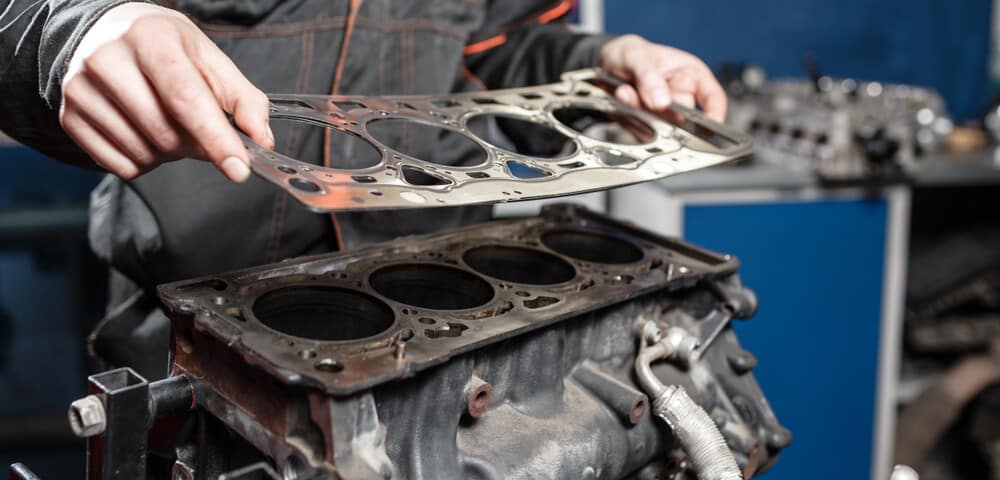
Now we move from “normal and expected” territory into “serious and potentially expensive” territory. If water-like liquid is coming from the exhaust because engine coolant is entering the combustion chambers, a failed head gasket is one of the first possibilities that needs to be investigated.
The head gasket sits sandwiched between the engine block and the cylinder head, performing one of the hardest jobs in the entire engine: it has to simultaneously seal combustion pressure, oil passages, and coolant passages while withstanding extreme heat and pressure cycles thousands of times per minute. When this gasket fails — due to overheating, age, manufacturing defects, or thermal stress — those normally separated systems can begin to mix. One common result is coolant leaking into one or more cylinders, where it gets burned during combustion and expelled through the exhaust as steam-like white smoke or moisture.
From a driver’s perspective, this might initially look like unusually heavy water dripping from the tailpipe. But in real diagnostic work, a bad head gasket rarely announces itself with water alone. It almost always brings other symptoms along for the ride:
- Thick white exhaust smoke that persists even after the engine is fully warmed up
- Engine overheating or erratic temperature gauge behavior
- Coolant level dropping steadily without any visible external leak
- Bubbling or gurgling in the coolant reservoir
- Unexplained pressure buildup in the cooling system
- Rough idle or misfire, especially after the car has sat overnight
- In severe cases, milky or contaminated engine oil
One of the most important diagnostic clues is smell. Coolant has a distinctive sweet odor that’s quite different from ordinary exhaust. If the moisture coming from your tailpipe smells sweet rather than neutral — and especially if white exhaust smoke is hanging visibly in the air — don’t write it off as condensation. Unlike harmless exhaust moisture, coolant-contaminated discharge typically persists well after the engine should already be at full operating temperature. That persistence is a critical distinction.
Let me be direct about the repair implications: a suspected head gasket leak is not something to “monitor for a few months” while continuing to drive normally. Coolant entering the combustion chamber can wash protective lubricant off cylinder walls, dramatically increase overheating risk, damage the catalytic converter, create hydrolock risk in severe cases, and escalate a difficult-but-repairable gasket job into a complete engine replacement if the problem is ignored through repeated overheating episodes. I’ve personally seen engines that could have survived a $1,200 gasket repair end up needing $5,000+ rebuilds because the owner kept driving after clear warning signs appeared.
This is also the area where a very common and very expensive mistake happens. Drivers assume white vapor during cold weather is “just steam because it’s cold outside” and keep driving without investigating further. Some white vapor is perfectly normal in cold weather — especially during the first few minutes of warm-up. The crucial difference is duration and context. Normal cold-weather vapor fades as the engine heats up. Coolant-burning smoke lingers, smells different, and arrives with other symptoms. That’s why diagnosis needs to be evidence-based, not assumption-based.
4. A Cracked EGR Cooler — The Hidden Culprit Many Owners Don’t Know About
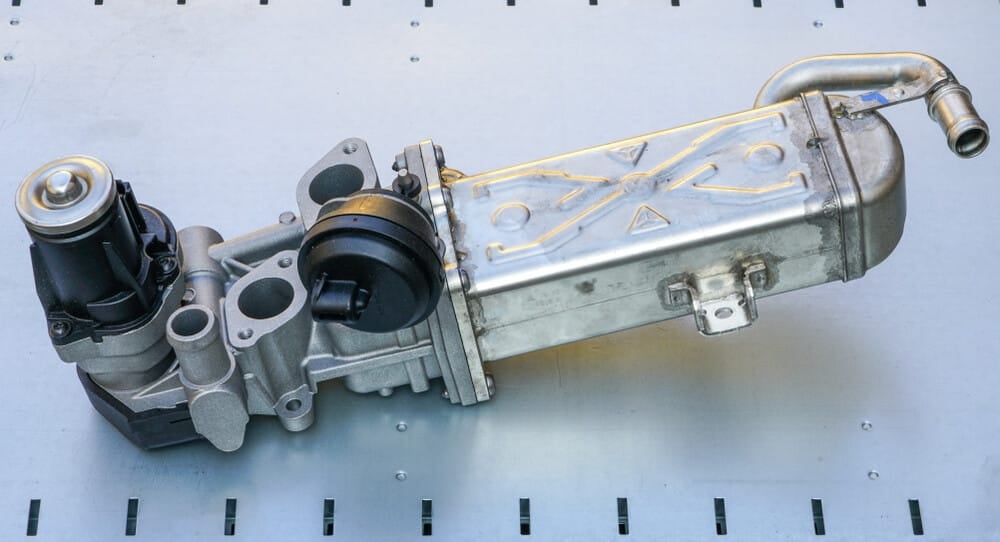
On many modern engines — particularly diesels, but also some gasoline applications — an EGR (Exhaust Gas Recirculation) cooler is used to lower the temperature of exhaust gas before it’s recirculated back into the intake system for emissions purposes. The design varies by manufacturer, but the basic concept involves hot exhaust gas flowing through a cooler that’s surrounded by engine coolant. If that cooler develops an internal crack, coolant can leak directly into the exhaust path — and eventually exit through the tailpipe as moisture.
This type of failure can be genuinely confusing, even for experienced vehicle owners, because the symptoms overlap significantly with head gasket trouble. You might notice white exhaust smoke, see fluid at the tailpipe, or observe gradual coolant loss. The critical difference is that the coolant leak may not originate in the combustion chamber at all — instead, it’s entering the exhaust stream downstream through the failed EGR cooler. From outside the vehicle, both scenarios can look remarkably similar, which is precisely why proper diagnosis matters before anyone recommends major engine disassembly.
In practical terms, if your vehicle is equipped with an EGR cooler and the fluid at the exhaust carries a sweet smell, an EGR cooler failure needs to be taken seriously. Additional clues may include:
- Unexplained coolant loss without visible external leaks
- White exhaust smoke that persists beyond normal warm-up
- Exhaust moisture without clear signs of oil contamination
- Emissions-related fault codes stored in the engine computer
- Visible exhaust moisture that exceeds typical cold-start condensation patterns
From an expert standpoint, EGR coolers are frequently overlooked because most drivers are far more familiar with head gaskets than with emissions-cooling components. Yet on engines known for EGR-cooler vulnerabilities, this part can be the actual source of coolant entering the exhaust system — not the head gasket at all. Getting the diagnosis right saves both money and unnecessary surgery on the engine. Replacing a head gasket when the real failure is a cracked EGR cooler is exactly the kind of expensive mistake that careful diagnostic work prevents.
The broader takeaway is important: the exhaust system isn’t always isolated from the engine’s cooling system. On vehicles with coolant-cooled emissions components, an internal cooler failure creates exactly the kind of “water from the exhaust” complaint that sends owners into immediate panic mode. If your vehicle uses this design and the tailpipe moisture smells sweet or coincides with coolant loss, the EGR cooler deserves close investigation before anyone starts pulling cylinder heads.
5. Worn Pistons or Piston Rings — Not Usually the Water Source, But Part of the Bigger Picture

Worn pistons or piston rings don’t typically cause water to drip from the exhaust in the same direct way that condensation or coolant intrusion does. This is an area where many articles oversimplify the connection. Ring wear is primarily associated with oil consumption, blow-by, reduced compression, crankcase pressure problems, and exhaust smoke that tends to be blue or gray — not white. Still, this topic belongs in the conversation because exhaust symptoms can overlap, and a damaged engine can present multiple problems simultaneously.
If the engine has significant ring wear and also suffers from normal exhaust condensation, you might still see water at the tailpipe — but the water isn’t being caused by the rings. What worn rings do contribute is a set of additional warning signs that help paint a clearer picture of overall engine health. You may notice oily residue coating the inside of the tailpipe, blue-tinted smoke during acceleration or after extended idling, excessive crankcase pressure, oil-fouled spark plugs, or a sootier-than-normal exhaust outlet. If the engine is simultaneously burning oil and dealing with another issue like a minor head gasket seep, the combined exhaust picture can become genuinely confusing.
Typical signs that point more toward ring or piston trouble than simple condensation include:
- Blue or blue-gray smoke from the exhaust, especially under acceleration
- Measurable oil loss between service intervals
- Oily deposits inside or around the tailpipe opening
- Poor compression readings or excessive blow-by
- Noticeable power loss compared to when the engine was newer
- Spark plugs fouled with oil residue
So the expert conclusion here is nuanced: worn rings and pistons aren’t the first thing to blame for clear water dripping from a tailpipe. However, they’re absolutely relevant if the vehicle shows oil-burning symptoms, unusual smoke character, or signs of serious internal engine wear. If a car is burning oil and showing exhaust moisture, the smart approach is to broaden the diagnostic scope rather than assuming only one isolated problem exists.
How to Tell Whether Tailpipe Water Is Harmless or a Warning Sign
This is the section most drivers actually need, because the visual symptom by itself tells you almost nothing useful. A few drops of water under the tailpipe are meaningless without context. The real difference between harmless condensation and a costly internal leak comes from observing the pattern of behavior — not just the droplets.
When I’m diagnosing this complaint, I immediately focus on five things: timing, appearance, smell, accompanying exhaust smoke, and engine behavior. Those five clues reveal far more than the liquid alone ever could.
When Does the Dripping Happen?
If water is most noticeable during a cold start, on a cool morning, or within the first few minutes of operation, normal condensation is overwhelmingly likely. If the dripping continues after twenty or thirty minutes of driving — especially once the vehicle is fully warmed up — the situation warrants closer attention. A healthy exhaust system purges most of its moisture as internal temperatures rise. Persistent discharge after warm-up is more suspicious.
What Does the Exhaust Smoke Look Like?
A wisp of white vapor on a cold morning can be completely normal — it’s simply steam-like moisture becoming visible in cool air, no different from seeing your breath on a winter day. But thick white smoke that hangs in the air after the engine reaches operating temperature is a different story entirely. Blue-tinted smoke suggests oil burning. Black smoke points to overly rich fuel combustion. And white smoke that smells sweet and refuses to clear even after a long drive points strongly toward coolant entering the exhaust.
What Does It Smell Like?
Normal exhaust condensation smells like ordinary exhaust — or barely smells like anything at all. Coolant, on the other hand, has a distinctively sweet, almost syrupy odor. Burned oil smells acrid and sharp. If the moisture coming from the tailpipe is accompanied by a sweet smell, move coolant-related problems significantly higher on your list of suspects. Smell is a genuinely useful diagnostic tool — and much safer than tasting, which some outdated guides mistakenly recommend.
Is the Coolant Level Dropping?
This single check is one of the most valuable things you can do at home. If your coolant reservoir level remains stable over multiple days and the engine temperature stays normal, harmless condensation remains the leading explanation by a wide margin. However, if the coolant keeps dropping — and you can’t find any visible external leak on the ground or around hoses — while the exhaust is simultaneously wet or smoky, the evidence starts building toward internal coolant loss. An engine that’s creeping toward overheating while also producing suspicious tailpipe moisture should be professionally diagnosed without delay.
How Is the Engine Running?
A healthy engine experiencing normal condensation starts, idles, accelerates, and cruises without any noticeable issues. A vehicle suffering from a failed head gasket or internal coolant intrusion may stumble on startup, misfire intermittently, idle roughly, or feel weak under load. In some cases, the misfire is most noticeable after the vehicle has sat overnight — because coolant slowly seeps into a cylinder while the engine is off, then causes a momentary stumble when combustion restarts. That kind of drivability change isn’t normal condensation behavior.
Here’s a practical step-by-step checklist you can use at home:
- Start the engine completely cold and watch the tailpipe for the first several minutes
- Note whether the dripping stops or noticeably decreases after the engine reaches full operating temperature
- Check for sweet odor, thick white smoke, blue smoke, or black smoke
- Monitor the coolant reservoir level over several consecutive days
- Watch the temperature gauge for any signs of overheating or instability
- Pay attention to whether the engine idles smoothly or shows misfire, rough running, or power loss
If the only symptom you find is brief clear dripping at startup — with no coolant loss, no overheating, no unusual smoke, and no drivability issues — you’re almost certainly looking at normal condensation. If multiple abnormal symptoms are present together, a professional inspection is the logical next step.
The Science Behind It: Why Healthy Engines Produce Water
Because many drivers understandably wonder — “How can water be normal if my car burns fuel?” — it helps to explain the underlying chemistry more directly.
Hydrocarbon fuel (gasoline or diesel) contains hydrogen atoms. During combustion, those hydrogen atoms combine with oxygen from the intake air. One of the products of that chemical reaction is H₂O — water. So even in a perfectly healthy, well-maintained engine, water vapor is part of the exhaust stream from the very first moment fuel is burned. There’s nothing wrong happening — it’s simply how combustion chemistry works.
Under high exhaust temperatures, that water exits as invisible vapor. But the exhaust path isn’t uniformly hot from end to end, especially when you first start a cold engine. The exhaust manifold begins heating first, followed by the catalytic converter, then the intermediate pipes, resonator, and finally the muffler. The tail end of the system can remain relatively cool for several minutes, particularly in cold weather. That temperature gradient is exactly what creates condensation — hot vapor reaches cooler metal surfaces downstream, changes phase from gas back to liquid, and collects as droplets.
This also explains why repeated short-trip driving is particularly hard on exhaust systems. Each cold start introduces fresh moisture into the system. If the drive ends before the exhaust fully heats up, some of that moisture stays trapped inside. Day after day, the water accumulates, encouraging internal corrosion that gradually eats through muffler walls and pipe seams. So if your car frequently drips water on short trips, the moisture itself is normal — but it’s also telling you the exhaust may not be drying out completely, which can shorten component life over time.
From a maintenance perspective, the solution isn’t “repairing the dripping.” The better approach is simply ensuring the car occasionally gets a longer drive that brings the entire exhaust system up to full operating temperature. That helps burn off accumulated moisture and can meaningfully extend exhaust component life. It’s a small, simple habit — but it genuinely matters.
White Smoke Plus Water: When to Take It Seriously
Water and white smoke appearing together is where many diagnoses become either straightforward or dangerously misleading. The complication is that water vapor itself can look like white smoke under the right temperature and humidity conditions. This is exactly why healthy cars often appear to “smoke” heavily on cold winter mornings — triggering needless alarm from owners who assume something catastrophic is happening.
The trick is separating normal steam from coolant-burning smoke, and the distinction is usually clear once you know what to look for.
Normal cold-weather vapor is typically light, thin, and temporary. It fades noticeably once the exhaust warms up, and it doesn’t persist in heavy clouds once the engine reaches operating temperature. Coolant-related white smoke is different. It tends to be denser, thicker, more persistent, and often carries that characteristic sweet smell. It may leave significant moisture at the tailpipe and coincide with coolant loss, rough running, or temperature gauge issues. In severe cases, it can be thick enough to obscure visibility behind the vehicle.
The practical mistake many owners make falls into one of two extremes: either assuming all white exhaust in winter means damage, or assuming all white smoke is “just the weather.” Neither extreme is accurate. The right approach is observing whether the exhaust clears as the vehicle warms and whether any additional symptoms are present alongside it. Context determines everything.
A proper diagnostic mindset asks these questions:
- Does the white exhaust disappear within the first few minutes of driving?
- Is coolant level dropping measurably over time?
- Is the engine overheating or misfiring?
- Is the smell sweet rather than neutral or faint?
- Does the smoke remain visible even after a long highway drive?
If the answer to several of those questions is yes, you’re no longer looking at normal condensation.
A Step-by-Step Diagnostic Guide for Exhaust Water
If you want to approach this issue intelligently, resist the temptation to jump straight to parts replacement. Exhaust moisture is a symptom, not a diagnosis. The proper method moves from simple observation toward targeted testing — starting with what you can check yourself, then escalating to professional measurement only when the evidence warrants it.
Step 1: Watch the Tailpipe During a Cold Start
Start the engine when it’s completely cold. Watch the tailpipe for the first several minutes. Is the fluid clear and minimal? Does the dripping stop or slow once the engine warms up? Is there visible vapor only during the initial moments? Or is there a continuing stream of moisture, heavy smoke, and a sweet odor? This first observation immediately tells you whether you’re likely dealing with normal condensation or something that needs further investigation.
Step 2: Track the Coolant Level Over Several Days
Don’t rely on a single glance at the reservoir. Mark the level with a piece of tape or a marker and monitor it over several days under similar driving conditions. If the level drops steadily and there’s no visible puddle under the vehicle, internal coolant loss becomes a strong possibility. Normal condensation doesn’t consume coolant — that’s a major dividing line between harmless and serious.
Step 3: Monitor Engine Temperature Behavior
An engine dealing with harmless condensation will still regulate its temperature normally. If the gauge climbs unexpectedly, fluctuates erratically, or the engine overheats under load, that’s a red flag. Many coolant-related internal leaks eventually disturb the cooling system’s ability to maintain proper temperature. Overheating combined with suspicious exhaust moisture should never be dismissed casually.
Step 4: Inspect the Tailpipe Residue Closely
Clear water is one thing. Greasy, oily, or soot-heavy residue is something else entirely. If the inside of the tailpipe is wet but also coated with oily deposits or dark soot mixed with moisture, the diagnostic scope needs to widen. Oil burning, ring wear, and rich-running conditions may all be contributing to the overall picture. Moisture alone doesn’t tell the full story.
Step 5: Have a Shop Perform Targeted Cooling-System and Combustion Tests
When the evidence starts pointing toward a head gasket failure or internal coolant leak, a qualified shop will typically use several specific tests to confirm or rule out the suspicion:
- Cooling-system pressure test: Pressurizes the cooling system and checks whether it holds pressure or leaks — and identifies where the leak is occurring
- Combustion-gas test in the coolant: Detects the presence of exhaust gases in the cooling system — a strong indicator of gasket breach
- Compression test: Measures cylinder sealing to identify weak or compromised cylinders
- Leak-down test: Pinpoints exactly where cylinder pressure is escaping — into the coolant jacket, exhaust, or crankcase
- Borescope inspection: A camera inserted into the cylinder can reveal coolant-washed cylinder walls or unusual deposits
These tests matter because they convert suspicion into evidence. Proper diagnosis saves money. It prevents unnecessary head gasket replacement when the real culprit is an EGR cooler, and it prevents someone from dismissing a genuine internal leak as harmless condensation until the engine is damaged beyond reasonable repair.
Step 6: Factor In Vehicle Design and Usage History
Does the engine use an EGR cooler? Is it a diesel platform known for EGR-cooler failures? Does the specific model have a documented history of head gasket problems? Has the vehicle been used primarily for short-distance city driving? These contextual details are genuinely part of the diagnostic process. There’s no one-size-fits-all answer without understanding the vehicle and how it’s been used.
My diagnostic philosophy boils down to this: observe first, verify second, measure third, and only then repair. Too many expensive mistakes happen because someone sees liquid at the tailpipe and assumes they already know the answer before doing the actual work.
What Does It Actually Cost to Fix Water Coming From the Exhaust?
Repair cost depends entirely on the root cause — which is precisely why accurate diagnosis matters so much before any wrench turns.
If the moisture is normal condensation, the repair cost is exactly $0. No parts need replacing. No labor is required. In fact, replacing parts to “fix” normal condensation would be wasteful and misguided. The only sensible “action” might be adjusting driving habits slightly — taking the car on longer drives periodically so the exhaust system gets hot enough to purge internal moisture.
If the problem turns out to be a blown head gasket, the cost changes dramatically. Head gasket repair is expensive primarily because of labor, not because the gasket itself costs much. The cylinder head must be removed, inspected, and frequently resurfaced or machined, and associated components like bolts, thermostats, and seals are typically replaced at the same time. In most markets, expect a range of roughly $1,000 to $2,000, though some engines cost considerably more depending on complexity, accessibility, and whether additional damage is discovered once the head comes off.
If defective pistons or severely worn piston rings are involved, costs escalate further because the engine requires much more extensive disassembly. Replacing pistons or rings is labor-intensive work that often overlaps with a partial or full engine rebuild. Realistic estimates typically fall between $1,000 and $5,000, and on some vehicles the economics push owners toward engine replacement rather than internal repair. This is exactly why continuing to drive a badly overheating or heavily oil-burning engine can turn a manageable repair into a financial disaster.
EGR cooler replacement cost varies significantly by make and model. On some vehicles it’s relatively straightforward; on others — particularly those where access is tight — the labor bill can still be substantial. The saving grace is that replacing an EGR cooler is generally less invasive than tearing down the engine for head gasket work, provided the cooler is accurately identified as the source of the problem before anyone starts disassembling things.
The overarching financial lesson is clear: the sooner you correctly identify a coolant-related exhaust issue, the cheaper it usually is to resolve. Drivers who continue operating an overheating engine risk warping the cylinder head, destroying the catalytic converter, scoring cylinder walls, or pushing the engine into complete failure. At that point, “water from the exhaust” becomes the smallest item on a much larger repair bill.
Should You Be Worried About Oil Coming From the Tailpipe?
Yes — oil appearing at the tailpipe is never considered normal. While water can be a perfectly harmless byproduct of combustion and condensation, oil has no legitimate reason to be exiting the exhaust system in liquid form. If oil is showing up at the tailpipe, it means the engine is somehow burning oil or pushing oil-contaminated residue through the combustion and exhaust path.
The most common pathways for oil to enter combustion include worn piston rings, damaged valve stem seals, excessive cylinder wall wear, or a malfunctioning PCV (positive crankcase ventilation) system creating abnormal crankcase pressure and oil ingestion. In turbocharged engines, a failing turbocharger seal can also introduce oil into either the intake or exhaust stream. Once burned, that oil typically produces blue-tinted smoke, oily deposits at the tailpipe, and contamination that can shorten catalytic converter life.
From a professional perspective, oil at the tailpipe is a stronger warning signal than normal water condensation because it directly suggests internal engine wear or a significant sealing/ventilation problem. It should be investigated promptly — not just because of the wear it represents, but because ongoing oil burning fouls spark plugs, damages catalytic converters, increases emissions, and gradually degrades engine performance. If you see oily droplets or sooty oil residue from the exhaust, don’t treat it as a cosmetic issue.
Why Does Water Drip From the Exhaust While Idling?
In many cases, water dripping during idle is still perfectly normal. Even while idling, the engine produces hot exhaust gases, and the catalytic converter continues processing them. If the exhaust system hasn’t reached full operating temperature yet — or if the outside air is cool enough to promote condensation — water vapor can continue condensing inside the pipes and muffler. Since the vehicle is stationary, the dripping can actually become more noticeable because droplets have time to collect and fall in one concentrated spot, drawing your attention.
This is especially common on cold mornings, immediately after startup, and during warm-up periods when the vehicle is left idling in the driveway. Under those conditions, the water is typically clear, and the car otherwise behaves normally. Once the exhaust system reaches and sustains full operating temperature, the dripping usually diminishes.
That said, idling doesn’t automatically rule out more serious problems. If the watery discharge carries a sweet smell, the exhaust produces persistent thick white smoke, or the engine is losing coolant, coolant intrusion still needs to be considered. Additionally, idling alone may not warm the entire exhaust system as effectively as driving under load — so a vehicle can continue showing condensation moisture at idle even when it would dry out completely after a proper highway drive.
The practical expert takeaway: water dripping at idle is often normal. Water dripping at idle combined with coolant loss, white smoke, overheating, or rough running is not normal.
What Does Brown or Rusty Water From the Exhaust Mean?
Brown liquid at the tailpipe usually means you’re not looking at “pure” condensation water anymore — you’re seeing water mixed with rust particles or soot deposits that have accumulated inside the exhaust system. This happens most frequently on vehicles that make lots of short trips where the exhaust never gets hot enough long enough to evaporate all internal moisture. Over time, that trapped water encourages corrosion on interior metal surfaces. When the water eventually drains, it carries rust along with it and appears brownish or discolored.
This brown discharge typically isn’t a sign of catastrophic engine failure, but it does indicate that the exhaust system may be aging internally. If the muffler or piping has been damp on the inside for months or years, corrosion may already be eating into the metal. Eventually, that deterioration leads to pinholes, rattling baffles, visible rust spots, and exhaust leaks.
From a maintenance standpoint, the most effective way to reduce this problem is making sure the vehicle periodically gets a longer drive at full operating temperature. Short-trip-only use is genuinely hard on exhaust systems because it repeatedly introduces moisture without giving the system time to dry. So brown water is often less about an immediate emergency and more about what the vehicle’s operating pattern is doing to its exhaust components over time.
If the brown liquid is accompanied by loud exhaust noise, visible rust flakes, a loose or rattling muffler, or obvious corrosion underneath the vehicle, an exhaust inspection is wise. What’s draining harmlessly today may become a perforated muffler or failed pipe joint tomorrow.
Does Water Dripping From the Muffler Specifically Mean Something Different?
Water dripping from the muffler is usually part of the same condensation story — just happening at a specific collection point within the exhaust. The muffler is one of the larger enclosed chambers in the system and often functions like a reservoir for condensed moisture. Because it sits relatively low, has internal baffles and chambers where water can settle, and is one of the last components to reach full temperature, it’s a natural collection point for condensation.
This is especially true when the vehicle is driven for short distances, hasn’t yet reached operating temperature, or is being used in cool or damp weather. Under those conditions, exhaust vapor condenses before the muffler has had time to heat up enough to evaporate the moisture internally. The accumulated water can collect inside the muffler body and drip from seams, drain holes, or the tailpipe outlet.
In most cases, this is normal and not a standalone repair concern. However, because the muffler is where exhaust moisture tends to sit longest, it’s also where internal corrosion typically begins. Vehicles used predominantly for short trips often develop rusted-through mufflers significantly earlier than vehicles that regularly run at highway temperatures. So while muffler dripping is usually harmless in the short term, it can contribute to accelerated exhaust component wear over time.
The same rules apply: if the liquid from the muffler is clear and temporary, and the car runs normally, it’s almost certainly just condensation. If it’s sweet-smelling, persistent, mixed with heavy smoke, or accompanied by coolant loss, look beyond the muffler and investigate the engine or EGR system.
Why Short Trips Make Exhaust Moisture Significantly Worse
Short trips are one of the primary reasons drivers notice increased water from the exhaust — and the explanation is thermal, not mechanical. Every time you start the engine cold, moisture begins forming throughout the exhaust system. But if the trip ends before the entire system gets hot enough to evaporate that moisture, the water stays trapped inside. Repeating this cycle day after day creates persistent internal dampness that wouldn’t exist with longer, highway-speed driving.
This matters for two practical reasons. First, you’ll notice more tailpipe dripping because there’s simply more moisture accumulated in the system. Second, the long-term durability of the exhaust suffers because steel components spend more time sitting wet. Mufflers and pipes corrode from the inside when condensation is repeatedly allowed to accumulate without being evaporated.
From an expert maintenance perspective, vehicles that primarily make short urban runs benefit meaningfully from occasional longer drives at sustained highway speeds. This practice helps burn off trapped internal moisture, reduces condensation accumulation, and can genuinely extend exhaust component life. It’s a simple and underrated habit — one of those small things that can save you from premature muffler and pipe replacement down the road.
How Cold Weather Changes What You See (And Whether It Changes the Diagnosis)
Cold weather makes normal exhaust moisture dramatically more visible. The colder the outside air, the more easily hot exhaust vapor condenses into visible droplets or steam-like clouds. That’s why perfectly healthy cars seem to “smoke” more heavily during winter months and why drivers are far more likely to notice water pooling under the tailpipe when temperatures drop.
This is one of the first factors I consider during diagnosis. A complaint that appears exclusively on cold mornings and resolves once the vehicle warms up points very strongly toward normal condensation. The same complaint persisting during warm weather — especially if it’s accompanied by coolant loss, white smoke, or engine performance issues — carries an entirely different diagnostic weight.
Cold weather doesn’t make serious mechanical problems go away, but it absolutely makes harmless moisture look more alarming than it actually is. That’s why proper diagnosis always considers ambient temperature, trip length, warm-up time, and whether symptoms persist once the engine has reached full operating temperature.
Can a Failing Muffler Cause Water to Appear?
A deteriorating muffler doesn’t create water on its own, but it can change how moisture is stored, released, and noticed. Since mufflers naturally collect condensation, a corroding muffler may trap water differently, rust more rapidly from the inside, or develop seam leaks and pinholes that allow water to exit in new locations. In that sense, the muffler influences where you see the water — even though it didn’t create the moisture in the first place.
If a muffler is heavily rusted, you may notice brown-tinted water, rattling internal components, or visible dampness around the case. The root cause still traces back to condensation, but the failing muffler becomes part of the visible symptom pattern. So when a vehicle shows persistent exhaust moisture alongside muffler deterioration, the accurate conclusion isn’t “the muffler makes water” — it’s “condensation has been sitting in the muffler long enough to damage it from within.”
Does Fuel Type or Engine Design Affect How Much Exhaust Water You See?
Yes — different engines, fuel types, and emissions systems can measurably change how much exhaust moisture appears and under what conditions. Modern engines with highly efficient combustion and effective catalytic converters may produce noticeable water vapor under completely normal operation. Diesel engines equipped with EGR coolers introduce another potential pathway for coolant-related issues if the cooler develops internal cracks. Turbocharged engines can add further complexity if turbocharger oil seals begin leaking into the exhaust side.
This is why diagnosis should never rely on a single universal rule applied to all vehicles. The same tailpipe symptom can mean different things on different platforms. Competent mechanics always consider the specific engine design, the known weak points and recalls associated with the model, and the vehicle’s usage history before drawing conclusions.
Should You Keep Driving if Water Is Dripping From the Tailpipe?
If the water is clearly normal condensation — brief, clear, odorless, and unaccompanied by any warning symptoms — then yes, driving is perfectly fine. In fact, a proper longer drive may actually help by bringing the exhaust to full temperature and drying out accumulated moisture. That’s the best thing you can do in that situation.
However, if the dripping is accompanied by persistent white smoke, measurable coolant loss, rising engine temperature, misfire, sweet smell, or oily contamination, continued driving carries real risk. The decision should always be based on the complete symptom picture:
- Safe to keep driving normally: Brief cold-start condensation with absolutely no other symptoms
- Drive cautiously and schedule inspection soon: Persistent white smoke or suspicious sweet-smelling moisture without overheating
- Stop driving and have the vehicle inspected immediately: Engine overheating, significant coolant loss, severe misfire, or any signs of internal engine damage
I strongly advise against gambling with an overheating engine. I’ve personally seen too many drivers destroy otherwise repairable engines by continuing to drive after clear coolant-related symptoms appeared. Tailpipe moisture by itself isn’t always dangerous. Tailpipe moisture combined with overheating is a completely different situation — and one where prompt action can save you thousands of dollars.
Frequently Asked Questions About Water From the Exhaust
Why does my exhaust only drip water first thing in the morning?
Morning dripping is the textbook sign of normal condensation. The car has sat long enough for the exhaust system to cool completely — usually overnight — and morning air tends to be cooler and more humid than later in the day. When the engine fires up, hot exhaust vapor enters a cold system and condenses rapidly into liquid droplets. If the dripping appears mostly in the morning and resolves once the vehicle reaches operating temperature, the odds overwhelmingly favor normal condensation rather than any mechanical problem.
Can bad fuel cause water to come out of the tailpipe?
Poor-quality fuel isn’t a common primary cause of plain water dripping from the exhaust. Normal combustion always produces some water vapor regardless of fuel quality. However, severely contaminated or degraded fuel can cause rough running, incomplete combustion, or misfire-related symptoms that complicate the diagnostic picture. You might notice unusual smoke, poor acceleration, or a check-engine light — but the water itself is still more likely condensation unless another failure is also present.
Is clear water from the exhaust always completely safe?
Usually, but not absolutely always. Clear water seen briefly at startup is typically harmless condensation. However, clear-looking fluid that appears alongside coolant loss, overheating, or persistent white smoke warrants more concern — because coolant contamination can sometimes appear deceptively water-like, especially in early stages. That’s why evaluating the entire symptom set matters more than relying on color alone.
Why is my tailpipe wet even though the car drives perfectly fine?
That combination — wet tailpipe, normal driving behavior — almost always points to standard exhaust moisture. A car that drives normally, maintains stable coolant levels, doesn’t overheat, and only shows wetness at the tailpipe during warm-up is doing exactly what healthy combustion engines do. Moisture at the tailpipe with no accompanying symptoms is significantly less concerning than moisture paired with smoke, rough running, or temperature problems.
Can a catalytic converter actually leak water?
Not in the conventional “leak” sense — like a failed hose spraying coolant. But catalytic converter operation does produce water vapor as a chemical byproduct of the emissions-reduction process. That moisture can condense and drip from the tailpipe, especially when the exhaust system is still warming up. So the converter isn’t “leaking water” the way a cooling component might — it’s contributing to the normal moisture that exits the exhaust during operation.
Why does my car drip more water after I’ve only driven a short distance?
Because short trips frequently don’t generate enough sustained heat to evaporate the moisture that accumulates inside the exhaust during every cold start. Each startup introduces fresh condensation, and short journeys end before the system can dry itself out. Over repeated short-trip cycles, water accumulates inside the exhaust — particularly in the muffler — and drains out the next time you start or idle the vehicle. This pattern is extremely common and typically reflects driving habits rather than a mechanical failure.
Does white smoke from the exhaust always mean a blown head gasket?
No — and this is an important misconception to clear up. White exhaust vapor can be completely normal in cold weather, especially during the first few minutes of warm-up. A failed head gasket is only one of several possible causes of persistent white smoke. A cracked EGR cooler, a cracked cylinder head, or other coolant-path failures can produce similar-looking symptoms. The correct diagnosis depends on duration, smell, coolant level behavior, temperature stability, and supporting test results — not on the smoke alone.
Can exhaust condensation actually damage my car over time?
Yes, indirectly. The condensation itself is normal, but if the vehicle rarely gets driven long enough to evaporate that trapped moisture, the accumulated water can corrode mufflers, pipes, and exhaust connections from the inside. This is exactly why vehicles used primarily for short urban trips often develop rusted-through exhaust components significantly sooner than vehicles that regularly see longer highway-speed driving.
What if my coolant level is completely stable but I still see water from the exhaust?
Stable coolant levels are one of the most reassuring signs in this scenario. If the coolant isn’t dropping, the engine isn’t overheating, there’s no persistent white smoke, and the car drives normally, harmless exhaust condensation remains by far the most probable explanation. Coolant-related internal faults almost always create some measurable coolant loss over time. If the reservoir stays steady and the engine behaves well, you’re most likely looking at normal moisture — nothing more.
What to Do Next: Practical Expert Advice
If you’re trying to make a calm, informed decision about your vehicle right now, here’s the clearest path forward:
- Don’t panic at the first sight of tailpipe water. Condensation is one of the most common and harmless things a car does.
- Pay attention to timing. If the dripping happens mostly at cold startup and fades as the engine warms, that’s reassuring.
- Monitor your coolant level over several days. Dropping coolant without a visible external leak changes the entire diagnostic picture.
- Watch the temperature gauge and engine behavior closely. Overheating or misfire symptoms mean you should act quickly.
- Smell the exhaust carefully from a safe distance. A sweet odor strongly suggests coolant is involved.
- Inspect the tailpipe residue. Oily, sooty, or unusually dirty deposits point toward different engine problems beyond condensation.
- If symptoms persist or concern you, get a proper professional diagnosis rather than continuing to guess. The cost of a diagnostic evaluation is always less than the cost of a misdiagnosed repair — or an ignored problem that escalates.
The goal isn’t simply identifying whether water is present at the tailpipe — that’s the easy part. The real goal is determining whether your vehicle is showing a harmless moisture cycle or an underlying cooling-system or engine fault that needs attention. That distinction can save you from unnecessary worry on one end — or from a catastrophic repair bill on the other if a serious problem gets ignored too long.
The Bottom Line on Exhaust Water
Water dripping from the tailpipe is one of those symptoms that sits right on the border between perfectly normal and genuinely alarming — and the dividing line isn’t always obvious at first glance.
On one side of that border is simple, harmless condensation: the ordinary result of fuel combustion chemistry, catalytic converter reactions, and cool metal surfaces inside the exhaust system. It appears during cold starts, fades as the system warms, and requires no repair whatsoever. Most tailpipe water falls squarely into this category.
On the other side are genuine mechanical failures — a compromised head gasket, a cracked EGR cooler, or internal engine wear — where coolant or oil enters places it should never be and exits through the tailpipe disguised as “just water.” These conditions are expensive to ignore and relatively manageable to fix when caught early.
The expert approach to this symptom isn’t emotional — it’s diagnostic. Ask when the dripping happens. Ask whether the vehicle is overheating. Ask whether coolant levels are changing. Observe what the exhaust looks and smells like after the engine is fully warm. Those context clues matter infinitely more than the droplets themselves.
If the moisture is brief, clear, and limited to cold starts or short trips — your car is behaving normally. If the discharge is persistent, sweet-smelling, accompanied by heavy white smoke, overheating, rough running, or coolant loss — the problem deserves prompt attention. And if the tailpipe is producing oil or greasy residue instead of plain water, that points to a different class of engine issue altogether.
Not all tailpipe water is bad news. But the context around it determines everything. A careful observation today can prevent either unnecessary anxiety or a very expensive mistake tomorrow. And if you’re ever unsure which side of the line your vehicle falls on, a proper diagnostic evaluation from a qualified technician is always the smartest investment you can make.