
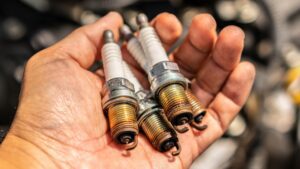

You are driving on the highway, and your automatic transmission seems to hesitate before shifting into the next gear. There is a noticeable jerk, almost like the car hiccupped. Then it happens again at the next shift point. And again. Your mind immediately jumps to the worst-case scenario: the transmission is going out. You start mentally calculating the cost of a transmission rebuild, and the number is not pretty.
But before you start shopping for a new car or budgeting for a $3,000 to $5,000 transmission repair, consider something that might save you a small fortune. The problem might not be your transmission at all. It might be your spark plugs.
Table of Contents
That sounds strange, right? Spark plugs and transmissions are completely separate systems. They are not even in the same part of the engine. One creates a spark to ignite fuel. The other manages gear changes to transfer power to the wheels. How could a failing spark plug possibly affect the transmission?
The answer is that it does not affect the transmission directly. There is no wire, no hose, and no mechanical link connecting your spark plugs to your transmission. But in a modern vehicle, everything is connected through the engine control module (ECM) and the way the engine delivers power. When spark plugs fail, the engine’s power output becomes erratic, and that erratic power delivery creates symptoms that look, feel, and sound almost identical to transmission problems.
This is one of the most common misdiagnoses in automotive repair. People spend thousands of dollars on transmission work when the actual problem was a $40 set of spark plugs. Let us make sure that does not happen to you.
What Spark Plugs Actually Do (And Why They Matter So Much)
To understand how spark plugs can create symptoms that mimic transmission failure, you first need to understand what spark plugs do and what happens inside your engine when they stop doing it properly.
Your engine runs on a four-stroke cycle: intake, compression, power, and exhaust. During the intake stroke, a mixture of air and fuel enters the cylinder. During the compression stroke, the piston compresses that mixture into a tiny space. Then comes the moment that matters: the spark plug fires.
The spark plug generates a small but intensely hot electrical arc across its electrode gap, typically around 40,000 to 100,000 volts depending on the system. That arc ignites the compressed air-fuel mixture, creating a controlled explosion that drives the piston downward with tremendous force. This is the power stroke, and it is the only stroke in the cycle that actually produces energy. The exhaust stroke then pushes the spent gases out of the cylinder, and the whole process starts over.
This happens thousands of times per minute, across all cylinders, in a precisely timed sequence. Each cylinder fires at exactly the right moment to produce smooth, consistent power. Your engine might have four, six, or eight cylinders, and each one has its own spark plug responsible for igniting its air-fuel charge at precisely the right instant.
When all spark plugs are working correctly, the engine produces smooth, predictable power. The crankshaft rotates evenly. The transmission receives a consistent flow of torque and can shift gears smoothly because it knows exactly how much power is coming from the engine at any given moment.
When one or more spark plugs fail, that entire system of smooth, predictable power delivery falls apart. And that is where the trouble starts.
How Bad Spark Plugs Create Symptoms That Feel Like Transmission Problems
Here is the connection that most people miss. Your transmission does not operate independently. It is constantly communicating with the engine control module, receiving data about engine speed, throttle position, engine load, and vehicle speed. The transmission control module (TCM) uses all of this information to decide when to shift, how quickly to shift, and how much pressure to apply to the clutch packs or bands inside the transmission.
When spark plugs are failing and the engine is misfiring, the engine’s power output becomes inconsistent. One moment the engine is producing full power, the next moment a cylinder misfires and power drops suddenly, then power comes back when the cylinder fires again on the next cycle. This creates a pulsating, uneven torque output that the transmission has to deal with.
The transmission was not designed to handle wildly fluctuating input torque. Its shift programming is based on the assumption that the engine is running smoothly. When it receives erratic torque signals, several things happen that feel exactly like transmission failure to the driver.
Harsh or Delayed Shifting
When the engine misfires during a shift event, the sudden drop in torque can confuse the transmission’s shift logic. The transmission might hesitate, waiting for the expected power to arrive before completing the shift. Or it might slam into the next gear because the torque fluctuation caught it mid-shift, resulting in a harsh, jarring gear change.
To the driver, this feels identical to a transmission with worn clutch packs or a failing valve body. The shift is not smooth. It is either delayed, harsh, or both. You might feel a distinct “thunk” when the gear engages, or the car might seem to hang between gears for a second before lurching forward.
Here is a real-world example. Say you are accelerating from a stop in your car, and the transmission is about to shift from first to second gear. At the exact moment the shift begins, cylinder number three misfires. The engine’s torque output drops suddenly. The transmission, which was mid-shift and expecting a certain amount of torque, now has to recalculate. The result is a clunky, delayed shift that feels like the transmission slipped or hesitated.
But the transmission is fine. It did exactly what it was programmed to do given the information it received. The problem was the inconsistent torque from the misfiring engine. Fix the spark plugs, restore smooth power delivery, and the “transmission problem” disappears.
The Feeling of Transmission Slipping
Transmission slipping is one of the most feared symptoms a driver can experience. It is that feeling where the engine revs up but the car does not accelerate proportionally. The RPMs climb, but the car does not go faster. It feels like the transmission is not gripping, like the connection between the engine and the wheels has become loose.
Bad spark plugs can create an almost identical sensation. When a cylinder misfires, the engine momentarily loses power. If you are pressing the gas pedal expecting a certain amount of acceleration and the engine delivers less because a cylinder is not firing, the car feels sluggish. The RPMs might climb as the engine tries to compensate, but the power reaching the wheels is less than expected.
The difference is subtle but important. With actual transmission slipping, the engine is producing full power, but the transmission is not transferring all of it to the wheels. With a misfire-induced “slip” feeling, the transmission is transferring everything the engine gives it, but the engine is not giving it full power because a cylinder is dead.
To the driver sitting in the seat, both scenarios feel almost exactly the same. And unless someone checks the spark plugs and engine performance before tearing into the transmission, the real cause can easily be missed.
Jerking or Bucking During Acceleration
When multiple cylinders misfire intermittently, the engine’s power output becomes choppy. Instead of a smooth stream of torque, the crankshaft delivers power in irregular surges and dips. The car jerks forward when the cylinders fire, then stumbles when they misfire, then surges again.
This jerking motion is often felt most prominently during moderate acceleration, like merging onto a highway or climbing a hill. Under these conditions, the engine is working harder and the misfires become more pronounced because each cylinder’s contribution matters more when the engine is under load.
Many drivers interpret this jerking as the transmission “hunting” for the right gear or struggling to engage. And it can certainly look that way on a casual inspection. The car feels like it is repeatedly grabbing and releasing, which is a classic description of a slipping transmission. But the transmission is not hunting or struggling. It is responding correctly to an engine that is delivering power like a strobe light instead of a spotlight.
Rough or Erratic Downshifting
Downshifting problems are another area where bad spark plugs can masquerade as transmission issues. When you slow down and the transmission downshifts, it expects a certain amount of engine braking resistance from the engine. If a cylinder is misfiring, the engine braking effect is reduced and inconsistent.
The transmission may downshift at the wrong time or with the wrong amount of firmness because the engine’s behavior does not match what the transmission control module expects. You might feel a surge or a lurch when the transmission downshifts, or the car might seem to coast when it should be engine-braking.
In vehicles with adaptive transmission programming (which includes most modern automatics), the TCM learns your driving patterns and adjusts shift points and shift firmness over time. If your spark plugs are degrading gradually, the TCM might adapt its shift strategy to compensate for the increasingly erratic engine output. This means the transmission’s behavior slowly changes over weeks or months, making you think the transmission itself is deteriorating when it is actually just adapting to a deteriorating engine.
The Role of the Engine Control Module in This Mix-Up
Modern vehicles are rolling computer networks. The engine control module (ECM), the transmission control module (TCM), and numerous other control modules are all connected and constantly sharing data. This interconnection is what makes modern cars run so smoothly, but it is also what allows a problem in one system to manifest as symptoms in another.
When the ECM detects a misfire (which it does by monitoring crankshaft rotational speed and looking for irregularities that indicate a cylinder is not producing power), it does several things:
- It sets a diagnostic trouble code (DTC). Misfire codes are in the P0300 range: P0300 for random misfires, P0301 through P0308 for cylinder-specific misfires (the last digit corresponds to the cylinder number). The check engine light may or may not illuminate depending on the severity and frequency of the misfires.
- It may adjust fuel delivery. The ECM might cut fuel to the misfiring cylinder to prevent unburned fuel from reaching the catalytic converter, where it could cause overheating and damage.
- It communicates the engine’s status to the TCM. The TCM receives data about engine torque output, engine speed, and any active fault codes. If the ECM is reporting misfires, the TCM may alter its shift strategy in response.
- In severe cases, the ECM may enter a reduced power mode. Some vehicles will limit throttle response and engine power when persistent misfires are detected. This “limp mode” is designed to protect the catalytic converter and the engine, but it also dramatically changes how the transmission behaves because it is now working with a severely reduced power output.
Here is where things get interesting. Some vehicles share a single powertrain control module (PCM) that handles both engine and transmission management. In these vehicles, a misfire detected by the engine side of the PCM can directly trigger changes in the transmission side’s behavior. The transmission might shift later, shift more gently, avoid certain gears, or hold a lower gear longer, all because the engine management system told it something was wrong.
The driver experiences these changes as transmission symptoms. The shifts feel different. The car does not accelerate the way it used to. The transmission seems to be “acting up.” But the transmission hardware is perfectly healthy. It is just following new instructions from a control module that knows the engine is not running right.
This is one of the reasons why a good mechanic will always check for engine-related trouble codes before diagnosing a transmission problem. If there are active misfire codes stored in the ECM, those need to be addressed first. Fix the engine, clear the codes, reset the adaptive transmission learning, and then see if the transmission symptoms persist. More often than not, they do not.
The Specific Ways Spark Plugs Fail (And What Each Failure Does to Your Engine)
Not all spark plug failures are the same. Different types of spark plug deterioration cause different symptoms, and understanding these can help you identify a spark plug problem before it snowballs into what feels like a major transmission issue.
Worn Electrode Gap
Every spark plug has a gap between its center electrode and its ground electrode. The spark jumps across this gap to ignite the fuel mixture. Over time, the electrodes erode from the constant electrical arcing and the intense heat of combustion. As the metal wears away, the gap widens.
A wider gap requires more voltage to jump. If the gap exceeds the ignition system’s ability to deliver enough voltage, the spark becomes weak or fails entirely. A weak spark might ignite the fuel mixture inconsistently, causing partial misfires where some combustion events produce less power than others. A complete failure to spark results in a dead cylinder.
The effect on the engine is a gradual loss of power and smoothness. The misfires might be intermittent at first, occurring only under heavy load or at high RPMs when the demand on the ignition system is greatest. Over time, as the gap continues to widen, the misfires become more frequent and occur under a wider range of conditions.
This gradual deterioration is particularly sneaky because it happens slowly. You might not notice the day-to-day change. But over the course of several months, the car gradually feels more sluggish, the shifts feel less smooth, and the fuel economy drops. By the time you notice something is genuinely wrong, the spark plugs may have been deteriorating for thousands of miles.
Carbon Fouling
Carbon fouling occurs when carbon deposits build up on the spark plug’s electrodes and insulator. These deposits create a conductive path that allows electrical energy to leak away instead of forming a clean spark across the gap. The result is a weak or absent spark.
Carbon fouling can be caused by several things: running the engine too rich (too much fuel relative to air), short trips that do not allow the engine to reach full operating temperature (the plugs never get hot enough to burn off deposits), oil leaking into the combustion chamber from worn valve seals or piston rings, or using the wrong heat range spark plug for your engine.
A carbon-fouled plug produces misfires that are often worst during cold starts and at low RPMs. The deposits conduct electricity better when they are cold, so the leakage is worse before the engine warms up. As the engine heats up and the plugs get hot, some of the deposits may burn off, and the misfires may improve. This gives you that classic pattern of the car running rough when you first start it but smoothing out after a few minutes of driving.
If your car jerks and hesitates during the first few minutes of driving but gets better once it is warmed up, carbon-fouled spark plugs are a strong possibility.
Oil Fouling
Oil fouling happens when engine oil gets into the combustion chamber and coats the spark plug. The oil acts as an insulator, preventing the spark from forming properly. Oil-fouled plugs typically have a wet, oily appearance and a distinctive smell.
This is a more serious situation than simple carbon fouling because it usually indicates an underlying mechanical problem: worn valve stem seals, worn piston rings, or a failing PCV system. Replacing the spark plugs will temporarily fix the misfire, but the new plugs will eventually foul again because the oil leak has not been addressed.
Oil fouling creates persistent misfires that do not improve much with engine temperature. The cylinder affected by oil contamination will underperform consistently, producing less power than the other cylinders. The engine runs rough, the car feels down on power, and the transmission struggles with the uneven torque delivery.
Cracked Insulator
The ceramic insulator that surrounds the center electrode of the spark plug can crack from thermal shock, over-tightening during installation, or physical impact. A cracked insulator allows the spark energy to short-circuit through the crack instead of arcing across the electrode gap. The result is either no spark or an extremely weak spark that cannot reliably ignite the fuel mixture.
A cracked insulator typically causes a consistent misfire on the affected cylinder. It does not come and go like a worn gap or carbon fouling. The cylinder simply does not fire, or fires so weakly that it barely contributes to engine power. The engine runs rough, the car is noticeably down on power, and the transmission receives significantly less torque than it is programmed to expect.
Incorrect Gap or Wrong Plug Type
This one happens more often than you would think, especially after a DIY spark plug replacement. If the spark plug gap is set incorrectly (too wide or too narrow), or if the wrong heat range plug is installed, the ignition system cannot produce an optimal spark under all conditions.
A gap that is too narrow produces a small, weak spark that may not fully ignite the fuel charge. A gap that is too wide may exceed the ignition system’s ability to fire the plug consistently, especially under high load. Either way, the result is intermittent misfires that can create the transmission-like symptoms we have been discussing.
Always use the exact spark plug type and gap specification listed in your owner’s manual or on the emissions label under the hood. Using “close enough” plugs from the parts store counter might save you a few dollars, but it can cost you in driveability.
What Bad Spark Plugs Feel Like Behind the Wheel
Let us move away from the technical explanations and talk about what you actually experience as a driver when your spark plugs are going bad. These are the symptoms you will feel, hear, and see from the driver’s seat.
Engine Misfires
This is the primary symptom and the one that triggers all the downstream effects. A misfire feels like a brief, sudden loss of power. The engine stutters or stumbles for a fraction of a second, then recovers. At idle, you might feel the car vibrate or shake rhythmically. Under acceleration, you might feel a series of small jerks or hesitations.
Severe misfires are obvious. The engine shakes, the check engine light flashes (a flashing check engine light always indicates an active misfire), and the car may barely be drivable. Mild misfires are subtler. You might just notice a slight roughness at idle or a vague lack of power during acceleration. These mild misfires are the ones most likely to be confused with early transmission problems because the symptoms are not dramatic enough to immediately point to the engine.
Poor Fuel Economy
When spark plugs are not igniting the fuel properly, some of that fuel passes through the engine unburned. It goes in as liquid fuel and comes out as unburned hydrocarbons in the exhaust. You paid for that fuel, but the engine did not use it to produce power. The result is more trips to the gas station for the same amount of driving.
A drop in fuel economy of 10 to 30 percent is not unusual with worn spark plugs. If you normally get 30 miles per gallon and you are suddenly getting 22 or 23, bad spark plugs should be on your suspect list.
The ECM may try to compensate for the misfires by adjusting fuel trim (adding more fuel to try to produce the expected power level). This compensation makes the fuel economy even worse because now you are burning extra fuel that is also not being used efficiently.
Hard Starting
Worn spark plugs make it harder for the engine to start, especially in cold weather. The spark needs to be strong enough to ignite a relatively cold, dense air-fuel mixture during cranking. Plugs with eroded electrodes or carbon deposits may not produce a spark strong enough to get combustion started on the first few compression strokes.
The symptom is extended cranking before the engine catches, or the engine catching and then stumbling for a few seconds before settling into a rough idle. In extreme cases, the engine might crank and crank without starting at all, especially on very cold mornings when the ignition system is already challenged by the cold, dense air and the battery is working harder.
Hard starting puts extra stress on your starter motor and drains your battery faster. Over time, this can lead to premature failure of those components, adding cost on top of the original spark plug problem.
Weak or Sluggish Acceleration
You press the gas pedal expecting your car to respond with its usual authority, and instead you get a lazy, underwhelming response. The car accelerates, but it feels like it is dragging something behind it. There is a noticeable gap between what you are asking the engine to do and what it actually delivers.
This is the symptom most often confused with transmission slipping. The car is not accelerating as expected, the RPMs might be climbing faster than the car’s speed, and the overall driving experience feels mushy and unresponsive. But the issue is not that the transmission is failing to transfer power. The issue is that the engine is not producing the power in the first place.
A quick way to get a clue about whether you are dealing with an engine issue or a transmission issue: pay attention to the tachometer. If the RPMs climb but the car does not accelerate proportionally, and you can feel the engine running smoothly at those higher RPMs, the transmission may be slipping. If the RPMs climb and the engine itself sounds or feels rough, stumbling, or uneven at those RPMs, the engine is the problem. Bad spark plugs fall into the second category.
Rough Idling
A healthy engine should idle smoothly enough that you barely feel any vibration in the cabin. If you are sitting at a stoplight and the steering wheel is shaking, the rearview mirror is vibrating, or you can feel a rhythmic pulse through your seat, the engine is not firing evenly on all cylinders.
Rough idling from bad spark plugs is caused by one or more cylinders not contributing their share of power. The engine’s natural balance is disrupted, and the imbalanced forces create vibrations that you can feel throughout the car. The RPM needle on your tachometer might bounce or waver slightly, reflecting the uneven power output.
Rough idling might seem like a minor annoyance, but it is your engine telling you that combustion is not happening properly. If you ignore it, the symptoms will get worse, and the potential for collateral damage to more expensive components (catalytic converter, ignition coils, engine mounts) increases.
The Chain Reaction: How Spark Plugs Affect Other Components
Bad spark plugs do not just affect the transmission’s perceived behavior. They set off a chain reaction of problems that can damage multiple systems if left unaddressed. Understanding this chain reaction helps you see why a $40 set of spark plugs can save you thousands in repairs down the line.
Catalytic Converter Damage
This is the most expensive collateral damage from bad spark plugs, and it happens more often than it should. When a cylinder misfires, unburned fuel enters the exhaust system. That fuel reaches the catalytic converter, which operates at extremely high temperatures (1,200 to 1,600 degrees Fahrenheit under normal conditions). The unburned fuel ignites inside the converter, pushing temperatures far above the design limit.
Over time, this overheating melts the converter’s internal ceramic substrate, destroying its ability to clean exhaust gases. A replacement catalytic converter costs anywhere from $500 to $2,500 depending on your vehicle and whether you need an OEM or aftermarket unit. In some states, particularly California, the regulations on catalytic converter replacements are strict and expensive.
The irony is that a $10 spark plug, replaced in time, could have prevented the entire problem. Every mile you drive with a misfiring engine is another mile of damage to the catalytic converter.
Ignition Coil Failure
When a spark plug’s electrode gap widens from wear, the ignition coil has to work harder to generate the higher voltage needed to jump the larger gap. This extra electrical stress generates more heat within the coil, accelerating its internal insulation breakdown.
A spark plug that should have been replaced at 80,000 miles but is still running at 120,000 miles can burn out an ignition coil that would have otherwise lasted 150,000 miles. Now instead of a $10 plug, you are buying a $10 plug plus a $50 to $150 ignition coil. And if the pattern continues across multiple cylinders, you might be replacing all four, six, or eight coils.
This is one of those cases where a small maintenance item, neglected long enough, creates a bigger maintenance item.
Oxygen Sensor Contamination
Your engine’s oxygen sensors (located in the exhaust system) measure the oxygen content of the exhaust gases to help the ECM maintain the correct air-fuel ratio. When spark plugs are misfiring and dumping unburned fuel into the exhaust, the oxygen sensors read abnormally rich conditions and send signals to the ECM that can cause it to lean out the fuel mixture across all cylinders.
This over-correction can cause lean misfires on cylinders that were previously running fine, compounding the original problem. The rich exhaust can also contaminate the oxygen sensors themselves, causing them to become sluggish or inaccurate. A contaminated oxygen sensor sends bad data to the ECM, which makes bad decisions about fuel delivery, which creates more misfires. It is a vicious cycle.
Engine Mount Stress
This one is subtle but real. When the engine misfires, it vibrates more than it should. Those vibrations are transmitted through the engine mounts that secure the engine to the vehicle’s frame. Engine mounts are made of rubber and are designed to absorb a certain amount of vibration. Persistent, excessive vibration from misfires accelerates the rubber’s deterioration.
Worn engine mounts cause their own set of symptoms: clunking noises when shifting gears, vibrations felt through the steering wheel and floor, and in severe cases, the engine physically moving enough to put strain on exhaust pipes, coolant hoses, and wiring. Guess what worn engine mounts feel like to a driver? More “transmission problems.”
How to Tell If It Is the Spark Plugs or the Transmission
This is the practical section. You are experiencing symptoms that could be spark plugs or could be the transmission. How do you figure out which one without spending a fortune on diagnostic fees?
Step 1: Check for Trouble Codes
Plug an OBD-II scanner into the diagnostic port under your dashboard and read any stored trouble codes. This is the single most important diagnostic step, and it is free if you own a scanner ($20 to $40 for a basic one) or if you visit an auto parts store that offers free code reading.
Look specifically for:
- Misfire codes (P0300 through P0312). These directly indicate that the engine is misfiring. If you see any of these, address the engine problem first before considering the transmission.
- Ignition system codes (P0350 through P0362). These indicate problems with ignition coils, which can be caused by worn spark plugs overworking the coils.
- Fuel system codes (P0170 through P0175). Fuel trim codes can indicate that the ECM is compensating for misfires by adjusting the fuel mixture.
- Transmission codes (P0700 through P0799). These are transmission-specific codes. If you see these alongside misfire codes, the transmission may be responding to the engine problem. If you see these without any misfire codes, the transmission is more likely to be the actual source of the problem.
If you have misfire codes but no transmission codes, the odds are very high that fixing the misfire will resolve your transmission symptoms. If you have both misfire codes and transmission codes, fix the misfire first and then reassess. Many transmission codes are triggered as a secondary response to engine issues and will clear once the engine is running properly.
Step 2: Inspect the Spark Plugs
Pulling and inspecting spark plugs is a straightforward job on most vehicles, though access can be tricky on some engines (particularly V6 and V8 engines where the rear bank of plugs is buried under the intake manifold).
Here is what to look for on each plug:
| Plug Condition | What It Looks Like | What It Means |
|---|---|---|
| Normal wear | Light tan or gray deposits, slightly rounded electrode | Plug is aging but may still be functional. Check the gap against spec. |
| Carbon fouled | Black, dry, sooty deposits covering the electrode and insulator | Running rich, short trips, or plug heat range too cold. Plug is not firing properly. |
| Oil fouled | Wet, oily, dark deposits | Oil entering the combustion chamber. Mechanical issue likely (valve seals, rings). |
| Worn electrode | Center electrode rounded or thinned, ground electrode eroded | Plug has exceeded its service life. Gap is likely out of spec. |
| Cracked insulator | Visible crack in the white ceramic body | Plug is damaged. Replace immediately. |
| Melted electrode | Electrode melted, blistered, or deformed | Engine running too hot, pre-ignition, or wrong plug type. Investigate further. |
If the plugs are visibly worn, fouled, or damaged, replace them with the correct type and gap specification for your engine. This is one of the most cost-effective repairs you can make on any car.
Step 3: Check the Transmission Fluid
While you are investigating, check the transmission fluid (if your vehicle has a dipstick for it; many modern vehicles require a shop to check it). Healthy automatic transmission fluid is typically pink or red and has a slightly sweet smell. Fluid that is dark brown, smells burnt, or has visible particles in it indicates actual transmission wear or damage.
If the transmission fluid looks and smells normal, that is another data point suggesting the transmission hardware is fine and the symptoms are engine-related. If the fluid looks bad, you may have both an engine problem and a transmission problem, and both need to be addressed.
Step 4: Fix the Spark Plugs First, Then Reassess
If your diagnostic steps point to spark plugs as the likely culprit, replace them. A full set of spark plugs for a four-cylinder engine costs $20 to $60 for standard or iridium plugs. For a V6 or V8, you are looking at $40 to $100. Labor at a shop runs $50 to $200 depending on the engine’s plug accessibility.
After installing new plugs, clear all diagnostic trouble codes, drive the car for a few days under varied conditions, and see if the “transmission” symptoms have disappeared. If the car now shifts smoothly, accelerates cleanly, and the rough idle is gone, the spark plugs were the problem. You just saved yourself thousands of dollars by not replacing a perfectly good transmission.
If the symptoms persist after new spark plugs, you have at least eliminated one possibility and can move on to other engine components (ignition coils, fuel injectors, sensors) or begin investigating the transmission with confidence that the engine side is healthy.
Manual Transmissions and Bad Spark Plugs
Most of the discussion so far has focused on automatic transmissions because their computer-controlled shift logic is what makes them so susceptible to being confused by engine misfires. But bad spark plugs can affect manual transmissions too, though in different ways.
In a manual transmission vehicle, you control the gear changes. The transmission does not have a computer deciding when and how to shift. So you will not experience the computer-driven shift anomalies that automatics produce. But you will feel the effects of reduced and inconsistent engine power.
With bad spark plugs, a manual transmission car may feel like it bogs down when you try to accelerate in gear. It might shudder or jerk during acceleration, especially when you are in a higher gear at lower RPMs and the engine is under load. You might find yourself downshifting more frequently because the engine does not have the power to pull the car in the gear you would normally use.
Some manual transmission drivers interpret these symptoms as clutch slip. The car feels like it is not connecting power to the wheels efficiently, which is a classic clutch slipping description. But the clutch is actually fine. The engine just is not producing the power the driver expects because one or more cylinders are not firing.
Before you replace a clutch on a manual transmission car that feels weak or jerky, check the spark plugs. A clutch replacement runs $800 to $1,500 on most vehicles. Spark plugs cost $40 to $100. The math speaks for itself.
When Was the Last Time Your Spark Plugs Were Replaced?
Most drivers cannot answer this question. Spark plugs are out of sight and out of mind. They are buried inside the engine, they do not make noise when they are wearing out (at least not until they are really far gone), and most people simply forget about them.
Here are the typical replacement intervals for different spark plug types:
| Spark Plug Type | Typical Replacement Interval | Approximate Cost Per Plug |
|---|---|---|
| Copper | 20,000 to 30,000 miles | $2 to $5 |
| Platinum (single) | 60,000 miles | $5 to $10 |
| Platinum (double) | 80,000 to 100,000 miles | $8 to $15 |
| Iridium | 80,000 to 100,000+ miles | $8 to $20 |
Most modern vehicles come with iridium or platinum plugs that are designed to last 80,000 to 100,000 miles. That is a long time, and it is easy to lose track. If you bought your car used and do not have service records showing when the plugs were last changed, there is no way to know their condition without pulling one out and looking at it.
If your car has more than 80,000 miles and you cannot verify when the spark plugs were last replaced, consider replacing them as preventive maintenance. It is cheap insurance against misfires, poor fuel economy, catalytic converter damage, and yes, those phantom “transmission problems” that send people to transmission shops unnecessarily.
Other Engine Problems That Mimic Transmission Issues
While we are on the subject of engine problems masquerading as transmission problems, spark plugs are not the only offenders. Several other engine-related issues can produce symptoms that feel like transmission trouble. If you replace the spark plugs and the symptoms persist, consider these possibilities before assuming the transmission is at fault.
Failed ignition coils. A dead ignition coil produces the same symptoms as a dead spark plug because the end result is the same: no spark, no combustion, and a misfiring cylinder. If you replaced the spark plugs and still have a misfire on a specific cylinder, the ignition coil for that cylinder is the next thing to check.
Clogged or failing fuel injectors. A fuel injector that is partially clogged delivers less fuel than the cylinder needs, creating a lean misfire. A completely failed injector delivers no fuel at all, creating a dead cylinder. Both situations produce erratic power delivery that the transmission has to cope with.
Vacuum leaks. A vacuum leak allows unmetered air into the intake, creating a lean condition that causes misfires. Cracked vacuum hoses, a leaking intake manifold gasket, or a torn intake boot can all cause symptoms that feel like a transmission that is hunting for gears or shifting roughly.
Dirty or failing mass air flow (MAF) sensor. The MAF sensor tells the ECM how much air is entering the engine. If it sends inaccurate data, the ECM delivers the wrong amount of fuel, causing misfires or rough running that affects how the transmission shifts.
Low fuel pressure. A weak fuel pump, a clogged fuel filter, or a failing fuel pressure regulator can cause system-wide lean conditions that create misfires across all cylinders. The inconsistent power delivery makes the transmission shift erratically.
Throttle position sensor (TPS) issues. The TPS tells the ECM and TCM how far the gas pedal is pressed. If the sensor sends erratic or inaccurate signals, the transmission may shift at the wrong times because it thinks the driver is requesting more or less power than they actually are. This is one of the few situations where an engine-side sensor directly commands a transmission response.
Why Mechanics Sometimes Get This Wrong
You might be wondering: if bad spark plugs can cause symptoms that mimic transmission problems, why would a mechanic not catch this immediately? The answer comes down to specialization and diagnostic approach.
If you take your car to a transmission shop because you think the transmission is the problem, the transmission specialist is going to look at the transmission. That is what they do. They will check the fluid, scan for transmission codes, road-test the car, and evaluate the transmission’s behavior. If they find anything remotely abnormal with the transmission, they are going to recommend transmission work because that is their area of expertise.
A transmission specialist might not think to check for engine misfires because they are focused on their specialty. They might not scan the engine module for codes. They might not pull a spark plug. And so the engine problem goes undiagnosed while the transmission gets rebuilt.
The car comes back from the transmission shop with a new or rebuilt transmission, the owner pays $2,500 to $4,000, and the symptoms are still there because the spark plugs are still bad. Now the customer is frustrated, the shop is confused, and eventually someone thinks to check the engine, finds the misfire, and replaces $40 worth of spark plugs. The “transmission problem” was never a transmission problem at all.
This is why it is so important to insist on a comprehensive diagnostic before authorizing any major repair. A good general mechanic or a dealership technician will typically scan both the engine and transmission control modules before making a diagnosis. They will look for misfire codes, check engine performance, and rule out engine-related causes before pointing the finger at the transmission.
If anyone tells you that you need a transmission rebuild without first verifying that the engine is running correctly, get a second opinion. That one step could save you thousands of dollars.
What Spark Plug Replacement Costs vs. What Transmission Repair Costs
Let us put the financial stakes in perspective with a direct comparison:
| Repair | DIY Cost | Shop Cost |
|---|---|---|
| Spark plug replacement (4-cylinder) | $20 to $60 | $100 to $300 |
| Spark plug replacement (V6) | $40 to $80 | $150 to $400 |
| Spark plug replacement (V8) | $50 to $100 | $200 to $500 |
| Ignition coil replacement (single) | $30 to $80 | $100 to $300 |
| Automatic transmission fluid and filter change | $50 to $100 | $150 to $400 |
| Transmission valve body repair | Not recommended DIY | $500 to $1,500 |
| Transmission rebuild | Not recommended DIY | $2,000 to $4,500 |
| Transmission replacement (new/reman) | Not recommended DIY | $3,000 to $6,000+ |
Look at that gap. Spark plugs: $20 to $300. Transmission rebuild: $2,000 to $4,500. The difference is staggering. And the only thing standing between one and the other is a proper diagnostic process that starts with the cheapest, simplest possibility before escalating to the most expensive one.
Preventing Spark Plug Problems From Becoming Bigger Problems
The best way to avoid the spark-plug-disguised-as-transmission-problem scenario is to stay on top of spark plug maintenance. Here are the practical steps every car owner should follow:
- Know your replacement interval. Check your owner’s manual for the recommended spark plug replacement mileage. Write it down somewhere you will actually see it. Set a reminder on your phone for the approximate date you will reach that mileage.
- Replace plugs on schedule, not when they fail. Spark plugs do not just stop working one day. They deteriorate gradually, and by the time you notice symptoms, they have already been underperforming for thousands of miles. Replacing them on schedule keeps the engine running optimally and prevents the cascading damage that worn plugs can cause.
- Use the correct plug type and gap. Your owner’s manual or the emissions label under the hood specifies the exact plug part number (or equivalent) and gap setting for your engine. Use exactly that. Not what the parts store counter person suggests. Not what your buddy used in his car. What the manufacturer specifies for your specific engine.
- When you buy a used car, verify the spark plug history. If the seller cannot show you documentation of when the plugs were last replaced, budget for a plug change as part of your ownership costs. Pull one plug and look at it. If it is worn, replace the whole set.
- Do not ignore a check engine light. A check engine light with a misfire code is telling you exactly what the problem is. Ignoring it does not make the problem go away. It makes the problem more expensive.
- If you experience “transmission” symptoms, check the engine first. This is the golden rule of this entire article. Before you spend money on transmission diagnostics, make sure the engine is running correctly. Check for misfire codes. Inspect the spark plugs. Verify that the ignition coils are working. Confirm that fuel delivery is normal. If the engine is healthy and the symptoms persist, then the transmission becomes the focus.
A Real-World Scenario That Plays Out Every Day at Repair Shops
Let us walk through a scenario that is so common it is practically a cliche in the automotive repair world.
A customer brings in a 2015 sedan with 95,000 miles. The complaint is “transmission is jerking and not shifting right.” The customer has already been to a quick-lube place that told them the transmission fluid “looked a little dark” and recommended a transmission flush for $300. The customer is worried the transmission is failing and is bracing for the worst.
The mechanic starts by scanning the vehicle. The engine module has two stored codes: P0302 (cylinder 2 misfire) and P0304 (cylinder 4 misfire). There are no transmission codes stored.
The mechanic pulls the spark plugs. All four are the original factory plugs with 95,000 miles on them. They should have been replaced at 80,000 miles per the manufacturer’s recommendation. The electrodes are significantly worn, the gaps are well beyond specification, and the plugs on cylinders 2 and 4 show heavy carbon deposits.
The mechanic installs a new set of iridium spark plugs ($48 for all four), clears the codes, and takes the car for a test drive. The shifts are smooth. The acceleration is strong. The engine idles like new. No jerking. No hesitation. No “transmission problem.”
Total repair cost: $48 in parts plus $80 in labor. Total: $128.
The customer drives away happy, having avoided a $300 unnecessary transmission flush and potentially thousands in transmission repairs that were never needed. The actual problem was 15,000 overdue miles on a set of spark plugs.
This exact scenario plays out at repair shops every single day. The only variable is whether the customer walks into a shop that checks the engine first or a shop that goes straight to the transmission.
Can Spark Plugs Actually Damage a Transmission?
We have established that bad spark plugs cause symptoms that mimic transmission problems. But can they actually cause real, physical damage to the transmission hardware?
In the vast majority of cases, no. The transmission hardware itself, the clutch packs, bands, planetary gears, valve body, and torque converter, is not damaged by misfiring spark plugs. The transmission is responding to abnormal engine behavior, but the transmission components themselves are doing their job correctly.
That said, there is a theoretical scenario where prolonged spark plug failure could contribute to accelerated transmission wear. If the engine is misfiring severely and the transmission is constantly receiving erratic torque pulses, the sudden load changes put additional stress on the transmission’s clutch packs and bands. Over a very long period, this abnormal stress could contribute to premature wear.
But in practice, the engine would likely become undrivable long before the transmission sustained measurable damage from misfires alone. The engine would run so poorly that you would be forced to address the spark plugs (or the engine in general) before the transmission wore out.
The real financial risk is not transmission damage from spark plugs. It is paying for a transmission repair you do not need because the spark plug problem was misdiagnosed as a transmission problem. That is where the money goes wrong.
The Diagnostic Rule That Saves Thousands of Dollars
If there is one takeaway from this entire article, it is this: always diagnose the engine before diagnosing the transmission.
The engine provides the input that the transmission works with. If the input is bad, the transmission’s behavior will be bad, even if the transmission itself is in perfect condition. You cannot evaluate transmission performance accurately when the engine feeding it is not running correctly.
This is not just good advice for spark plugs. It applies to any situation where you suspect transmission trouble. Before spending money on transmission diagnostics, make sure:
- There are no engine misfire codes stored in the ECM.
- The spark plugs are in good condition and within their service interval.
- The ignition coils are functioning properly.
- The fuel system is delivering adequate pressure and the injectors are working.
- There are no vacuum leaks or sensor failures affecting engine performance.
- The engine is running smoothly at idle and under load.
Only after confirming that the engine is healthy should you move on to evaluating the transmission. This disciplined approach prevents misdiagnosis and saves car owners from paying for repairs they do not need.
If your car is shifting roughly, hesitating, jerking, or feeling sluggish, do yourself a favor before you call a transmission shop. Pull out a spark plug and look at it. That two-minute inspection might just save you the most expensive repair bill of your car-owning life.