

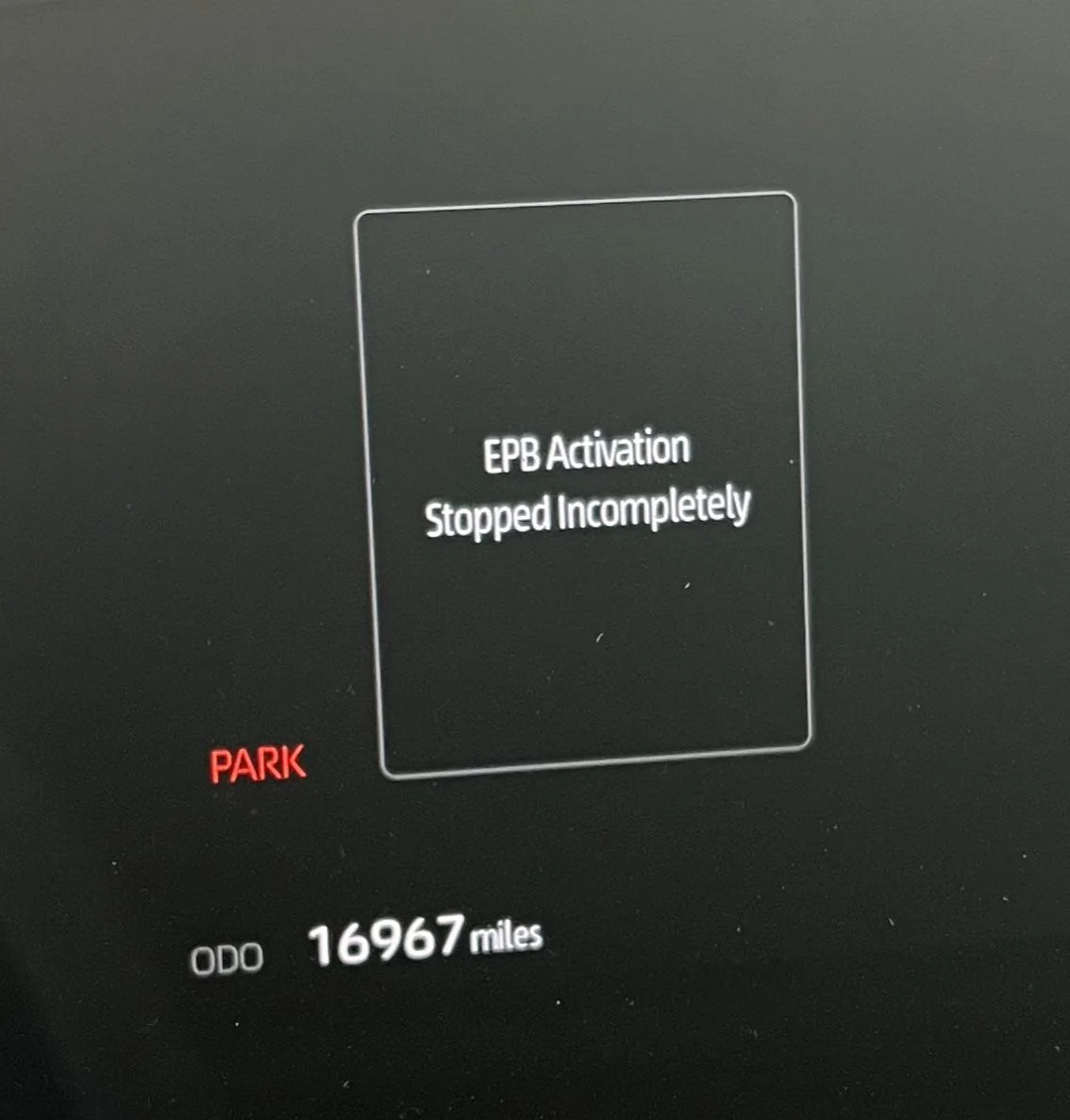
You park your Toyota or Lexus, engage the electronic parking brake, and instead of the usual confirmation, you get a message you have never seen before: “EPB Activation Stopped Incompletely.” The parking brake warning light might be flashing on the dashboard too. Now you are wondering whether the car is actually secure, whether you should drive it, and what on earth caused this in the first place.
That uncertainty is exactly why this message needs to be understood and addressed properly. The Electronic Parking Brake is a safety-critical system. When it tells you something went wrong mid-activation, it means the rear brakes did not fully engage or disengage as commanded. That is not a warning you can comfortably ignore.
This guide covers everything you need to know: what EPB is, what this specific message means, what causes it, and how to fix it properly.
What Is the Electronic Parking Brake and How Does It Work?
Not that long ago, every car used a mechanical hand brake. You pulled a lever, a cable physically pulled the rear brake pads against the rotors, and the car stayed put. Simple and reliable, but also entirely dependent on cables, and cables corrode and stretch over time.
The Electronic Parking Brake replaces that mechanical cable system with an electronically controlled actuator. When you press the EPB button, the ECU sends a command to an electric motor at the rear brakes, which clamps the brake pads against the rotors. When you disengage it, the motor reverses and releases the clamp. The whole process happens in about a second, with no cable pulling required.
The advantages over a traditional handbrake are real. The EPB applies consistent, calibrated clamping force. It integrates with other safety systems like Hill Start Assist. It frees up center console space. And it can hold the car securely on steep inclines without any driver effort.
But because it is electronically controlled, it is also dependent on electrical power, functioning sensors, a healthy ECU, and properly operating actuators. When any link in that chain breaks down, the system may fail to complete its activation cycle, and that is exactly what the “EPB Activation Stopped Incompletely” message is telling you.
What Does “EPB Activation Stopped Incompletely” Actually Mean?
The message is specific and intentional. It is not a general EPB fault warning. It is telling you that the system attempted to complete the parking brake activation cycle and was unable to finish it. The process started but stopped before the brakes were fully engaged or fully released.
Think of it like asking someone to close a door, watching them get halfway through the motion, and then just stopping. The door is neither open nor properly closed. The EPB is in a similar state: neither fully locked nor fully free.
This matters for safety. If the brake did not fully engage, the car may not be as securely held as you assume. If it did not fully disengage, the rear brakes may be dragging while you drive, which generates heat, accelerates brake wear, and can affect vehicle handling.
Before doing anything else, try this quick reset: toggle the EPB button on and off several times in succession. This can sometimes reset the system and clear a temporary fault. If the message disappears and does not return, a brief software hiccup or momentary power interruption was likely the cause. If the message comes back or the button pressing has no effect, something more substantive needs attention.
Important warranty note: If your Toyota or Lexus is within 36 months or 36,000 miles (whichever comes first), the basic Toyota warranty covers EPB repairs. Attempting to fix this yourself before checking warranty coverage could void that protection. Contact your dealer first if you are within that window.
How to Recognize an EPB Problem Beyond the Warning Message
The warning message on the instrument cluster is the most obvious sign, but there are a few other things to look for that confirm the EPB is genuinely malfunctioning rather than just displaying a false alarm:
- The parking brake warning light flashes on the dashboard rather than staying solid. A flashing warning light typically indicates an active fault rather than a reminder that the brake is engaged.
- The EPB button does not respond normally. It might feel unresponsive, or you might not get the usual confirmation from the system when you press it.
- The car moves more easily than expected when parked on a slope. If the brake did not fully engage, this could be an early sign.
- You notice a burning smell or reduced braking response while driving. This could indicate the rear brakes are partially dragging because the EPB did not fully disengage.
- A diagnostic scan reveals fault code DTC C059746. This is the specific Toyota and Lexus code associated with EPB activation incomplete errors. If this code is stored in the ECU alongside the warning message, it confirms a genuine parking brake system fault.
What Causes the EPB Activation Stopped Incompletely Message?
Corroded or Damaged Brake Cables and Wiring
Even though the EPB does not use the old-style mechanical cable to apply the brakes, there is still wiring connecting the EPB switch, the ECU, and the actuator at each rear wheel. That wiring is exposed to heat, moisture, road debris, and vibration throughout the car’s life.
Corrosion at connection points, particularly at the actuator connectors near the rear wheels where road spray is constant, can introduce resistance into the circuit. That resistance causes inconsistent power delivery to the actuator, and the actuator cannot complete its travel. The system detects the incomplete cycle and throws the error message.
Physical damage to wiring, from road debris impact, animal chewing, or accidental damage during unrelated repairs, can also break the circuit entirely or partially. A partial break is particularly deceptive because the system may work intermittently, making the fault hard to pin down without careful inspection.
Inspect the wiring harness running to the rear actuators, particularly at connection points and anywhere the harness routes near hot or moving components. Look for fraying, melted insulation, corrosion at connector pins, or any wiring that has been chafed by contact with body panels.
Low or Unstable Battery Voltage
The EPB actuator is a motorized component. It draws a significant amount of current when it operates, more than a simple sensor or light. When the battery voltage is too low to sustain that current demand during the activation cycle, the actuator may stall partway through its travel. The system registers an incomplete activation and triggers the error.
Voltage that is too high is also problematic, though less common. An overcharging alternator can deliver voltage spikes that confuse the ECU’s expected operating parameters for the EPB system.
Use a multimeter to check battery voltage under the following conditions:
- Engine off: A healthy battery should read between 12.4V and 12.9V.
- Engine running at idle: The charging voltage should read between 13.7V and 14.7V.
Anything outside these ranges points to either a failing battery or a charging system problem. Both need to be addressed before doing anything else, because even if you fix other components, low voltage will keep triggering the fault.
A Damaged or Faulty EPB Switch
The EPB switch is the button you press to engage or release the parking brake. It sends the command signal to the ECU, which then instructs the actuators at the rear wheels to move.
If the switch is faulty, it may send an incomplete or garbled command to the ECU. The ECU initiates the activation cycle but receives an inconsistent or broken input signal, causing the sequence to stop before completion. A damaged switch can also cause phantom activations or complete non-response depending on how the failure presents.
A bad EPB switch can also affect related systems that share communication with the EPB module, including the brake light circuit and the torque converter control system. So if you are seeing multiple unusual behaviors alongside the EPB message, the switch is worth investigating as a single point of failure affecting multiple systems.
A Faulty Fuse
The EPB system has dedicated fuse protection in the fuse boxes. If that fuse has blown, the system loses power and cannot complete its operation. Depending on exactly when the fuse blew relative to an activation attempt, the system may end up in a partially activated state, triggering the “stopped incompletely” message.
Check the fuse boxes in both the engine compartment and the interior. Identify the EPB-related fuse using the fuse box diagram in your owner’s manual. Pull the fuse and inspect it visually, or use a multimeter to test for continuity. If the fuse is blown, replace it with the exact same amperage rating.
If the replacement fuse blows again, stop and have a professional trace the overcurrent fault causing it. A recurring blown fuse always indicates an underlying electrical problem that needs to be found and fixed rather than repeatedly patched.
EPB Actuator Failure
The actuator is the motorized device at each rear wheel that physically clamps and releases the brake pads. These components are robust, but they do fail, particularly in higher-mileage vehicles or in cars operated in harsh conditions where moisture and corrosion penetrate the actuator housing.
A partially failed actuator may be able to start its travel but not complete it, which is textbook “EPB Activation Stopped Incompletely” territory. The motor inside the actuator may be weakening, the gearing may be worn, or internal corrosion may be creating enough resistance to prevent full travel.
Physical inspection of the actuator can reveal obvious external damage or corrosion. Internal actuator failure typically requires diagnostic tools to confirm, as the failure may not be visible from the outside.
Skid Control Computer Software Outdated
This is a cause that many owners and even some mechanics overlook. Toyota and Lexus have issued technical service bulletins related to the EPB Activation Stopped Incompletely message, specifically identifying that an outdated or uncalibrated skid control computer (which manages the EPB system) can cause this fault even when all the hardware is functioning correctly.
If the skid control computer calibration is not current, the software may incorrectly interpret the actuator’s feedback signals and terminate the activation cycle prematurely. The fix for this specific cause is a software reflash of the skid control computer, not a hardware replacement.
How to Fix the EPB Activation Stopped Incompletely Message
Work through these steps in order. Many of these checks build on each other, and skipping ahead risks missing the actual cause.
Step 1: Try the Quick Reset
Toggle the EPB button on and off several times. If the system had a momentary fault from a brief voltage drop or a transient software state, this cycling can reset it. If the message clears and does not return within a few drive cycles, you are likely done. If it comes back, move on.
Step 2: Check the Battery Voltage
Test the battery with a multimeter as described above. Confirm resting voltage and charging voltage are both within spec. If the battery is weak, charge or replace it before proceeding. A weak battery will keep triggering this fault regardless of what else you fix.
Step 3: Inspect the Fuses
Check both fuse boxes for any blown fuses related to the EPB system. Replace any blown fuse with the correct amperage rating and test the system again.
Step 4: Visually Inspect Wiring and Actuators
Check the wiring harness running to the rear actuators for any visible damage, corrosion at connectors, or chafing. Also look at the actuator housings for obvious external corrosion or physical damage. If you find damaged wiring, have it properly repaired by a qualified technician.
Step 5: Run a Diagnostic Scan
This step requires Toyota Techstream software or an equivalent diagnostic tool that can communicate with Toyota and Lexus-specific modules. A generic OBD-II reader will not have access to the EPB module’s specific fault codes.
Connect the scan tool and check for stored fault code DTC C059746. If this code is present alongside the warning message, it confirms a genuine parking brake system malfunction. The scan tool will also show whether the actuators are responding to commands and what the ECU is reading from each component, which helps identify exactly which part of the system is failing.
Step 6: Reflash the Skid Control Computer
If the diagnostic scan confirms that all hardware is functioning but the fault persists, or if the scan reveals that the skid control computer calibration is not current, the next step is a software reflash. This is the fix specified in Toyota’s own technical service bulletin for this fault.
The reflash must be performed with the battery voltage maintained at 13.5V throughout the process. If the voltage drops during the flash, the procedure can fail and potentially corrupt the module. A battery maintainer or charger set to the correct output should be connected before starting the flash.
After the reflash is complete, the authorized modification label should be installed on the vehicle as specified in the technical service bulletin, and a test drive should be performed to confirm the error message is gone and the EPB operates normally through several full engage and disengage cycles.
This step is best handled at a Toyota or Lexus dealer, or by an independent shop with Toyota Techstream access and experience performing software updates on Toyota safety systems.
Quick Reference Diagnosis Guide
| Symptom or Finding | Most Likely Cause | Recommended Action |
|---|---|---|
| Message clears after toggling EPB button | Temporary software or voltage glitch | Monitor for recurrence; no immediate repair needed |
| Message persists; battery below 12.4V at rest | Weak or failing battery | Load test battery; charge or replace as needed |
| Message persists; blown fuse found | Electrical fault causing overcurrent | Replace fuse; if it blows again, trace the short circuit |
| Corrosion or damage found on actuator wiring | Wiring fault interrupting actuator signal | Professional wiring repair or harness replacement |
| DTC C059746 present; hardware checks out fine | Outdated skid control computer calibration | Software reflash at dealer or specialist shop |
| Actuator does not respond to diagnostic commands | Failed EPB actuator | Replace actuator; calibrate after installation |
| EPB switch unresponsive or intermittent | Faulty EPB switch | Inspect switch; replace if confirmed faulty |

What Happens If You Ignore This Warning?
The EPB is a parking brake, not a service brake, so your ability to drive and stop normally while moving is generally not affected by this fault. But parking in a state of uncertainty about whether the brake is fully engaged is a genuine safety risk, particularly on any kind of slope.
If the EPB did not fully disengage after the error, the rear brakes may be dragging. Driving with dragging rear brakes generates heat that degrades brake fluid, damages brake pads and rotors faster than normal, and in severe cases can cause brake fade that affects your ability to stop safely. You may also notice reduced fuel economy and a burning smell from the rear of the vehicle.
This is not a warning to put in the “deal with it eventually” category. Address it within a few days at most, and if you are uncertain whether the brake fully disengaged, have the car inspected before driving it for an extended period.
The EPB Activation Stopped Incompletely message is your Toyota or Lexus being precise about what went wrong. It is not a vague warning light with a dozen possible interpretations. It is a specific report that a specific process did not complete. That specificity makes it easier to diagnose than most warning messages, and in many cases the fix is more straightforward than the technical-sounding message might suggest.