
Modern vehicles depend on several specialized fluids to operate safely and smoothly. Engine oil lubricates the internal moving parts of the engine. Coolant manages temperature. Transmission fluid handles hydraulic control and gear lubrication. Brake fluid transfers pressure through the braking system. Power steering fluid helps the steering system stay light, smooth, and responsive. Because all of these fluids live under the hood, many drivers naturally wonder whether some of them can substitute for one another in an emergency.
That question becomes especially urgent when a reservoir looks low and the correct bottle is not nearby. Maybe you are in your garage on a Sunday. Maybe you are at a parts store, staring at a shelf full of similar-looking bottles with unfamiliar labels. Or maybe, in a moment of distraction, the wrong fluid has already been poured into the wrong reservoir. At that point, what started as a simple maintenance task suddenly feels much more serious.
One of the most dangerous assumptions a vehicle owner can make is that because two fluids are both “hydraulic” or both “automotive,” they must be close enough to interchange. In reality, automotive fluids are engineered for very different jobs. Brake fluid and power steering fluid may both help transfer force within their respective systems, but they are chemically different, physically different, and designed to interact with very different seals, metals, temperatures, and operating conditions.
As an automotive systems specialist, I can say with confidence that this is not an area where improvisation is wise. The wrong fluid can create expensive damage quickly, and in the case of braking or steering systems, the consequences go beyond cost. They can also affect safety. A mistake here is not comparable to using the wrong windshield washer fluid or buying a filter from a different brand. Brake fluid in a power steering system—or power steering fluid in a brake system—can lead to component failure, contamination, leaks, reduced performance, and in severe cases loss of control.
This article is designed to remove the confusion completely. I will explain what power steering fluid is, what brake fluid is, why they are not interchangeable, how they differ in composition and purpose, what you can use as a legitimate alternative in some power steering systems, what damage may occur if brake fluid ends up in the steering system, and exactly what to do if the mistake has already happened. I will also walk you through how to check your power steering fluid properly, when to consider replacing it, and the most common myths that lead drivers into trouble.
If you only remember one thing from this guide, remember this: brake fluid and power steering fluid do not belong in each other’s systems. The rest of this article will show you why that statement matters so much.
Can You Use Brake Fluid as Power Steering Fluid?
No. You should not use brake fluid as power steering fluid, and you should not use power steering fluid as brake fluid either. These two fluids are designed for completely different systems, and mixing them can damage seals, hoses, pumps, valves, and other hydraulic components. In some cases, the damage starts immediately. In others, it builds quietly until the system begins to leak, groan, or fail.
This is not one of those situations where the difference is mostly theoretical. The difference is mechanical, chemical, and practical. Brake fluid is generally glycol-based in DOT 3, DOT 4, and DOT 5.1 applications, while power steering fluid is usually petroleum-based or a specially engineered hydraulic oil, and in some vehicles it may be automatic transmission fluid. Their additive packages are different. Their seal compatibility is different. Their moisture behavior is different. Their lubrication properties are different. Even their relationship to paint and rubber is different.
If brake fluid is poured into the power steering reservoir, the best-case outcome is that you catch it before the engine is started and the fluid never circulates. In that case, the reservoir can often be emptied and the system flushed before major damage occurs. If the engine runs and the contaminated fluid travels through the steering pump, rack, and hoses, the repair becomes more serious. The longer the wrong fluid circulates, the greater the risk that seals swell, soften, or degrade and that pump components lose the lubrication they need.
If the reverse mistake happens—power steering fluid into the brake system—the situation is even more dangerous from a safety perspective. Brake systems rely on very specific hydraulic behavior and seal materials. Petroleum-based contamination in a brake system can ruin rubber components rapidly and compromise stopping ability. That mistake should be treated as a no-drive emergency.
So the direct answer is simple, but the reason behind it is worth understanding in detail. Let’s begin by examining what each fluid is supposed to do in its proper environment.
Why Drivers Think These Fluids Might Be Interchangeable
The confusion is understandable. Brake fluid and power steering fluid are both found under the hood. They both sit in reservoirs. They are both associated with hydraulic pressure. They are both essential to control-related systems. If you are not used to thinking about the chemistry behind automotive fluids, it is easy to assume the differences are small or mostly about branding.
That assumption becomes even more tempting in an emergency. If the steering feels heavy and you only have brake fluid in the garage, the wrong kind of logic appears quickly: “It is a hydraulic fluid, so it should work for now.” That thinking is exactly what gets people into trouble. The word hydraulic describes a function, not a universal chemical formula. Many fluids can transfer pressure. That does not mean they can all safely live in the same system.
Manufacturers design brake systems and steering systems around specific elastomers, metals, temperatures, pressure cycles, and maintenance expectations. The fluid is part of that design, not an interchangeable afterthought. Treating these fluids as close cousins because both are used in hydraulic systems is like assuming cooking oil and transmission fluid are interchangeable because both are oils. The category is too broad to be meaningful on its own.
To make the risks easier to understand, we need to define each fluid properly and then compare them from an engineering point of view rather than from the outside of the bottle.
What Is Power Steering Fluid?
Power steering fluid is the hydraulic medium used in traditional hydraulic power steering systems. Its job is not only to transfer pressure but also to lubricate moving parts, reduce friction, control heat, and protect internal components against wear and corrosion. In many vehicles, power steering fluid is petroleum-based. In others, especially some European and Japanese vehicles, the system may require a synthetic hydraulic fluid with specific performance characteristics. There are also vehicles that use certain automatic transmission fluids as their specified steering fluid.
That last point is important because it helps explain why power steering fluid creates so much confusion. It is not one chemically identical product across all brands and models. Some systems are designed around dedicated power steering fluid. Others are designed around ATF. Some use special mineral-based hydraulic fluids. In all cases, though, the required fluid is chosen for that steering system’s materials, pressure demands, and operating temperature.
In a hydraulic steering system, the power steering pump pressurizes the fluid and sends it where it is needed to help move the steering rack or steering gear. This is what gives the driver the familiar light steering feel at low speeds and during parking. Without the correct fluid, the pump cannot maintain proper lubrication and hydraulic behavior. That means the steering can become noisy, inconsistent, stiff, or eventually damaged.
A good power steering fluid must remain stable across temperature changes, resist foaming, and maintain predictable viscosity under repeated pressure cycles. It also has to protect seals and pump internals over long service intervals. In other words, it is not just a liquid that happens to be in the system. It is a functional component of the system.
Many people think of power steering fluid only when there is a leak or a whining pump, but its role is much deeper than that. It is the lifeblood of the steering assist system, and like any specialized fluid, it works properly only when its chemistry matches the system it was intended for.
That brings us to brake fluid, which serves another critical job in a very different environment.
What Is Brake Fluid?
Brake fluid is the hydraulic fluid used in the braking system to transfer force from the brake pedal to the calipers or wheel cylinders. In most passenger vehicles, the fluid is glycol-based, usually DOT 3, DOT 4, or DOT 5.1. There is also DOT 5 brake fluid, which is silicone-based, but it is far less common and should not be casually mixed into systems that were designed for glycol-based fluid. Because the majority of roadgoing vehicles use glycol-based brake fluid, that is what most people are referring to when they simply say “brake fluid.”
Unlike power steering fluid, brake fluid is designed specifically to operate in a closed brake system where heat resistance and moisture management are crucial. One of its defining characteristics is that it is hygroscopic, meaning it absorbs moisture from the air over time. That may sound like a weakness, but it is actually intentional. By absorbing moisture into the fluid rather than allowing water to pool in isolated sections of the brake system, brake fluid helps reduce localized corrosion and freezing risk. The tradeoff is that old brake fluid eventually becomes contaminated with absorbed moisture and needs replacement to preserve braking performance.
Brake fluid must also have a very high boiling point. During braking, especially repeated hard braking, the system generates substantial heat. If the fluid were to boil, vapor would form in the hydraulic lines, and vapor compresses far more than liquid. That would create a soft or fading brake pedal and a serious loss of braking effectiveness. So brake fluid is engineered around thermal stability and moisture tolerance in a way that is very different from steering fluid priorities.
It also has a very different relationship with rubber and painted surfaces. Glycol-based brake fluid is extremely hard on automotive paint and must be cleaned off immediately if spilled. It also interacts with rubber components differently than petroleum-based hydraulic fluids do. That is one of the main reasons it can damage steering-system seals if used in the wrong place.
From a functional standpoint, brake fluid is one of the most safety-critical liquids in the entire vehicle. Its job is to translate foot pressure into reliable stopping force with consistency, heat resistance, and minimal compressibility. That mission is very different from helping a pump lubricate and steer a rack smoothly. The systems may both use hydraulic principles, but the fluids are serving very different engineering goals.
Power Steering Fluid vs. Brake Fluid: The Crucial Differences
Now that the two fluids have been defined, the next step is comparing them directly. This is where the incompatibility becomes obvious. The differences are not superficial. They are fundamental.
1. Composition
Power steering fluid is generally petroleum-based or a specially engineered hydraulic oil. Some applications call for synthetic hydraulic fluid. Some older or manufacturer-specific systems call for automatic transmission fluid. In all of these cases, the fluid behaves like an oil-based hydraulic medium with strong lubricating properties.
Brake fluid, in contrast, is usually glycol-based in DOT 3, DOT 4, and DOT 5.1 systems. DOT 5 is silicone-based, but again, that is a separate category and still not interchangeable with steering fluid. The chemistry of brake fluid is designed around high boiling point, moisture absorption, and compatibility with brake-system seals and metals—not around lubricating a pump or rack.
This means the two fluids are chemically different before we even talk about what they do. A glycol-based fluid simply does not behave like a petroleum-based hydraulic oil inside a steering system. Nor does petroleum fluid belong in the tightly calibrated hydraulic environment of the brakes.
2. Lubrication and Viscosity Behavior
Power steering fluid is expected to lubricate moving parts continuously. The power steering pump depends on that lubricity, as do internal rack components and various seals and valves. The fluid also needs to maintain suitable viscosity under repeated pressure cycles so the steering assist feels predictable and the pump remains protected.
Brake fluid provides some internal hydraulic-system protection, but it is not primarily a lubricating oil in the same sense. A brake system is not built around the same kind of rotating pump and continuous lubrication requirements found in a hydraulic steering system. This is why using brake fluid in place of steering fluid deprives the steering pump and associated components of the kind of lubrication they were designed to receive.
If the wrong fluid circulates through the steering system, pump wear can accelerate quickly. Noise often follows, then leakage, then component failure if the problem continues long enough.
3. Moisture Handling
This is one of the biggest differences. Brake fluid is intentionally hygroscopic. It absorbs moisture so that water does not collect separately in the braking system. This helps reduce corrosion concentration and keeps the hydraulic system functioning safely under changing conditions.
Power steering fluid is not designed for this kind of moisture absorption. The steering system does not want a fluid that actively takes on atmospheric water the way brake fluid does. A steering system wants stable hydraulic lubrication and seal protection, not a moisture-absorbing glycol solution moving through an oil-oriented circuit.
This is one reason contaminated brake fluid should be replaced periodically. It has a finite service life because absorbed moisture lowers boiling point over time. Power steering fluid ages differently and is judged more by oxidation, contamination, wear particles, and general fluid breakdown than by this specific moisture-loading behavior.
4. Heat Management
Both fluids deal with heat, but they do so in very different contexts. Power steering fluid experiences heat from pump operation, under-hood temperature, and hydraulic shear. It must remain stable while lubricating and maintaining pressure transfer. Brake fluid experiences heat from braking events, where caliper temperatures and repeated friction loads can be intense. It must resist boiling and maintain hydraulic firmness.
Because their heat-related design priorities differ, neither fluid is an acceptable substitute for the other. A fluid designed to resist brake boil is not automatically designed to lubricate a steering pump. A fluid designed to protect steering hardware is not automatically engineered for repeated brake heat cycles and moisture loading.
This is why the phrase “they are both hydraulic fluids” is so misleading. Yes, they both transmit force. But they do so under entirely different conditions and with very different engineering demands.
5. Seal and Rubber Compatibility
This is perhaps the most damaging part of the mix-up. Hydraulic systems are built around seal materials that are selected for the correct fluid. Brake systems and steering systems do not necessarily use the same rubber formulations or expect the same chemical environment.
Brake fluid can cause certain rubber seals in a power steering system to swell, soften, or degrade. Once that happens, internal leaks and external seepage become far more likely. Steering fluid entering a brake system can also damage brake seals and cause system failure. These are not abstract risks. They are some of the most common reasons cross-contaminated hydraulic systems end up needing major repairs.
The seal issue is one of the clearest reasons why wrong-fluid accidents get expensive. A fluid change may seem harmless until the seals begin reacting to chemistry they were never designed to tolerate.
6. System Purpose
The power steering system uses fluid to help you turn the wheels more easily. The brake system uses fluid to stop the car. One system values smooth hydraulic assist and pump protection. The other values non-compressible pressure transfer, moisture management, and high boiling resistance. Their mission profiles are simply not the same.
That may seem like an obvious point, but it matters because each fluid is tuned to support the exact job the system must perform. The steering system and the braking system are not fluid cousins. They are separate engineered environments with separate chemical expectations.
Legitimate Power Steering Fluid Alternatives
Now that it is clear brake fluid is never a legitimate substitute, it is worth discussing the one fluid category that sometimes can serve as a real alternative in certain vehicles: automatic transmission fluid.
Some older vehicles and some manufacturer-specific steering systems were designed to use ATF rather than dedicated power steering fluid. In those cases, using the specified transmission fluid is not a compromise. It is exactly what the car was engineered to use. This is common enough in some older domestic vehicles that many technicians of a certain generation automatically think of ATF as a power steering fluid option—but only when the vehicle calls for it.
That last part matters enormously. ATF is only an acceptable alternative if the manufacturer says it is. You cannot assume every vehicle with hydraulic steering will safely accept transmission fluid just because another vehicle does. Some systems require dedicated hydraulic fluid. Some require special synthetic fluids. Some need exact OEM-approved steering fluid formulations.
In practical terms, this means your real alternatives are limited to the fluids listed in one of three places: the owner’s manual, the reservoir cap, or approved technical documentation. If the manual names a dedicated power steering fluid, use that. If it names Dexron, Mercon, ATF+4, or another ATF specification, use that exact type. If it names a special hydraulic fluid standard, use that. The right alternative is not whatever happens to be close. It is whatever the vehicle was designed for.
So yes, there are legitimate substitutes in some cars. But those substitutes are not discovered by guessing. They are discovered by reading the specification.
If you are ever unsure, stop and verify before adding fluid. Hydraulic system repairs cost far more than a phone call or a few minutes of research.
What to Do If Brake Fluid Was Put into the Power Steering Reservoir
If brake fluid was accidentally added to the power steering reservoir, your response should depend on one crucial question: has the engine been started since the mistake happened?
If the engine has not been started, your chances of preventing major damage are much better. In that situation, the brake fluid is likely still sitting mostly in the reservoir rather than circulating through the pump, hoses, and steering rack. That is the best-case scenario.
If the engine has been started—or worse, if the car has been driven—the contamination has almost certainly moved through much of the system. At that point, a more aggressive flush is needed, and component damage becomes much more likely.
The following sequence is the safest general response if brake fluid has entered the power steering reservoir. I have rearranged the process into the most useful order from a diagnostic and damage-prevention standpoint.
- Do not start the engine if you have not already done so.
- Remove as much contaminated fluid from the power steering reservoir as possible using a clean suction tool or fluid extractor.
- Raise the front of the vehicle safely and support it on jack stands if steering movement is needed for fluid displacement.
- Turn the steering wheel slowly from side to side with the engine off to move more fluid back toward the reservoir.
- Continue extracting the returning fluid until no more useful fluid can be removed from the reservoir alone.
- Disconnect the low-pressure return hose and drain the system into a proper container if a full flush is required.
- Add the correct power steering fluid, flush again, and repeat until the fluid leaving the system is clean.
- Reconnect the system, refill it with the proper fluid, and bleed the power steering system fully.
- Inspect closely for leaks, swelling hoses, unusual pump noise, or steering feel changes afterward.
- If the engine was started or the car was driven, have the system professionally inspected because seals or pump components may already be compromised.
That sequence is the overview. Now let’s examine what those steps really mean, because details matter here.
If the Engine Was Not Started
This is the ideal scenario after a wrong-fluid mistake. If the brake fluid was poured into the power steering reservoir but the vehicle has not been started, stop everything and leave the engine off. Do not “just move the car a few feet.” Do not test the steering. Do not crank the engine to see if anything feels different. The entire goal at this point is to prevent circulation.
Use a suction tool, vacuum extractor, or clean baster-type tool dedicated to shop use to remove the contaminated fluid from the reservoir. Dispose of the extracted fluid properly. Once the reservoir is mostly empty, turn the steering wheel slowly from side to side with the front of the vehicle lifted if possible. This may encourage additional fluid to move back toward the reservoir, where you can remove it as well.
At this stage, many careful technicians will still recommend disconnecting the low-pressure return line and flushing the system completely with the proper fluid just to be safe. That extra work is worthwhile because even small amounts of wrong fluid can matter. The reservoir extraction alone is good first aid; the flush is the better long-term repair.
If handled early enough, this mistake can sometimes be corrected without lasting damage. But the key is speed and discipline. The moment the wrong fluid goes in, the engine must stay off.
If the Engine Was Started or the Car Was Driven
If the engine was started after the brake fluid entered the reservoir, the situation becomes more serious. Once the power steering pump begins working, the contaminated fluid is carried throughout the system. That means the pump, lines, seals, rack or gearbox, and return circuit may all be exposed.
In this case, simply removing the reservoir fluid is not enough. The system needs a full flush. That typically involves disconnecting the low-pressure return hose, draining the system, flushing with the correct steering fluid repeatedly, and then bleeding the system thoroughly to remove air. Some vehicles may also need hoses, seals, or the reservoir itself replaced if damage has already started or if contamination cannot be confidently removed.
The biggest concern here is not only contamination but chemical reaction time. The longer the brake fluid circulates, the more opportunity it has to affect the seal materials. That can lead to swelling, softening, leaks, or altered steering feel. In some cases, the damage is not obvious immediately. The system may seem normal after the flush, only to begin leaking weeks later once the seal damage fully reveals itself.
If the vehicle was driven any meaningful distance, professional help becomes much more advisable. A mechanic can evaluate whether a flush is likely to save the system or whether certain components need replacement preemptively.
At this stage, towing is often smarter than driving. If you are serious about minimizing damage, do not let the contaminated fluid keep working through the system unnecessarily.
Damage Caused by Brake Fluid in the Power Steering System
The damage from brake fluid in the power steering system usually begins with the soft parts. Seals and hoses are often the first components to react because the chemistry of brake fluid is not what those materials were chosen for. The rubber may swell, soften, distort, or lose durability. Once that happens, the system becomes much more likely to leak.
At first, you may notice only a smell, mild pump noise, or a subtle change in steering feel. Then the leaks begin. A power steering leak may show up around the pump shaft seal, hose fittings, or the steering rack itself. Once a seal begins to fail, fluid level drops, air gets drawn into the system, and pump cavitation can begin. That is when the familiar whining or groaning noise often appears.
The power steering pump itself is another major victim. Brake fluid does not provide the lubricating protection the pump expects. The pump can begin wearing internally because the fluid film is wrong, the chemistry is wrong, and air contamination often follows once leaks begin. A damaged pump may start as a simple whine and end as a complete loss of assist.
If the contamination continues long enough, the steering rack or gearbox can also suffer. Internal valves and seals in hydraulic steering systems rely on the correct fluid behavior to function predictably. Once the fluid chemistry changes, the steering can become inconsistent, sticky, noisy, or leaky. Repair costs at that point can become substantial.
What makes this particularly frustrating is that the original mistake may have been small. A distracted owner, a mislabeled bottle, or a rushed top-off can turn into a repair estimate far larger than anyone expected. It is one of those automotive errors where the fluid itself is cheap but the consequences are not.
As a general cost perspective, replacing a power steering pump alone can run from a few hundred dollars to well over a thousand depending on the vehicle. Add hose replacement, reservoir replacement, or rack work, and the total climbs quickly. This is why immediate correction matters so much.
Brake fluid contamination in the steering system is not something to monitor casually over time. It is something to remove aggressively and evaluate seriously as soon as possible.
How to Check Power Steering Fluid Properly
Checking power steering fluid is simple, but it still needs to be done with care. Dirt in the reservoir or a wrong reading taken under the wrong conditions can create confusion. A proper inspection tells you both the fluid level and something about the fluid’s condition.
1. Locate the Correct Reservoir
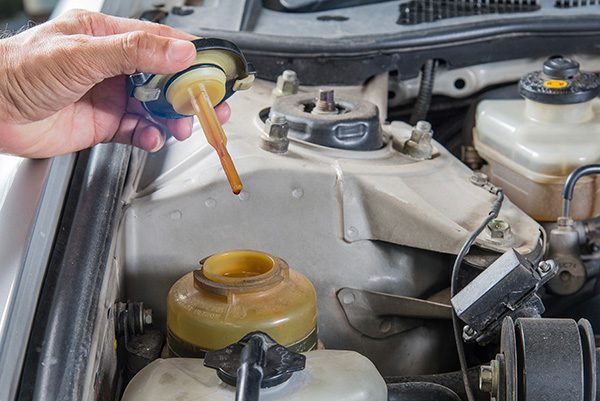
Open the hood and identify the power steering reservoir. On some vehicles, it is mounted directly on the pump. On others, it sits remotely nearby with hoses running to the pump. The owner’s manual is the easiest way to confirm the location if you are not sure. It is usually a small container with a cap, often labeled for steering fluid or hydraulic fluid.
Do not confuse it with the brake fluid reservoir. The brake reservoir is usually mounted at the master cylinder near the firewall, often on the driver side, and is usually designed differently. Confirm the reservoir before opening anything.
2. Clean Around the Cap
Before opening the reservoir, wipe the cap and surrounding area with a clean cloth. This prevents dirt or grit from falling into the system when the cap is removed. Steering systems do not respond well to contamination, so this simple step is more important than it looks.
3. Read the Fluid Level
Some power steering reservoirs use a dipstick built into the cap. Others have clear min and max markings on the side of the reservoir. Remove the cap if necessary, wipe the dipstick, reinstall it fully, then remove it again to get an accurate reading. Follow the markings carefully. Some systems have different indicators for hot and cold fluid levels.
If the fluid is below the correct mark, the system needs topping off—but only with the correct fluid type. Never assume any hydraulic-looking fluid is acceptable.
4. Evaluate Fluid Condition
While checking the level, look closely at the fluid itself. Healthy steering fluid is usually relatively clear and stable in appearance, though the exact color depends on the fluid type. If the fluid is dark, cloudy, burnt-smelling, or full of visible debris, a flush may be more appropriate than a simple top-off.
Foamy fluid is also a warning sign. It often means air has entered the system, usually from a low level, leak, or recent improper service. Air in the fluid can cause noise and poor assist behavior.
5. Top Off If Needed
If the level is low and the fluid condition is otherwise acceptable, add the correct fluid slowly until the level reaches the proper mark. Do not overfill. Too much fluid can create expansion issues and contribute to messy overflow. Once topped off, recheck the level and monitor it over time. If it drops again, you likely have a leak that needs attention.
Checking the reservoir takes only a few minutes, but it can prevent pump damage and help you catch leaks before they become expensive.
When Should You Flush or Replace Power Steering Fluid?
Many owners assume that if the steering feels fine, the fluid must be fine too. That is not always true. Power steering fluid degrades gradually, and because steering systems do not always show dramatic symptoms early, the fluid can become old and contaminated long before the driver realizes it.
A practical replacement interval for many vehicles is every 40,000 to 80,000 miles, depending on the manufacturer, vehicle use, and fluid condition. Some automakers provide a more specific interval. Others do not mention the fluid at all, which leads many people to assume it never needs service. In practice, that assumption is not ideal.
Heat, oxidation, moisture exposure, and wear particles all affect the fluid over time. Once the additives are depleted and contamination builds, the fluid no longer protects the pump and seals as well as it should. If the fluid is dark or dirty, do not wait for a mileage number. Service it based on condition.
A flush is especially worthwhile if the steering feels noisy, if the fluid is visibly contaminated, or if you just bought a used vehicle with no service history and want to establish a clean baseline. It is a relatively affordable maintenance task compared with the cost of replacing steering hardware later.
Fresh fluid is cheap insurance. Neglected fluid is a silent risk.
What If Power Steering Fluid Was Put into the Brake System?
While this article focuses on brake fluid accidentally entering the steering system, it is worth stating clearly that the reverse mistake is even more urgent from a safety standpoint. If power steering fluid or any petroleum-based fluid is poured into the brake master cylinder reservoir, do not drive the car.
Brake system seals are not designed for petroleum contamination. The wrong fluid can rapidly damage internal rubber components, creating leaks, loss of pressure, and potentially severe brake failure. Unlike a power steering issue, which may begin as noise or leakage, a brake-fluid contamination event directly threatens the system responsible for stopping the vehicle.
That kind of mistake usually requires extensive flushing and often replacement of multiple hydraulic components, including seals, hoses, calipers, wheel cylinders, and sometimes the master cylinder itself depending on how far the contamination spread. This is not something to “test drive” and see what happens. The car should be towed and repaired properly.
So while both mistakes are serious, power steering fluid in the brake system should always be treated as the more immediate safety emergency.
Common Myths About Brake Fluid and Power Steering Fluid
Fluid confusion is helped along by a few persistent myths. Clearing them up makes it easier to avoid expensive mistakes.
One common myth is that if two fluids are both “hydraulic,” they must be interchangeable. This is false. Hydraulic is a functional description, not a universal formula. Many fluids can transfer force, but they are still designed for different materials and system behavior.
Another myth is that topping off with the wrong fluid once is harmless if the system still works. This is risky thinking. Some damage begins chemically before you hear noise or feel changes. The fact that the steering still turns does not mean the seals are fine.
A third myth is that all power steering fluids are basically the same. Also false. Some vehicles use ATF. Some require special synthetic hydraulic fluid. Some accept certain universal formulas. The label “power steering fluid” is not enough information by itself.
Another dangerous myth is that if the fluid bottle says “safe for many systems,” it is acceptable everywhere. Broad compatibility language is not a substitute for checking the manufacturer specification.
And finally, some people assume that if a mistake was caught quickly, no flush is needed. That depends on whether the fluid circulated. If the wrong fluid entered the reservoir and the engine never started, the risk is lower. Once it circulated, a proper flush becomes much more important.
Frequently Asked Questions
Can you mix brake fluid and power steering fluid?
No. These fluids should never be mixed. They are chemically different and designed for different hydraulic systems. Mixing them can damage seals, reduce lubrication, create leaks, and lead to steering or braking system failure depending on where the contamination occurs.
Can you use transmission fluid instead of power steering fluid?
Sometimes, but only if your vehicle manufacturer specifically allows it. Some older vehicles and some manufacturer-specific systems use automatic transmission fluid in the power steering system. Others do not. Always check the owner’s manual or reservoir specification before using ATF as a substitute.
Can you use brake fluid for anything else?
Brake fluid does have industrial hydraulic uses outside the braking system, but in the context of normal passenger-car maintenance, you should not casually repurpose it. It is not a general substitute fluid for steering, transmission, or clutch systems unless a specific system was designed for that exact brake fluid type. In ordinary car care, its proper home is the brake system and, in some vehicles, the hydraulic clutch system that shares brake fluid by design.
Can you use transmission fluid as brake fluid?
No. Transmission fluid should never be used as brake fluid. It is incompatible with the brake system’s seal materials and hydraulic requirements. Using it in the brake system can lead to seal failure, leaks, and dangerous loss of braking performance.
How quickly can the wrong fluid damage the steering system?
It depends on the amount added, whether the engine was started, and how long the wrong fluid circulated. If the mistake is caught before the vehicle is started, major damage may be avoided. If the wrong fluid circulates through the pump and seals, chemical damage can begin quickly even if symptoms do not become obvious until later.
Will flushing the system always save it?
Not always, but flushing immediately gives you the best chance. If the contamination was caught early, a proper flush may prevent lasting damage. If the fluid circulated long enough to swell or weaken seals, some components may still require replacement later even after a thorough flush.
Final Thoughts
Brake fluid and power steering fluid may both live under the hood and may both help move hydraulic force, but they are not remotely interchangeable. Their chemistry, lubricating properties, moisture behavior, seal compatibility, and system purpose are all different. Using one in place of the other is not a harmless shortcut. It is a genuine risk to important vehicle systems.
If brake fluid enters the power steering reservoir, immediate action matters. If the engine has not been started, your odds of avoiding serious damage are much better. If it has already circulated, the system needs a proper flush and should be watched closely for leaks, noise, or steering changes. And if power steering fluid ever enters the brake system, treat that as a no-drive emergency.
The larger lesson here is simple: automotive fluids are specialized for a reason. When in doubt, verify the specification before you pour anything into a reservoir. The correct bottle is always cheaper than the wrong repair.
If you maintain the system properly, use the right fluid, and respond quickly to any contamination mistake, you can usually protect the steering system from long-term harm. But if there is one mistake to avoid entirely, it is assuming that brake fluid and power steering fluid are close enough to swap. They are not—and your vehicle will make that very clear if you test the theory the hard way.