
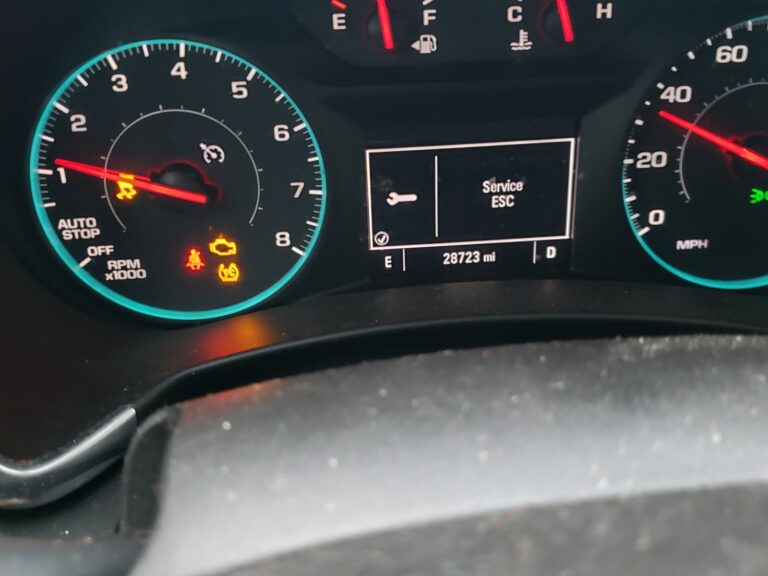
You are cruising along in your Chevy Traverse. Maybe it is a rainy Monday morning commute, or maybe you are on a highway heading to your kid’s soccer game. Everything feels fine. Then a little chime goes off, cutting right through whatever song was playing on the radio.
You look down at the dash. There it is. That amber warning light staring back at you: “Service ESC.” And right next to it, just to make your day a little worse, you might also see “Service StabiliTrak.”
Your stomach drops. You start running through worst-case scenarios in your head. Are the brakes going out? Is the engine about to quit on me? Can I even make it home safely, or do I need to pull over right now?
Take a breath. You are not the first Traverse owner to have this experience, and you will not be the last. This warning light is not some mysterious curse that only your vehicle has. It is actually one of the most common dashboard warnings across the entire GM SUV lineup, and it has been triggering panic in drivers for years.
But here is the thing. While the “Service ESC” warning is not usually an emergency, it is also not something you should ignore. That little amber light is your vehicle telling you that something in its stability control system is off. And when a 5,000-pound SUV loses the ability to correct itself during a slide or a sudden swerve, you want to know about it before you actually need it.
So let us break this whole thing down. No mechanic jargon overload. No guessing games. Just a straight, thorough explanation of what is happening under your Traverse, why it is happening, and exactly what you can do to fix it.
What the ESC System Actually Does (And Why It Matters More Than You Think)
Before we get into what goes wrong, you need a basic understanding of what this system actually does when it is working properly. Think of the ESC system as an invisible co-driver who has lightning-fast reflexes and zero ego.
ESC stands for Electronic Stability Control. In GM vehicles like the Chevy Traverse, this system goes by the brand name StabiliTrak. It has been required on all passenger vehicles sold in the United States since the 2012 model year because, frankly, it saves lives. The National Highway Traffic Safety Administration estimates that ESC reduces single-vehicle crashes by about 50 percent. That is not a small number.
Here is what it does in plain English. The system constantly monitors whether your vehicle is actually going where you are steering it. If you turn the wheel to the left but the vehicle starts sliding to the right (because of ice, wet pavement, gravel, or just taking a turn too fast), the ESC system jumps in. It applies the brakes to individual wheels, one at a time if needed, and even reduces engine power to bring the vehicle back in line.
All of this happens in milliseconds. Faster than you could ever react on your own. And in many cases, you would not even realize a correction was made.
The Three Systems That Work Together to Keep You Safe
The ESC system does not work alone. It is actually part of a trio that operates together, and understanding this group is important because a fault in one system often causes warning lights for all three.
Anti-lock Braking System (ABS) prevents your wheels from locking up during hard braking. When you slam on the brakes in a panic stop, ABS rapidly pulses the brake pressure so the tires maintain grip instead of skidding across the pavement.
Traction Control System (TCS) handles the opposite situation. When you hit the gas and a wheel starts spinning freely (on ice, wet grass, or loose gravel), TCS reduces power to that wheel or applies a touch of braking to it so it can regain traction.
Electronic Stability Control (ESC) is the big-picture system. While ABS and TCS deal with individual wheels during braking or acceleration, ESC manages the overall direction and stability of the entire vehicle. It is the boss, and ABS and TCS are its tools.
When your dash lights up with “Service ESC,” there is a good chance you will also see ABS and traction control warnings. That does not mean three different things broke at once. It usually means one issue is cascading through the whole safety network.
A Closer Look at the Hardware Behind the Curtain
The ESC system is not just a single computer chip somewhere under the hood. It is a network of sensors, a hydraulic unit, and control modules all working in real time. Here is what each piece does:
- Wheel Speed Sensors (one at each wheel): These sit right at the wheel hub. They use magnetic technology to count how fast each tire is rotating. If three wheels are spinning at 50 mph but one is barely moving, the system knows something is wrong at that corner.
- Steering Angle Sensor: This lives inside the steering column. Its job is to tell the computer exactly where you are pointing the steering wheel and how quickly you turned it. Basically, it communicates your intentions.
- Yaw Rate and Lateral Acceleration Sensor: This is usually mounted near the center of the vehicle, often under the center console or beneath the driver seat. It works like a gyroscope, measuring whether the vehicle is rotating (spinning on its axis) or sliding sideways. This sensor tells the system what the vehicle is actually doing, as opposed to what you want it to do.
- Hydraulic Modulator (ABS/ESC Unit): This is the muscle of the operation. It contains an electric pump and a series of valves that can squeeze individual brake calipers without you ever touching the brake pedal. When the computer says “apply brake pressure to the right rear wheel,” this unit makes it happen.
- Electronic Brake Control Module (EBCM): This is the brain. It takes all the data from every sensor, compares it in real time, and decides if the vehicle needs a correction. When it detects bad or missing data from any sensor, it sets a fault code and turns on the “Service ESC” light.
The magic of the system is in the comparison. The steering angle sensor tells the EBCM where you want to go. The yaw rate sensor tells it where the vehicle is actually going. If those two stories do not match up, the system activates and starts making corrections.
When the “Service ESC” light comes on, it means the EBCM has detected that the data it is receiving is missing, does not make sense, or is conflicting. Without reliable data, the system cannot do its job safely. So it shuts itself off and warns you.
Why Your Traverse Feels Sluggish When the Light Comes On
A lot of Traverse owners notice something weird when this warning pops up. The engine feels like it lost power. It feels sluggish, almost like the vehicle is holding back. And that is exactly what is happening.
One of the ESC system’s tools is engine torque reduction. When the system detects instability, it can actually reduce the power your engine produces by pulling back on ignition timing or cutting fuel to certain cylinders. This is a safety measure designed to reduce the force that is feeding the instability.
On ice, this is a great thing. On dry pavement with a malfunctioning sensor? It is incredibly annoying. Your vehicle is cutting its own power because it thinks something is wrong, even when everything is fine.
This is one of the biggest reasons why you do not want to just ignore the “Service ESC” light and keep driving like normal. Even if you do not care about the stability control itself, the false activation of torque reduction can make your vehicle unpredictable and frustrating to drive.
The Usual Suspects: What Actually Causes the “Service ESC” Warning
Here is some good news. When the “Service ESC” light comes on, it is almost never the main computer or the hydraulic modulator that has failed. Those components are actually quite durable. In most cases, a peripheral sensor or a wiring issue is sending bad information to the brain.
Let us walk through the most common causes, ranked roughly by how often they show up in Chevy Traverse vehicles.
Worn-Out or Dirty Wheel Speed Sensors
If there is one component that causes more “Service ESC” lights than anything else, it is the wheel speed sensor. These little sensors are the most exposed components in the entire system. They are bolted right onto the wheel hubs, where they face constant punishment.
Think about what these sensors deal with every single day. Extreme heat radiating off the brake rotors. Constant vibration from the road surface. Water spray. Road salt in the winter. Mud. Gravel. Brake dust coating everything. It is a brutal environment for a precision electronic component.
Over time, two things typically happen. First, the sensor itself can degrade internally. The thermal cycling, going from very hot to cold over and over, eventually wears out the internal electronics.
Second, and this is really common on Traverses with higher mileage, the magnetic reluctor ring gets damaged. This ring is part of the wheel bearing hub assembly, and the sensor reads the teeth on this ring to measure wheel speed. When the ring cracks, rusts, or gets caked with brake dust and debris, the sensor can no longer get a clean reading. The signal gets choppy or drops out entirely.
When the EBCM loses the signal from even one wheel speed sensor, it cannot accurately calculate what the vehicle is doing. So it disables the whole system and lights up the dash.
Here is a real-world example. A 2015 Traverse comes into the shop with a “Service ESC” light that comes and goes. Some days it is fine. Other days it pops on within five minutes of driving. A scan reveals a code for the left rear wheel speed sensor. Visual inspection shows the sensor is fine, but the reluctor ring on the hub assembly has a chunk of rust buildup on it. Cleaning would only be a temporary fix. Replacing the hub assembly (which includes a new reluctor ring) solves the problem permanently.
Low Brake Fluid or Brake Fluid That Has Gone Bad
This one surprises a lot of people. How could something as simple as brake fluid cause a high-tech stability control warning?
The ESC system relies on hydraulic pressure to apply brakes to individual wheels. If the brake fluid level in the master cylinder reservoir drops below a certain point, the system cannot guarantee that it has enough pressure available to intervene during a skid. So it shuts down and alerts you.
But it is not just about the level. Brake fluid quality matters too. Brake fluid is hygroscopic, which is a fancy way of saying it absorbs moisture out of the air over time. Every time you open that cap to check the level, every time humidity gets in through the rubber seals, the fluid absorbs a tiny bit of water.
Over months and years, the water content builds up. This lowers the boiling point of the fluid and can cause internal corrosion in the ABS/ESC hydraulic modulator. The valves inside that modulator are precision-engineered, and even a small amount of corrosion can change how they respond to commands. Modern GM pressure sensors are sensitive enough to pick up on these irregularities and flag them.
Most vehicle manufacturers recommend flushing and replacing brake fluid every two to three years, but almost nobody actually does it. If your Traverse is five or six years old and still running on the original brake fluid, that could very well be contributing to your ESC warning.
Steering Angle Sensor That Has Lost Its Center Point
The steering angle sensor needs to know exactly where “dead center” is. When you are driving straight down the highway with the wheel perfectly centered, the sensor should be reading zero degrees. This is its baseline. Everything it measures is relative to that center point.
But that calibration can get thrown off. A few common situations that cause this:
- You had a wheel alignment done, and the technician did not recalibrate the steering angle sensor afterward.
- You disconnected or replaced the battery, which can sometimes wipe the sensor’s stored center point.
- You hit a big pothole or a curb hard enough to jolt the steering components.
When the sensor thinks center is actually 10 degrees to the left, it tells the EBCM that you are constantly turning left. But the yaw rate sensor says the vehicle is going straight. Those two pieces of data do not agree. The EBCM gets confused, cannot figure out what is real, and shuts the system down as a safety precaution.
The fix for this one is usually straightforward. A steering angle sensor recalibration (sometimes called a “zero-point calibration”) can be done with a scan tool at a shop. In some cases, simply turning the wheel all the way to the left, then all the way to the right, and then centering it again will allow the system to relearn on its own. But not always.
Engine Misfires Triggering ESC Warnings (Yes, Really)
This is the one that really throws people off. You go to a mechanic for a “Service ESC” light, and they tell you the problem is a bad spark plug or a failing ignition coil. That does not seem to make any sense. What do spark plugs have to do with the braking and stability system?
Here is the connection. All of the control modules in your Traverse communicate over a data network called the CAN Bus (Controller Area Network). The engine control module, the transmission control module, the EBCM, and dozens of other modules all share information on this network constantly.
The ESC system needs to know exactly how much torque the engine is producing at any given moment. If the engine is misfiring, the engine control module cannot guarantee a consistent torque output. And if the ESC system cannot predict or control engine torque, it cannot do its job properly.
Picture it this way. The ESC system is trying to stabilize the vehicle by reducing engine power, but the engine is already misfiring and producing erratic power on its own. The system basically says, “I cannot work with this,” and disables itself.
So if your “Service ESC” light came on at the same time as the Check Engine Light, and you are noticing a rough idle or a stumble during acceleration, start with the engine issue first. Fixing the misfire often clears the ESC warning automatically.
A Faulty Brake Pedal Position Sensor
On the Chevy Traverse, the brake light switch is not just a simple mechanical switch that turns your tail lights on and off when you press the brake pedal. It is actually a multi-position sensor that tells the EBCM how hard and how fast you are pressing the brake pedal.
This information is important because the ESC system needs to understand your braking intentions. If the sensor is giving erratic readings or failing intermittently, the system receives conflicting information about what you are doing with the brake pedal. Are you braking hard? Are you barely touching it? Are you not braking at all? When the computer cannot figure out driver intent, it defaults to safety mode and shuts down.
This is a known issue on several GM vehicles from the mid-2010s era. The sensor itself is not terribly expensive, but diagnosing it can be tricky because the symptoms can be intermittent.
Weak Battery or Charging System Problems
This is a cause that many people overlook, and it is responsible for a surprising number of “Service ESC” episodes. Modern vehicles are incredibly sensitive to voltage. The EBCM and the various sensors it communicates with need a stable power supply to function correctly.
A battery that is on its last legs might still have enough juice to crank the engine over and start the vehicle. But during that startup process, if the voltage dips below a certain threshold (usually around 10 to 11 volts), the EBCM can register a fault. Low voltage can also cause sensors to send inaccurate readings, which the system interprets as failures.
Similarly, an alternator that is not charging properly can allow the system voltage to fluctuate while driving. These fluctuations cause all sorts of strange electronic behavior, and the ESC warning is a common one.
If your “Service ESC” light comes on intermittently, especially when you first start the vehicle or when you are using a lot of electrical accessories (headlights, heated seats, rear defroster, all at once), get your battery and alternator tested. This is a quick, usually free test at most auto parts stores.
Corroded or Damaged Wiring
Sometimes the sensors are fine, the fluid is fine, the battery is fine, and the problem is literally just a broken wire.
The wiring harnesses that run to the wheel speed sensors take a lot of abuse. They run along the suspension components, near the wheel wells, where they are exposed to road spray, salt, and physical impacts from debris. On the Chevy Traverse specifically, the wiring harnesses near the rear control arms are notorious for rubbing against metal components and eventually wearing through their protective insulation.
Once the insulation is gone, the copper wire inside is exposed. Moisture gets in. Corrosion starts. The signal gets weaker and more erratic until eventually it drops out, and the EBCM throws a code.
This is actually one of the cheapest fixes if you catch it early. A wire repair, a new connector, or even some quality electrical tape and dielectric grease can solve the problem. But if you ignore it, the corrosion can spread along the harness and eventually require a much more expensive replacement.
How to Track Down the Problem Without Wasting Money
Nobody wants to throw parts at a problem and hope something sticks. That gets expensive fast, and it does not even guarantee a fix. Here is a systematic approach that professional technicians use to nail down the cause of a “Service ESC” warning on a Chevy Traverse.
Get the Right Scan Tool (Not Just Any Code Reader)
This is where a lot of DIY attempts go sideways. You grab a $30 code reader from the auto parts store, plug it in, and it comes back with no codes. You think the scanner says everything is fine, but the warning light is still glaring at you.
Here is why. Most cheap code readers only read “P” codes, which are powertrain-related codes (engine, transmission). The ESC system stores “C” codes (chassis codes) and sometimes “U” codes (network communication codes). You need a scanner that can access the ABS/ESC module specifically.
A mid-range scan tool like a BlueDriver, Autel, or Innova that advertises ABS scanning capability will usually do the job. If you do not want to buy one, most auto parts stores will scan your vehicle for free, but make sure they scan the ABS module, not just the engine.
Common codes you might find include:
| Code | What It Means |
|---|---|
| C0035 to C0050 | Wheel speed sensor fault (specific to each wheel location) |
| C0460 | Steering angle sensor calibration or signal issue |
| C0131 | ABS/ESC pressure sensor circuit malfunction |
| C0196 | Yaw rate sensor fault |
| C0710 | Steering position signal not received |
| U0121 | Lost communication with ABS control module |
| P0300 to P0308 | Engine misfire codes (which can trigger ESC faults) |
Once you have the specific code, you know exactly which part of the system to investigate. This alone can save you hundreds of dollars in unnecessary parts and labor.
Try a Hard Reset Before You Buy Anything
Modern vehicles are rolling computers, and just like your laptop or smartphone, sometimes the software just needs a reboot.
Here is how to perform a hard reset on your Traverse:
- Turn the vehicle off completely. Remove the key or make sure the push-button start system is fully shut down.
- Pop the hood and locate the battery.
- Disconnect the negative (black) battery cable. Just the negative. Leave the positive connected.
- Wait at least 15 to 20 minutes. This gives the capacitors in the electronic modules time to fully discharge, which clears the volatile memory.
- Reconnect the negative cable.
- Start the vehicle. Before you drive anywhere, turn the steering wheel all the way to the left until it stops, then all the way to the right until it stops, and then bring it back to center. This helps the steering angle sensor relearn its center position.
- Take the vehicle for a drive of at least five to ten miles at varying speeds. See if the light comes back.
If the light stays off, there is a decent chance you were dealing with a temporary software glitch or a one-time sensor hiccup. If the light comes right back on, you know the problem is persistent and mechanical.
One word of caution here. Disconnecting the battery will reset your radio presets, your clock, and possibly your power window calibration (you might need to do a “one-touch” relearn procedure for the windows afterward). It is a minor inconvenience, but worth mentioning so you are not caught off guard.
Get Under the Vehicle and Look With Your Own Eyes
If the reset did not work and you have a fault code pointing to a specific sensor, the next step is a visual inspection. You will need to safely lift the vehicle using a floor jack and jack stands (never work under a vehicle supported only by a jack).
Focus on the wheel that the code is pointing to. Look at the wiring harness running from the wheel hub sensor up to the body of the vehicle. Follow it with your eyes, and if you can, run your fingers along it. You are looking for:
- Frayed or cut wires where the harness might be rubbing against a suspension component
- Corroded connectors that are green, white, or crusty
- Mud or debris packed into the sensor connector
- Physical damage to the sensor itself from road debris
On the Traverse, pay special attention to the wiring near the rear suspension. The harnesses in that area take a beating, and a lot of shops have seen cases where a perfectly good sensor was getting blamed for a problem that was really just a chafed wire six inches away from it.
If you find a corroded connector, unplug it, clean both sides with electrical contact cleaner, apply a thin layer of dielectric grease to keep moisture out, and plug it back in. This alone has fixed more ESC warnings than most people would believe.
What the Repair Typically Costs
Repair costs for a “Service ESC” warning can range from basically free to fairly expensive, depending on what is actually wrong. Here is a general breakdown so you know what to expect.
| Repair | Estimated Parts Cost | Estimated Labor Cost | Total Estimate |
|---|---|---|---|
| Hard reset / sensor recalibration | $0 (DIY) | $50 to $120 (if shop does it) | $0 to $120 |
| Wheel speed sensor replacement | $25 to $80 per sensor | $80 to $150 | $105 to $230 |
| Hub assembly replacement (includes reluctor ring) | $100 to $250 per hub | $120 to $200 | $220 to $450 |
| Steering angle sensor recalibration | $0 (sometimes DIY) | $60 to $120 | $0 to $120 |
| Brake fluid flush | $10 to $20 (DIY) | $80 to $150 | $10 to $150 |
| Brake pedal position sensor | $20 to $60 | $60 to $120 | $80 to $180 |
| Wiring harness repair | $5 to $30 | $80 to $200 | $85 to $230 |
| EBCM replacement (rare) | $300 to $800 | $200 to $400 | $500 to $1,200 |
These are rough estimates and can vary by region, shop, and model year. But the point is that most “Service ESC” repairs fall in the $100 to $400 range. The really expensive EBCM replacement is uncommon and usually only happens on very high-mileage vehicles or those with a history of water intrusion.
Keeping Your ESC System Running Strong for the Long Haul
You cannot prevent every sensor failure. Parts wear out. That is the nature of owning a vehicle with 200,000+ individual components. But there are practical things you can do to push back against premature ESC failures and avoid being caught off guard.
Take Care of Your Battery and Charging System
Get your battery tested at least once a year, more often if your vehicle is more than five years old or if you live in a climate with harsh winters. A load test will tell you how much life is left in the battery, even if it still starts the engine just fine today.
Clean your battery terminals every time you pop the hood for an oil change. A wire brush, some baking soda, and five minutes of your time can prevent the kind of voltage drops that confuse sensitive electronic modules. Apply a thin coat of terminal protectant or petroleum jelly when you are done.
If your alternator is not holding a consistent charge between 13.5 and 14.5 volts while the engine is running, get it addressed. Fluctuating voltage is a silent killer of automotive electronics.
Do Not Ignore Wheel Bearing Noise
On the Chevy Traverse, the wheel speed sensor is built right into the wheel hub assembly. When wheel bearings start to fail, they develop looseness or “play.” This might show up as a humming or droning sound that gets louder as you drive faster, or you might feel a vibration through the steering wheel or the floor.
That play in the bearing changes the gap between the wheel speed sensor and the reluctor ring. Even a tiny increase in that gap can cause the sensor reading to become erratic or intermittent. The EBCM sees this as a sensor failure and triggers the warning.
Replacing a worn wheel bearing hub assembly before it completely fails often solves an ESC warning at the same time. Two problems, one fix.
Flush Your Brake Fluid on Schedule
Most people never think about brake fluid unless there is a visible leak. But as we discussed earlier, brake fluid absorbs moisture over time, and that moisture causes corrosion inside the ABS/ESC hydraulic modulator.
A brake fluid flush every two to three years (or roughly every 30,000 to 45,000 miles) is cheap insurance against a very expensive hydraulic modulator replacement down the road. At a shop, a brake fluid flush typically costs between $80 and $150. That is a fraction of what a new ABS modulator would cost.
Check for Software Updates and Recalls
Your Traverse is essentially a computer on wheels, and like any computer, its software occasionally needs updates. GM regularly releases Technical Service Bulletins (TSBs) that address known issues with the EBCM software. Sometimes the factory-programmed parameters for sensor tolerances are too tight, causing the system to flag a fault that is not really a problem. A TSB update widens those parameters and eliminates the false warning.
You can check for open recalls and TSBs for your specific vehicle by entering your VIN at the NHTSA website (nhtsa.gov) or by calling your local Chevrolet dealership. If a recall applies to your vehicle, the repair is done at no cost to you. Even TSB-related reflashes are often covered under the powertrain or bumper-to-bumper warranty if your vehicle is still within the coverage period.
Watch What Tires You Put On
This is a tip that does not get mentioned often enough. The ESC system relies heavily on wheel speed sensor data, and those sensors measure tire rotation. If you have mismatched tires on your vehicle (different sizes, different brands with different tread depths, or even a spare tire that is a different diameter), the wheel speed sensors will report different rotation speeds even when all four wheels are traveling at the same ground speed.
The EBCM can interpret these speed differences as a traction event or a sensor fault. If you recently replaced only two tires instead of all four, or if you are running on a temporary spare, that could be contributing to an ESC warning.
Always try to keep all four tires at the same size, brand, and approximate tread depth. When you rotate your tires (which you should be doing every 5,000 to 7,500 miles), it helps keep the wear even and the sensor readings consistent.
Can You Still Drive With the “Service ESC” Light On?
This is the question everybody asks first. And the honest answer is: yes, in most cases you can still drive, but you need to understand what you are giving up.
When the “Service ESC” light is on, the stability control system is disabled. The traction control is almost certainly disabled too. Your regular hydraulic brakes still work normally (unless you also see a red “BRAKE” warning light, in which case stop driving immediately and get the vehicle towed).
So in dry, clear conditions on familiar roads, you are generally fine to drive to work or to the repair shop. You are basically driving the way people drove before ESC was invented. Your grandparents survived without it. You can manage for a day or two.
But here is what you need to be aware of:
- On wet roads, your Traverse will not prevent wheel spin during acceleration. Ease onto the gas gently, especially from a stop.
- On icy or snowy roads, you have no electronic safety net. The vehicle will not correct a slide. If the rear end starts to come around, you are on your own. This is where ESC saves the most lives, so driving without it in winter conditions is genuinely risky.
- During emergency maneuvers, like swerving to avoid a deer or a stopped vehicle, the system will not selectively brake individual wheels to keep you on course. Your odds of losing control go up significantly.
- Insurance implications are worth considering. Modern vehicles have an Event Data Recorder (often called the “black box”) that logs whether safety systems were active at the time of a crash. If you are in an accident on slippery roads and the data shows that ESC was disabled due to an unrepaired fault, it could complicate an insurance claim.
The bottom line? You can drive it. But do not treat it as a “get around to it someday” repair. Get it diagnosed and fixed within a few days, and in the meantime, drive conservatively.
A Note on Model-Year Differences
Not all Chevy Traverses are created equal when it comes to ESC issues. The first-generation Traverse (2009 to 2017) and the second-generation (2018 to present) have some differences in their ESC hardware and software that are worth knowing about.
First-generation models (2009 to 2017) are more prone to wheel speed sensor and hub assembly failures, simply because these vehicles are older and have more miles on them. The wiring harnesses in the rear suspension area are a particular weak spot. If you own a first-gen Traverse with over 80,000 miles, a proactive inspection of those harnesses is a smart move.
Second-generation models (2018 and newer) have improved sensor technology and more robust wiring, but they are not immune. Steering angle sensor calibration issues are more common in these newer models, often triggered by battery replacements or alignment work where the technician did not perform the recalibration step.
Regardless of the model year, the diagnostic approach is the same. Read the codes, trace the fault, and fix the root cause.
When to DIY and When to Take It to a Professional
If you are handy with basic tools and comfortable reading fault codes with a scan tool, several of these repairs are within reach for a home mechanic.
Things you can likely handle at home:
- Battery disconnect reset
- Inspecting and cleaning wiring connectors
- Checking and topping off brake fluid
- Replacing a wheel speed sensor (if accessible and you have the right tools)
- Basic electrical tape repairs on chafed wiring
Things you should probably leave to a shop:
- Steering angle sensor recalibration (requires a professional scan tool in most cases)
- Hub assembly replacement (requires a press or significant disassembly)
- EBCM software reflash (requires dealer-level diagnostic equipment)
- ABS modulator diagnosis or replacement
- Any situation where the red “BRAKE” light is also illuminated
There is no shame in taking your vehicle to a professional for this kind of work. ESC and ABS systems are safety-critical, and a mistake during a DIY repair could have serious consequences. If you are not confident in the repair, spend the money and have it done right.
Stop Guessing and Start Fixing
The “Service ESC” warning on your Chevy Traverse is your vehicle asking for attention. Not screaming for it, but firmly requesting it. The system that keeps your family safe during sudden swerves, icy patches, and rainy highway drives has found something it does not like, and it needs you to figure out what.
In most cases, the fix is straightforward and affordable. A worn sensor, a corroded connector, a tired battery, or old brake fluid. These are not catastrophic failures. They are maintenance items that, when addressed promptly, keep a sophisticated safety system doing exactly what it was designed to do.
The worst thing you can do is ignore it. The second-worst thing is to start replacing parts at random without reading the fault codes first. Get the codes, follow the diagnostic steps, and fix the actual problem.
Your Traverse was built to protect the people inside it. Give it what it needs to keep doing that job.