
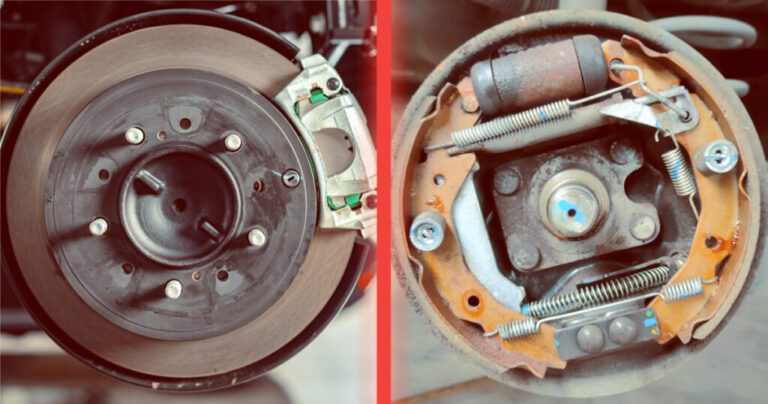
Every time you press the brake pedal, a carefully engineered system converts your vehicle’s momentum into heat through friction. Simple in concept, but the part doing that job has evolved significantly over the decades. Today, most drivers encounter two types of brake systems: disc brakes and drum brakes. Both work. Both stop cars. But they do it differently, and those differences have real consequences for safety, performance, maintenance costs, and how your car handles under pressure.
Understanding how each system works, and why carmakers choose one over the other, helps you make smarter decisions when buying a vehicle, maintaining the one you already own, or diagnosing a problem before it gets expensive.
How Disc Brakes Actually Work
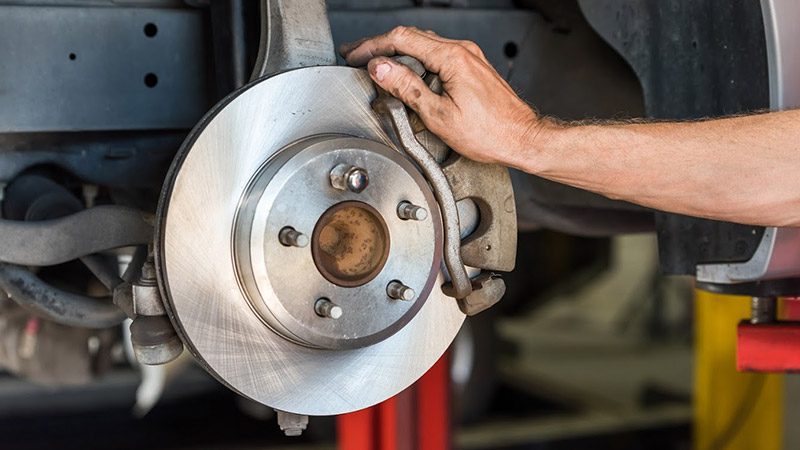
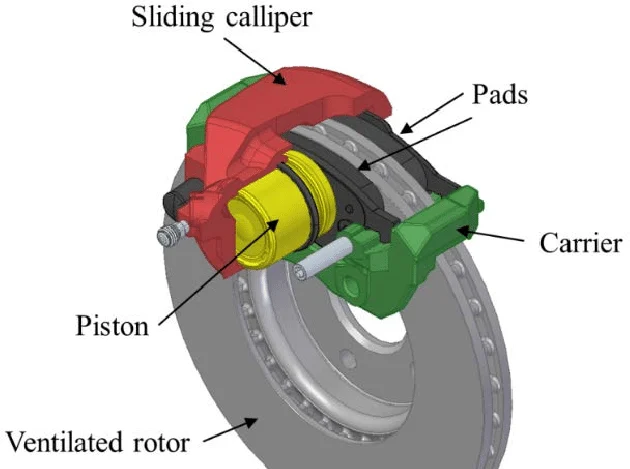
A disc brake system has four core components working together every time you hit the pedal: the rotor, brake pads, pistons, and the brake caliper. When you press the pedal, hydraulic pressure forces the pistons to push the brake pads against the spinning rotor. The friction between the pads and rotor is what slows the wheel down and brings the car to a stop.
Disc brakes have been the standard on most modern vehicles for good reason. Compared to drum brakes, they handle heat better, deliver stronger and more consistent stopping power, and give the driver better pedal feel and control. Very few new vehicles still use drum brakes on all four wheels. Some use them only on the rear, and we will get to why that is in a moment.
The Components of a Disc Brake System
1. The Rotor (Brake Disc)
The rotor is the large, flat disc you can usually see through the spokes of a wheel. It is mounted directly to the wheel hub and spins with it. Most rotors are made from cast iron because it handles heat well and holds up under the constant friction of repeated braking.
Higher-end and performance vehicles often use carbon-ceramic rotors. These are lighter, dissipate heat faster, and last longer, but they are significantly more expensive. Many performance rotors also feature drilled holes or machined slots across the surface. Those design features help push heat, gas, and debris away from the braking surface, keeping the pads in better contact with the rotor and maintaining consistent braking performance even under hard use.
2. Brake Pads
Brake pads are the components that physically press against the rotor to create friction. Each pad has a metal backing plate with a friction material bonded to one side. That friction material is what contacts the rotor surface when you brake.
The material the pad is made from matters more than most people realize. There are three main types:
- Organic pads are quieter and gentler on rotors but wear out faster and do not handle sustained heat as well
- Semi-metallic pads offer better heat resistance and stopping power but tend to be noisier and produce more brake dust
- Ceramic pads are the premium option, running quieter, lasting longer, and producing less dust, but at a higher price point
The pad material you choose affects how long they last, how much noise you hear when braking, and how quickly the car stops. Each step up in quality costs more, but the performance tradeoffs are real.
3. Pistons
Pistons live inside the brake caliper and are responsible for pushing the brake pads onto the rotor when hydraulic pressure is applied. Some brake systems use a single piston on one side of the caliper to push both pads simultaneously. Others use two pistons, one for each side, which tends to produce more even pad contact and wear.
Performance vehicles often run four, six, or even eight pistons per caliper. More pistons mean more even clamping force across the pad surface, which translates to stronger and more consistent braking. The trade-off is increased complexity and higher maintenance costs.
4. Brake Calipers
The caliper is the housing that straddles the rotor and holds the brake pads and pistons in position. There are two types: floating calipers and fixed calipers.
Floating calipers have pistons on only one side and are designed to slide back and forth on guide pins. When the piston pushes the inner pad against the rotor, the caliper slides inward, pulling the outer pad into contact as well. It is a clever, cost-effective design used on most everyday vehicles.
Fixed calipers do not move at all. They have pistons on both sides of the rotor and clamp both pads simultaneously. This design delivers more precise and powerful braking, which is why it is standard on performance and sports cars.
5. Brake Wear Sensors
Many modern vehicles have wear sensors built into the brake pads. When the friction material wears down to a certain thickness, the sensor makes contact with the rotor and triggers a warning light on the dashboard. Other sensors in the system serve the ABS, monitoring wheel speed to prevent lockup during hard braking. These are not just convenience features. They are early warning systems that can prevent you from unknowingly driving on dangerously worn brakes.
The Full Braking Process, Step by Step
Here is what happens from the moment your foot touches the pedal to the moment the car stops:
- Your foot applies pressure to the brake pedal
- A piston inside the master brake cylinder compresses the brake fluid
- That pressurized fluid travels through the brake hoses to each wheel
- The fluid pressure pushes the caliper pistons outward
- The pistons force the brake pads against the spinning rotor
- Friction between the pads and rotor slows the wheel
- When you release the pedal, the pressure drops and the pads retract from the rotor surface
The harder you press the pedal, the higher the hydraulic pressure, and the harder the pads clamp against the rotor. That linear relationship between pedal pressure and braking force is one of the reasons disc brakes feel so predictable and controllable.
How Long Do Disc Brake Components Last?
Disc brakes are durable, but they are not maintenance-free. Heat and friction take a toll on every component over time.
| Component | Typical Service Life | Notes |
|---|---|---|
| Brake pads | 40,000 to 120,000 km | Varies widely based on driving style and pad material |
| Rotors | 90,000 to 110,000 km | Can be damaged earlier if pads are neglected |
| Brake fluid | Check every 38,000 to 57,000 km | Replace immediately if contamination or leakage is suspected |
| Calipers and pistons | Lifetime of the vehicle (typically) | Can fail due to road debris, accidents, or seizure from neglect |
Brake pads are by far the most frequently replaced component in any disc brake system. If pads wear completely through without being replaced, the metal backing plate contacts the rotor directly. That metal-on-metal contact can score or warp the rotor surface quickly, turning what would have been a simple pad replacement into a much more expensive rotor replacement as well.
Warning Signs That Your Disc Brakes Need Attention
Disc brake problems rarely appear without warning. The system gives you clear signals before things get serious. Here is what to watch and listen for:
- Scraping or grinding noise when braking. This is the most common warning sign. When the pad friction material wears down far enough, a small metal wear indicator contacts the rotor and produces a sharp scraping noise. That sound is intentional. It is designed to be annoying enough that you cannot ignore it. Continuing to drive on worn pads risks rotor damage. Occasionally, road debris trapped inside a caliper can produce similar sounds, but worn pads are the more likely cause.
- Pedal vibration or shaking during braking. If the brake pedal pulses or shudders when you apply pressure, the rotor is likely warped. Rotors need to be perfectly flat to function properly. Overheating or excessive braking loads can warp them over time. Warped rotors can sometimes be machined down to restore a flat surface, though at a certain thickness it is safer and more cost-effective to replace them outright.
- A soft or low brake pedal. The pedal should have firm, consistent resistance. If it feels spongy, drops lower than usual before the brakes engage, or goes closer to the floor than normal, that points to air in the brake lines, contaminated brake fluid, or an active fluid leak. None of those issues resolve themselves. They need immediate attention from a mechanic.
Why Some Cars Still Use Disc Brakes on the Front and Drums on the Rear
This combination confuses a lot of people. If disc brakes are better, why not use them on all four wheels? The honest answer is cost and necessity.
In most passenger vehicles, particularly those with smaller or less powerful engines, the front brakes do the overwhelming majority of the braking work. Physics is the reason for that. When you brake, weight transfers forward. The front wheels carry most of the vehicle’s mass during deceleration, so the front brakes are working significantly harder than the rears in almost every stopping scenario.
You can actually see this in action. If you have driven a car with disc brakes on all four wheels that sat unused for a few months, you have probably noticed that the front rotors clear their surface rust after just a short drive through town, while the rear rotors stay rusty for much longer. That happens because the rear brakes are barely being called on during normal city driving.
For a vehicle that is not built for high speeds or aggressive driving, adding rear disc brakes means adding two extra calipers, two rotors, and two more sets of brake pads for a system that is doing very little work. The cost goes up. The maintenance complexity increases. And for that type of vehicle, drum brakes in the rear are genuinely sufficient.
How Drum Brakes Work
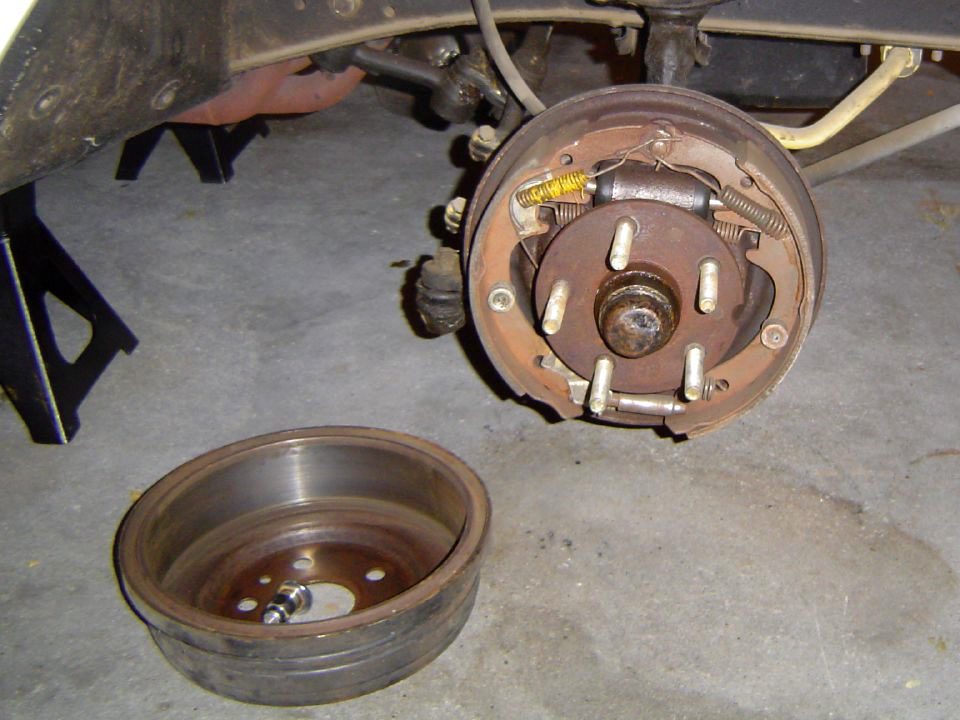
Drum brakes operate on the same basic principle as disc brakes but with a fundamentally different mechanical approach. Instead of clamping brake pads against a flat spinning disc, drum brakes push curved brake shoes outward against the inside of a rotating drum. The friction between the shoes and the drum interior is what slows the wheel.
The drum itself is attached to the wheel hub and spins with the wheel. When the brake pedal is pressed, hydraulic pressure in the wheel cylinder pushes the brake shoes outward and into contact with the drum. Release the pedal and springs pull the shoes back away from the drum surface.
Drum brakes were the dominant braking technology for decades and still appear on the rear axles of many entry-level and budget-focused vehicles today. They are simpler, cheaper to manufacture, and in low-demand applications, they do the job adequately.
Components of a Drum Brake System
- Backing plate. The fixed foundation that holds all the other drum brake components in position. It is bolted to the axle and does not rotate.
- Drum. Cast iron and mounted to the wheel hub, the drum spins with the wheel. It is the surface against which the braking force is applied. You can see it on an assembled drum brake setup as the large round housing over the wheel.
- Wheel cylinder. Contains one piston at each end. When hydraulic pressure is applied, the pistons push outward in opposite directions, forcing the brake shoes against the drum interior. One wheel cylinder is required per wheel.
- Brake shoes. The curved friction components that contact the drum. Each drum brake has two shoes. The primary shoe faces forward and typically generates more braking force. The secondary shoe faces rearward. Both are coated in friction material, either organic or semi-metallic, that wears down gradually with use.
- Automatic adjuster. As the friction material on the brake shoes wears down over time, the gap between the shoe and drum would increase and the pedal would travel further before engaging. The automatic adjuster compensates for this wear by gradually increasing the resting position of the shoes to maintain a consistent pedal feel.
- Return springs. When you release the brake pedal, these springs pull the shoes back away from the drum surface. Without them, the shoes would stay in contact with the drum and create constant friction drag that would wear the components down rapidly.
How Long Do Drum Brake Components Last?
Drum brakes have a reputation for longevity, and that reputation is largely deserved. The enclosed design protects the friction components from road debris, water, and dust. That protection translates directly into longer service life.
Brake shoes typically need replacement around 56,000 km, though that figure varies based on how the vehicle is driven and how often the rear brakes are actually called on. In light-duty applications on the rear axle, some drum brake shoes outlast that estimate by a considerable margin.
The wheel cylinder, springs, and automatic adjuster should generally last the life of the vehicle, barring physical damage from debris or an accident. That said, wheel cylinders can develop internal leaks as they age, which will cause brake fluid loss and a soft pedal. Check brake fluid levels every 38,000 to 57,000 km and immediately if you notice any signs of a leak or pedal feel changes.
The Parking Brake Inside a Disc Brake System
Here is something that surprises a lot of people. Some vehicles that have disc brakes on all four wheels still use a small drum brake mechanism inside the rear wheel hub assembly, but only for the parking brake.
The reason for this is practical. A parking brake needs to hold the vehicle stationary through a mechanical linkage, not a hydraulic one. That way, it works even if the main hydraulic brake system fails or loses pressure.
When you apply the parking brake, a cable pulls a lever that mechanically forces small brake shoes against the inner surface of a drum built into the rear hub. It bypasses the wheel cylinders and hydraulics entirely, giving you a reliable, independent hold on the vehicle. Some modern vehicles have replaced this setup with an electrically actuated parking brake that uses the rear disc brake calipers, but the traditional cable-actuated drum-in-hat design remains common on older and mid-range vehicles.
Warning Signs That Your Drum Brakes Need Attention
Drum brakes give off their own set of warning signs when something is wrong. Do not ignore these:
- Unusual brake noise. Squealing, grinding, or scraping sounds when braking usually indicate that the friction material on the brake shoes is worn down. A technician can inspect the shoes and confirm the cause. Replacing worn shoes early prevents drum damage, which is more expensive to fix.
- Pedal vibration or shaking. Just like with disc brakes, a shuddering pedal when you brake points to a warped or out-of-round drum. Drums need to be perfectly circular to function correctly. Overheating is the most common cause of drum deformation. In most cases, drum replacement is the right fix.
- A low or spongy brake pedal. If the pedal sinks lower than normal before the brakes engage, or if it feels soft and unresponsive, suspect contaminated brake fluid, air in the lines, or a leaking wheel cylinder. A failed or leaking wheel cylinder is a drum-brake-specific culprit that does not appear in disc brake systems, and it needs to be caught early before it causes a brake failure.
Disc Brakes vs Drum Brakes: A Direct Comparison
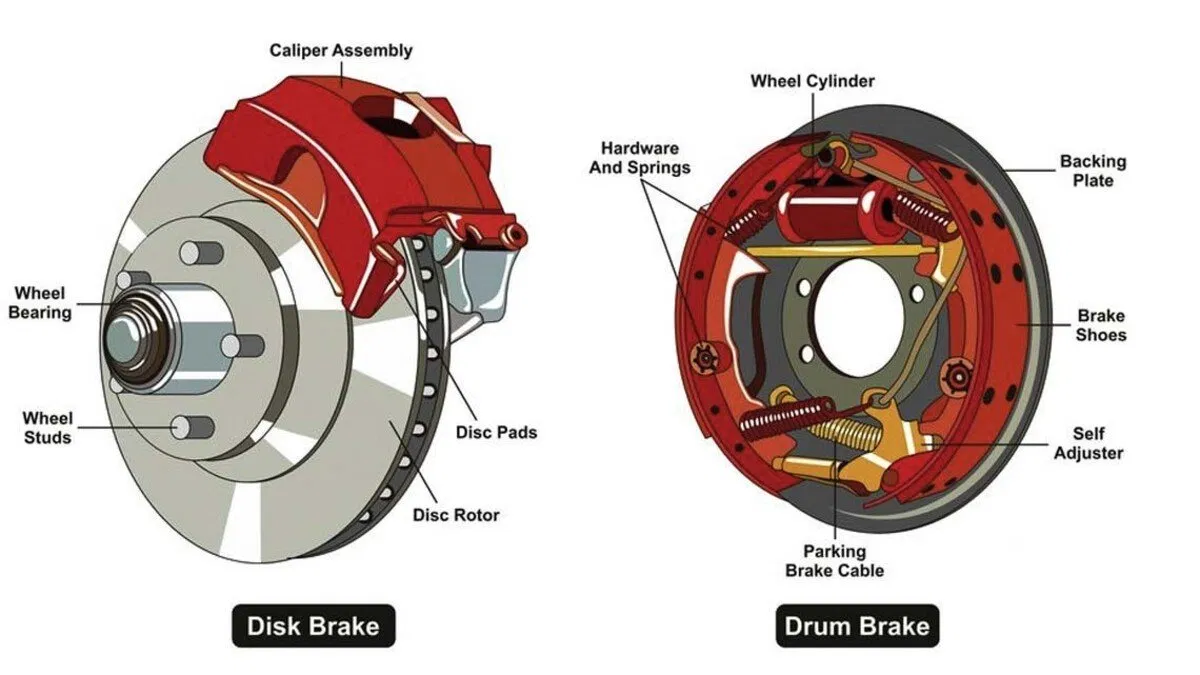
Now that both systems are clear, it is worth putting the key differences side by side.
| Factor | Disc Brakes | Drum Brakes |
|---|---|---|
| Stopping power | Superior, especially under hard braking | Adequate for light-duty and rear applications |
| Heat management | Excellent, open design dissipates heat quickly | Poor, enclosed design traps heat |
| Wet weather performance | Good, water clears from open rotor surface quickly | Can take longer to dry out, slight initial fade possible |
| Fade resistance | High, especially with quality pads and rotors | Prone to brake fade under sustained heavy use |
| Inspection ease | Visible without removing the wheel in many cases | Requires wheel and drum removal to inspect |
| Component durability | Moderate, pads wear faster than drum shoes | High, enclosed system protects components from debris |
| Cost to manufacture | Higher | Lower |
| Maintenance cost | Moderate, pads and rotors need periodic replacement | Lower, shoes last longer and replacement is simpler |
| Parking brake function | Requires separate mechanism (electric or drum-in-hat) | Shoes can double as parking brake mechanism directly |
| Common applications today | Front axle of nearly all vehicles; all four wheels on performance and modern vehicles | Rear axle of budget and entry-level vehicles |
The Real Advantages of Disc Brakes
The biggest advantage disc brakes have over drums is stopping power. The contact surface area of two brake pads clamping against a rotor is significantly larger in effective terms than a shoe pushing against the inside of a drum. More contact, applied with more consistent clamping force, means shorter stopping distances.
Heat management is the second major advantage. Disc brakes are open to the air. As the rotor spins, airflow across its surface constantly pulls heat away from the braking zone. Drum brakes are enclosed, which traps heat inside the drum housing. Under sustained or repeated hard braking, this trapped heat leads to brake fade, a condition where the friction material loses effectiveness as it gets too hot. On a mountain descent or during aggressive driving, this is not just inconvenient. It is genuinely dangerous.
Disc brakes are also easier to inspect without disassembly. In most cases, you can check pad thickness and rotor condition through the wheel spokes without pulling the wheel off. That makes routine checks faster and more likely to actually happen.
The hydraulic control and braking force distribution is also more precise with disc brakes, which is why ABS systems, stability control, and other active safety technologies work better and more consistently with disc brakes on all four corners.
The Real Advantages of Drum Brakes
Drum brakes are not obsolete. They have genuine strengths that explain why they still appear on millions of vehicles.
The enclosed design is their biggest protection asset. Because all the friction components are contained inside the drum, they are shielded from road grit, mud, water, and debris. That protection significantly extends the life of the friction material compared to disc brake pads, which are exposed to everything the road throws at them.
That longevity translates directly into lower maintenance costs over time. Drum brake shoes can last up to 200,000 kilometers in low-demand rear applications. Disc brake pads typically need replacement every 40,000 to 120,000 km depending on pad material and driving style. For vehicle owners trying to minimize running costs, that difference adds up.
Drum brakes are also simpler and cheaper to manufacture, which keeps entry-level vehicle prices lower. And when they do eventually need attention, replacing drum brake shoes is generally faster and less labor-intensive than a full disc brake service involving rotors.
One final practical advantage: the drum brake mechanism naturally lends itself to serving as a parking brake without additional hardware. The same shoes that stop the vehicle can hold it stationary through a simple cable and lever arrangement. Disc brake systems require additional engineering to accomplish the same thing.
Are Rear Disc Brakes Worth the Upgrade?
This depends entirely on how and where you drive.
If you drive a performance vehicle, do track days, tow a trailer regularly, or spend a lot of time at higher speeds on open roads, rear disc brakes are worth having. Fast cars come from the factory with disc brakes on all four wheels for exactly this reason. Under hard braking from higher speeds, the rear brakes are called on more significantly than they would be during city driving, and you want the better heat management and fade resistance that discs provide.
But if your driving life consists mainly of city commuting, stop-and-go traffic, and highway cruising at normal speeds in a vehicle without a lot of power behind it, rear drum brakes are genuinely sufficient. The rear brakes are doing a small fraction of the total braking work in most real-world driving situations. Paying extra for rear disc brakes in a vehicle that will never need them is not a safety investment, it is just a more expensive braking system that will not perform any better in the conditions that vehicle actually sees.
The choice between disc and drum is not about which technology is universally superior. It is about matching the braking system to the demands the vehicle will actually face. A well-maintained drum brake system on the rear of a sensibly driven family sedan is safer than neglected disc brakes on any car. Maintenance and attention matter more than the hardware choice in most day-to-day situations.
Whatever system is on your vehicle, inspect it regularly, replace worn components before they damage the parts around them, and do not wait until the noise becomes impossible to ignore. Your brakes are the one system on your vehicle where delayed maintenance never stays cheap for long.