
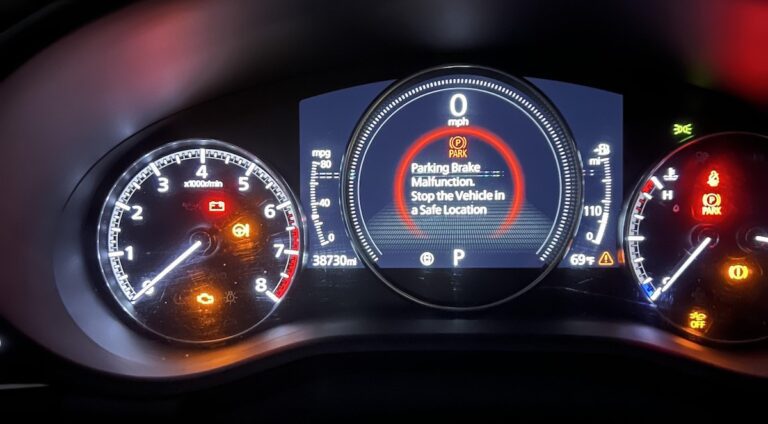
Ever found yourself stuck in a parking lot with a flashing brake light on your Mazda’s dashboard? Nothing ruins your day quite like a parking brake that will not release, or worse, a system that will not engage properly when the car is parked on a hill. Mazda’s electronic parking brake, often called EPB, has a reputation for a few frustrating failure patterns across popular models like the CX-5, CX-9, Mazda3, and Mazda6.
But here is the good news. You do not always have to jump straight to an expensive tow and a dealership visit with no other plan. Many owners can regain control using smarter emergency release steps, the right maintenance mode procedures during brake service, and a better understanding of the trouble codes that show up when the EPB system fails.
This article is built to help you do three things fast. First, understand what Mazda means by Parking Brake Malfunction. Second, recognize the warning lights and physical symptoms that point toward the right kind of repair. Third, use emergency methods when you are truly stuck, plus follow the maintenance mode steps when servicing rear brakes so you do not create a bigger EPB problem.
As an auto mechanic would put it: the EPB system is simple to explain and harder to fix if you treat it like a normal hand-brake cable. The goal is to keep you safe, get you moving, and help you avoid repeat failures.
What Exactly Is a Mazda Parking Brake Malfunction?
Mazda’s electronic parking brake replaces the traditional hand lever with an electronic switch. When you activate it, motors at the rear wheels apply and release the parking brake. When it is working, it feels convenient and seamless. When it fails, you can be dealing with anything from annoying warning messages to a vehicle that feels like it is immobilized or rolling when it should be held.
The system uses electric motors to apply and release the parking brake. Those motors, along with their control modules and switches, can develop problems. When that happens, your Mazda displays the dreaded Parking Brake Malfunction message on the dashboard and often triggers additional warning lights.
One reason this gets stressful is that EPB issues can be both electrical and mechanical. Some failures show up mainly in cold weather. Others are tied to switches, wiring, corrosion, or maintenance problems after rear brake service. This is not always a “one part and done” situation.
That is why the best approach is not guesswork. You want to know what the car is telling you, which trouble codes are stored, and what emergency release method is safest for your situation.
Common Warning Signs of Mazda Parking Brake Problems
Dashboard Warning Lights
Your Mazda typically alerts you to parking brake problems through a few warning indicators. Owners commonly see combinations of the following:
- A red parking brake light that will not stop flashing
- An amber parking brake warning light with an exclamation point
- The words “Parking Brake Malfunction” displayed on your information screen
- A “See dealer” message that appears alongside brake warnings
If you see the parking brake warning light flashing while driving, do not ignore it. A flashing warning indicates a problem that needs attention. The problem might be serious enough to affect how the car holds, how it releases, or how the rear braking system is controlled.
Physical Symptoms
Warning lights are not the only clue. Owners also report physical symptoms that help separate an electrical failure from a mechanical one. Common reports include:
- The parking brake will not engage when you pull up the switch
- The parking brake refuses to release when you press down the switch
- Your vehicle rolls even though the parking brake appears to be engaged
- Strange grinding or clicking noises coming from the rear wheels
- The parking brake switch and dashboard lights flashing simultaneously
Those symptoms generally mean either a mechanical failure in the rear brake system or an electrical issue inside the EPB control path. Sometimes owners notice both at the same time, especially after rear brake service when maintenance mode is not used.
If you are dealing with any rolling risk, treat it like a safety issue. If the car can move when it should be held, you cannot trust it on a hill, in traffic, or in tight parking situations.
Diagnostic Trouble Codes: Speaking Your Mazda’s Language
When your Mazda’s parking brake malfunctions, it stores specific error codes. Those codes help identify what part of the EPB system is acting up. You can retrieve these codes using an OBD-II scanner.
Here are the trouble codes shown in the provided guidance, along with what they usually mean and the typical symptoms associated with them:
| Code | Description | Typical Symptoms |
|---|---|---|
| C1128 | Electric parking brake switch circuit malfunction | Switch unresponsive or intermittent |
| C2005:07 | Mechanical problem of EPB motor gear unit (right) | Right rear brake will not engage/release |
| C2006:07 | Mechanical problem of EPB motor gear unit (left) | Left rear brake will not engage/release |
| C112A:77 | Incorrect EPB motor gear unit position | Parking brake partially engaged |
| U3000 | Missing calibration in control module | System needs reprogramming |
Those codes are valuable because they reduce guessing. Instead of saying “the EPB is broken,” you can say “the right motor gear unit has a mechanical issue” or “the system needs calibration.” That gives you a better repair plan, and it helps you ask the right questions when you talk to a technician.
If you have a scanner that can show more details, write down everything. Codes are helpful, but the conditions when the code was stored can guide diagnosis too.
Why Your Mazda’s Parking Brake Is Acting Up
Mechanical Failures
The physical components inside the parking brake system can wear out or fail. In the guidance, common mechanical problems include:
- Worn brake pads and shoes reduce the effectiveness of the electronic parking brake
- Damaged or frayed parking brake cables prevent proper operation
- Faulty brake calipers with integrated EPB motors fail to respond to commands
- EPB motor gear units with dimensions outside specifications cannot function properly
Here is the mechanic reality. EPB motors are not “free to move.” They depend on the rest of the brake hardware behaving correctly. If the pads are worn too thin, if a cable is stretched, or if the caliper is not releasing properly, the motor can struggle. That struggle can trigger warning messages and stored trouble codes.
Owners often notice the mechanical side through sound and feel. Grinding, clicking, and inconsistent engagement tend to point toward mechanical wear, improper release, or a problem with the motor gear movement itself.
Electrical Problems
A lot of EPB malfunctions come from electrical faults. The guidance lists common electrical causes like:
- A faulty parking brake switch sends incorrect signals to the control module
- Low battery voltage prevents the EPB motors from operating correctly
- Corroded electrical connections disrupt communication between components
- Control module programming errors prevent proper system function
One key point is the battery. The guidance states that CX-5 owners have reported low battery voltage is a surprisingly common cause of parking brake malfunctions. In the real world, low voltage is notorious for causing “ghost” faults in electronics. EPB motors need enough power to move. When voltage drops too far, the system can fail mid-action and then throw a malfunction message.
Corrosion and connection issues can also break communication. A poor electrical connection can interrupt signals even when the hardware itself is in decent shape. That is why two cars can show similar warning messages but require completely different repairs.
Environmental Factors
Your environment plays a bigger role than most owners expect. Here are environmental causes mentioned in the guidance:
- Corrosion and rust buildup on brake components can cause mechanical failures
- Cold weather conditions, particularly temperatures between -4°F to 14°F, have caused EPB failures in some 2016 CX-5 models
- Moisture intrusion into electrical components can short-circuit the system
Also important: Mazda has acknowledged that certain 2016 CX-5 models produced before June 9, 2015 have a known cold weather EPB failure requiring motor gear unit replacement.
That is a huge clue. Cold-weather EPB failures are not random. They are tied to a known issue that shows up under specific temperatures. If you live where it regularly drops below freezing, your EPB system is more likely to show these faults.
Maintenance-Related Issues
Maintenance is where owners can accidentally create EPB problems, especially after rear brake service. The guidance lists maintenance-related issues such as:
- Rear brake service performed without using maintenance mode can damage EPB components
- Liquid spills near cup holders have been known to affect electrical connections in some models
- Failure to calibrate the system after component replacement leads to malfunction warnings
This is a pattern I see a lot. A rear brake job is a common service. If maintenance mode is skipped on an EPB-equipped vehicle, the EPB motor can be moved out of the safe state during service. Then the next time the system tries to work normally, it might fail or trigger calibration codes.
Calibration matters too. The guidance includes the code U3000 for missing calibration in the control module. That is exactly the type of warning you can see when reprogramming or recalibration is not completed after a motor or caliper replacement.
Emergency Release Methods When You’re Stuck
Now we get to the part you actually need when you are stuck. These methods are meant to get the vehicle moving again during an EPB malfunction. Still, treat them like safety procedures, not entertainment. If you are on a slope, chock the wheels when possible and move slowly once the vehicle is free.
Battery Reset Method
When your parking brake refuses to release, try this simple fix. The guidance notes that it has worked for many Mazda owners:
Steps:
- Turn off your vehicle completely
- Pump the brake pedal several times until it becomes firm
- Restart the car and try the parking brake again
This method has successfully resolved issues for many CX-5 owners by resetting the electronic systems. If your battery is weak or the system is confused due to a voltage dip, this can sometimes clear the condition long enough for the EPB to operate again.
If it works, do not celebrate too loudly and forget about it. If the malfunction returns quickly, you need real diagnosis, because the underlying cause might still be present.
Manual Caliper Release
If you are comfortable working around your brakes and the battery reset method does not work, you may be able to manually release the brake by adjusting the caliper piston through the EPB motor housing.
The guidance steps:
- Safely raise and support the vehicle
- Locate the EPB motor on the rear caliper
- Remove the EPB motor mounting bolts (do not disconnect the wiring)
- Use the appropriate socket to turn the caliper piston adjustment bolt 1/2 to 1 full turn
- Perform this procedure on both sides if necessary
This manual override can get you moving again when the electronic system fails.
Two practical cautions. First, support the vehicle correctly with proper jack stands. Second, do not disconnect wiring unless you are sure what you are doing. The guidance specifically says not to disconnect wiring, and there is a reason for that. Disconnecting can create new electrical problems and additional work.
Maintenance Mode Activation
If the issue involves EPB behavior during service, or if you are planning rear brake work and the system needs a safe state, you can force the system into maintenance mode using this sequence:
Maintenance mode steps:
- Turn ignition ON (engine off) by pressing the start button twice without pressing the brake pedal
- Make sure the parking brake is released
- Hold the accelerator pedal fully down
- Press and hold the parking brake switch DOWN
- Press the start button 3 times quickly
- Listen for motor operation and check for the amber warning light
This maintenance mode trick has helped many Mazda owners release stuck parking brakes when other methods fail.
The Importance of Maintenance Mode for Brake Service
If you are planning to service your rear brakes, you must use maintenance mode to prevent damage to the EPB system. The guidance is clear on this. Skipping maintenance mode is one of the easiest ways to end up with EPB motor or calibration issues after a brake job.
Even if you do everything else correctly, the EPB system still expects to be placed into the right state so it does not fight the service procedure. Maintenance mode sets the system in a safe configuration.
Entering Maintenance Mode Correctly
Follow these steps precisely:
- Switch ignition ON (engine off) by pressing the start button twice without pressing the brake pedal
- Release the parking brake by pressing the brake pedal and pushing the EPB switch down
- Release the brake pedal, then fully depress the accelerator pedal
- Press and hold the EPB switch DOWN
- Press the start button 3 times within 5 seconds
- Confirm the amber parking brake warning light is illuminated
This procedure puts the EPB system in a safe state for rear brake service.
Exiting Maintenance Mode
After you finish your brake work:
- Switch ignition ON (engine off)
- Fully depress and hold the accelerator pedal
- Pull UP and hold the EPB switch
- Press the start button 3 times within 5 seconds
- Verify the amber warning light turns off
These steps ensure the system is properly reactivated after service. If you do not exit correctly, you can confuse the system and keep it stuck in a state it should not be in.
Critical Maintenance Notes
The guidance also includes critical notes. These are not optional details. They are the difference between a clean brake service and a repeat EPB failure:
- Never rotate rear brake pistons during compression. Push them straight back like front calipers
- Do not disconnect the battery while in maintenance mode, as it may require dealer recalibration
- Failure to use maintenance mode can damage EPB motors and require complete caliper replacement
Many Mazda owners have learned this the hard way. EPB failures can follow rear brake service when maintenance mode was not used.
Repair Costs and Solutions
Let us talk about the part everyone asks about: cost. EPB repairs can range from a relatively manageable switch replacement to expensive motor or caliper replacements, depending on the failure and whether calibration work is needed.
Component Replacement Costs
If you need professional repairs, here is what you might expect based on the guidance:
| Component | Approximate Cost |
|---|---|
| Parking brake activation switch | $161-$184 |
| EPB motor actuator (each) | $100+ |
| Complete rear brake caliper with EPB | $250-$500 each |
| Control module replacement | $300-$600+ |
The parking brake activation switch is relatively affordable at $161-$184. Actuators and calipers can climb higher, and control module replacement can also add to the total depending on your exact situation.
These numbers are parts-only estimates. Labor and calibration or reprogramming can increase the overall repair bill.
Known Service Issues
Some Mazda parking brake problems are well-documented. Based on the guidance, you will often see these service patterns:
- 2016 CX-5 models produced before June 9, 2015 have a known cold weather EPB failure requiring motor gear unit replacement
- Mazda service departments often report that EPB actuators are “known failure items” that should be replaced during rear brake service
- Some repairs are covered under Mazda warranty, while others (like liquid damage) are considered owner-caused and not covered
This tells you something important. If you are in a model and time range known for EPB cold weather failures, it is more efficient to diagnose toward the motor gear unit issue rather than chasing random causes.
When DIY Isn’t Enough
Temporary fixes like the battery reset method can get you moving. Still, underlying problems typically require professional attention. The guidance highlights why:
- Many EPB malfunctions need dealer-level diagnostic equipment
- Calibration procedures often require proprietary Mazda software
- Component replacement frequently necessitates system reprogramming
If you have tried emergency release methods without success, it is time to seek professional help. Continuing to attempt fixes can sometimes worsen wear on EPB motors or lead to additional brake system complications.
Model-Specific Parking Brake Issues
Mazda CX-5
The CX-5 seems particularly prone to parking brake issues. The guidance points to a technical service bulletin about cold weather EPB failures for the 2016 model year. Many owners report that the battery reset method works well for temporary relief.
When the CX-5 fails in cold temperatures, the fix is often not a generic “re-try the switch.” It can involve motor gear unit replacement, especially for models produced before the noted date. If you want a faster repair path, align diagnosis with the known failure pattern.
Mazda3
Mazda3 owners commonly report the “Parking Brake Malfunction” message along with a flashing red light. The guidance emphasizes that the maintenance mode procedure is particularly important when servicing these vehicles.
In other words, if you are doing rear brakes on a Mazda3 with EPB, you do not treat it like a normal rear brake job. Maintenance mode is the difference between EPB staying reliable or becoming part of the problem after service.
Mazda6
The Mazda6 often experiences switch-related issues. Owners report that the parking brake will not disengage even after multiple attempts. The guidance points to the possibility that the parking brake switch itself is the culprit.
If the switch signals are incorrect, the EPB control module may not receive the correct instruction to release. That is why the trouble codes matter. When you see a code tied to the switch circuit malfunction, it usually narrows the repair path.
Mazda CX-9
CX-9 owners have reported parking brake actuator problems. Some mechanics note these are common failure points that require replacement during regular maintenance.
That matches how EPB systems behave. If the actuator or gear mechanism is worn or out of specification, the system can attempt to apply or release and fail partially. The dashboard warnings then communicate the system cannot perform the action properly.
The Bottom Line on Mazda Parking Brake Malfunctions
Mazda’s electronic parking brake offers convenience when it is working. When it fails, it can be frustrating, stressful, and sometimes downright dangerous if the vehicle can roll when it should not. The best way to reduce stress is to understand the warning signs, use the emergency release steps that get you moving safely, and recognize when it is time to seek professional diagnosis and repair.
Remember this. DIY emergency methods can get you out of a jam. They do not always correct the root cause. For long-term reliability, you want proper diagnosis and repair by qualified technicians using Mazda-specific tools and procedures, especially when calibration and reprogramming are involved.
If you are dealing with this right now, you probably want to know one thing above all else. What should you do today to keep yourself safe and avoid making the EPB system worse? Start with your warning lights and symptoms, grab your trouble codes, and then choose the safest emergency method that matches your situation.
Have you experienced parking brake problems with your Mazda? What solutions worked for you? Share your experience so fellow Mazda owners can navigate this common issue with fewer mistakes and less stress.
Action question: when your Mazda shows the Parking Brake Malfunction, do you see the red light flashing or the amber warning with an exclamation point, and which trouble code did your scanner pull?