
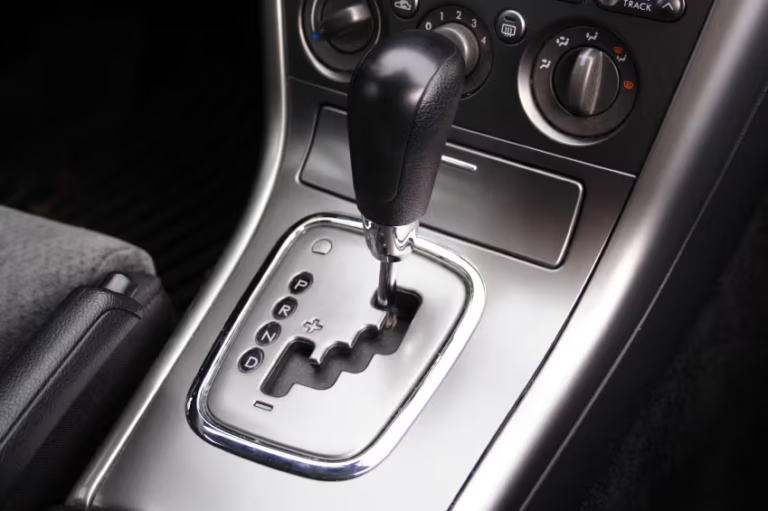
Automatic transmissions are genuinely convenient. No clutch pedal, no manual gear changes, smooth power delivery at every speed. But that convenience comes with a trade-off: when something goes wrong, it tends to go wrong in a big way. And one of the most alarming things an automatic transmission can do is simply refuse to move the car, regardless of which gear you select.
You shift into Drive. Nothing. You try Reverse. Still nothing. You cycle through every position on the shifter and the car just sits there, engine running, going absolutely nowhere. That is a frustrating situation, and understandably a scary one.
The most common reasons an automatic transmission car will not move in any gear include low transmission fluid, a faulty transmission control unit, a bad torque converter, worn clutch discs, valve body problems, and poor-quality transmission fluid.
Some of these causes are simple and cheap to fix. Others require pulling the entire transmission out of the car, which is time-consuming and expensive. Knowing which is which can save you a lot of wasted time and money at the repair shop.
In most cases, the transmission will shift into emergency or “limp” mode, and you will see warning lights or error codes on the dashboard. Scanning those codes with an OBD2 scanner is a good starting point before anything else. It will at least point you in the right direction.
Why Your Automatic Car Will Not Move in Any Gear
1. Low Transmission Fluid: The First Thing to Check
This is the most straightforward cause on the list, and thankfully, it is also the easiest to check and fix. Automatic transmissions depend entirely on hydraulic pressure to function. The transmission fluid is what creates that pressure, lubricates the internal components, and allows power to transfer from the engine to the wheels.
When the fluid level drops too low, that hydraulic pressure disappears. And without pressure, the transmission simply cannot engage any gear. The car will sit there with the engine running and go nowhere, which is exactly the symptom we are talking about.
Low fluid is usually caused by one of two things: a leak somewhere in the system, or fluid that has been neglected and never topped up. Before you do anything else, locate the transmission fluid dipstick (on vehicles that have one), check the level, and inspect the color. Fresh transmission fluid is typically pink or red and relatively transparent. If it looks dark brown or smells burnt, low fluid is not your only problem. The fluid itself may be degraded and overdue for a change.
Adding the correct type of transmission fluid and bringing the level back to spec sometimes fixes the no-movement issue immediately. If it does, great. But also look for signs of a leak underneath the car, because the fluid went somewhere, and if there is an active leak, it will happen again.
2. A Faulty Transmission Control Unit
The transmission control unit, often referred to as the TCU or TCM, is the electronic brain of your automatic transmission. It receives data from various sensors throughout the drivetrain and uses that information to decide when to shift gears, how much pressure to apply, and how to manage the overall behavior of the transmission.
When the TCU fails or starts sending incorrect signals, the transmission can become completely unresponsive. In some cases, it will refuse to engage any gear at all. You might also notice that the gear indicator on your dashboard shows a different gear than what you actually selected. For example, you shift to Drive and the display still shows Park or Neutral.
Before assuming the TCU itself is dead, check the car battery. A weak or failing battery can cause all kinds of strange electronic behavior, including erratic transmission control unit operation. Use a multimeter to check battery voltage. It should read around 12.6 volts when the engine is off. Anything significantly below 12 volts suggests the battery is not in good shape, and that could be contributing to the problem.
If the battery checks out and the fault codes point to the TCU, the repair gets more involved. Replacing or reprogramming a transmission control unit requires someone with solid electronics knowledge and the right diagnostic equipment. Labor costs are not cheap, and it is worth knowing upfront that even after a successful repair, the problem can sometimes return. A TCU that has failed once is not always fully reliable afterward.
A failing transmission control unit can also cause these specific symptoms:
- Putting the car in Drive but the transmission refuses to shift through the gears even as RPM climbs higher and higher
- Driving normally in third gear, pressing the accelerator, and instead of upshifting, the transmission unexpectedly drops all the way back down to first gear
- Erratic or unpredictable gear changes that feel nothing like normal operation
3. Valve Body Problems Inside the Transmission
The valve body is one of the most complex components inside an automatic transmission. Think of it as a hydraulic control center, a maze of channels, valves, and passages that direct transmission fluid to exactly the right places at exactly the right times. When everything is working correctly, gear shifts are smooth and precise. When the valve body starts failing, things get messy fast.
The hydraulic channels inside the valve body can become clogged with sludge and debris from degraded transmission fluid. The internal valves themselves wear over time. Either way, when the valve body cannot direct fluid properly, the transmission loses the ability to engage gears, which is why the car stops moving.
Beyond the no-movement symptom, a failing valve body often causes noticeable vibration or shuddering when the car changes gears. You might also experience the engine stalling during gear changes, especially at low speeds. These are not subtle symptoms. Once the valve body starts going, you tend to feel it.
Repairing the valve body is not a roadside fix. The transmission has to come out of the car, and the valve body has to be carefully disassembled, cleaned, inspected, and either rebuilt or replaced. Of all the causes on this list, valve body repair is among the most labor-intensive and costly. Regular fluid changes with the right quality fluid go a long way toward preventing this problem in the first place.
4. A Bad Torque Converter
In an automatic transmission, the torque converter does the job that the clutch does in a manual car. It sits between the engine and the transmission and transfers engine power to the transmission using hydraulic fluid. It also allows the engine to keep running when the car is stopped in gear, something a manual clutch handles differently.
When the torque converter fails, power simply does not make it from the engine to the transmission efficiently. The result is a car that cranks, idles, and runs fine but refuses to move. The engine is doing its job. The transmission just is not receiving what it needs to engage.
Torque converter failure is almost always the result of neglected maintenance. Using the wrong type of transmission fluid, going too long between fluid changes, ignoring a dirty transmission filter, or brushing off early warning signs like jerking and unusual noises all accelerate torque converter wear. It does not fail overnight. It usually deteriorates gradually over time, and by the time the car stops moving, the damage has been building for a while.
Some telltale signs that the torque converter is the problem:
- Strange grinding or rattling noises when you first start the car that gradually fade after a few minutes of running
- The engine stalls or shudders when you shift from one gear to another
- A significant delay between shifting into gear and the car actually moving
Fixing the torque converter means removing the transmission, which puts this repair in the expensive category. There is no shortcut around it.
5. Worn or Burned Clutch Discs
Wait, clutches? In an automatic transmission? Yes. Automatic transmissions do have clutches, they are just internal and operate automatically rather than through a pedal. These clutch packs engage and disengage specific gear sets inside the transmission to produce the right gear ratio for the driving condition.
When these internal clutch discs wear out or get burned from overheating, they lose their ability to engage properly. The result is a transmission that cannot hold a gear or transfer power effectively. In severe cases, none of the gears engage at all.
Beyond the complete loss of movement, worn clutch discs typically produce these additional symptoms:
- A distinct thudding or banging feeling when shifting between gears
- The car cannot move in Reverse even if forward gears seem to work partially
- The transmission refuses to shift into third gear or higher
Do not put off this repair once the symptoms start appearing. Worn clutch discs that are left in service accelerate wear on everything else around them inside the transmission. What starts as a clutch problem quickly becomes a much larger, more expensive transmission rebuild.
When replacing clutch discs, a good mechanic will replace the entire set, even the ones that look okay. Heat and stress inside the transmission affect all the clutch discs together, and replacing just the obviously damaged one while leaving worn companions behind is a short-term solution that leads to a repeat repair.
A Quick Reference: Causes, Symptoms, and Repair Complexity
| Cause | Key Symptoms | Repair Difficulty | Approximate Cost |
|---|---|---|---|
| Low transmission fluid | No movement in any gear, slipping | Easy | Low (fluid cost only) |
| Faulty transmission control unit | Wrong gear displayed, no engagement, erratic shifts | Moderate to High | Medium to High |
| Valve body problems | No gear engagement, vibration, stalling during shifts | Very High | High |
| Bad torque converter | Noise at startup, stalling during shifts, delayed movement | High | High |
| Worn clutch discs | Banging when shifting, no reverse, no third gear | High | High |
What You Should Do First When Your Car Stops Moving
Before you call a tow truck or start panicking about transmission replacement costs, run through these steps in order. They cost nothing and could save you a lot of unnecessary expense.
- Check the transmission fluid level. Do this before anything else. If the level is low, add the correct fluid specified in your owner’s manual and see if the car moves. If it does, you have a leak to track down. If it does not, move to the next step.
- Scan for fault codes. Use an OBD2 scanner to pull any stored diagnostic codes. Transmission-related codes like P0700 (transmission control system malfunction), P0715, or P0730 can point you toward specific failed components without any guesswork.
- Check the car battery. A battery that is underperforming can cause the transmission control unit to behave erratically. Test battery voltage with a multimeter. It should sit around 12.6 volts at rest. Below 12 volts is a red flag.
- Note any other symptoms. Were there any unusual noises before the problem started? Any recent changes in shift quality? Any warning lights? The more information you can give a mechanic, the faster they can diagnose the real problem.
- Do not keep trying to drive it. If the transmission is not engaging, forcing it by repeatedly shifting through gears and revving the engine can cause additional damage to components that might otherwise be salvageable.
How to Protect Your Automatic Transmission and Avoid This Problem
Automatic transmissions are durable when they are properly maintained. Most of the failures described in this article are preventable. Here is what actually makes a difference in the long run.
- Warm up the car properly in cold weather. When temperatures drop, transmission fluid thickens and does not flow as freely. Give the car a few minutes to warm up before driving aggressively. While the transmission is still cold, keep RPMs low and avoid hard acceleration. Pushing a cold transmission hard is one of the fastest ways to accelerate internal wear.
- Cycle through all gear positions before driving. Before pulling away, slowly move the shifter through each position, Park, Reverse, Neutral, Drive, and any lower gear positions, pausing for about five to ten seconds in each. This allows transmission fluid to reach every hydraulic channel in the system before you put it under load.
- Check fluid level and condition regularly. Get into the habit of checking transmission fluid every few months. Look at the level and the color. Dark, burnt-smelling fluid that has metal shavings or black specks floating in it needs to be changed immediately. Waiting longer only makes the problem worse.
- Avoid towing beyond the vehicle’s rated capacity. Automatic transmissions are engineered to handle a specific weight range. Regularly towing heavy loads beyond that rating puts enormous stress on the torque converter, clutch packs, and valve body. If you do tow occasionally, keep distances short and monitor transmission temperature if your vehicle has a gauge.
- Skip the aggressive driving habits. Hard launches, drifting, and aggressive gear hunting on slippery roads put the transmission under extreme stress in very short bursts. Over time, that stress adds up. Smooth, deliberate driving extends transmission life significantly.
- Change the transmission fluid on schedule. This is the single most impactful thing you can do. Even if your manufacturer claims the fluid is a “lifetime fill,” real-world driving conditions tell a different story. A practical rule of thumb used by many experienced mechanics is to change the transmission fluid every 60,000 to 100,000 kilometers, or roughly every 37,000 to 62,000 miles, depending on how hard the vehicle is driven.
- Use the correct fluid specification. Not all transmission fluids are interchangeable. Using the wrong fluid type can damage seals, cause foaming, reduce lubrication quality, and ultimately shorten the life of internal components. Always check the owner’s manual or the manufacturer’s specification for the correct fluid type before topping up or changing.
What to Expect at the Repair Shop
If the problem turns out to be something more serious than low fluid or a weak battery, you are going to need a professional. Here is what the repair process generally looks like depending on the cause.
For a transmission control unit replacement, the technician will need to source the correct replacement unit for your specific vehicle, install it, and then reprogram it to match your car’s configuration. This is not a generic part swap. The programming step is critical. Expect to pay for parts, labor, and programming separately in many cases.
For valve body repair or replacement, the transmission has to be dropped from the vehicle. The valve body is then removed, inspected, cleaned, and either rebuilt with new valves and seals or replaced entirely with a remanufactured unit. This is a full day of shop time at minimum, often more.
For a torque converter replacement, the transmission also has to come out. The torque converter sits at the front of the transmission and bolts to the engine’s flexplate. Once the transmission is out, the old converter is unbolted, the new one installed, and the whole assembly goes back in. A fluid and filter change is typically done at the same time.
For clutch disc replacement, this is essentially a full transmission rebuild or at minimum a partial rebuild. The transmission comes out, is disassembled down to the clutch packs, and all the friction discs, steel plates, and seals are replaced. A quality shop will also inspect and replace any other worn components they find during the process.
Transmission repairs are not cheap, and that is just the reality. But they are significantly less expensive than a full transmission replacement, which is why early diagnosis and not ignoring symptoms matters so much.
Is It Worth Repairing or Should You Replace the Transmission?
This is the question every car owner dreads, and the honest answer depends on several factors.
If the car is relatively new, has reasonable mileage, and is otherwise in good condition, repairing the transmission almost always makes financial sense. A rebuilt or repaired transmission at $1,500 to $3,000 is still far less than a car payment on a replacement vehicle.
If the car is old, has high mileage, and the repair estimate approaches or exceeds the vehicle’s market value, the math changes. In that case, a used transmission from a salvage yard, a remanufactured unit, or replacing the vehicle entirely might make more sense depending on the rest of the car’s condition.
Get a second opinion if you are unsure. Transmission shops specialize in exactly this type of repair and can often give you a more accurate assessment and a better price than a general mechanic who outsources transmission work anyway.
Common Questions About Automatic Transmissions That Will Not Move
Can a transmission suddenly fail without warning?
It can feel sudden, but in most cases, there were signs beforehand that either went unnoticed or were ignored. Delayed gear engagement, subtle shuddering, unusual noises, and small changes in shift quality are all early warning signs. Paying attention to how your car normally feels and drives makes it much easier to catch problems before they become complete failures.
Why does the car move in one gear but not others?
If the car moves in one gear, say Reverse, but not Drive, or vice versa, that often points to a specific clutch pack failure rather than a complete transmission failure. Different gear ratios use different internal clutch packs, and if one pack is worn while others are okay, you end up with selective gear loss. This still requires transmission work, but it helps narrow down the diagnosis.
Can dirty transmission fluid cause the car to stop moving?
Yes, it can contribute significantly. Severely degraded fluid loses its viscosity and lubricating properties. It can also cause sludge and debris to clog the valve body channels, starve the torque converter, and accelerate clutch wear. In extreme cases, contaminated fluid alone can prevent the transmission from generating enough hydraulic pressure to engage any gear.
Will adding transmission fluid fix the problem every time?
Only if low fluid was the actual cause. If the fluid level is correct but the transmission is still not moving, adding more fluid will not help. The underlying mechanical or electronic problem still needs to be diagnosed and repaired. Do not let anyone convince you that simply adding an additive or more fluid will fix a mechanical transmission failure.
How long does an automatic transmission last if properly maintained?
A well-maintained automatic transmission in a vehicle that is not regularly abused can last 200,000 miles or more. The key word is maintained. Neglected transmissions, those that run on old fluid, dirty filters, or the wrong fluid type, often fail well before 100,000 miles. The difference in longevity between a maintained and neglected transmission is dramatic.
If your automatic transmission has stopped cooperating entirely, start with the simple stuff: check the fluid, scan for codes, and check the battery. You might solve the problem in 20 minutes. If those basics check out and the car still will not move, get it to a qualified transmission specialist rather than letting it sit. The longer a damaged transmission sits unaddressed, especially if it has been run while failing, the more internal damage tends to accumulate.