
The fuel consumption figure in your car’s brochure and the number your dashboard computer shows you are both useful, but neither one tells you what your car is actually burning in the real world. Your real consumption depends on how you drive, where you drive, what the traffic is like, whether the air conditioning is running, and a dozen other variables that no laboratory test or onboard computer can fully account for.
Knowing your actual fuel consumption is not just satisfying from a curiosity standpoint. It helps you budget accurately for fuel each month, gives you a baseline to compare against after a service or repair, and can alert you to developing mechanical problems before they become expensive ones.
Here is everything you need to understand about how fuel consumption is calculated, what your dashboard is actually showing you, and how to measure your real consumption yourself with nothing more than a pen, a piece of paper, and two visits to a petrol station.
Why the Official Fuel Consumption Figure Is Almost Never What You Get
When a car manufacturer publishes a fuel consumption figure, it is measured under controlled laboratory conditions using a standardized test cycle. The test is designed to be repeatable and comparable across different vehicles, not to replicate the conditions of your actual daily commute.
In the real world, your consumption is shaped by factors that laboratory tests do not fully capture:
- Traffic congestion and the amount of stop-start driving you do
- Your driving style, how aggressively you accelerate and how late you brake
- Road type and terrain, motorway cruising uses fuel very differently from hilly country roads
- Air conditioning use, which adds meaningful load to the engine
- Vehicle load, more passengers and luggage means more fuel burned
- Tyre pressure, under-inflated tyres increase rolling resistance
- Ambient temperature, cold engines and cold air affect combustion efficiency
- Technical issues the car may have, even minor ones affect consumption
None of these variables exist in a standardized test environment. This is why most drivers find that their actual consumption is noticeably higher than the published figure, particularly in predominantly urban driving. It is not the car lying to you. It is the gap between a controlled test and actual life.
Understanding What Your Dashboard Computer Is Actually Showing You
Most modern cars display two fuel consumption readings on the dashboard: instant consumption and average consumption. Understanding what each one actually measures helps you interpret the numbers correctly.
Instant Fuel Consumption
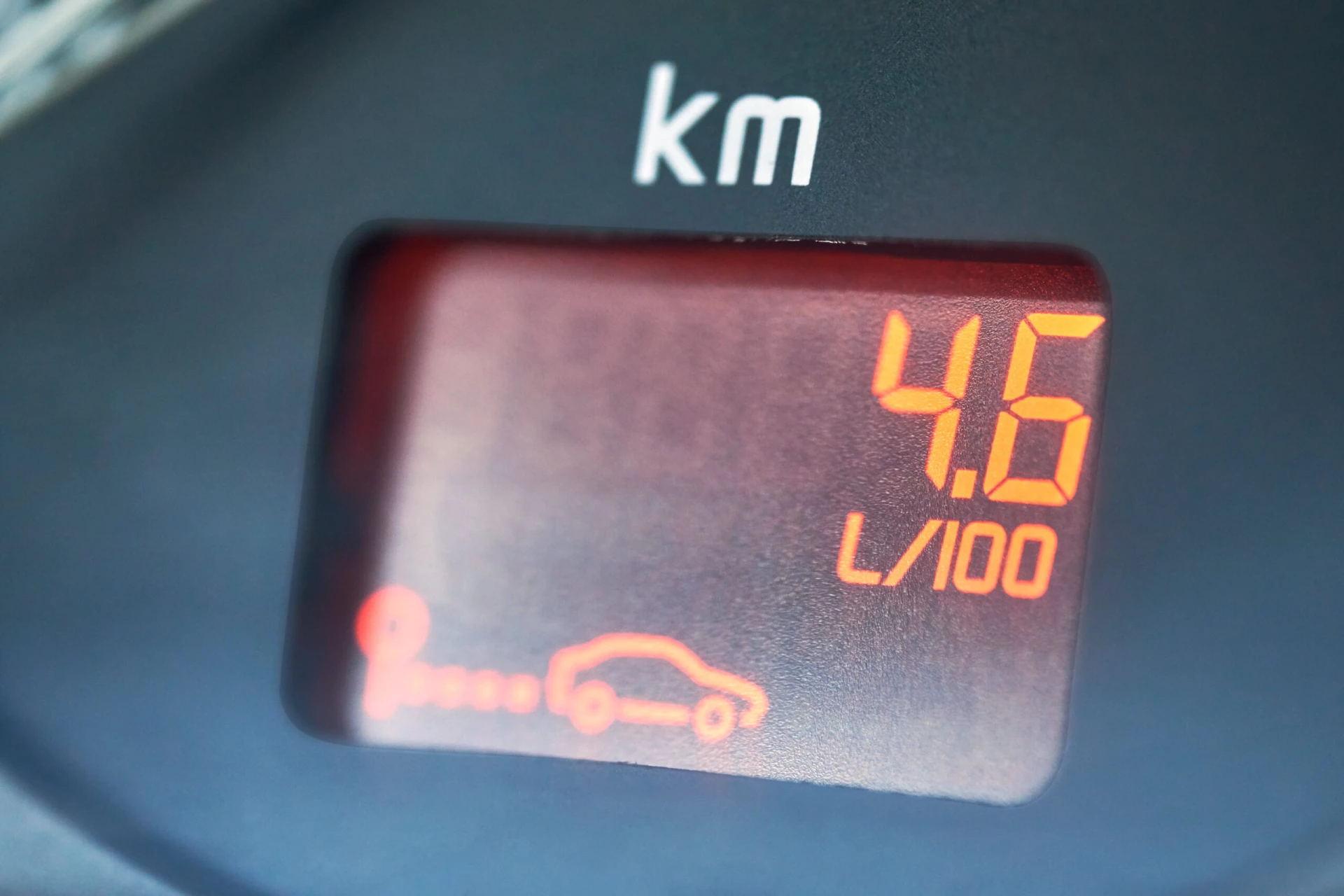
This is the live, moment-to-moment reading. It shows you how much fuel the engine is burning right now, updated continuously as you drive.
The computer calculates this by reading data from multiple sensors simultaneously: engine speed (RPM), fuel injector flow rate, intake manifold pressure, and throttle position. Combining these values gives the ECU a real-time picture of how hard the engine is working and how much fuel it is consuming to do that work.
In Europe, this is displayed in litres per 100 kilometres (L/100km). In the UK and USA, you will typically see miles per gallon (mpg), though the UK gallon (4.546 litres) and the US gallon (3.785 litres) differ in size, so the numbers are not directly comparable between the two regions.
The instant reading is most useful as feedback on your driving style. When you see consumption spike on hard acceleration and drop on a steady motorway cruise, you are seeing directly how your inputs translate into fuel burn. Used this way, it is a practical tool for developing more efficient driving habits.
Average Fuel Consumption
The average consumption figure is updated less frequently, either after a set distance or after a set time interval, and it represents the mean consumption over whatever driving you have done since the last reset. This is the number most drivers glance at to get a general sense of how efficiently they have been driving.
It is useful, but it is not the whole story.
What the Dashboard Computer Gets Wrong
Here is the important caveat. The consumption figures on your dashboard are calculated estimates, not direct measurements. The computer is very good at what it does, but it works with the sensor data available to it and cannot account for everything.
There are situations where fuel is effectively being consumed but the computer does not factor it in cleanly. Air conditioning is the classic example. Switching on the AC adds significant load to the engine, increasing fuel consumption, but the ECU calculates consumption based on injector data rather than directly measuring the additional load the AC compressor creates.
High-speed motorway driving creates aerodynamic drag that requires more engine effort to overcome, but this increased effort is not always reflected with full accuracy in the dashboard figure. Very slow urban driving with frequent idle periods can also cause the displayed figure to diverge from reality.
The result is that the average consumption shown on the dashboard is almost always slightly lower than your real consumption. In practice, when drivers calculate their actual consumption manually using the tank-to-tank method described below, they typically find the real figure is around 0.2 litres per 100km higher than what the dashboard showed. Over a full tank, that translates to roughly one to two litres of unaccounted fuel, or about half a US gallon.
There is another wrinkle. If any of the sensors feeding data to the ECU are faulty, giving inaccurate readings, the displayed consumption figure can be significantly wrong in either direction. A faulty air temperature sensor, manifold pressure sensor, or fuel flow sensor can all distort what you see on the dashboard. This is another reason why knowing how to calculate your real consumption independently is genuinely useful.
How to Calculate Your Real Fuel Consumption: Step by Step
The tank-to-tank method is the most accurate way to measure your car’s real-world fuel consumption. It requires no special equipment, just two visits to a petrol station, a record of the distance driven, and a straightforward calculation.
For the result to be meaningful, you need to cover a substantial distance between the two fill-ups. A few kilometres of city driving will not give you a reliable number. Several hundred kilometres of mixed or representative driving will.
- Check your tank capacity. This step is not strictly necessary for the calculation, but it helps you understand the scale of what you are measuring. Most passenger cars have tanks between 30 and 60 litres (roughly 8 to 15 US gallons). This information is in your owner’s manual.
- Fill the tank completely. Choose a petrol station and fill the tank until the automatic pump nozzle clicks off. The pump mechanism detects when the tank is full and stops automatically. Once done, start the car and confirm the fuel gauge reads at its maximum level.
- Record the fuel volume and current odometer reading. Write down exactly how many litres (or gallons) you have just added. This figure is printed on the pump display and on your receipt. Also write down the current odometer reading from the dashboard. Both numbers need to be as precise as possible.
- Reset your trip odometer to zero. Most cars have a separate trip distance counter that can be reset independently of the main odometer. On most vehicles, you hold a button on the instrument cluster for two to three seconds to reset it. If you are unsure how to do this, check your owner’s manual. This step is important because you need an accurate count of the distance driven between the two fill-ups.
- Drive normally. Continue driving as you normally would. Do not change your driving style for this test, since the whole point is to measure your actual typical consumption. Drive until the fuel level drops to near the minimum warning level, then make your way to a petrol station.
- Fill the tank again and record the figures. At the second petrol station, fill the tank completely using the same process as before. Write down the number of litres (or gallons) added and the distance shown on your trip odometer since the reset.
- Calculate your real consumption. Now apply the formula.
The Calculation: How to Work Out Your Consumption
Litres per 100 Kilometres (L/100km)
This is the standard European measurement. The formula is:
Consumption (L/100km) = (Litres added at second fill x 100) / Kilometres driven
Example: You added 35 litres at the second petrol station and drove 500 kilometres between fill-ups.
(35 x 100) / 500 = 7.0 L/100km
Miles Per Gallon (mpg)
If you want to express your consumption in miles per gallon, you first need to convert litres to gallons.
- To convert litres to US gallons: divide by 3.785
- To convert litres to UK gallons: divide by 4.546
Using the same example of 35 litres and 500 kilometres (which equals approximately 310 miles):
- 35 litres = 9.24 US gallons (35 / 3.785)
- 35 litres = 7.70 UK gallons (35 / 4.546)
310 miles / 9.24 US gallons = 33.5 mpg (US)
310 miles / 7.70 UK gallons = 40.3 mpg (UK)
You can also convert directly from L/100km to mpg using this shortcut formula:
mpg (US) = 235.215 / L/100km
So for 7.0 L/100km: 235.215 / 7.0 = 33.6 mpg (US)
Quick Reference: Consumption Conversion Table
| L/100km | mpg (US) | mpg (UK) |
|---|---|---|
| 4.0 | 58.8 | 70.6 |
| 5.0 | 47.0 | 56.5 |
| 6.0 | 39.2 | 47.1 |
| 7.0 | 33.6 | 40.4 |
| 8.0 | 29.4 | 35.3 |
| 9.0 | 26.1 | 31.4 |
| 10.0 | 23.5 | 28.2 |
| 12.0 | 19.6 | 23.5 |
| 15.0 | 15.7 | 18.8 |
City Driving vs. Motorway Driving: Why the Number Changes
One calculation is not the whole picture. Your car does not burn fuel at the same rate in every situation, and it is worth understanding why the difference between city and motorway consumption can be so significant.
In city driving, the engine spends a lot of time at idle and low speed, the car accelerates and brakes frequently, and the engine rarely reaches its optimal operating temperature and efficiency. Every cold start, every long idle at traffic lights, and every hard acceleration followed by braking represents fuel burned without useful distance covered. City consumption figures are almost always the worst your car will achieve.
On a motorway or open road, the engine reaches operating temperature quickly and maintains it. The car cruises at a steady speed with relatively little throttle variation. The engine operates in its most efficient RPM range for an extended period. Aerodynamic drag increases at very high speeds, which is why consumption rises again above around 110 to 130 km/h, but moderate motorway speeds produce the best consumption figures most cars will ever achieve.
If you want to measure your city consumption separately from your motorway consumption, simply repeat the tank-to-tank calculation for each type of driving independently. The results will help you understand how your overall consumption is influenced by the mix of driving you typically do.
What Your Real Consumption Can Tell You About Your Car’s Health
Tracking your fuel consumption over time is one of the most practical and underused ways to monitor your car’s mechanical condition. The numbers tell a story if you know how to read them.
A gradual increase in consumption over several months, with no significant change in your driving patterns, can indicate:
- Tyres losing pressure over time and not being checked regularly
- A dirty or clogged air filter restricting airflow to the engine
- Spark plugs reaching the end of their service life and not igniting fuel as efficiently
- An oxygen sensor beginning to give inaccurate readings, causing the ECU to inject more fuel than necessary
- An EGR valve or fuel injector issue affecting combustion quality
- Brake callipers that are partially seized, adding drag that the engine must overcome
A sudden, noticeable jump in consumption rather than a gradual increase is a stronger signal that something specific has changed or failed and warrants a diagnostic check sooner rather than later.
Many drivers have discovered a developing problem early simply by noticing that their car was covering fewer kilometres per tank than it used to. Catching these things early is almost always cheaper than waiting until the symptom becomes a breakdown.
Practical Tips for Reducing Your Real Fuel Consumption
Once you know what your car is actually burning, you have a baseline to work with. Here are the habits and maintenance steps that have a measurable impact on real-world consumption.
- Keep tyre pressure at the correct level. Under-inflated tyres increase rolling resistance significantly. Check pressure monthly and before long trips. The correct pressures are in your owner’s manual and often on a sticker inside the driver’s door.
- Accelerate smoothly and progressively. Hard acceleration is one of the largest contributors to high consumption. Anticipate traffic flow and accelerate gently to reach your cruising speed.
- Use engine braking. When approaching a stop or slowing for a bend, lift off the throttle early and let the engine braking slow the car. Most modern fuel-injected engines cut fuel delivery entirely when you are decelerating in gear with your foot off the throttle. This means coasting in gear actually uses less fuel than coasting in neutral.
- Avoid unnecessary idling. An idling engine burns fuel and produces zero useful distance. If you are stationary for more than a minute or two, switching off the engine saves fuel. Many modern cars do this automatically with stop-start systems.
- Use air conditioning judiciously. At lower speeds in town, opening windows is more efficient. At higher speeds, wind resistance from open windows can exceed the AC penalty, making air conditioning the better choice. The difference is meaningful but not enormous.
- Keep up with scheduled servicing. Fresh oil, a clean air filter, and healthy spark plugs all contribute to efficient combustion. Skipping service intervals has a direct cost in increased fuel consumption, not just long-term mechanical wear.
- Remove unnecessary weight. Every extra kilogram in the car requires slightly more fuel to accelerate. Roof racks and roof boxes add aerodynamic drag even when empty. Remove them when not in use.
Knowing your real consumption gives you a number to measure these changes against. Calculate your baseline, make a change, and calculate again after a few tanks. The difference will tell you whether the change made a measurable difference in your specific car and driving conditions. That kind of practical, data-driven approach to fuel management puts you in control of one of the largest ongoing costs of owning a vehicle.