
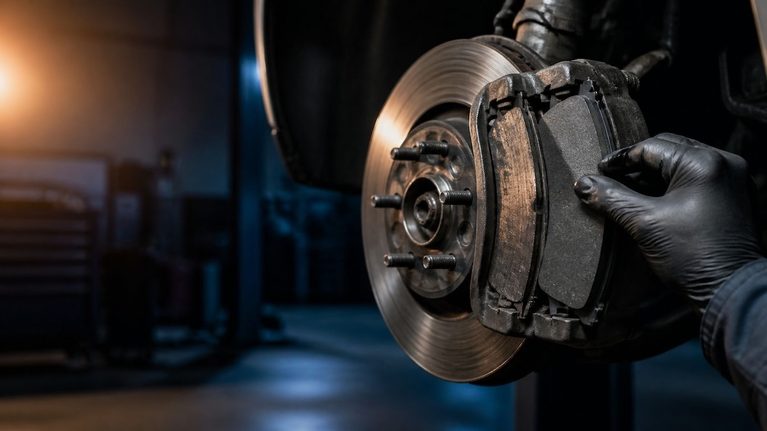
If you’ve had new brake pads installed and they’re worn out again three months later, don’t treat that as routine maintenance. Heavy mileage or constant stop-and-go driving can use pads quickly, but a brake that’s dragging or fitted incorrectly can do the same thing. The difference matters: changing the pads without finding the cause can leave you right back at the shop.
Brake pads sit inside the caliper assembly and press against the rotor when you brake. That friction slows the wheels, and the friction material wears down as part of the process. Some wear is normal. An unusually short life deserves a closer look.
Three months on its own doesn’t tell us much. One driver might cover a great deal of mileage in that time, while another barely uses the car. Start with the miles driven, the routes you take, and whether the pads wore evenly across the car.
Does a three-month pad life mean something is broken?
Not always, but it’s short enough to investigate. A car used for delivery work, steep mountain routes, or daily stop-and-go traffic puts its brakes to work much harder than a car used mainly for steady highway travel. If your driving hasn’t changed much and the pads disappeared quickly, ask the shop to check for a mechanical fault as well as normal wear.
A broad rule-of-thumb range often quoted for brake-pad life is 25,000 to 65,000 miles. About 40,000 miles is a rough midpoint, not a universal replacement interval or a guarantee that your pads will last that long. Your vehicle’s design, pad material, driving conditions, and inspection results matter more than a single mileage figure.
Check the repair invoice for the date, odometer reading, parts used, and which axle was serviced. If the car has covered a lot of hard miles since the repair, the wear may have a straightforward explanation. If it hasn’t, or the new set is wearing much faster on one wheel, have the brakes inspected before fitting another set.
Why brake pads wear down in the first place
Brakes slow a car by turning movement into heat. When you press the brake pedal, hydraulic pressure moves the caliper, which squeezes the pads against the rotor. The friction material gradually wears away with use, just as it’s designed to.
Rapid wear can come from heavy braking, unsuitable parts, or a brake that doesn’t release properly. A dragging brake keeps making contact with the rotor when your foot is off the pedal, so the pad wears and the wheel heats up. In that case, changing the pads alone treats the damage but leaves the cause in place.
What makes brake pads wear out unusually fast?
Frequent hard braking uses more pad material
Driving quickly and braking hard puts more work on the brakes than slowing down gradually. A high-speed stop produces more heat than a gentle stop from a lower speed, and repeated hard stops can shorten pad life. On the other hand, steady highway driving may involve less braking than a slower trip through heavy city traffic.
Leaving extra space and looking farther ahead lets you ease off the accelerator sooner instead of rushing from one stop to the next. You can’t avoid every sudden stop, of course, but repeated late braking adds up over a commute. If your route involves congestion, that may help explain why your pads wear faster than a mileage estimate suggests.
Hills, towing, and a heavy load increase brake work
Long downhill stretches can keep the brakes working for minutes at a time. Towing or carrying a heavy load also means the brakes have more weight to slow. If the car is used for mountain driving, regular towing, or frequent trips with a full load, tell the mechanic; that context helps make sense of the wear pattern.
On a long descent, use a suitable lower gear to help control speed, following the vehicle’s manual. That can reduce how much you rely on the brake pedal, but it doesn’t replace braking when you need it. Don’t coast in neutral or turn the engine off to save the brakes; you need proper control of the vehicle.
Pad material and fit affect how quickly the pads wear
Brake pads come in different compounds, including ceramic, semi-metallic, and organic types. They can differ in noise, dust, heat handling, feel, and wear. There isn’t a reliable rule that ceramic pads always last longer than semi-metallic pads; the right choice depends on the vehicle, the pad design, and how it’s driven.
Parts that aren’t suited to the vehicle can wear poorly or produce braking that doesn’t feel right. A pad may also bind if it doesn’t fit the caliper bracket correctly or corrosion prevents it from moving freely. If the problem started soon after a brake job, ask the shop to verify the part number and inspect the fit and installation.
A sticking caliper or slider can keep a pad against the rotor
The caliper must apply pressure when you brake and release it when you let go. If a piston sticks, a slider pin binds, or corrosion prevents the pads from moving in their bracket, the pad may stay in contact with the rotor. That creates extra heat and can wear one wheel’s pads much faster than the others.
Drivers sometimes notice a hot or sharp brake smell, a car that pulls to one side, or one wheel that seems hotter than its neighbors. Those are clues, not proof of a stuck caliper. Don’t touch a wheel or rotor to check its temperature, especially after driving; brake components can be hot enough to burn you.
A brake hose or other hydraulic fault can cause drag
A damaged or deteriorating flexible brake hose can sometimes interfere with pressure returning from a caliper. The brake may apply but not release properly, leaving the pad dragging against the rotor. This is less obvious than a worn pad, and replacing the friction parts won’t fix it if the pressure problem remains.
A mechanic can check the caliper and hydraulic circuit to find out whether pressure is being held where it shouldn’t be. Don’t attempt to open a brake line or hose as a driveway test. The brake system is safety-critical, and the repair needs to be followed by proper bleeding and checks.
A parking brake that doesn’t release can wear the rear brakes
A parking-brake cable or mechanism can stick, or an electronic parking brake may not fully release. Depending on the vehicle, the parking brake may act on the rear pads or on separate brake components. If it drags, the car may feel held back, and the affected wheel can overheat.
If a parking-brake warning stays on or the system makes an unusual sound, check the owner’s manual and arrange an inspection. Don’t force an electronic parking brake or push its components back without following the vehicle’s service procedure. Some cars need the parking brake placed in a service mode before rear brake work.
Worn rotors or rusty hardware can interfere with pad movement
A rotor with deep grooves, heavy corrosion, or heat damage can contribute to poor pad contact and wear. A worn-looking rotor doesn’t automatically explain rapid pad loss, though. The mechanic needs to check the rotor’s condition and compare it with the vehicle’s service limits before deciding whether it can stay in use.
Caliper brackets and pad clips also need to be clean and correctly fitted. Rust buildup can pinch a pad in place, and damaged or incorrectly installed hardware can prevent it from moving as intended. Brake lubricant belongs only on the specified contact points, not on the pad’s friction surface or the rotor.
Front and rear pads don’t always wear at the same rate
On many conventional cars, the front brakes do a larger share of the stopping work, so front pads may wear faster than rear pads. That doesn’t mean every car should wear its front pads first or that any difference is harmless. Vehicle design, brake balance, driving conditions, and faults can all change the pattern.
A manual transmission can let a driver use engine braking by choosing a suitable lower gear, particularly on a descent. Some automatic transmissions can also help control speed in a lower gear, and the driver still has to use the brakes as needed. A manual gearbox by itself doesn’t guarantee longer pad life.
Some hybrids and electric vehicles use regenerative braking to slow the car and recover energy, which can reduce use of the friction brakes in certain conditions. Their pads still need inspection. Long periods without friction-brake use can leave corrosion or other problems that should be checked rather than assumed away.
Driving mileage matters more than the number of months
A person who drives for work every day may use more brake material in three months than another driver uses in a year. The number of stops, speed changes, hills, and loads matter along with the miles. That’s why a calendar-based answer can’t tell you exactly when your pads should be replaced.
Time spent parked doesn’t normally wear the friction material away. A car that sits for a long time can still develop corrosion on exposed brake parts, especially in damp conditions, and severe corrosion can affect braking. After storage, pay attention to persistent grinding, a pull, or braking that doesn’t feel normal.
Use the wear pattern to narrow down the cause
A technician compares pads across the vehicle, including the inner and outer pads at each wheel. One pad that’s much thinner than its partner can point toward a movement or release problem. Here are some common patterns and what they may suggest:
| Wear pattern or symptom | Possible explanation | What to check |
|---|---|---|
| Pads wear down at a similar rate across the car | Heavy use, stop-and-go driving, towing, or a pad compound that wears quickly in those conditions | Compare mileage and driving conditions with the parts that were installed. |
| One wheel wears much faster than the others | A sticking caliper, binding pad, parking-brake fault, or hydraulic issue | Inspect that wheel’s caliper, hardware, brake hose, and parking-brake mechanism. |
| The inner and outer pads at one wheel differ a lot | Restricted movement, a sticking piston or slider, or an installation problem | Remove the wheel and check both pads and the caliper assembly. |
| Front pads wear faster than rear pads | This may reflect the vehicle’s normal braking balance, but it can also indicate a fault | Compare the measurements with the manufacturer’s guidance and inspect for drag. |
| One pad has tapered or uneven wear | A pad may not be moving squarely or freely in the caliper assembly | Check the bracket, clips, slider pins, and rotor surface. |
| A wheel smells hot or the car pulls while braking | A dragging brake is one possibility; other faults can produce similar symptoms | Have the brakes inspected promptly and avoid touching hot components. |
This is a guide to questions worth asking, not a parts-replacement chart. Several faults can create similar symptoms, and a visual check through a wheel spoke may show only the outer pad. A proper inspection compares the full set before deciding what needs repair.
Watch for these signs before the pads are completely worn
A high-pitched squeal may come from a warning tab fitted to the pad, but squealing can also have other causes. Some vehicles use an electronic pad-wear sensor, while others don’t. If the sound started after a brake repair or keeps returning, have it checked rather than assuming the pads are fine or finished.
A grinding sound is more urgent. It can mean the friction material is badly worn and metal is contacting the rotor, which can damage parts and reduce braking performance. Stop driving if you hear persistent grinding and arrange help.
A hot, sharp odor after heavy braking can come from overheated brakes. Smoke, a strong burning smell that continues after normal driving, a car that pulls, or a wheel that seems to be dragging all call for prompt inspection. If braking feels weak or the pedal changes suddenly, don’t continue the trip to see whether it gets better.
A brake warning light or an electronic parking-brake warning also deserves attention. A general OBD-II reader may not show every fault in the ABS or parking-brake system, and no single generic code proves that the pads are worn. Some vehicles have pad-wear sensors; a mechanic may need a scan tool that can read the relevant vehicle modules.
How to check your brakes safely at home
You can gather useful clues without taking anything apart. Park on level ground, let the brakes cool, and write down the current odometer reading, the last brake-service date, and which parts were replaced. A phone photo of the visible pads and any warning messages can also help the shop.
- Look through the wheel spokes. Use a flashlight to see whether the outer pad appears very thin or uneven. The inner pad may be more worn, so this view alone can’t confirm that the whole brake is healthy.
- Compare wheels on the same axle. A noticeable difference from left to right is worth mentioning. Don’t reach behind a wheel or touch the rotor to check for heat.
- Note how the car behaves. Record any squeal, grinding, pulling, vibration, burning smell, or warning light, and when it happens. Avoid a test drive if the brakes feel unsafe.
- Use safe support if removing a wheel. Follow the vehicle’s lifting points, chock the wheels, and use properly rated jack stands on solid ground. Never rely on a jack alone or put any part of your body under a car supported only by a jack.
- Don’t guess at a thickness limit. There isn’t one number that applies to every vehicle and pad. Ask the shop to report the measured thickness and compare it with the manufacturer’s service guidance.
Check the brake-fluid warning light and the fluid level only as the owner’s manual directs. A low level can have more than one cause, including worn pads or a leak, and topping it up without investigating may hide a problem. If the brake warning light stays on, arrange an inspection.
What a proper shop diagnosis should include
When you book the car in, give the mechanic the previous repair invoice if you have it. Mention how many miles the pads covered, which axle was repaired, whether the parts were ceramic or another type if you know, and when the symptoms started. “The brakes feel hot after my commute” is more useful than simply saying the pads wore out quickly.
A good inspection should look beyond the visible pad. The technician should compare the inner and outer pads at each wheel, inspect the rotor surfaces, and check whether the calipers, slider pins, clips, and parking-brake parts move and release correctly. If one wheel is responsible for most of the wear, that corner deserves close attention.
If the brake hardware looks sound, the shop may check the hydraulic circuit for a restriction or retained pressure. A vehicle with an ABS or electronic parking-brake warning may need a scan tool that can read those systems. The scanner can help locate a fault, but it doesn’t replace checking the mechanical parts.
Before approving another set of pads, ask what caused the fast wear and what test supports that diagnosis. Ask for the measured condition of the pads and rotors, whether the brakes were dragging, and whether the quote includes any required hardware. If the explanation is only “the pads are bad again” and there’s no answer about why, it’s reasonable to ask for a fuller inspection.
How repair costs and time can change
There’s no reliable price to quote without knowing the vehicle, local labor rate, parts, and the fault. A pad-only repair is usually a smaller job than replacing pads and rotors, while a seized caliper, damaged hose, or electronic parking-brake problem adds parts and labor. The right repair depends on inspection results, not on a guess made from the sound alone.
Ask for an itemized estimate that separates pads, rotors, hardware, caliper or hose work, diagnostic labor, and any required electronic parking-brake procedure. That makes it easier to compare estimates and see whether the shop is addressing the cause or only replacing the worn friction material. A cheaper pad set can become an expensive choice if it isn’t suitable for the car or the installation leaves a dragging brake.
Many routine pad jobs can be completed within a few hours, but the schedule can change if rotors need replacement, hardware is seized by corrosion, or the shop has to trace an intermittent drag. Parts availability and model-specific service steps matter too. Ask the shop for its estimate after inspection rather than relying on a general time promise.
Mistakes that can lead to another early brake job
- Replacing pads without checking why they wore out. If a caliper is sticking, fresh pads may wear quickly too.
- Judging all four brakes by the pad you can see. The inner pad can be thinner than the outer one, and the rear brakes may be in different condition from the front.
- Assuming ceramic pads always last longer. Material choice involves trade-offs, and the right pad depends on the vehicle and how it’s used.
- Replacing pads at a fixed mileage without an inspection. The 40,000-mile figure is a rough reference, not a universal service rule.
- Replacing only one side of an axle. Brake pads are normally replaced as a matched set across the axle, following the vehicle’s repair guidance.
- Using grease or spray on the friction surface. Contamination on the pad or rotor can compromise braking; use only the specified brake lubricant on the intended contact points.
- Ignoring grinding or a hot-wheel smell. Continued driving can damage more parts and may make the car unsafe to operate.
Skipping the proper bedding procedure can also affect how new pads contact the rotors. Follow the instructions supplied with the pads or from the vehicle manufacturer, and ask the installer what break-in procedure applies. Don’t improvise a series of high-speed stops on a public road.
How to help your brake pads last longer
Leave more space ahead and ease off the accelerator early when traffic slows. Smoother braking helps reduce repeated hard stops, though safe stopping always comes first. You can’t control every driver around you, so don’t delay braking when a quick stop is needed.
On long descents, select a suitable lower gear if the owner’s manual allows it, and avoid resting your foot lightly on the brake pedal. If you tow or carry heavy loads, allow extra room and plan for the added stopping work. The brakes still need to work properly, even when you’re using engine braking to help control speed.
Keep up with brake inspections, especially if you drive in traffic, tow, or use hilly routes. If a wheel starts to smell hot or the car begins pulling, get it checked before the pads wear down to the backing plate. Catching a sticking component early can prevent damage to the rotor and other parts.
Can brake pads deteriorate while the car is parked?
Yes, brake components can age or corrode even when the car isn’t being driven, but the pads don’t wear down from friction while the vehicle sits still. Moisture and long storage can lead to corrosion on the rotor or other brake parts. In severe cases, corrosion can affect how parts move or how a pad remains attached to its backing plate.
A light film of surface rust on a rotor after rain or storage may clear during normal braking. Persistent grinding, a strong pull, or a brake that remains noisy after the car has been driven should be inspected. Don’t assume that years of storage have left the brakes safe just because the pads look thick.
Common questions about fast brake-pad wear
How many months should brake pads last?
There isn’t a dependable number of months. Mileage, traffic, hills, load, pad compound, and brake condition all affect how quickly they wear. Judge them by inspection and symptoms rather than the calendar alone.
How many miles do brake pads usually last?
A commonly quoted broad range is 25,000 to 65,000 miles, with about 40,000 miles used as a rough midpoint. Those figures aren’t a guarantee or a universal change interval. Your vehicle’s service guidance and the actual condition of the pads should decide when replacement is needed.
Is it normal for the front pads to wear faster?
It can be normal for the front pads to wear faster on many cars because the front brakes do more of the stopping work. A large difference, unusually rapid wear, or a hot wheel still needs inspection. Brake balance and design vary from one vehicle to another.
Can I keep driving if the pads are squealing?
A light squeal can come from a wear indicator or another brake condition, so it doesn’t tell you exactly how much pad is left. Grinding, smoke, a strong burning odor, a pull, or a change in pedal feel is more urgent. If you’re unsure whether the brakes are safe, have them inspected before driving farther.
Should I replace the rotors every time I replace the pads?
Not automatically. The shop should inspect the rotors and compare their condition with the vehicle’s service limits. Deep scoring, damage, or measurements outside the permitted range may call for rotor work, but the decision should come from inspection.
What to do if your pads are wearing out in three months
Start by confirming the mileage since the last brake job and whether the wear is on one wheel, one axle, or all four. If there’s a hot smell, grinding, pulling, smoke, or a change in braking, stop driving and arrange an inspection. For a routine check, ask the shop to measure all the pads and look for a caliper, hose, hardware, or parking-brake fault before fitting replacements.
You can safely gather the service history and look for obvious warning signs at home. Leave hydraulic repairs, seized calipers, and uncertain brake work to a qualified mechanic. The main takeaway is simple: three months is a reason to find out why the pads wore quickly, not a reason to install another set and hope for better luck.