
Speed junkies might argue otherwise, but the ability to stop your car quickly matters far more than how fast you can get it moving. Any experienced driver will tell you that. A car that can sprint from zero to sixty in three seconds is impressive, but if it cannot stop just as fast, you have a serious problem on your hands.
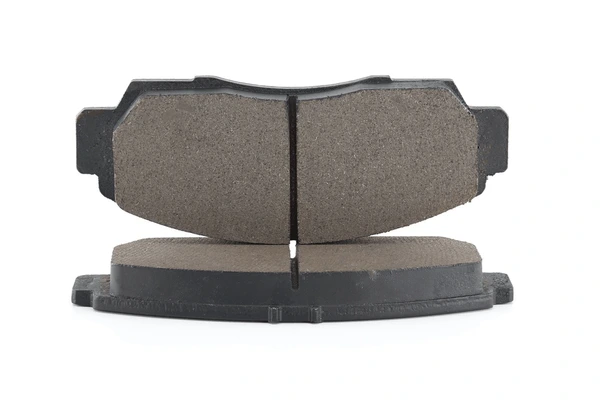
Brake pads sit at the heart of your car’s braking system. They press against the rotor to create the friction that actually slows your vehicle down. Over time, that friction grinds the pads down, which is why they need to be replaced regularly. Understanding what type of brake pad your car needs is not just a mechanic’s concern. It is something every driver should know.
Here is a quick breakdown of how the system works before we get into the different types:
When you press the brake pedal, pressurized fluid travels through the brake lines to a caliper at each wheel. That caliper squeezes the brake pads against a spinning disc rotor. The friction created between the pads and the rotor slows the wheel down and eventually brings the car to a complete stop. In simple terms, your brake pads convert the car’s forward momentum (kinetic energy) into heat. That heat is what stops you.
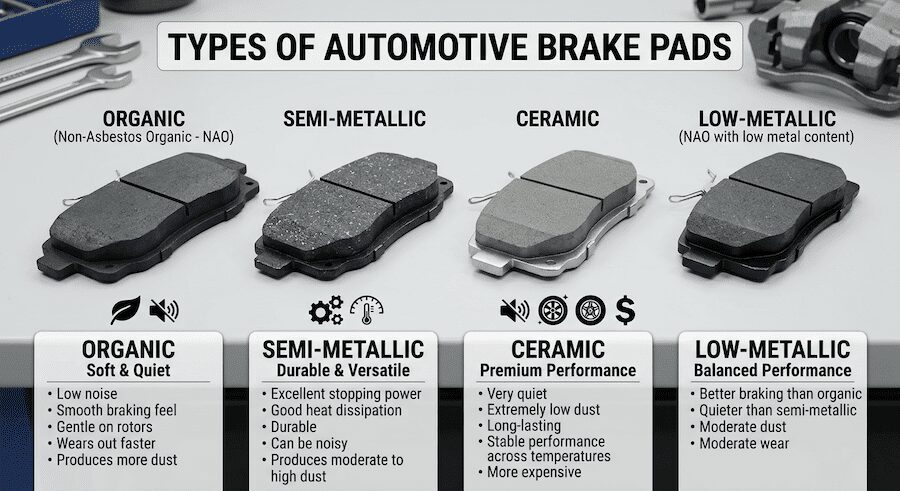
Now, not all brake pads are created equal. There are four main types available on the market today: semi-metallic, non-asbestos organic (NAO), low-metallic NAO, and ceramic. Each one is built differently, performs differently, and is suited to different driving situations. Picking the wrong one for your car is not just a waste of money. It can actually compromise your safety.
So let’s break them all down, plain and simple.
The 4 Types of Brake Pads Every Driver Should Know
1. Semi-Metallic Brake Pads: The Workhorse of the Bunch
Semi-metallic brake pads are by far the most widely used type across the automotive world. Walk into any auto parts store and you will find shelves full of them. They are popular for good reason.
Their composition sits somewhere between 30 and 65 percent metal. That metal content typically includes materials like steel wool, wire, and copper, all bound together with an organic resin. Once the mixture is shaped, it gets baked in a furnace to harden and strengthen the final product.
The result? A brake pad that is tough, durable, and handles heat remarkably well. If you have ever driven through mountain switchbacks or done any kind of aggressive driving, you know how quickly brake pads can overheat. Semi-metallic pads manage that heat better than most alternatives, which is why they are the go-to choice for high-performance and sports vehicles.
They are also more affordable than ceramic pads and hold up well under repeated hard braking. Think about a driver who regularly navigates steep city hills or tows a trailer on the highway. Semi-metallic pads are built for exactly that kind of punishment.
But here is the thing. They are not perfect. Cold weather is their Achilles heel. In very cold climates, semi-metallic pads can become stiff and less responsive before they warm up. They are also noisier than other pad types and can be harder on your rotors over time, meaning you might end up replacing the rotors sooner than expected.
Pros of Semi-Metallic Brake Pads:
- Exceptionally long-lasting under heavy use
- Excellent heat transfer and thermal management
- Compatible with a very wide range of vehicles
- More affordable than ceramic options
- Perform well under repeated hard braking
Cons of Semi-Metallic Brake Pads:
- Noticeably noisy, especially when cold
- Poor performance in freezing temperatures until warmed up
- Can accelerate rotor wear compared to softer pad types
- Generate more brake dust than ceramic alternatives
If you drive a sports car, a performance vehicle, or you simply put your brakes through a lot on a daily basis, semi-metallic pads deserve serious consideration. The noise is a trade-off most performance drivers are willing to accept.
2. Non-Asbestos Organic (NAO) Brake Pads: The Quiet, Everyday Option
The name tells you a lot about the history here. Brake pads were not always made of organic materials. For decades, asbestos was a key ingredient because of its impressive heat-resistance properties. But as the serious health risks of asbestos became undeniable, the automotive industry moved away from it entirely.
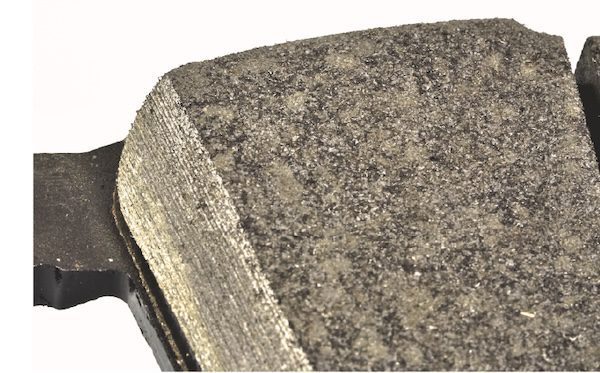
Today’s non-asbestos organic brake pads are made from a blend of materials like fiberglass, rubber, Kevlar, cellulose, and various binding resins. These materials are naturally softer, which is both a strength and a weakness depending on how you drive.
On the positive side, NAO pads are much quieter than metallic options. If you have ever cringed at the sound of screeching brakes in a quiet parking lot, you will appreciate the low-noise performance of organic pads. They are also gentler on brake rotors, which means less wear on that component over time.
The downside is durability. Because they are softer, organic pads wear down faster than metallic or ceramic types. They are built for regular, everyday driving situations. Short commutes, school runs, grocery store trips. That sort of thing. They are not designed for aggressive or frequent braking scenarios.
Another issue worth mentioning is brake dust. Despite being made of softer materials, NAO pads can produce a surprising amount of dust. If you notice a dark, powdery residue building up on your wheels, there is a good chance your organic pads are shedding.
One more thing: NAO pads tend to sit on the higher end of the price scale for everyday brake pads. You are paying for the quiet, rotor-friendly performance, but that cost comes with the trade-off of shorter pad life.
Pros of Non-Asbestos Organic (NAO) Brake Pads:
- Much quieter than metallic pad types
- Gentle on brake rotors, extending rotor life
- Made from durable resins and strong natural fibers
- Good choice for light daily driving
Cons of Non-Asbestos Organic (NAO) Brake Pads:
- Softer material means faster wear under heavy use
- Not suitable for frequent or aggressive braking
- Can produce significant brake dust
- Generally pricier than semi-metallic options
If you drive a smaller car, commute in light traffic, and prioritize a quiet, smooth braking experience, NAO pads are worth your attention. Just be prepared to replace them more often than you might expect.
3. Ceramic Brake Pads: Premium Performance With a Price Tag to Match
If semi-metallic pads are the workhorse, ceramic pads are the thoroughbred. They sit at the top of the price range, and for good reason. They are engineered for superior braking performance under extreme conditions.
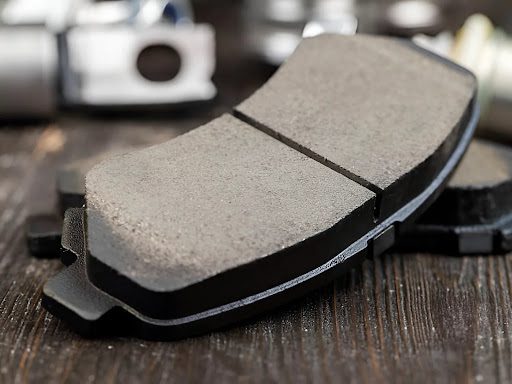
Ceramic brake pads are made from ceramic fibers and various fill materials, similar in concept to the ceramics used in high-temperature industrial applications. They handle heat exceptionally well, which is why they shine in high-performance driving scenarios like track days and rallying. Even under the most sudden, aggressive stops, ceramic pads absorb and dissipate heat efficiently without fading or degrading quickly.
They are also the cleanest option of the four. They produce very little dust compared to metallic or organic pads, which means your wheels stay cleaner for longer. And they operate quietly, making them a dual-purpose winner in terms of performance and comfort.
But here is the catch, and it is a big one. Ceramic brake pads need to reach a certain operating temperature before they perform at their best. In everyday driving, short trips to work, picking up the kids, popping to the supermarket, your brakes rarely get hot enough for ceramic pads to do what they are designed to do.
Think about it this way: if you install track-grade ceramic pads on a car you only use for city driving, you are spending a lot of money for very little return. The pads will still work, but you will not be getting the full benefit of what you paid for.
Ceramic pads also transfer more heat into the brake caliper than some alternatives, which can potentially lead to caliper damage over time if the braking system was not designed to handle that level of heat in everyday use.
Pros of Ceramic Brake Pads:
- Outstanding braking performance at high temperatures
- Very quiet operation
- Minimal dust production, keeping wheels cleaner
- Durable and longer-lasting than organic pads
- Consistent performance under extreme braking conditions
Cons of Ceramic Brake Pads:
- The most expensive option by a significant margin
- Require high operating temperatures to perform optimally
- Overkill for light daily driving scenarios
- Can transfer excess heat into brake calipers in some setups
Ceramic pads are ideal if you own a performance vehicle, drive aggressively, or need a pad that can handle serious heat. For the average daily commuter, the cost may simply not be worth it.
4. Low-Metallic NAO Brake Pads: The Middle-Ground Option
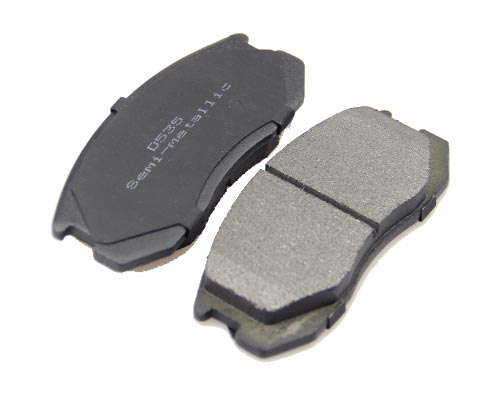
Low-metallic NAO pads are essentially a hybrid. They start with an organic base, similar to the standard NAO pads discussed earlier, but then a portion of copper or steel is mixed in. That metal content typically falls between 10 and 30 percent.
Why add metal to an organic pad? Better heat transfer. The added metallic content improves the pad’s ability to manage braking heat, which translates to better stopping performance compared to a purely organic pad. You get more bite and more consistent braking under harder conditions.
The trade-off is noise and dust. The metal content makes these pads louder than standard organic ones, and they tend to generate more brake dust too. If you park on a light-colored surface or you are particular about your wheel finish, that dust buildup can become annoying pretty quickly.
That said, low-metallic NAO pads offer a solid balance of performance and affordability, making them a popular choice for midsize vehicles and drivers who want better stopping power than organic pads offer without jumping all the way up to semi-metallic or ceramic options.
Pros of Low-Metallic NAO Brake Pads:
- Better heat transfer and braking performance than standard organic pads
- Good middle-ground option between organic and semi-metallic
- Well-suited for midsize and heavier vehicles
Cons of Low-Metallic NAO Brake Pads:
- Noisier than standard NAO pads
- Generate more brake dust due to the metal content
- Not the best choice for lightweight daily drivers
How to Choose the Right Brake Pad for Your Vehicle
Now that you understand what each type brings to the table, the real question is: which one should go on your car? The honest answer is that it depends on a few things. Your vehicle’s size and weight, how and where you drive, and what your manufacturer recommends all play a role in making the right call.
Let’s walk through the most common vehicle categories and what works best for each.
Light Compact Cars: Keep It Simple and Affordable
If you drive a small compact car, say something like a Honda Fit, Toyota Yaris, or a similarly sized hatchback, standard organic (NAO) brake pads are going to serve you just fine. You do not need the heavy-duty stopping power of semi-metallic pads for a vehicle this light.
Organic pads are quiet, easy on your rotors, and affordable to replace. For a compact car used primarily for commuting and everyday errands, that combination is hard to beat.
Now, if you are noticing an excessive amount of brake dust building up on your wheels, or if you simply want to upgrade, ceramic pads are a logical step up. They offer cleaner, quieter performance for a compact car without the noise penalty that comes with metallic options.
Midsize Cars: You Need a Little More Bite
Midsize sedans and crossovers like the Toyota Camry, Honda Accord, or Mazda CX-5 are heavier than compact cars. More weight means more momentum to manage when you hit the brakes. Standard organic pads may not give you the stopping power you need.
Low-metallic NAO pads are the typical recommendation for this category. The added metal content gives you the improved braking performance needed to safely stop a heavier vehicle, while still keeping costs reasonable.
Yes, they are a bit louder. But if the noise really bothers you, switching to ceramic pads is a perfectly reasonable move. You will pay more upfront, but you get a quieter, cleaner brake experience that still handles the weight of a midsize vehicle well.
Sports Cars and Performance Vehicles: Go Semi-Metallic or Go Home
Here is where semi-metallic pads really earn their reputation. A car that can accelerate from zero to sixty in under four seconds needs brakes that can match that level of performance in the opposite direction. The braking forces involved in stopping a sports car at speed are enormous, and organic pads simply are not built to handle that.
Semi-metallic pads are the go-to for sports cars, muscle cars, and any performance-oriented vehicle. They handle the heat generated by aggressive braking, they respond well when the pads are hot, and they hold up to repeated hard stops without fading quickly.
Some high-end performance cars also use ceramic pads, particularly on the track. But for most performance drivers on public roads, semi-metallic is the practical and cost-effective choice. The noise that comes with them is a small price to pay for the confidence of knowing your car will stop when you need it to.
Trucks, SUVs, and Vans: Heavy-Duty Braking for Heavy-Duty Vehicles
Big vehicles need serious stopping power. A fully loaded pickup truck, a large SUV like a Ford Expedition, or a cargo van carries substantial weight. Getting all of that mass to stop safely requires brake pads that are built for the job.
Semi-metallic pads or high-metal-content pads are the standard recommendation for trucks, SUVs, and vans. The higher the metal content, the more stopping force those pads can generate. That is exactly what you need when your vehicle weighs three tons or you are hauling a trailer down a long hill.
Yes, they will be louder. Yes, they will generate more brake dust. But when you are responsible for stopping that much weight on the road, comfort and cleanliness take a back seat to safety and reliability. There really is no debate here.
A Side-by-Side Comparison: Which Brake Pad Wins in Each Category?
Here is a quick reference table to help you compare all four types at a glance:
| Feature | Semi-Metallic | NAO (Organic) | Low-Metallic NAO | Ceramic |
|---|---|---|---|---|
| Metal Content | 30% to 65% | None | 10% to 30% | None (ceramic fibers) |
| Durability | Very High | Low to Medium | Medium | High |
| Noise Level | High | Low | Medium to High | Very Low |
| Dust Production | High | Medium | High | Very Low |
| Heat Management | Excellent | Fair | Good | Excellent |
| Rotor Wear | Higher | Low | Medium | Low |
| Cost | Moderate | Moderate to High | Moderate | Very High |
| Best For | Sports cars, trucks, heavy vehicles | Compact cars, light daily driving | Midsize vehicles | Performance cars, low-dust preference |
| Cold Weather Performance | Poor until warmed up | Acceptable | Acceptable | Good |
Signs Your Brake Pads Need to Be Replaced Right Now
Knowing the different types of brake pads is useful, but knowing when to replace them is just as important. Worn brake pads are a safety issue, full stop. Here are the most common warning signs that your pads are past their service life:
That Squealing Sound Is Not Random
Most brake pads come with a built-in wear indicator. It is a small metal tab that makes contact with the rotor when the pad has worn down to a certain level. The result is that high-pitched squealing or squeaking sound you sometimes hear when you apply the brakes. That sound is not a coincidence. It is literally the pad telling you it is time for a change.
Ignore it for too long and that squeal turns into a grinding sound. At that point, the pad material has worn through completely, and the metal backing plate is grinding directly against your rotor. That is significantly more expensive to fix because now you are looking at rotor replacement on top of the pads.
Your Car Pulls to One Side When Braking
If your car drifts noticeably to the left or right when you apply the brakes, it could mean one of your brake pads is wearing unevenly compared to the other side. This creates an imbalance in braking force. Not only is it uncomfortable, it can also become a serious handling issue at speed.
The Brake Pedal Feels Different Than Usual
A spongy, soft, or low brake pedal is a warning sign that something is off in the braking system. It could be worn pads, air in the brake lines, or a leak in the hydraulic system. Any unusual change in how the pedal feels deserves attention from a qualified mechanic.
Vibration Through the Pedal or Steering Wheel
If you feel a pulsating or vibrating sensation through the brake pedal or the steering wheel when you brake, that is often a sign of warped rotors. Warped rotors frequently go hand in hand with worn or overheated brake pads. If you have been riding your brakes down a long hill or doing a lot of hard stops, this is a real possibility.
Longer Stopping Distances
This one is harder to notice gradually, but it is one of the most dangerous signs. If your car seems to take longer to stop than it used to, your brake pads are likely worn and no longer generating adequate friction. Do not wait until a close call forces the issue.
The Brake Warning Light Comes On
Many modern vehicles have sensors that detect brake pad wear and trigger a warning light on the dashboard. If that light comes on, take it seriously. It is the car’s way of telling you the pads need to be checked immediately.
How Long Do Brake Pads Actually Last?
This is one of the most common questions car owners ask, and the honest answer is: it depends. Brake pad lifespan varies quite a bit based on driving habits, vehicle type, pad material, and road conditions.
That said, here are some general guidelines:
- Organic (NAO) pads: Typically last between 25,000 and 40,000 miles under normal driving conditions.
- Semi-metallic pads: Usually last between 30,000 and 70,000 miles, depending on metal content and driving style.
- Low-metallic NAO pads: Similar lifespan to semi-metallic, roughly 30,000 to 60,000 miles.
- Ceramic pads: Often last the longest of the four types, with some lasting up to 70,000 miles or more under appropriate conditions.
Aggressive driving shortens that lifespan significantly. A driver who brakes hard and often can go through a set of pads in half the time compared to someone with a smooth, anticipatory driving style. City driving with frequent stop-and-go traffic also eats through pads faster than highway cruising, simply because you are using the brakes far more often.
As a rule of thumb, have your brake pads inspected every time you get a tire rotation. Most shops will check them as a courtesy during routine service visits anyway. Staying ahead of the wear prevents the much more expensive problem of damaged rotors.
Does Brake Pad Brand Matter, or Is It All Marketing?
Fair question. The short answer is: brand matters, but only to a point.
Reputable brands like Brembo, EBC, Bosch, Wagner, Akebono, and ACDelco produce brake pads to consistent quality standards. Buying from a recognized manufacturer gives you confidence that the pad material is what it says it is, the wear indicators work as designed, and the pads meet the friction specifications your car needs.
Extremely cheap, no-name brake pads from unknown suppliers are a gamble. The quality can vary wildly, and the last thing you want to gamble on is your ability to stop. Spend a little more for a brand with a reputation. It is absolutely worth it.
That said, you do not always need the top-of-the-line option either. A mid-range set of semi-metallic pads from a reputable brand will outperform a cheap set of ceramics any day of the week. Match the pad type to your driving needs first, then choose a quality brand within that category.
Can You Mix Brake Pad Types on the Same Car?
Technically? Yes. Recommended? Generally, no.
Using different pad types on the front versus the rear axle is not uncommon from the factory, since front brakes typically do more of the stopping work and may require a different pad grade than the rear. But randomly mixing pad types without a clear reason can create uneven braking forces, which throws off your car’s handling balance under hard braking.
The safest approach is to replace brake pads in axle pairs. Both front pads or both rear pads together. That keeps the braking force consistent from side to side and maintains predictable, stable stopping behavior. If you are unsure what to do, check your vehicle’s owner’s manual or ask a trusted mechanic.
What Your Manufacturer Recommends Still Matters
All of this information is useful, but it does not override one key source: your vehicle manufacturer’s recommendations. The engineers who designed your car tested it with specific brake pad specifications in mind. Straying too far from those specifications, especially in terms of friction ratings, can affect braking performance and potentially void parts of your warranty.
Check your owner’s manual for the recommended brake pad type and friction rating. If you want to upgrade, do your research and make sure the alternative you choose is compatible with your vehicle’s braking system. When in doubt, ask a professional.
A good mechanic will not just tell you what pad to buy. They will ask about your driving habits, the conditions you drive in most often, and your budget, and then give you a recommendation based on that full picture. That is the kind of advice worth listening to.
A Few Things Drivers Get Wrong About Brake Pads
Before wrapping up, let’s clear up a few misconceptions that come up regularly:
“More Expensive Always Means Better”
Not necessarily. Ceramic pads are expensive, but they are not the right choice for every car. Putting premium ceramics on a compact city car is like buying racing tires for a minivan. The specs do not match the application. The best brake pad is the one that suits your vehicle and your driving style, not the one with the highest price tag.
“Brand New Pads Should Not Make Noise”
New brake pads often make some noise during the bedding-in period. This is the process where the pad material and the rotor surface establish consistent contact with each other. A light squeal or scraping sound in the first few hundred miles after a pad change is usually normal. If it persists beyond that, it is worth having the installation checked.
“If the Pedal Works, the Pads Are Fine”
This is one of the more dangerous assumptions drivers make. Brake pads can be dangerously worn and the pedal can still feel perfectly normal to the foot. Pad wear happens gradually, and many drivers adapt to the changes without noticing. Regular inspections are the only reliable way to know what condition your pads are actually in.
“Replacing Just the Pads Is Always Enough”
Sometimes the rotors need attention too. If your pads have worn down severely, there is a good chance the rotors have developed scoring, grooves, or surface irregularities from metal-on-metal contact. Putting fresh pads on damaged rotors reduces the effectiveness of the new pads and accelerates their wear. Have the rotors inspected at the same time as the pads and resurface or replace them if needed.
The Bottom Line on Brake Pads
Your car’s braking system is not an area where guessing or cutting corners makes any sense. Brake pads are a relatively affordable maintenance item, especially compared to the cost of replacing warped rotors, damaged calipers, or worse, dealing with the consequences of a brake failure on the road.
Know your vehicle. Know your driving habits. Match the pad type to both, and you will have a braking system that works reliably every single time you need it. Whether you are stopping gently in a parking lot or hauling down from highway speed, the right brake pad makes that entire experience safer and more predictable.
The next time you take your car in for service, do not just ask about the oil and tires. Ask about the brake pads too. A quick look at the pad thickness can save you a lot of money and a lot of stress down the road. And if a mechanic tells you the pads are getting thin, take that seriously. They are not trying to upsell you. They are keeping you safe.
Your brakes are what stand between you and whatever is in front of you. Treat them accordingly.