
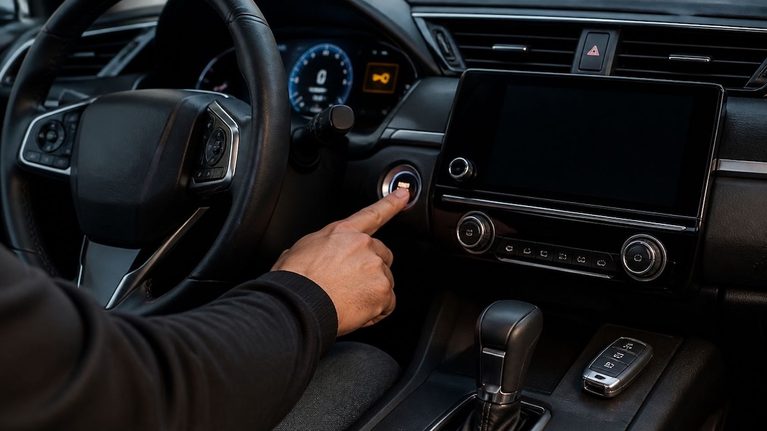
You press the start button, the dashboard wakes up, and then nothing happens. Maybe a warning says the key isn’t detected, or you hear one click and the engine stays quiet. Those symptoms can come from the key fob, the car’s 12-volt battery, a brake or gear-position switch, or the starter itself.
Honda’s keyless start system is convenient, but it still depends on several parts working together. The fob has to be recognized, the car needs enough battery power, and the start conditions must be met. A push button doesn’t tell you which part has failed, so it pays to check the simple things before ordering a new fob or starter.
At the shop, a driver will sometimes arrive convinced the starter is dead because the dashboard showed a key warning. We check the fob and the vehicle battery first. Those are quicker, cheaper places to start than replacing a major component on a hunch.
How Honda’s keyless start system works
When the fob is close enough to the car, it sends a coded radio signal that the vehicle’s keyless system can recognize. If the fob is authorized, the car allows the starting sequence to continue. The exact setup varies by Honda year and model, so the owner’s manual is the best source for that vehicle’s backup procedures and warning messages.
The fob’s small battery and the car’s 12-volt battery are separate. A weak fob battery can make it hard for the car to recognize the key, while a weak car battery can prevent the dashboard, control modules, or starter from working properly. One battery can be fine while the other is not.
On most push-button Hondas, the driver also needs to press the brake and have the transmission in Park before the engine will start. The system checks those conditions as a safety measure. If the fob is detected but the brake or gear-position input isn’t, the button may appear to do nothing.
Common Honda keyless start problems and what they mean
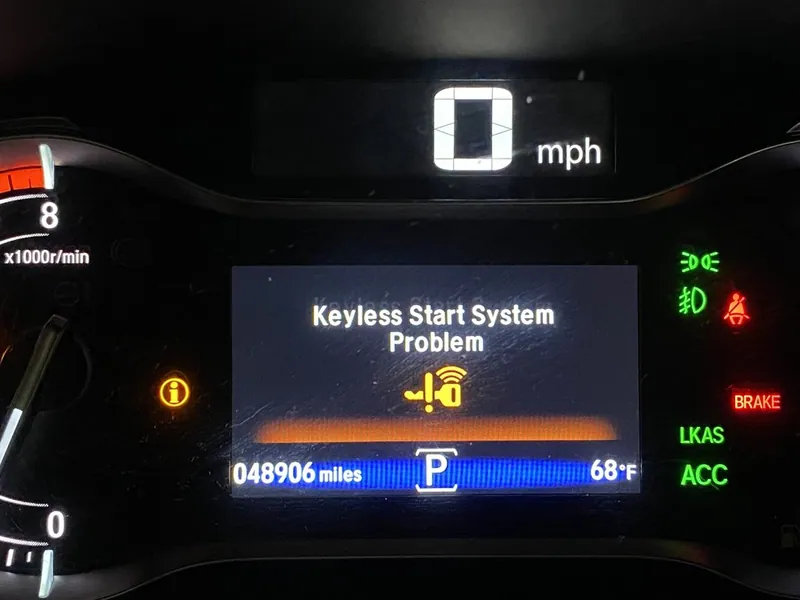
The fob isn’t being detected
A message about the key, an intermittent start, or a need to hold the fob close to the start button can point to a weak fob battery. The fob may also be too far from the cabin, damaged from a drop or water exposure, or affected by nearby electronic devices. A spare fob is useful here: if it works normally, the first fob is the more likely place to investigate.
Move the fob into the cabin and away from a phone, another key fob, or other electronics, then try again. Radio interference isn’t the first thing I’d assume, but changing the fob’s location is an easy check. If the problem happens with both fobs, look beyond the coin cell and check the car’s battery and keyless system.
A weak car battery makes the system act strangely
A low 12-volt battery can cause dim lights, a dashboard that resets, rapid clicking, or a start button that gets no response. It can also make electrical warnings appear together, which may send you chasing the wrong fault. If several systems started acting up at once, test the car battery before blaming the keyless unit.
Loose or corroded battery connections can cause similar symptoms. A voltmeter reading below 12 volts with the engine off is a reason to have the battery checked, but one voltage reading doesn’t prove the battery needs replacement. A proper battery test can show whether it’s discharged, weak under load, or simply being drained by another problem.
The brake or gear-position input isn’t registering
The car won’t follow the normal push-button start sequence unless it sees the required safety inputs. Press the brake firmly, confirm the transmission display shows Park, and try again. If the brake lights don’t come on when you press the pedal, a brake-light switch or related circuit may need attention.
A switch fault doesn’t automatically mean the keyless system has failed. It means the car may not be receiving the signal it needs to allow the start. A technician can check whether the brake-pedal input changes in the vehicle data, rather than replacing parts based on the button’s behavior alone.
The starter may be failing, but a jump-start doesn’t repair it
A single click, repeated clicking, slow cranking, and complete silence can all point to different electrical or starting problems. A weak battery or poor connection can imitate a bad starter, so those should be checked first. A jump-start may help if the battery is low, but it won’t fix a worn-out starter motor or a failed starter circuit.
If the engine cranks normally but won’t run, the keyless start button may not be the main problem. The fault could be elsewhere in the engine or fuel system. Pay attention to whether the engine actually turns over, because “won’t start” can describe two very different situations.
Idling is a drawback of convenience, not a keyless-system failure
With a push-button car, it can be easy to leave the engine running while you step away. Some vehicles warn the driver if the fob leaves the cabin, but don’t rely on a warning to shut the engine off. Check your owner’s manual for how your Honda behaves, and don’t leave a running car unattended.
Long periods of idling use fuel and add emissions. They can also increase engine wear or maintenance needs in some conditions, but the keyless system itself doesn’t damage the engine. If your car is idling for a long time because it won’t shut off normally, that’s a separate issue worth having checked.
Security concerns and fob pairing need some perspective
Proximity-key systems can face relay theft, where equipment is used to extend a fob’s signal. The risk varies by vehicle and security setup, and it isn’t a common explanation for an ordinary no-start. If you’re concerned, keep the fob away from exterior doors or use a signal-blocking pouch that you’ve tested.
A fob and receiver don’t normally become interchangeable just because they use a similar radio frequency. Honda key systems use coded identification, and a fob generally needs to be registered to the vehicle. If you think a key has been incorrectly paired, or you have a replacement fob that won’t work, ask a Honda dealer or qualified automotive locksmith to check the vehicle’s key registration.
Use the symptoms to narrow down the fault
| What you notice | Areas to check first | A useful next step |
|---|---|---|
| The dashboard is dark or resets | 12-volt battery, battery connections, main power supply | Check the battery and connections before testing the keyless system. |
| A key warning appears, but the dashboard works | Fob battery, fob location, spare fob, keyless receiver | Try the spare fob and consult the manual for the emergency start method. |
| There’s rapid clicking or slow cranking | Low battery, poor connection, starter circuit | Have the battery load-tested and the starting circuit inspected. |
| The brake pedal is pressed but there’s no response | Brake input, gear-position input, battery power | Confirm Park and check whether the brake lights work. |
| The engine cranks but doesn’t run | Engine, fuel, ignition, or immobilizer diagnosis | Don’t assume the start button is the cause just because the car won’t run. |
| The car starts only when the fob is close to the button | Fob battery, fob condition, signal reception | Replace the fob battery with the correct type and test again. |
This table is a starting point, not a parts-replacement chart. Several different faults can produce the same symptom, particularly when the car’s battery voltage is low. If the problem keeps returning after a basic check, a proper diagnosis is worth more than guessing.
Work through the likely causes before buying parts
Check the fob battery and the spare key
A weak coin-cell battery is one of the simplest things to rule out. The buttons may still lock or unlock the doors while the fob’s signal is too weak or inconsistent for reliable starting. Try the spare fob if you have one, then replace the battery in the suspect fob if the spare works better.
If neither fob is recognized, don’t buy two new fobs straight away. The car’s 12-volt battery, a receiver, or another part of the vehicle’s keyless system may be responsible. If both fobs stopped working at the same time, that’s a good reason to check the car before paying to replace both keys.
Test the car battery, not just the fob
You can use a voltmeter across the battery terminals with the engine off for a rough check. A resting reading below 12 volts should prompt further testing, but a single reading doesn’t show how well the battery performs under load. A shop can test its condition and check whether the charging system is keeping it charged.
Look for loose connections or visible corrosion, but don’t poke at damaged wiring or a battery that appears cracked or swollen. If you need a jump-start, follow the procedure in the owner’s manual and use the designated jump points if your Honda has them. On a hybrid, use the manual’s instructions rather than guessing at battery locations.
If the car starts after a jump, have the battery and charging system tested instead of assuming the problem is solved. If it still won’t crank, the starter, its wiring, or the start authorization system may need diagnosis. A jump-start is a test of sorts, not a repair for every no-start problem.
Confirm the brake and Park signals
Press the brake firmly and make sure the transmission display shows Park. If you can, ask someone to check the brake lights while you press the pedal, or use a reflection in a window or garage door. Brake lights that don’t illuminate are a useful clue, though the exact cause still needs testing.
If the lights work but the car won’t start, the brake switch can still have a separate signal problem. A scan tool that reads the correct Honda modules can show whether the vehicle sees the brake input. That’s more reliable than pressing the button repeatedly and hoping the system changes its mind.
Separate a starter fault from a keyless fault
The starter only becomes a serious suspect after the battery and connections have been checked. A mechanic can test the starter command, inspect the wiring, and measure voltage drop or starter current as needed. If the car is not authorizing a start at all, replacing the starter may do nothing.
Listen closely when you press the button. Rapid clicks often point toward low voltage or a poor connection, while a single click can have several causes. No sound at all doesn’t prove the starter is bad, either. The vehicle may not be seeing the key, brake pedal, or Park signal.
Consider the button, receiver, and any added equipment
A button that feels unusually stiff or loose deserves inspection, but its feel alone won’t identify the fault. The switch may be worn, or the problem could be in the wiring or control system behind it. A technician can check whether the car registers the button press and whether the start request reaches the right module.
If an aftermarket alarm or remote starter has been installed, mention it when you book the repair. Added equipment can be relevant to the wiring and start authorization, especially if the problem began after an installation or electrical repair. It shouldn’t be blamed without testing, but leaving it out of the history can send diagnosis in the wrong direction.
What a warning message or scan tool can tell you
Some Hondas display a warning about the keyless start system or say the key isn’t detected. The exact wording and the conditions that trigger it vary by model. A warning tells you which system noticed a problem, but it doesn’t always identify the failed part.
A basic OBD-II reader may show engine-related faults and miss information stored in the body, immobilizer, or keyless-access modules. A shop may need a Honda-capable scan tool to read those systems. If a scan finds a fault, ask which module reported it and what test confirmed the suspected part.
There isn’t one universal code that proves a Honda fob, receiver, starter, or push button is bad. A stored code can point toward a circuit or communication problem, but it still needs to be matched with symptoms and test results. Clearing codes without recording them can also remove useful information if the problem returns.
Try these fixes in a sensible order
- Set the car up to start. Put the transmission in Park, press the brake firmly, and make sure the fob is inside the cabin. Don’t keep pressing the start button without checking those conditions.
- Try the spare fob. If it works, focus on the original fob’s battery or condition. If neither works, check the vehicle’s battery and system rather than ordering two replacements.
- Move the fob. Keep it away from other electronics and try again. If your manual lists an emergency recognition method, use that procedure.
- Replace a weak fob battery. Use the cell type listed for your exact fob and install it in the correct orientation. Details are covered below.
- Check the car’s 12-volt battery. Dim lights, clicking, or several electrical warnings make this an especially worthwhile check.
- Stop if the engine cranks but won’t run. That symptom needs a wider engine diagnosis, not repeated attempts to reset the fob.
A restart can sometimes clear a temporary electronic hiccup, but it’s not a dependable fix for a weak battery, a bad switch, or a failed starter. If the car is safe and you can shut it off normally, turn it off, wait briefly, and try once more with the fob in the cabin. If the same warning or no-start returns, move on to testing instead of cycling the button over and over.
Can a Honda key be reset or reprogrammed?
Sometimes, but “resetting the key” can mean different things. Replacing the fob’s coin-cell battery, pairing the remote’s lock and unlock buttons, and registering a smart key for starting are not necessarily the same procedure. A sequence that works for one Honda year may be wrong for another.
Some guides describe an onboard remote-programming routine that uses the driver’s door, the accessory position, and the LOCK button on the remote. One version calls for repeating the on-and-off cycle up to four times, waiting about four seconds between steps, listening for a buzz or chime, and then holding LOCK for about ten seconds. Those details are not universal, so use that routine only if the owner’s manual for your exact Honda describes it.
- Keep the driver’s door closed if the vehicle’s manual specifies that setup.
- Switch to the accessory position, or press the start button once without pressing the brake, only if that is the procedure for your model.
- Press LOCK on the fob, then switch the ignition off after the interval listed in the manual.
- Repeat the on, LOCK, and off cycle the required number of times. Some procedures use a sound to indicate programming mode.
- Complete the final LOCK-button step and test the remote as the manual directs.
Be careful with older instructions copied from one model to another. A routine that pairs the remote’s door-lock buttons may not register a smart key with the immobilizer, which is what allows the engine to start. If a replacement fob needs to be registered, a Honda dealer or qualified automotive locksmith may need to use specialist equipment.
Changing a fob battery normally doesn’t erase its pairing. If the fob stops working right after a battery change, check that the new cell is the correct type, seated properly, and facing the right way before attempting a reset.
How to start a Honda when the fob battery is dead
Many push-button Hondas have a backup recognition method for a fob with a weak or dead battery. It often involves holding the fob against or very near the start button, then pressing the button with the brake applied. The exact position and steps vary, so check the owner’s manual rather than relying on a procedure from a different model year.
Many fobs also contain a small mechanical key blade for unlocking the driver’s door. That blade usually isn’t a substitute for the smart-key authorization needed to start a push-button car. Some vehicles have a separate backup slot, but don’t assume your Honda has one near the start button.
If the backup method doesn’t work, the fob may have a damaged circuit rather than only a dead battery. The car’s 12-volt battery may also be too weak to power the system. If you have a spare fob, try it; if both keys fail and the dashboard is dim or unresponsive, have the vehicle battery checked.
How to change a Honda key fob battery
Check the owner’s manual or the marking inside the fob for the correct battery type. Honda fobs don’t all use the same cell, so don’t buy one based only on what worked in another person’s car. The battery number and the fob design are the details that matter.
- Use the small release or key blade, if your fob has one, to open the case at its seam. A plastic trim tool is less likely to mark or crack the housing than a large metal screwdriver.
- Before removing the old cell, note which side faces up and how it sits in the holder.
- Fit the matching new battery in the same orientation. Avoid bending the contacts or forcing the case closed.
- Reassemble the fob and test the lock and unlock buttons, then try the normal start procedure.
If the fob still doesn’t work, reopen it and check the battery orientation and contact points. A new battery can be faulty, or the fob may have been damaged by a drop or moisture. If the buttons work but the car still won’t recognize the key, test the spare and have the vehicle checked before paying for a replacement fob.
What repairs may cost and how long they take
A fob battery is usually the least expensive fix, and changing it generally takes only a few minutes once you have the correct cell. A vehicle battery, starter, replacement smart key, or keyless-system repair involves more parts and testing. I wouldn’t quote a reliable price without the Honda’s year, model, location, and the exact fault.
A replacement fob can cost more than the battery because the part may need to be registered to the car. If it has an emergency key blade, cutting that blade may be another part of the job. Ask whether the estimate includes the fob, key registration, any blade cutting, and diagnostic labor.
Battery testing is usually a quick part of diagnosis. Finding an intermittent receiver, wiring, brake-input, or starter-circuit problem can take longer because the technician has to reproduce the fault and test the relevant signals. Before approving an expensive part, ask what failed in the test and whether the estimate includes programming or additional diagnostic time.
Mistakes that can waste time or money
- Replacing the starter before testing the battery. Low voltage and poor connections can imitate starter trouble.
- Buying a new fob before trying the spare. If the spare works, you’ve narrowed the problem to one fob instead of the whole vehicle.
- Following a reset routine from another Honda. A remote-pairing procedure may not register a push-button smart key.
- Assuming a dashboard warning names the failed part. A warning identifies a system concern, not always the component that needs replacing.
- Repeatedly pressing the button or cranking the engine. This can drain a weak battery further and won’t repair a fault.
- Using the wrong fob battery or forcing the case open. Check the battery marking and work carefully around the plastic clips and contacts.
Don’t approve a starter or keyless control module based only on a warning message. Ask the shop to confirm the battery condition, key recognition, brake input, and start request before it recommends a major part. That doesn’t mean the part can’t be faulty. It means the diagnosis should show why it is.
When it’s time to call a mechanic
Get help if both fobs fail, the car’s battery tests good, and the start problem keeps coming back. The same goes for a push button that works intermittently, a keyless-system warning that remains after a fob battery change, or a starter that clicks without turning the engine. A Honda-capable scan tool may be needed to read the relevant body and immobilizer systems.
Call for assistance sooner if the battery cables are damaged, you smell burning insulation, or you see smoke. Don’t keep trying to start a car with an electrical fault. If the engine cranks but won’t run, tell the shop exactly what happens when you press the button, including whether you hear clicks, see a key warning, or notice dimming lights.
What I’d check first on my own Honda
I’d start with the spare fob, confirm the car is in Park, and press the brake firmly. Then I’d check the fob battery and test the vehicle’s 12-volt battery before ordering anything. If those checks don’t explain the problem, I’d want the keyless, brake-input, and starter circuits tested with the right scan tool and equipment.
You can handle a fob battery change at home if you have the correct cell and can open the case carefully. Leave immobilizer programming, persistent electrical faults, and uncertain starter problems to a shop or qualified automotive locksmith. The useful takeaway is simple: separate the fob, the car battery, the start interlocks, and the starter before replacing parts.