
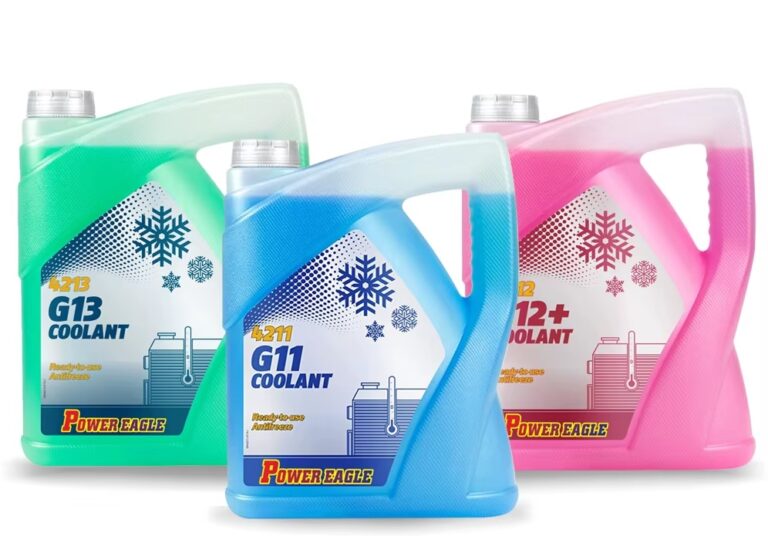
Why topping off with “whatever coolant’s on the shelf” can actually hurt your engine
I had a customer a couple years back top off his cooling system with a jug of green coolant because it was cheap and on sale. Problem was his car came from the factory with the orange stuff, G12 territory, and mixing the two created a gel-like sludge that clogged a section of his radiator. He ended up paying for a full flush and a new radiator over a five dollar bottle of the wrong coolant.
Coolant isn’t one-size-fits-all, and the color on the cap means a lot more than people assume. G11, G12, G12+, G12++, and G13 are all built around different chemistry, and knowing which one your car actually needs can save you from exactly the kind of mess my customer ran into. Let’s go through what G12 actually is, how it differs from the others, and how to pick the right one without guessing.
What G12 coolant actually is
G12 is an ethylene glycol and carboxylate based coolant, usually red or pink in color, and it doesn’t contain silicates the way older coolant formulas did. It was the standard for cars built between 1996 and 2001, and a lot of vehicles from that era still run on it today if they’ve never been switched to a newer formula.
Here’s the technical profile worth knowing if you’re comparing bottles at the parts store:
- Service life: 4 to 5 years
- Density: 1.065 to 1.085 g/cm³ (at 20°C or 68°F)
- Freezing point: around -50°C (-58°F)
- Boiling point: about +118°C (245°F)
- Chemistry: contains two or more carboxylic acids
What makes G12’s chemistry interesting is how it handles corrosion. Instead of blanketing the entire cooling system in a protective layer the way older coolants do, G12’s additives target corrosion right where it’s actually forming, creating a resistant microfilm specifically at those trouble spots. It’s a more surgical approach rather than a blanket one.
The ethylene glycol base
Most G12 formulas run somewhere around 50% to 60% ethylene glycol, which is the sweet spot manufacturers have landed on for best overall performance. In its pure, undiluted form, ethylene glycol is a colorless, oily liquid that boils at 197°C (386.6°F) and freezes at -13°C (8.6°F). The dye added to G12 isn’t just for show either, it’s there to make the coolant level easier to see in your reservoir tank, which matters more than you’d think when you’re trying to eyeball a quick level check in a dim engine bay.
What’s actually in the bottle
A typical G12 coolant breaks down roughly like this:
- About 5% distilled water
- Ethylene glycol, the core antifreeze component
- A colorant, both for class identification and tank visibility
- Organic acid additives that act as corrosion inhibitors, since ethylene glycol on its own is actually fairly aggressive toward non-ferrous metals
- Anti-scale additives to keep mineral buildup from forming inside the system
- Anti-foaming agents and lubricants, both necessary for the coolant to circulate properly without churning up air pockets or wearing down the water pump seal
That combination is why G12 isn’t just colored water with antifreeze properties, it’s a fairly engineered chemical product doing several jobs at once inside your cooling system.
The one real weakness G12 has
G12’s biggest drawback is timing. It only kicks into action once corrosion has already started to form, rather than preventing it from happening in the first place. The upside of this reactive approach is that the protective layer it does build stays thin and sheds quickly when vibration or temperature swings hit it, which actually helps heat transfer and extends how long the coolant stays effective overall.
So it’s a tradeoff, not a flaw exactly. You get better heat transfer and a longer usable life in exchange for not getting ahead of corrosion before it starts. This is the detail that later formulas like G12++ were specifically designed to address, which we’ll get to.
How G11, G12, G12+, G12++, and G13 actually differ
The core difference across all these coolant classes comes down to one thing: whether the additive package is organic or inorganic. Everything else, the color, the service life, the temperature range, flows from that one chemical decision.
G11, the older inorganic formula
G11 predates G12 and was the standard on cars built before 1996, typically vehicles with larger-volume cooling systems. You’ll usually spot it by its blue or green color.
Its specs tell a pretty clear story about why it eventually got replaced:
- Boiling point: 105°C (221°F)
- Service life: no more than 2 years, or roughly 31,000 to 50,000 miles
- Additive type: inorganic, built around phosphates, nitrates, and silicate
The silicate in G11 works by coating the entire inner surface of the cooling system with a protective layer regardless of whether corrosion is actually present there or not. It’s a blanket approach, the opposite of G12’s targeted microfilm strategy. The upside is that it protects existing corrosion from getting worse. The downside is real though: low chemical stability, weaker heat transfer, and a notably shorter service life than what came after it.
There’s also a mechanical issue worth knowing. As G11 wears out over its service life, it starts turning abrasive, and that abrasiveness can actually damage components inside the cooling system rather than just losing effectiveness quietly. And critically, G11 is not suitable for cars with aluminum radiators. Its additive package simply can’t protect aluminum adequately once things get hot, which rules it out for most modern vehicles outright.
Can you mix G12 and G11?
No. You should not, under any circumstances, mix an organic coolant with an inorganic one. This isn’t a minor compatibility quirk, it’s the kind of mistake that can gel up inside your system and clog passages, similar to what happened to my customer’s radiator. If you’re switching coolant types, a full flush is the only safe way to do it.
G12 and G12+, close cousins with one key difference
G12 and G12+ are both organic “long life” coolants, both used on cars manufactured from 1996 onward, and both built around an ethylene glycol base. The difference is that G12+ uses a hybrid production approach, blending silicate technology with the carboxylate chemistry that defines G12. It’s essentially a bridge formula, borrowing a piece of the older silicate approach while keeping the organic base.
G12++, the formula that fixed G12’s one weakness
G12++ showed up in 2008 and it’s worth calling out separately because it directly addresses the reactive-only drawback we talked about earlier. G12++ combines organic additives with a smaller amount of mineral (inorganic) additives, essentially mixing both philosophies into one product. That blend lets it do something G12 alone couldn’t: perform preventive corrosion protection in addition to the reactive, after-the-fact protection G12 is known for.
Mixing G12+ with G12 or G11
Technically, mixing G12+ with G12 or G11 is possible without the same catastrophic gelling risk you get mixing organic with inorganic outright. That said, I don’t recommend doing it. “Possible” and “a good idea” aren’t the same thing when it comes to coolant chemistry, and you lose any guarantee of predictable performance once you start blending formulas. If you need to switch, flush the system and start clean.
G13, the newest and most environmentally conscious option
G13 has been around since 2012, developed largely in response to tightening environmental standards. You’ll typically find it in light red or violet shades.
Its performance numbers are the strongest of the bunch:
- Freezing point: -69°C (-92°F)
- Boiling point: about 175°C (347°F)
Chemically, G13 isn’t drastically different from G12. The real distinguishing factor is that G13 uses propylene glycol instead of straight ethylene glycol. Propylene glycol is less toxic and does less environmental harm when disposed of, producing about 11% less CO2 emissions than G12 over its lifecycle. That environmental benefit comes at a cost though, literally, G13 is priced noticeably higher than G12.
G13 also happens to offer stronger protection for radiators and cooling system components made from aluminum, cast iron, and magnesium alloy, which lines up with what most modern engines are actually built from. Where it falls short is on older systems. G13 is not recommended for cooling systems with copper or brass radiators and heaters, those older metals are better served by sticking with G11 or G12 instead.
All five side by side
| Coolant | Additive type | Typical color | Boiling point | Freezing point | Service life | Best for |
|---|---|---|---|---|---|---|
| G11 | Inorganic (silicate, phosphate, nitrate) | Blue or green | 105°C (221°F) | Not specified in detail, standard antifreeze range | Under 2 years / 31,000-50,000 miles | Pre-1996 cars with copper/brass radiators and cast-iron blocks |
| G12 | Organic (carboxylate) | Red or pink | 118°C (245°F) | -50°C (-58°F) | 4-5 years | 1996-2001 cars with aluminum radiators |
| G12+ | Hybrid (silicate + carboxylate) | Red/orange range | Similar to G12 | Similar to G12 | Similar to G12 | Cars from 1996 onward needing organic protection with some preventive coverage |
| G12++ | Organic + small amount of inorganic | Varies | Similar to G12 | Similar to G12 | Similar to G12, with preventive benefit added | Cars wanting both preventive and reactive corrosion protection |
| G13 | Organic, propylene glycol based | Light red or violet | 175°C (347°F) | -69°C (-92°F) | Long life, similar range to G12 family | Modern aluminum, cast iron, and magnesium alloy systems, environmentally conscious buyers |
The pattern across this whole lineup is pretty clear once you see it laid out: newer formulas trend toward organic chemistry, better temperature ranges, and increasingly specific metal compatibility, while older formulas trade some of that performance for cost and simplicity on older vehicles that don’t need the extra protection anyway.
How to actually pick the right one for your car
This part trips people up more than it should, mostly because they assume color is the deciding factor. It’s not, color is just a visual identifier, not a spec.
Start with the manufacturer’s recommendation. Some car brands print the correct coolant type right on the reservoir tank itself, and every manufacturer lists it in the owner’s manual. That’s your first and best source, not the sticker on the coolant bottle at the auto parts store.
Concentrate versus pre-diluted
Coolant comes both pre-diluted and fully concentrated. My advice is to buy the concentrated version and mix it yourself with distilled water based on your local climate. Colder regions call for a higher concentration ratio, warmer regions can run a bit less concentrated. This gives you more control than grabbing a jug that’s already been mixed to some generic 50/50 ratio that may not suit where you actually live and drive.
Matching coolant to radiator material
Here’s the practical rule of thumb I give customers at the counter:
- Copper or brass radiator with a cast-iron block: go with green or blue G11.
- Modern car with an aluminum radiator: go with orange, purple, or red G12 or G12+.
If you’re not sure which one your car has, a quick look at your radiator (or a call to your dealership parts department with your VIN handy) will clear it up fast.
What to check before you buy any coolant
- No pungent or harsh chemical smell coming from the bottle.
- No visible sediment settled at the bottom of the container.
- Packaging that looks professionally made, no blurry labels or printing errors that suggest a counterfeit or low-quality product.
- Pricing that’s roughly in line with what similar products are selling for. A price that’s dramatically lower than everything else on the shelf is a red flag, not a bargain.
I’ll add one from personal experience: stick with name brands or your dealership’s recommended coolant if you’re at all unsure. I’ve seen cheap off-brand coolant separate and leave chalky deposits inside a radiator within a year, something you basically never see from established brands.
Changing your coolant the right way
Before you do anything, check your car’s manual for the specific technical requirements for your cooling system. Capacity, recommended coolant type, and any special bleeding procedure for air pockets will all be listed there, and skipping that step is how people end up with the wrong coolant type or an air-locked system after the job.
The basic process looks like this:
- Let the engine cool completely before opening anything. Never crack a radiator cap or drain plug on a hot system.
- Drain the old coolant completely through the radiator’s drain plug (and the engine block drain if your vehicle has one), giving it time to fully empty rather than rushing the process.
- Flush the system with clean water if you’re switching coolant types or if the old coolant looked contaminated, then drain that out too.
- Pour in the new coolant, properly mixed with distilled water if you bought concentrate, to the manufacturer’s specified capacity.
- Run the engine with the heater on to help cycle coolant through the whole system and bleed out trapped air pockets, following your manual’s specific bleeding procedure if one exists.
- Check the level again once the engine’s cooled back down and top off as needed.
After that, keep an eye on the coolant periodically. If you notice the color shifting, going murky, rusty, or developing a different hue than what you put in, that’s a sign the coolant is losing its protective properties and breaking down chemically. At that point, don’t wait for the full service interval, change it out.
Mistakes I see in the shop with this exact topic
- Topping off a G12 system with whatever coolant is cheapest or most available, regardless of chemistry type, and ending up with a gelled, partially clogged system.
- Assuming color alone tells you the coolant class, when manufacturers don’t always follow the same color conventions across brands.
- Skipping the owner’s manual and guessing based on what the last shop used, which may not have even been correct in the first place.
- Buying pre-diluted coolant without checking if the ratio actually suits a genuinely cold or hot climate.
- Ignoring a color change in the coolant for months because the car “seems fine,” only to find corrosion damage once the system is finally flushed.
DIY versus letting a shop handle it
A straightforward coolant change on a system without a complex bleeding procedure is a reasonable DIY job if you’ve got basic tools, a drain pan, and patience to let the engine cool fully first. The actual process isn’t complicated, it’s the details, correct coolant type, correct dilution ratio, correct bleeding procedure, that trip people up more than the mechanical steps themselves.
If your car has a notoriously tricky bleeding procedure (some European models are known for this, requiring specific bleed screws and idle sequences to fully purge air pockets) or if you’re not confident identifying your radiator material and matching the right coolant class, I’d let a shop handle it. A botched air bleed can leave a pocket that causes localized overheating, and that’s a far more expensive mistake than paying for a professional coolant service in the first place.
My take: know your coolant class before you buy anything, check the manual or the reservoir tank sticker first, and never mix organic and inorganic formulas regardless of what anyone tells you about it being “fine in a pinch.” If your coolant’s changing color or you’re coming up on the service interval for your specific class, whether that’s the 2-year mark for G11 or the 4-5 year window for G12 and its variants, get it changed before corrosion has a chance to start rather than after you notice a problem.