
Here is a scenario most drivers have experienced at least once. You are cruising down a straight road, you let go of the steering wheel for just a moment, and the car starts drifting to one side. Or maybe you notice one of your tires looking noticeably more worn than the others. Or the steering wheel sits slightly crooked even when you are driving perfectly straight ahead.
All of those are signs of bad wheel alignment, and they are signs you should not ignore. The question a lot of drivers ask is: can I just keep driving? The short answer is yes, technically you can. But the longer answer is more complicated, and understanding it could save you a significant amount of money and, more importantly, keep you safe on the road.
Can You Drive With a Bad Wheel Alignment?
Yes, you can drive with a bad wheel alignment, but doing so will cause real and progressively worsening damage over time. The longer you leave misaligned wheels unaddressed, the more you accelerate tire wear, the more fuel you burn unnecessarily, and the more you compromise your ability to control the car safely. It is one of those problems that does not go away on its own and does not stay the same either. It gets worse the more miles you put on it.
Every car rolls off the production line with the wheels set to precise manufacturer specifications. Those specifications are not arbitrary. They are carefully engineered to ensure the tires wear evenly, the car tracks straight without constant correction, and the vehicle responds predictably when you steer, brake, or accelerate. When those angles shift, everything downstream from that change is affected.
What shifts those angles? Several things. Potholes are the most common culprit, and depending on where you live, they might be an almost daily challenge. Hitting a curb even at low speed can knock a wheel out of alignment. Being involved in an accident, even a minor one, can disturb the suspension geometry. Going over a speed bump too fast, or dropping a wheel off the edge of the road onto a soft shoulder, can all contribute to alignment problems over time.
What Wheel Alignment Actually Means
Wheel alignment is not about the wheels themselves. It is about the angles of the suspension components that hold those wheels in position. During an alignment service, a technician adjusts the suspension geometry so that the wheels sit at the correct angles relative to each other and relative to the road surface.
When everything is set correctly, all four tires contact the road at the proper angle, roll in the same direction with minimal resistance, and share the vehicle’s load evenly. The result is a car that drives straight without driver correction, handles predictably, wears its tires evenly, and operates at maximum fuel efficiency.
When the alignment is off, even slightly, those benefits erode quickly. The tires start fighting against each other instead of working together. The rolling resistance increases. The car wants to pull in a direction you are not steering toward. And because the tires are no longer making full, even contact with the road, they wear out at irregular rates that can leave you shopping for new tires far sooner than you should need to.
The Three Alignment Angles Every Driver Should Understand
When a mechanic talks about wheel alignment, they are specifically referring to three measurements: camber, toe, and caster. Understanding what each one means helps you have a more informed conversation with your technician and understand why specific alignment problems cause specific symptoms.
Camber: The Inward or Outward Tilt
Camber is the angle of the wheel when you look at the car from the front. Stand directly in front of your car and look at each tire. If the tops of the tires lean inward toward the center of the car, that is called negative camber. If the tops lean outward away from the car, that is called positive camber.
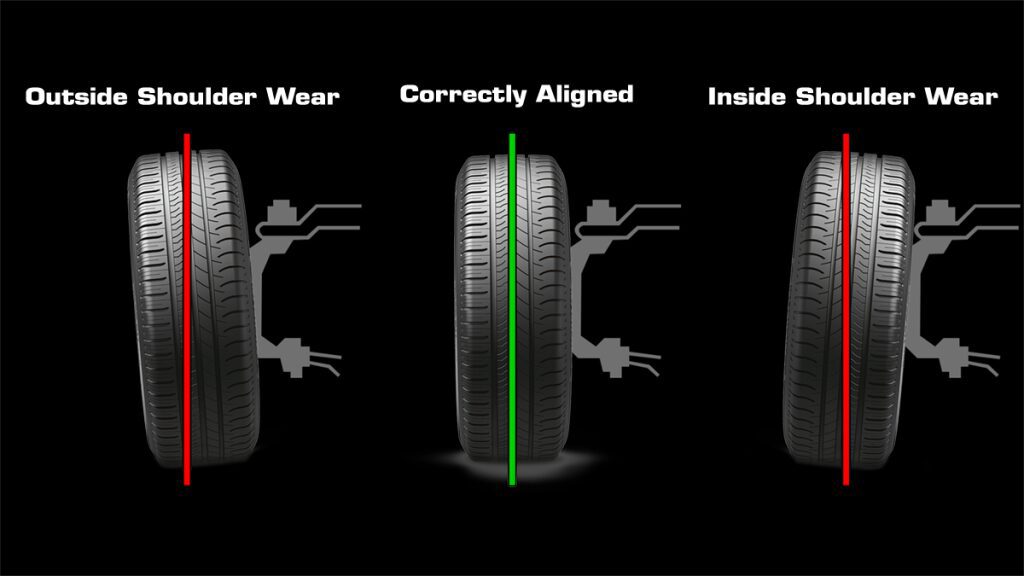
On most everyday road cars, the ideal camber is close to zero degrees, meaning the tire sits perfectly perpendicular to the road surface. A small amount of negative camber is sometimes intentionally engineered into performance vehicles because it improves grip during cornering. But when negative camber becomes excessive due to worn ball joints, damaged control arms, or bent suspension components, it causes the inner edges of the tires to wear far faster than the rest of the tread. You end up with tires that look fine from the outside but are worn down to dangerous levels on the inside edge.
Positive camber causes the opposite, with the outer edges of the tires wearing prematurely. Too much camber in either direction affects handling, reduces braking effectiveness, and shortens tire life considerably.
Toe: The Front-to-Back Angle
Toe alignment is viewed from above. Imagine looking straight down at your car from a bird’s eye view. If the front edges of the tires point toward each other, that is called toe-in. If the front edges point away from each other, that is toe-out.
Think of it like a person walking pigeon-toed versus walking with their feet splayed outward. Either extreme creates unnatural wear on the tires and affects how the car tracks down the road. Most passenger cars are set with a very small amount of toe-in, which helps the tires stay stable and track straight under normal driving conditions.
Incorrect toe alignment is one of the most common causes of rapid and uneven tire wear. Even a small deviation from the correct toe setting causes the tires to scrub sideways as they roll forward, similar to dragging your feet instead of lifting them when you walk. That constant scrubbing removes tread from the tire edges at a rate that can shorten tire life from tens of thousands of miles to just a few thousand.
Caster: The Steering Axis Angle
Caster is the angle of the steering axis when viewed from the side of the vehicle. A positive caster means the steering axis tilts toward the driver, while a negative caster means it tilts toward the front of the car. Most modern vehicles use positive caster because it improves straight-line stability and helps the steering wheel return naturally to center after a turn.
Unlike camber and toe, caster has less direct impact on tire wear. Its primary effect is on steering feel and stability. A car with incorrect caster may feel vague or unstable at highway speeds, or the steering may feel heavy and unresponsive. In severe cases, it can contribute to the car pulling to one side. Caster adjustment is not always possible on every vehicle, as it depends on the suspension design, but it is an important measurement in a full four-wheel alignment assessment.
Warning Signs That Your Wheels Are Out of Alignment
Your car will almost always give you warning signs before the alignment problem becomes severe. Learning to recognize them early can save you the cost of a full set of tires and potentially prevent a dangerous driving situation.
1. Uneven Tire Wear
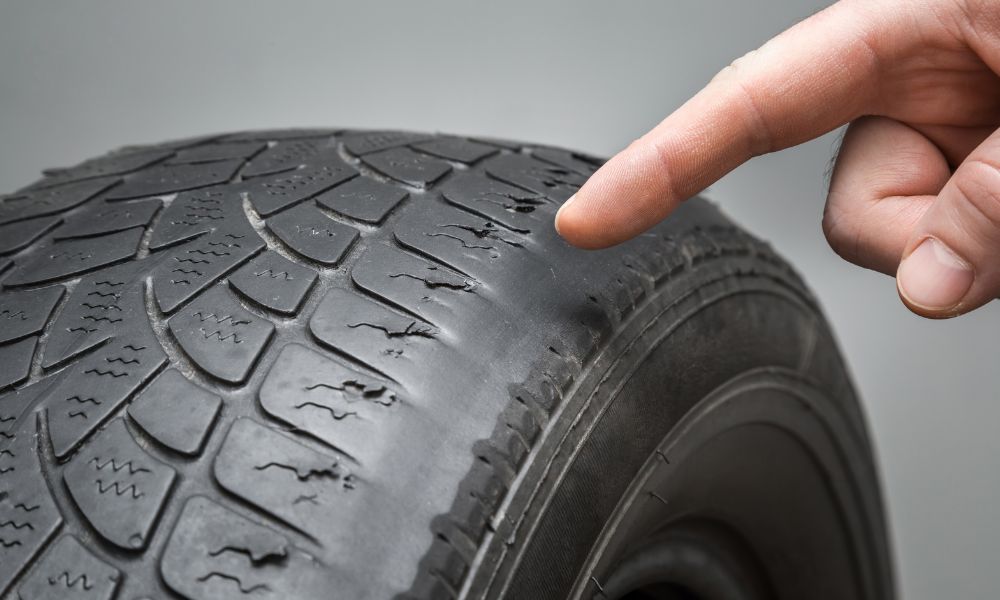
This is the most reliable and common indicator of alignment issues. Get into the habit of checking your tire tread depth and wear pattern regularly. All four tires should show similar wear patterns and similar tread depth. If one tire is significantly more worn than the others, or if you notice wear concentrated on one edge of a tire while the rest of the tread looks fine, that is a clear sign something is wrong with the alignment.
Feathering is another wear pattern worth knowing about. Run your hand across the tire tread. If the blocks of tread feel sharp on one side and rounded on the other, almost like the edge of a row of cards fanned out, that feathered pattern points directly to a toe alignment problem. You will not always be able to see feathering easily, but you can feel it with your hand.
Replacing tires is expensive. A set of four mid-range tires for a family sedan can easily cost $500 to $800 or more. Catching an alignment problem before it destroys your tires is far cheaper than the tire replacement it prevents.
2. The Car Pulls to One Side
On a flat, straight road with no noticeable crosswind, your car should track straight ahead with minimal steering input from you. A simple test you can do safely is to relax your grip on the steering wheel while driving on a quiet, level road and observe whether the car wants to drift to the left or right. Do not take your hands completely off the wheel, just reduce your input and feel which direction the car wants to go.
If it consistently pulls to one side, alignment is the most likely cause, though tire pressure differences between sides can sometimes produce a similar effect. Check your tire pressures first to rule that out. If pressure is equal and the car still pulls, get an alignment check.
A car that pulls is more than an inconvenience. On a wet road, it increases the risk of hydroplaning and losing directional control. At highway speeds, it increases driver fatigue because you have to constantly correct the steering. Over a long journey, that constant correction becomes genuinely tiring and reduces your attentiveness.
3. The Steering Wheel Is Off-Center
When you are driving in a perfectly straight line, the steering wheel should sit level, with the logo or emblem centered. If the wheel looks visibly rotated slightly to the left or right when the car is tracking straight, the alignment is off. This is one of the easier signs to notice because you look at the steering wheel every time you drive.
A steering wheel that is only a few degrees off-center might seem trivial, but it indicates that the wheels themselves are not pointing exactly where they should. That small deviation is enough to cause uneven tire wear and handling issues over time.
4. Steering Vibration or Instability
Misalignment can cause the steering wheel to vibrate, particularly at certain speeds. This vibration often gets confused with a wheel balance problem, which causes a similar symptom. Both issues should be investigated, and a good alignment shop will typically check both when you bring the car in with these symptoms.
If the steering feels vague, loose, or like the car is wandering slightly even without pulling strongly to one side, that can also point to alignment issues, particularly with caster or toe settings. A car that feels unsettled or requires constant minor steering corrections to hold a straight line is not driving the way it should.
5. Squealing Tires
If you hear your tires squealing at low speeds or on gentle turns where there is no reason for them to squeal, that sound is worth paying attention to. Misaligned tires that are running at incorrect angles generate heat and friction that can cause this noise. It is not always alignment related, but when other symptoms are present alongside tire noise, the combination points strongly toward an alignment check being overdue.
What Damage Does Bad Wheel Alignment Actually Cause?
Let’s be specific about this because understanding the actual damage helps you appreciate why alignment is worth addressing promptly rather than putting off.
Premature and Uneven Tire Wear
This is the most direct and expensive consequence of neglecting alignment. Tires are engineered to be worn evenly across the full width of the tread, distributing the wear over tens of thousands of miles. When alignment is incorrect, only part of the tire makes proper contact with the road, concentrating wear on one edge or one area. A tire that should last 50,000 miles might be unusable at 15,000 miles simply because alignment was never checked.
Worse, severely worn tires develop structural weaknesses that can lead to blowouts. A blowout at highway speed is a genuine life-threatening event. No tire replacement bill is worth risking that.
Increased Fuel Consumption
Misaligned wheels create additional rolling resistance. When the tires are not all pointing in exactly the same direction, they are working against each other to some degree. The engine has to work harder to push the car forward, which means it burns more fuel to cover the same distance. The increase is not dramatic on a single tank, but across thousands of miles of driving, misalignment can add a meaningful amount to your fuel costs.
Studies have shown that incorrect wheel alignment can reduce fuel economy by as much as 10 percent in significant cases. On a car that normally gets 30 miles per gallon, that is roughly 3 miles per gallon lost. At current fuel prices, those inefficiencies add up quickly over a full year of driving.
Suspension Component Wear
Misalignment does not just affect the tires. When the wheels are not set at correct angles, the forces acting on the suspension components, the ball joints, wheel bearings, tie rod ends, and control arm bushings, are distributed incorrectly. These parts are designed to handle loads within specific parameters. Sustained misalignment puts parts of those components under stress they were not designed to absorb, which accelerates their wear and failure.
Wheel bearings, in particular, can be significantly impacted. Excessive camber applies a constant sideways load to the wheel bearing that it is not designed to sustain indefinitely. A wheel bearing failure that might have been ten or fifteen years away with correct alignment can happen within a few years when alignment is consistently off. Wheel bearing replacement is not a cheap repair.
Compromised Safety
A car that pulls to one side, has worn tires with compromised grip, or responds unpredictably when you steer is a car that is harder and more dangerous to drive in an emergency situation. When you need to swerve suddenly to avoid an obstacle, or when you need to brake hard on a wet road, the vehicle’s response needs to be immediate and predictable. A car with alignment problems may not respond the way you expect, which in a genuine emergency is exactly when you cannot afford any surprises.
How Long Can You Actually Drive With Bad Alignment?
There is no hard mileage limit on driving with misalignment. The car will keep moving. But the question is really about how much damage you are willing to absorb, and over what timeframe.
Mild misalignment that causes minor pulling and slightly uneven tire wear can be tolerated for a short period if you genuinely cannot get to an alignment shop immediately. A few days of driving to get to an appointment is not going to destroy your tires.
Severe misalignment, where the car is pulling aggressively, the tires are wearing visibly unevenly, and the steering feels genuinely unstable, is a different situation. Continuing to drive in that condition is creating compounding damage with every mile and presents a real safety concern. In that situation, getting to an alignment shop should be a priority, not something you schedule for next month when it is convenient.
The honest answer for most people with moderate alignment issues: get it fixed as soon as reasonably possible. Within a week or two. Do not let it sit for months and certainly do not ignore it indefinitely.
Wheel Alignment vs. Wheel Balancing: Understanding the Difference
These two services often get confused because they both involve the wheels and are both performed at tire shops. They are completely different procedures addressing completely different problems.
Wheel alignment adjusts the angles of the suspension components to ensure the wheels point in the correct direction relative to each other and the road. It addresses how the wheel is positioned.
Wheel balancing corrects the distribution of weight around the wheel and tire assembly. Even a new tire mounted on a new wheel will have slight variations in weight distribution around its circumference. At highway speeds, those small imbalances cause vibration. Small counterweights are attached to the wheel rim to compensate, smoothing out the rotation.
A car can have perfect alignment and still vibrate due to balance issues. A car can be perfectly balanced and still pull to one side due to alignment issues. Both services address different aspects of how the wheel system functions, and both are part of proper vehicle maintenance. They are often done together at the same appointment, but they are not the same service.
| Service | What It Addresses | Common Symptoms It Fixes | How Often Needed |
|---|---|---|---|
| Wheel Alignment | Angles of suspension components and wheel positioning | Car pulling to one side, uneven tire wear, off-center steering wheel | Every 1 to 2 years or after hitting a major pothole or curb |
| Wheel Balancing | Weight distribution around the wheel and tire assembly | Steering wheel vibration at highway speeds, shimmy through the seat | Every 5,000 to 7,500 miles or when new tires are fitted |
When Should You Get a Wheel Alignment?
Beyond the obvious answer of “when you notice symptoms,” there are specific situations that should trigger an alignment check even if you are not experiencing any noticeable problems yet.
- After hitting a significant pothole: A hard impact with a deep pothole applies sudden lateral force to the wheel and suspension components that can shift alignment angles immediately. If you felt the impact and winced, get the alignment checked.
- After hitting a curb: Even a relatively low-speed curb strike can knock toe and camber out of spec. Parking lot mishaps are a very common cause of alignment issues.
- After any accident involving the wheels or suspension: Any collision that affects the front or rear of the vehicle, or any impact that affects a wheel directly, warrants an alignment check before returning to normal driving.
- When fitting new tires: Getting an alignment check when you install new tires makes financial sense. You are about to spend money on new rubber. Starting those tires on properly aligned wheels ensures they wear correctly from the very first mile.
- Every 1 to 2 years as general maintenance: Even without any dramatic road events, normal driving gradually causes small changes in alignment. Most manufacturers recommend an alignment check every 12 to 24 months as part of routine vehicle maintenance.
- After suspension repairs: Any time a ball joint, tie rod end, control arm, or other suspension component is replaced, the alignment should be checked and corrected afterward because component replacement can change the geometry.
How Long Does a Wheel Alignment Take?
A standard wheel alignment takes between 30 minutes and an hour at most shops. Some alignments on simpler vehicles can be completed in as little as 15 to 20 minutes. More complex vehicles, particularly those with adjustable rear suspension or those requiring additional work to bring into spec, may take longer.
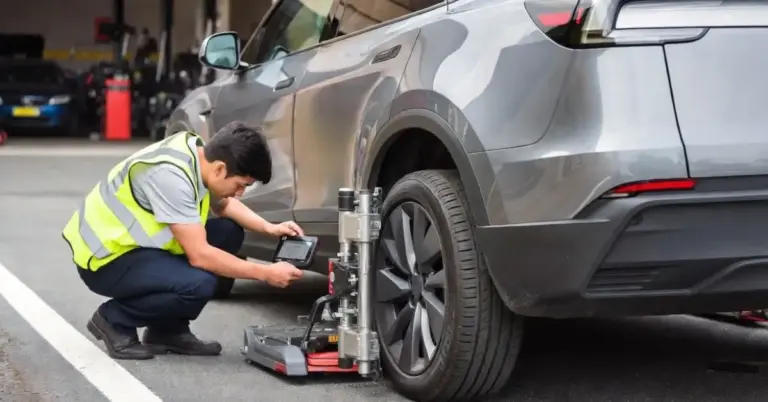
The process involves driving the car onto an alignment rack, attaching sensors to all four wheels, and using specialized software to measure the current angles against manufacturer specifications. The technician then adjusts the relevant components until all measurements fall within acceptable tolerances. A final measurement confirms the correction before the car is driven off the rack.
It is one of the quickest and most straightforward services a shop performs. There is no reason to put it off based on concerns about how long it will take.
How Much Does a Wheel Alignment Cost?
A standard front-wheel alignment on a typical passenger car typically costs between $50 and $100 at most shops. A four-wheel alignment, which covers all four wheels and is recommended for all-wheel drive vehicles and most modern front-wheel drive cars with adjustable rear suspension, generally runs between $100 and $175 depending on the shop and the vehicle.
Some dealerships charge slightly more for alignment services, while dedicated tire and alignment shops and large chain stores often run promotions that bring the price down further. Many shops include a lifetime alignment warranty with their service, which means you can bring the car back for free alignment checks at any time, which is excellent value if you plan to keep the vehicle for several years.
Compare that cost to a set of replacement tires that were worn out prematurely because of neglected alignment, and the economics of regular alignment maintenance become obvious. Spending $100 once a year to protect a $600 to $800 tire investment is straightforward math.
What Happens If You Never Get an Alignment?
If alignment is permanently ignored, the damage compounds progressively. Here is the full picture of what eventually happens:
- Tires wear out much faster than they should, costing significantly more in replacement costs over the life of the vehicle
- Rolling resistance increases fuel consumption, adding to operating costs over every mile driven
- Suspension components wear prematurely, leading to ball joint, tie rod, and wheel bearing failures that are considerably more expensive to repair than an alignment service
- Handling becomes less predictable, increasing the mental demand of driving and reducing your ability to respond quickly in emergency situations
- The risk of hydroplaning increases because tires that are not tracking correctly do not manage water as effectively as properly aligned tires
- Braking performance is reduced because tires not making full, even contact with the road have less grip available for braking
None of these consequences are hypothetical. They are documented, predictable results of ongoing alignment neglect. The cumulative cost of ignoring alignment over several years of vehicle ownership can easily reach thousands of dollars in tires, fuel, and suspension repairs.
Can You Check Alignment Yourself?
You cannot perform a proper alignment measurement at home without specialized equipment. The alignment rack and sensor system used by professional shops measures angles in fractions of a degree, which requires precision tools that are not available to the average home mechanic.
What you can do at home is perform the basic checks described earlier in this article. Inspect your tires for uneven wear patterns. Do the straight-road steering test. Check whether the steering wheel sits centered when you are driving straight. These checks will tell you whether alignment is a likely issue and help you decide whether a professional assessment is warranted. They are not a substitute for a professional alignment, but they are useful first steps that can catch a problem early.
If any of those home checks raise a concern, do not wait. Book an alignment check. The service is affordable, quick, and the peace of mind it provides is worth far more than the cost. The only thing worse than discovering an alignment problem is discovering it after it has already cost you a set of tires you should not have needed to replace yet.