
The Range Rover’s air suspension system is one of the things that makes this vehicle genuinely special. It adapts in real time to road conditions, adjusts ride height for different driving situations, and delivers a level of comfort that is hard to match. But when it goes wrong, it goes wrong in ways that are impossible to ignore. A vehicle sitting lopsided in the driveway, a suspension warning light that will not go away, or a ride that suddenly feels like you are bouncing over cobblestones when you used to glide over them. These are the signs that the air suspension system needs attention.
The good news is that Range Rover suspension faults, while they can feel alarming, are well understood. The system has a specific set of components that fail in predictable ways, and knowing what to look for makes diagnosis much more manageable. This guide covers how the system works, what every common symptom means, what causes the faults, and how to address them in a way that actually solves the problem rather than just clearing a warning light temporarily.
How the Range Rover Air Suspension System Actually Works
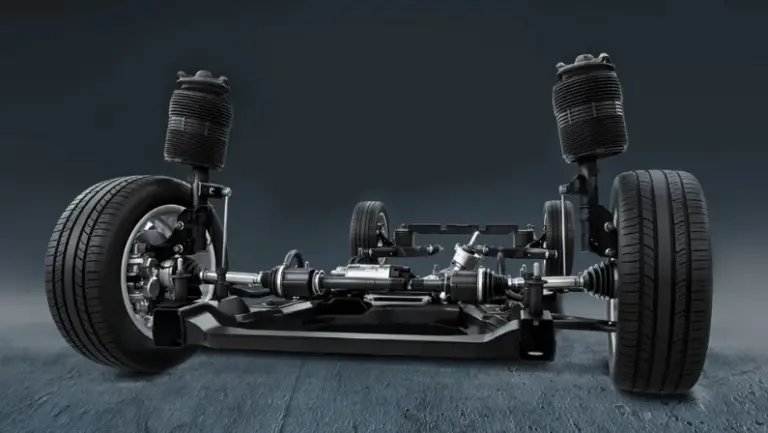
Understanding the system is the foundation for diagnosing it correctly. The Range Rover uses an Electronic Air Suspension (EAS) system rather than the conventional coil springs and shock absorbers found on most vehicles. Instead of metal springs, each corner of the vehicle uses an air spring, sometimes called an air bag or air strut, which is essentially a reinforced rubber bladder filled with pressurized air.
Here is how the pieces fit together:
- Air compressor: The heart of the system. It compresses air and pumps it into the suspension system to maintain or change ride height.
- Air reservoir or accumulator: A storage tank that holds pressurized air so the compressor does not have to run continuously for small adjustments.
- Air springs (air bags): One at each corner of the vehicle. The pressurized air inside them supports the vehicle’s weight and provides the cushioning that replaces conventional springs.
- Valve block (solenoid valve block): This is the distribution hub. It contains individual solenoid valves for each air spring and the reservoir. The ECU commands these valves to open and close to route air where it is needed.
- Height sensors: One at each corner of the vehicle, connected between the chassis and the suspension arm. They measure the current ride height and report it to the ECU continuously.
- ECU (Suspension Control Unit): The computer that manages everything. It reads the height sensors, commands the compressor and valve block, and monitors system pressure to maintain the correct ride height for the selected driving mode.
When the driver selects a different ride height, whether that is standard, off-road high, or motorway low, the ECU commands the valve block to route air from the compressor or reservoir into the relevant air springs to raise the vehicle, or to release air from those springs to lower it. The height sensors provide real-time feedback so the ECU knows when the target height has been reached.
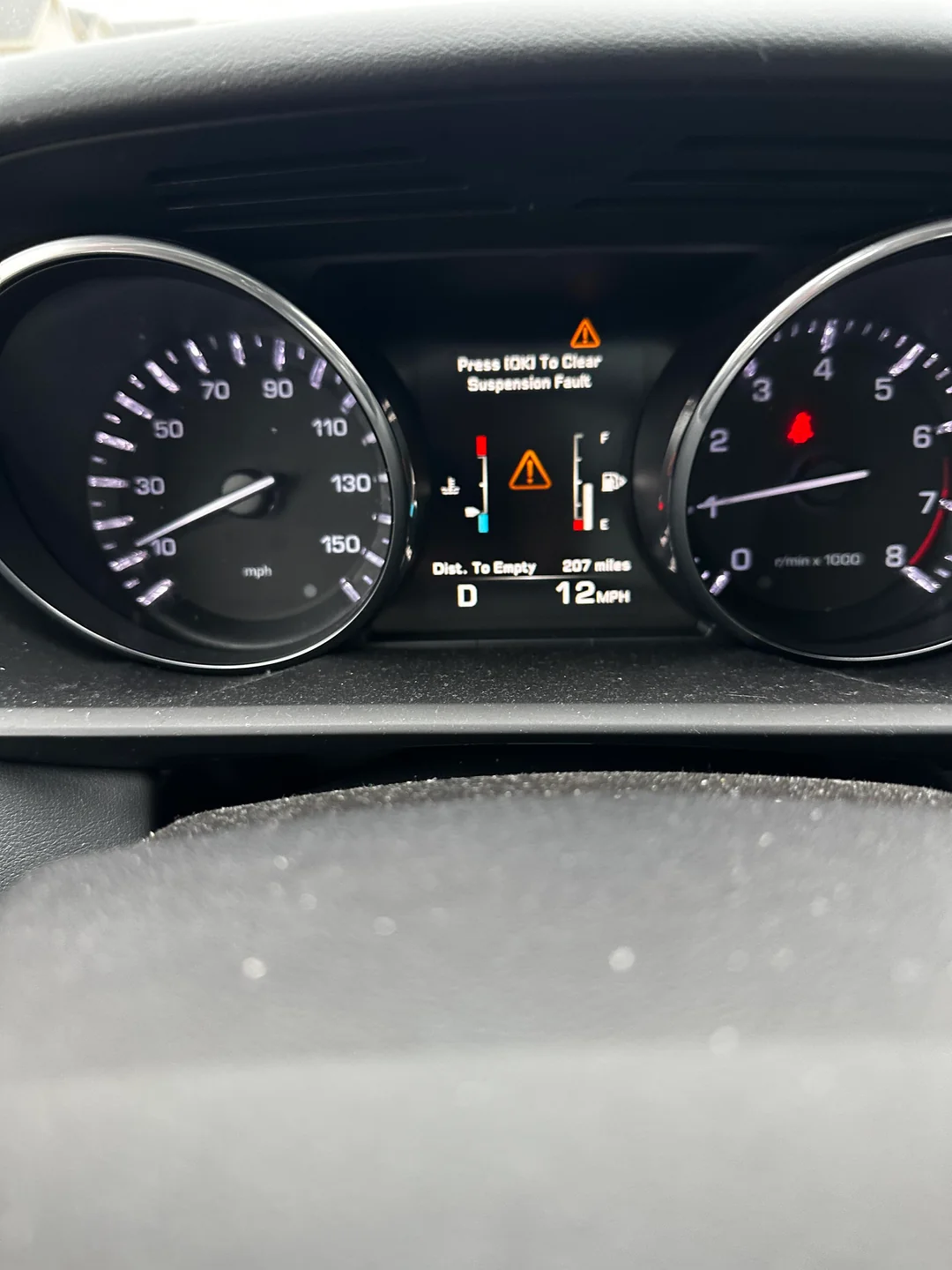
When any part of that loop breaks down, the suspension fault warning appears.
How to Use Your Range Rover’s On-Screen System to Check Suspension Status
Range Rovers with the full infotainment system have a built-in way to check the suspension status that many owners do not know about. This is a useful first step before doing any physical inspection.
- From the main menu on the touchscreen, select the 4X4 information option.
- Navigate to the Chassis View or Suspension Status section.
- You will see a diagram of the vehicle with the height status at each corner displayed.
- All four corners should show equal, level readings in the selected ride height mode. If one or more corners is showing significantly lower than the others, that corner has a suspension fault that is preventing it from maintaining the correct height.
This on-screen view does not diagnose the specific component that has failed, but it tells you exactly which corner of the vehicle is affected, which narrows the diagnosis significantly.
Symptoms of a Range Rover Suspension Fault
1. Suspension Warning Light on the Dashboard
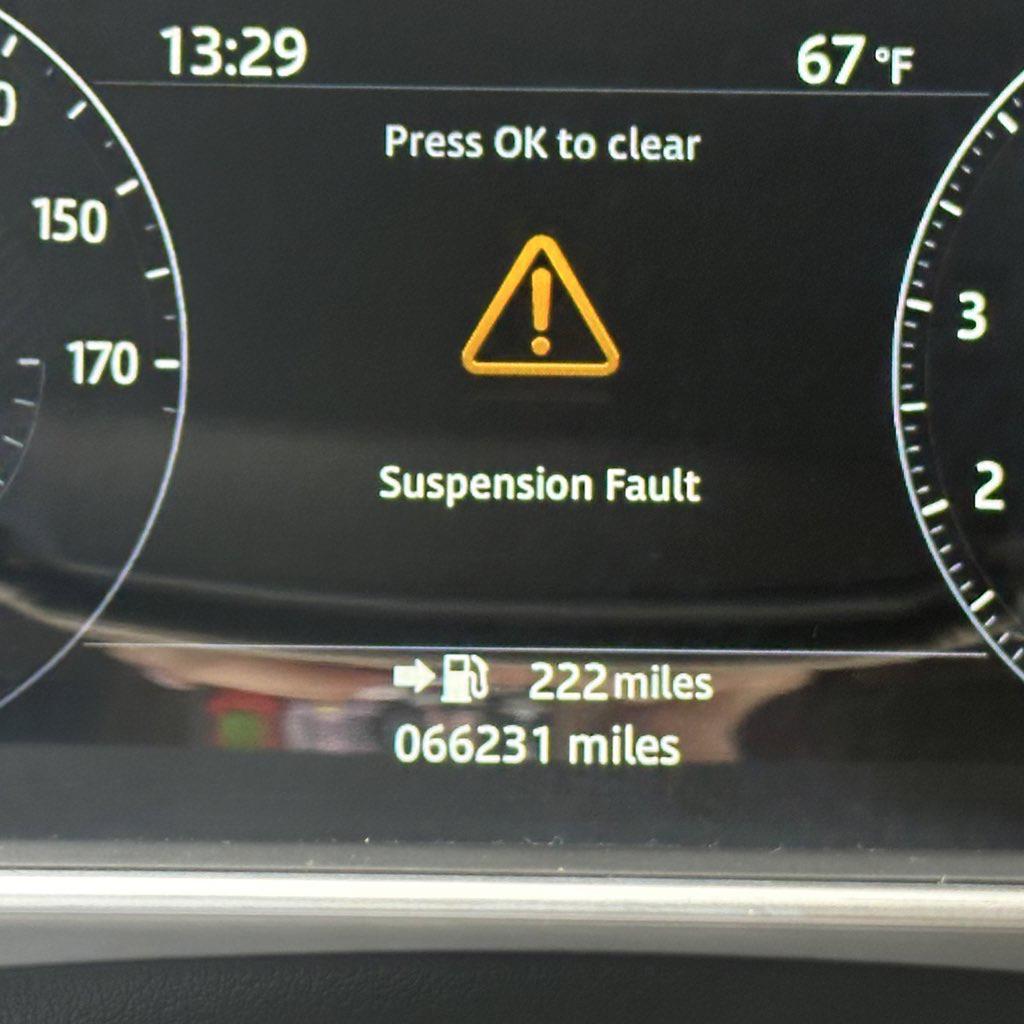
The amber suspension warning indicator is the most direct signal that the ECU has detected a fault. It may appear alongside a text message on the instrument cluster such as “Suspension Fault,” “Suspension Lowered,” or “Suspension Normal Height Not Available.” The specific message gives you context about what the system is doing in response to the fault.
Do not confuse this with the general warning triangle, which can appear for many different system faults. The suspension warning is specifically related to the air suspension system and should be your prompt to investigate the suspension components.
2. Vehicle Sitting Unevenly or Sagging at One Corner
If you walk up to your parked Range Rover and notice that one side or one corner sits lower than the others, an air spring is losing pressure. This is one of the clearest visual symptoms of an air suspension fault. It means either the air spring itself is leaking, the valve for that corner is not sealing properly, or the valve block is allowing air to bleed from that spring when it should be holding it.
In more severe cases, the vehicle may drop to its lowest possible position overnight as air bleeds out. This is sometimes called the “kneeling” position, and while it is the system’s safe mode to prevent driving on deflated bags, it also indicates that a component is not holding pressure as it should.
3. Noticeably Bumpier or Harsher Ride
When the air springs cannot maintain proper pressure, the cushioning effect that makes Range Rovers feel so smooth is dramatically reduced. Instead of absorbing road impacts, the vehicle transmits them directly to the cabin. If a ride that used to feel composed and smooth now feels hard and choppy over the same roads, a loss of air pressure in one or more springs is likely the cause.
4. Compressor Running Excessively or Constantly
The air compressor should run briefly when the vehicle starts and when a height change is commanded, then stop once the target pressure is reached. If the compressor is running almost constantly, or if you can hear it cycling on and off frequently while parked, it is fighting against a leak somewhere in the system. The compressor is trying to maintain pressure but cannot because air is escaping faster than it can replace it.
A compressor that runs excessively will wear out much faster than normal. An overworked compressor is not just a symptom of a leak. Left unaddressed, it becomes the next component to fail, turning a relatively inexpensive air spring or valve repair into a more costly compressor replacement as well.
5. Thumping or Knocking Noise From the Wheels
A thumping or clunking sound from around the wheels, particularly over bumps, speed bumps, or rough patches, often indicates a problem with the physical suspension components rather than the air system specifically. Worn ball joints, failed shock absorbers that are no longer damping properly, or a strut that has lost structural integrity can all produce these noises. On a Range Rover, these mechanical components work alongside the air system, and either type of failure produces audible symptoms.
6. The Bounce Test
This is a simple physical check that gives you a quick sense of the suspension’s damping performance. Push down firmly on each corner of the vehicle’s bodywork, then release. A healthy suspension with functioning dampers should push back up once and settle in one smooth motion. If the corner bounces up and down two or more times before settling, the shock absorber or air strut at that corner is not damping correctly and may need to be replaced.
What Actually Causes Range Rover Suspension Faults
1. Leaking Air Springs (Air Bags)
This is the single most common cause of Range Rover air suspension faults, particularly on older models and higher-mileage vehicles. The air springs are made from reinforced rubber, and that rubber degrades over time from exposure to UV light, road chemicals, ozone, and the constant flexing and pressurization cycles of daily driving.
The most common failure point is where the rubber bag meets the metal end cap at either the top or bottom of the spring. The bonded joint between the rubber and the metal cap can crack over time, allowing air to escape slowly. A small leak may only be noticeable as a corner that sits slightly low after sitting overnight. A larger leak causes the corner to drop noticeably while the vehicle is parked or even while driving.
Air spring leaks can sometimes be located by spraying soapy water on the spring and connections while the system is pressurized. Bubbles will form at the leak point. However, finding the leak location is easier than the repair, which requires depressurizing the system, removing the wheel and associated components to access the spring, and installing a replacement.
2. Faulty Valve Block (Solenoid Valve Block)
The valve block contains all the solenoid valves that route air to each corner of the vehicle. Each valve has a rubber O-ring seal that prevents air from bypassing the valve when it is commanded closed. These O-rings harden and crack over time, particularly from the compressor oil that is present in the air supply. When an O-ring fails, the valve cannot hold air in the spring, and the affected corner loses pressure.
A leaking valve block is sometimes distinguishable from a leaking air spring by the pattern of the fault. A valve block leak often affects the front two corners or rear two corners simultaneously if the leak is at a shared valve, or causes a corner to drop slowly rather than rapidly. An experienced technician with the right diagnostic equipment can perform pressure tests to differentiate between a spring leak and a valve block leak.
Valve block O-ring replacement kits are available and represent a much cheaper fix than replacing the entire valve block assembly. However, the work requires careful disassembly and the correct O-ring sizes for your specific Range Rover generation.
3. Failing Air Compressor
The compressor is a wear item that eventually reaches the end of its service life. On Range Rovers that have developed slow leaks anywhere in the system, the compressor has been working harder than normal to compensate. This accelerated wear can cause the compressor to fail prematurely.
Signs of a failing compressor beyond the already-mentioned excessive running include a grinding or whirring noise when the compressor operates, the compressor running but being unable to raise the vehicle to the target height, or the compressor not running at all when commanded. The compressor also contains a dryer element that absorbs moisture from the air supply. A saturated dryer can allow moisture into the air springs and valve block, accelerating corrosion and seal deterioration. Most compressor replacements should include a new dryer element.
4. Height Sensor Failure
There is one height sensor at each corner of the vehicle, connected between the suspension arm and the chassis. These sensors are potentiometers that measure the angle of the linkage and translate it into a ride height measurement that the ECU can use. The sensors and their linkage rods are exposed to road debris, mud, salt, and constant movement.
A failed height sensor gives the ECU incorrect data about the actual ride height at that corner. The ECU might think a corner is lower than it is and command the compressor to pump air unnecessarily, or it might think a corner is higher than it is and not respond to an actual drop in ride height. Height sensor failures will typically store a specific fault code that identifies the corner and the nature of the sensor fault.
The physical linkage arm connecting the sensor to the suspension can also break, bend, or disconnect from its mounting points, which produces the same effect as a failed sensor. A visual inspection of each corner’s sensor and its linkage rod is always worth doing before assuming the sensor itself has failed electronically.
5. ECU (Suspension Control Module) Failure
The suspension ECU manages the entire system and is typically very reliable. When it does fail, it is usually from water damage, which can happen if the module gets wet from a leak in the cabin, or from power supply issues such as a failing main battery causing voltage spikes. A failed ECU may produce multiple simultaneous fault codes, may fail to command any suspension changes, or may cause erratic behavior where the suspension attempts to adjust and cannot reach the target height.
ECU failures should be confirmed by a specialist before the module is replaced, as the symptoms can be confused with sensor or valve faults. A replacement ECU also needs to be coded to the vehicle, which requires specialist software.
6. Worn Mechanical Suspension Components
Beyond the air system, the Range Rover has conventional mechanical components that wear out over time: ball joints, bushings, control arm bearings, and the damping elements of the air struts themselves. These do not trigger the air suspension fault warning directly but produce symptoms that are easily confused with air system problems, particularly the thumping and clunking noises and degraded ride quality.
How to Fix Range Rover Suspension Faults
The repair approach depends entirely on what has been diagnosed. Here is how to address each specific cause.
Fix 1: Replace Leaking Air Springs
Air spring replacement requires depressurizing the system before any work begins. Attempting to remove an air spring without releasing the pressure first is dangerous. Here is the general sequence:
- Use a diagnostic tool with EAS access to depressurize the system and vent the air springs.
- Raise the vehicle safely on a lift or jack stands. Never work under a Range Rover supported only by a floor jack.
- Remove the wheel at the affected corner.
- Disconnect the air line from the top of the air spring. Have a rag ready as residual air will escape.
- Disconnect the top mount of the air spring from the chassis and the bottom from the suspension arm.
- Install the new air spring, reconnect all fittings and lines, and torque the mounting hardware to specification.
- Reinstall the wheel and lower the vehicle.
- Use the diagnostic tool to re-pressurize the system and perform a ride height calibration.
Air springs should ideally be replaced in pairs at the same axle, particularly if the vehicle has higher mileage. If one spring has failed from age-related rubber degradation, the opposite spring is likely at a similar state of wear.
Fix 2: Repair or Replace the Valve Block
If the O-ring repair kit approach is chosen, the valve block must be removed from the vehicle, disassembled carefully, the old O-rings replaced with the correct new ones, and the block reassembled and reinstalled. This requires patience and attention to detail, as the O-ring sizes are specific and the assembly must be done correctly to restore proper sealing.
If a complete valve block replacement is chosen instead, the procedure is simpler since the old unit comes out as a whole and the new unit goes in. The trade-off is cost: a complete valve block assembly is more expensive than an O-ring kit, but the repair takes less time and eliminates any uncertainty about the quality of the internal rebuild.
Fix 3: Replace the Air Compressor
Compressor replacement on the Range Rover is a relatively accessible job. The compressor is typically mounted in the engine bay or the rear of the vehicle depending on the generation. Replacement involves disconnecting the power connector, the air outlet line, and the mounting bolts. Installation is the reverse of removal. When fitting the new compressor, also replace the dryer element if it is not already included with the new unit. After installation, run the compressor through several inflation and deflation cycles to check for proper operation before returning the vehicle to normal use.
Fix 4: Replace Height Sensors or Linkage Rods
Height sensor replacement is one of the simpler jobs in the air suspension system. The sensor mounts to the chassis with two bolts, and the linkage rod connects to the suspension arm with a clip or bolt. Replacement is straightforward once the wheel is removed for access.
After replacing any height sensor, a ride height calibration must be performed using diagnostic software. Without this calibration step, the new sensor’s readings will not be matched to the known reference heights in the ECU, and the system will not operate correctly. This calibration step is frequently overlooked by non-specialist workshops and is the reason why a new sensor sometimes does not seem to fix the problem.
Fix 5: ECU Replacement and Programming
If the suspension ECU has failed, it needs to be replaced and programmed to the vehicle. A second-hand unit from a breaker’s yard is not usually viable because it will be coded to a different vehicle and will not simply plug in and work. A new or professionally remanufactured unit that is programmed during installation is the correct approach. This is a job for a Range Rover specialist or main dealer with the appropriate coding software.

Diagnosing Range Rover Suspension Faults With an OBD Tool
A standard OBD-II scanner will not access the air suspension system on a Range Rover. The suspension ECU is a separate module that requires either a Land Rover-specific diagnostic tool, such as SDD (Symptom Driven Diagnostics), or a quality third-party tool that supports Land Rover extended module access.
With the right tool, you can:
- Read all stored fault codes from the suspension module
- View live data from each height sensor in real time
- Monitor compressor run time and system pressure
- Command individual valves open and closed to test the valve block
- Perform ride height calibration after sensor or spring replacement
- Clear fault codes after repairs are completed
Without these capabilities, diagnosing a Range Rover suspension fault is largely guesswork. The diagnostic information the specialist tools provide eliminates that guesswork and gives you a clear direction for the repair.
What Does It Cost to Fix a Range Rover Suspension Fault?
| Repair | Estimated Cost |
|---|---|
| Air spring replacement (single corner) | $300 to $800 |
| Air spring replacement (full set of four) | $1,000 to $2,500 |
| Valve block O-ring kit (DIY) | $30 to $80 |
| Valve block replacement (complete unit) | $300 to $800 |
| Air compressor replacement | $300 to $700 |
| Height sensor replacement (single) | $100 to $300 |
| ECU replacement and programming | $500 to $1,500+ |
| Full air suspension rebuild (all major components) | $2,000 to $5,000+ |
Range Rover suspension repairs are not inexpensive, but the cost spread is significant depending on what has actually failed. A single height sensor is a manageable repair. A full system rebuild with new springs, compressor, and valve block is a major expense. This is another reason why proper diagnosis before any repairs begin is so important for Range Rover owners. Replacing an air spring when the real problem is a leaking valve block wastes money and leaves the vehicle with the same fault.
Should You Convert to Coilover Springs?
Some Range Rover owners, particularly those who have faced repeated or expensive air suspension repairs, consider converting to conventional coilover springs. Conversion kits are available that replace the air springs and often eliminate the need for the compressor and valve block entirely.
Here is the honest trade-off. A coilover conversion eliminates the ongoing air suspension maintenance costs and provides a more mechanically simple system that is less prone to failure. But it also eliminates the variable ride height capability, the terrain-specific suspension adjustment, and much of the ride quality refinement that makes the Range Rover what it is. The on-road ride quality of a coilover-converted Range Rover is noticeably firmer, and off-road capability is reduced since the vehicle can no longer raise its ground clearance on demand.
For a vehicle that is used primarily on road and the owner is done with air suspension repair bills, conversion is a practical choice. For a vehicle that is used for its intended purpose as a premium all-terrain vehicle, keeping the air suspension properly maintained and repaired preserves the character the vehicle was designed to deliver.
Preventive Maintenance to Reduce Suspension Fault Risk
Some Range Rover suspension problems are inevitable on a high-mileage vehicle with an air system. But the rate at which they occur can be reduced with a few maintenance practices:
- Never run the vehicle with the air springs severely underinflated or the vehicle noticeably sagging. Driving on a deflated air spring damages it further and stresses the compressor.
- Address leaks promptly. A small leak that is found and fixed early is far cheaper than waiting until the compressor burns out from overwork.
- Keep the compressor dryer element in serviceable condition. When the compressor is replaced, always replace the dryer at the same time.
- Keep the height sensor linkages and their pivot points clean and free from corrosion. A seized pivot can cause sensor readings to become inaccurate and eventually damage the sensor itself.
- Have the suspension fault codes read by a specialist whenever the warning light appears. Do not clear the codes without understanding what caused them. A code that keeps returning after clearing is telling you something important.
A Range Rover with a functioning air suspension system is a genuinely remarkable machine. The difference between a system that is properly maintained and one that is limping along with failing components is dramatic, both in comfort and in capability. Do not let suspension faults linger. Address them with proper diagnosis, and your Range Rover will continue to deliver the experience it was designed to provide.