
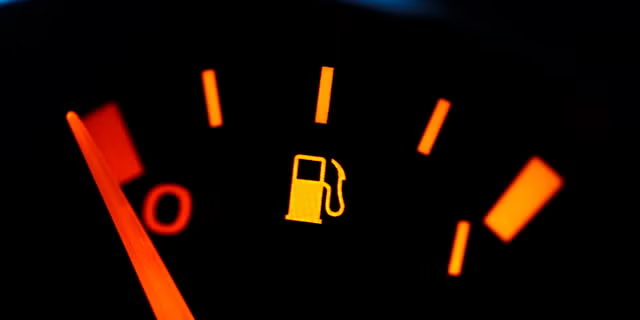
The fuel light coming on is never a relaxing moment. If it happens when you are close to home, you can breathe again. But if it shows up when you are on a highway with no nearby gas station, or you are miles away from “civilization,” it becomes a real problem you must solve fast: how far can you actually go before the engine starts acting up or the tank truly runs dry?
Good news: you can usually estimate your remaining range with the same logic car manuals already use. Your dashboard light is not random. It comes on when the fuel in the tank reaches a reserve level. The reserve amount is not identical for every car, but there is a common rule of thumb that helps you calculate a practical distance and make smart decisions.
In this article, I will show you how the reserve system works, how to estimate your distance after the fuel light turns on, and what to do next so you do not turn a simple refuel into an expensive and stressful roadside situation. I will also include the example calculation from the original guidance using the Toyota Corolla 2013 and the “Tank on Empty” option for a faster estimate.
Fuel light basics: what the light really means
When the fuel light on your dashboard turns on, it means your vehicle is running low on fuel. Many drivers react by panicking, mainly because they do not know whether they still have “a little” or “not much at all.” A few minutes of panic can lead to bad decisions, like driving aggressively or skipping the nearest station that is still within reach.
The key point is this: the fuel light usually comes on once your fuel drops to a reserve level. This reserve level is described in your vehicle manual and is usually tied to the total fuel tank capacity. If you understand that reserve amount, you can estimate how much fuel remains and how far you can go.
There is no single universal reserve percentage for every car. Even so, the original guidance gives a very common reference point: reserve volume is typically around 10 to 15 percent of the total tank capacity. That is usually enough information to estimate a realistic range using your vehicle’s average fuel consumption.
The reserve rule of thumb: 10 to 15 percent
Let us break the reserve idea into something you can use quickly.
- Step 1: Find your total fuel tank capacity in liters or gallons (your manual provides this).
- Step 2: Treat the reserve fuel as roughly 10 to 15 percent of that tank capacity.
- Step 3: Use your average fuel consumption (how many kilometers per liter, or how many miles per gallon) to estimate distance.
- Step 4: Drive to refuel sooner, not later, because real driving conditions can reduce range.
That is the “math” behind the fuel light. It is not perfect, but it is practical. It also stops you from guessing blindly when you are in a bad situation.
How to calculate how far you can go after the fuel light comes on
You do not need advanced tools to estimate your distance. You need three pieces of information:
- Total fuel tank capacity from your manual.
- Reserve percentage (the original guidance says reserve is usually about 10 to 15 percent).
- Your average fuel consumption for typical driving on your roads.
If you want to keep it simple, you can estimate using the 10 percent side first when you want to be cautious. Then you can treat the 15 percent side as the best-case scenario. This gives you a safer range and prevents you from overconfident calculations.
Here is a practical way to do the calculation on the road without turning it into a complicated math class.
| What you need | Where to find it | How you use it |
|---|---|---|
| Fuel tank capacity | Owner’s manual or spec sheet | Determine total liters or gallons |
| Reserve amount | Reserve is usually 10 to 15 percent | Multiply tank capacity by 0.10 to 0.15 |
| Average consumption | Your normal driving experience or vehicle trip computer | Use distance-per-fuel to estimate kilometers or miles |
Even if you do not want to do the math, the logic still helps you make good decisions. For example, if the reserve amount is small, you should treat the situation as urgent immediately.
Example calculation: Toyota Corolla 2013 fuel light range
The original guidance includes a clear example using the Toyota Corolla 2013. Let us walk through it in a way that makes the numbers feel real.
The fuel tank capacity for that Corolla is 13.2 gallons, which is about 50 liters. The reserve level is typically around 10 percent for this type of calculation. So 10 percent of 50 liters is roughly 5 liters remaining when the light comes on.
Then you take the vehicle’s average fuel consumption on the road and estimate how much distance those remaining liters can cover. In the example, the vehicle can travel about 60 kilometers when the fuel light comes on.
That number is an estimate. Your real range can shrink if your driving is not “average,” which brings us to the next important point.
Why your real range may be shorter than the estimate
Even if you use the same reserve percentage (10 to 15 percent), your actual remaining distance can vary. The original guidance highlights two major reasons:
- Vehicle version and modifications: Fuel tank capacity can change in modified or upgraded versions. That changes reserve volume too.
- Driving habits: Your driving technique affects fuel consumption. Good driving habits that improve fuel mileage matter a lot.
In plain terms, the fuel light may still mean you have reserve fuel, but how quickly you burn it depends on how you are driving right now. If you have been speeding, climbing hills, or sitting in heavy traffic, you may reach empty sooner than the calm driving estimate suggests.
That is why you should treat fuel-light range as a guide, not a promise. Use it to plan your next stop, not to keep pushing forward in denial.
Use “Tank on Empty” for a quicker estimate (if you do not trust your math)
If you do not fully trust your own calculation, the original guidance mentions a helpful online resource called “Tank on Empty”.
The idea is simple: users enter the car they are using and how far they have traveled after the fuel light turns on. Then the site calculates the number of miles you can go forward based on that input. This can be especially useful if you have a different trim, a different engine setup, or you do not know your accurate average fuel consumption at that moment.
Here is a practical tip. If you use a community estimate, you still should be conservative. Remember that your driving conditions and terrain may differ from other drivers, and your range can drop faster when you are dealing with traffic, hills, or aggressive driving.
What to do right when the fuel light comes on
Once you understand how far you can go, you should act with a clear mission: refuel soon and avoid pushing the tank too far. The biggest win is avoiding the moment where the car suddenly refuses to move.
That can happen, especially if you keep going until you run completely out of fuel. Then you are not only dealing with inconvenience. You can also damage parts of the fuel system over time.
The original guidance makes a specific warning here: letting the tank get extremely low can damage your vehicle’s fuel system. Deposits and residue at the bottom of the tank can get pushed out with the last drops of fuel. That residue can end up clogging the fuel filter, which creates a new problem you did not plan for.
So the practical approach is simple: use the fuel light range to reach a refueling station before you hit “empty.” Do not treat the fuel light as permission to stretch your luck.
A safe plan that helps you avoid getting stuck
Here is how to handle it calmly. Think like a driver, not like someone trying to win a challenge.
- Plan your next refuel stop immediately: Do not wait until you “start feeling it.” Your best decision is the one you make early.
- Drive smoothly: Sudden acceleration and heavy braking burn fuel faster.
- Reduce unnecessary loads: Extra weight can hurt fuel economy. Keep items secure and avoid extra trips.
- Avoid high idle when possible: If you are stuck at long lights, try to keep the engine running efficiently rather than revving.
- Follow your estimate but add a buffer: If the estimate is 60 kilometers, aim to stop well before that distance.
Even if the estimate is correct, you can lose range due to unexpected driving changes. A buffer protects you from that uncertainty.
How to squeeze a little more range without damaging your car
Sometimes you are already low. It is not about playing games with the fuel gauge. It is about driving in a way that helps your engine use fuel efficiently while you get to the station.
These tips are simple, and they match the original guidance about fuel mileage habits. They are also realistic for everyday driving.
- Accelerate gently: Smooth acceleration helps your car not waste fuel.
- Keep a steady speed where possible: Constant speed usually beats stop-and-go driving for consumption.
- Use higher gear appropriately: When your car allows it, do not keep the engine at unnecessarily high RPM.
- Check your tire pressure: Underinflated tires can increase rolling resistance and reduce fuel economy.
- Do not idle too long: If you are stopped for a long time and it is safe to turn off the engine, it can save fuel.
Even if you do everything right, do not gamble on reaching empty. The moment you hit empty, you are no longer just “running low.” You are entering the danger zone for your fuel system and your ability to restart the engine safely.
Common questions drivers ask when the fuel light comes on
Does the fuel light always mean 10 to 15 percent left?
Usually, the reserve is around 10 to 15 percent of the total tank capacity, according to the guidance used here. But remember there is no standard figure for every car. Different models can trigger the light at different points, and modified versions can change tank size and reserve volume.
This is why you should check your manual for your specific vehicle instead of assuming every car works the same way.
What happens if I keep driving hard after the light comes on?
You will likely reduce the distance you can cover. The original guidance directly states that driving habits and technique affect fuel consumption. Aggressive driving uses more fuel per kilometer, meaning the “reserve fuel” is burned faster.
That is why smooth driving and early refueling are tied together. When you drive calmly, your estimate becomes more realistic. When you drive hard, you cut your margin.
Should I use Tank on Empty or just do the math?
Either approach is fine. If you know your tank capacity and your typical fuel consumption, your own calculation can work well. If you do not trust your consumption estimate, or you are using a different trim or engine setup, the “Tank on Empty” database can provide a quicker estimate from other drivers.
The best strategy is conservative driving either way. You still should plan a refuel stop before you get close to the maximum estimate.
Is it bad to run the tank very low?
Yes, it can be risky. The original guidance explains that deposits and residue at the bottom of the tank can be pushed out when the last drops of fuel are used. That residue can clog the fuel filter and damage the fuel system over time.
That does not mean you will break your car the first time you run low. It means frequent “very low” driving can lead to recurring problems and cost.
Your next move: make the fuel light a plan, not a panic
Before you drive away today, make it a habit. Check your manual for tank capacity and reserve information, then keep your driving habits fuel-efficient so your estimate stays realistic.
When the fuel light comes on, use the estimate to reach the nearest refuel point. Do not try to stretch it until empty, and do not assume you have “hours” left just because the engine still runs.
Quick question: When your fuel light comes on, how many kilometers or miles do you think you can usually get based on your real experience?