

A long-term fuel trim that runs high at idle is one of those problems that many car owners discover through an OBD2 scanner without fully understanding what the reading actually means or why it matters. The engine may seem to be running, the car still moves, and there are no obvious signs of a crisis. But underneath that apparent normality, the engine control system is compensating hard for something that is wrong, and if the root cause is not addressed, more serious and expensive problems tend to follow.
This guide explains what long-term fuel trim is in plain terms, what causes it to read high specifically at idle, and how to work through the diagnosis and repair without overcomplicating things or spending money unnecessarily.
What Is Long-Term Fuel Trim and What Does “High” Actually Mean?
Your engine needs a precise ratio of air to fuel to run efficiently. Too much air and the mixture runs lean. Too much fuel and it runs rich. The engine control unit, sometimes called the ECU or PCM, continuously monitors this balance and makes real-time adjustments to keep everything within the correct range.
Fuel trim is the term for those adjustments. It comes in two types:
Short-term fuel trim (STFT) is the immediate, moment-to-moment correction the ECU makes based on live oxygen sensor readings. It fluctuates constantly as conditions change.
Long-term fuel trim (LTFT) is the sustained correction the ECU has learned to apply over time. If the short-term trim keeps making the same adjustment repeatedly, the ECU writes that pattern into the long-term trim so it does not have to keep relearning it from scratch every time the engine starts.
Both values are expressed as percentages. A positive LTFT means the ECU is adding fuel to compensate for a lean condition, meaning the engine is getting too much air or not enough fuel for the amount of air coming in. A negative LTFT means the ECU is reducing fuel to compensate for a rich condition.
Under normal operating conditions, both LTFT and STFT should sit reasonably close to zero. A combined value of LTFT and STFT above plus or minus 10 percent is generally considered outside the acceptable range and indicates a problem worth investigating. A long-term fuel trim that is persistently high, meaning consistently positive and above that threshold, tells you the engine has been running lean for long enough that the ECU had to bake in a permanent correction just to keep the air-fuel ratio within range.
The fact that it shows up specifically at idle is an important diagnostic clue. Idle is when the engine is at its most sensitive to small disruptions. Air leaks and sensor errors that get drowned out at higher engine speeds can have a disproportionate effect when the throttle is nearly closed and airflow is minimal.
What Causes Long-Term Fuel Trim to Run High at Idle
Vacuum Leaks: The Most Common Culprit by a Wide Margin
Vacuum leaks are responsible for the majority of high LTFT readings at idle, and understanding why helps you prioritize your diagnosis correctly.
Your engine’s intake system is designed to be a sealed environment between the throttle body and the combustion chamber. The ECU measures air entering the engine through the mass airflow sensor and uses that reading to calculate how much fuel to inject. If extra air enters the system through a crack or leak downstream of the MAF sensor, the ECU never sees it. That unmetered air goes straight into the engine, leans out the mixture, the oxygen sensor detects it, and the ECU starts adding fuel to compensate.
At idle, the throttle is nearly shut. The small amount of regulated air coming through the throttle body is a tiny flow. An unmetered leak that might represent a small percentage of total airflow at highway speed becomes a much larger percentage of total airflow at idle, which is why vacuum leaks so often show up specifically at idle rather than at cruising speed.
Common vacuum leak locations include:
- Cracked or disconnected vacuum hoses anywhere between the throttle body and the intake manifold
- A deteriorated or blown intake manifold gasket, particularly common on older vehicles
- A leaking throttle body gasket or boot connecting the air filter housing to the throttle body
- PCV system hoses that have hardened or cracked over time
- Brake booster vacuum lines that have developed small cracks
Failing Oxygen Sensor: When the Feedback Loop Gets Bad Data
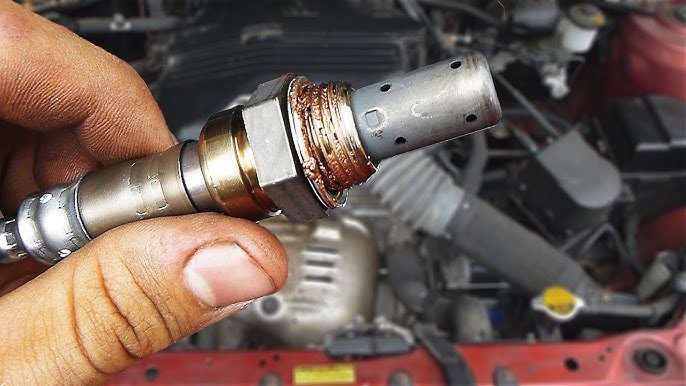
The oxygen sensor is positioned in the exhaust stream specifically to measure how much oxygen is present in the exhaust gases. That reading tells the ECU whether combustion was lean or rich, and the ECU uses that information to correct the fuel delivery for the next combustion event.
When the oxygen sensor ages or fails, its readings become inaccurate. A sensor that erroneously reports a lean condition when the mixture is actually correct will cause the ECU to add fuel that is not needed. Done consistently over time, this correction gets written into the long-term fuel trim as a high positive value.
Oxygen sensors do not always fail completely. In many cases, they slow down. A healthy sensor switches between rich and lean readings rapidly. An aging sensor responds sluggishly, and that slow response can confuse the ECU into making incorrect corrections. Sensors also become contaminated by oil burning in the combustion chamber, coolant leaks, or silicone contamination from certain types of RTV sealant used during engine repairs.
Clogged Fuel Injectors: When the Fuel Delivery Side Cannot Keep Up
Fuel injectors have precision-machined nozzles that spray a very specific pattern and volume of fuel. Over time, carbon deposits from combustion, varnish deposits from fuel sitting in the injector during hot shutdown cycles, and general contamination can partially block those nozzles.
A partially clogged injector delivers less fuel than the ECU is commanding. The engine runs lean as a result, the oxygen sensor detects it, and the ECU raises the fuel trim to compensate. If all injectors are slightly restricted rather than one being dramatically blocked, the effect is spread evenly across all cylinders and may not cause obvious misfires. Instead, it quietly pushes the long-term fuel trim upward as the ECU tries to make up the difference.
This issue tends to be worse at idle because fuel injectors on some engine designs spend more time in a particular part of their duty cycle at low engine speeds, making the restriction more significant relative to total fuel demand.
Malfunctioning Mass Airflow Sensor: Measurement Errors That Cascade Through the System
The mass airflow sensor measures the volume and density of air entering the engine. The ECU uses that measurement as the starting point for calculating how much fuel to inject. If the MAF reads low, meaning it reports less air than is actually entering the engine, the ECU calculates too little fuel for the actual airflow. The engine runs lean, the oxygen sensor confirms it, and the ECU raises fuel trim to compensate.
MAF sensors become contaminated over time. The sensing element is a very fine wire or film that sits directly in the airstream. Oil from a poorly maintained air filter, dust, carbon particles, and other contaminants can coat the sensor element and cause it to read inaccurately. A dirty MAF sensor is often recoverable with cleaning rather than replacement, which makes it one of the more satisfying diagnoses to work through.
A MAF sensor fault that affects idle more than cruise speed suggests the sensor may be partially contaminated rather than completely failed. At higher airflow rates, the error may be proportionally smaller. At idle airflow rates, the same absolute measurement error becomes a larger percentage of the total reading.
How to Diagnose and Fix Long-Term Fuel Trim High at Idle
The most effective approach is to work from the most common cause toward the less common ones, and to confirm each cause before spending money on parts.
Step 1: Read and Record the Fuel Trim Values
Before touching anything, connect an OBD2 scanner and record the live LTFT and STFT values at idle. Note whether the LTFT is elevated only at idle or also at cruise speed. This distinction is important:
- High LTFT at idle that normalizes at cruise speed points strongly toward a vacuum leak or an issue that is proportionally more significant at low airflow
- High LTFT at both idle and cruise suggests a fuel delivery issue, a weak fuel pump, clogged injectors, or a MAF sensor that is consistently reading low
- A high LTFT with a relatively stable STFT suggests the ECU has already corrected for the problem in long-term memory
- Both LTFT and STFT spiking high together suggests an acute lean condition the ECU is struggling to correct
If you see any stored fault codes alongside the fuel trim readings, record those too. They can point directly toward specific sensors or circuits that are reporting outside normal parameters.
Step 2: Check for Vacuum Leaks
Given that vacuum leaks are the most frequent cause of high LTFT at idle, this check belongs near the top of the list regardless of what else the scanner shows.
Start with a thorough visual inspection of all vacuum hoses. Look for cracks, particularly at the ends near the connection points where rubber tends to harden and split. Check that all hoses are fully seated on their fittings and have not slipped or been pulled loose. Inspect the intake boot between the air filter and the throttle body for tears or cracks.
A smoke test is the most reliable way to find small leaks that are not visible to the naked eye. A smoke machine pressurizes the intake system with harmless smoke, and leaks show up as wisps of smoke escaping from the fault point. Many independent shops offer smoke testing for a modest fee, and it can save hours of guessing.
If smoke testing equipment is not available, propane enrichment or carb cleaner can be used carefully to locate leaks by spraying small amounts near suspected areas while watching for changes in idle speed. Changes in idle when the spray hits a specific spot indicate that air was being drawn in at that point. Use extreme caution with carb cleaner near any ignition source, and never spray near hot exhaust components.
Once a leak is found, fix it. Cracked hoses are replaced. A leaking intake manifold gasket requires removing the intake manifold to install a new gasket set. The complexity varies by engine design, but on most four-cylinder engines this is a straightforward repair. On V6 or V8 engines, the lower intake manifold gasket can require considerably more disassembly.
Step 3: Inspect and Test the Oxygen Sensor
If vacuum leaks are ruled out or repaired but the LTFT remains elevated, the oxygen sensor moves up the suspect list. An OBD2 scanner with live data capability can show the upstream oxygen sensor voltage in real time. A healthy sensor should be switching between approximately 0.1 and 0.9 volts at a reasonably quick rate, typically several times per second at idle.
A sensor that is stuck at a constant voltage, switching very slowly, or hovering at an unusual value is not providing accurate feedback. An oxygen sensor that is consistently reporting lean, meaning it stays near 0.1 volts rather than oscillating normally, will cause the ECU to add fuel persistently, which shows up as a high positive LTFT.
Oxygen sensor replacement is straightforward on most engines. The sensor threads into the exhaust pipe and requires an oxygen sensor socket or wrench to remove. On a hot engine, use penetrating oil generously and allow time for it to work before attempting removal, particularly on older vehicles where the sensor threads may be corroded into the exhaust.
Replace with a sensor that matches the original specification for your vehicle. Sensors that do not match the correct impedance or response characteristics can cause the same symptoms as a failed original sensor.
Step 4: Clean or Replace the Fuel Injectors
Cleaning the fuel injectors is worth attempting before replacement, particularly if the vehicle has not had injector service in a long time. Fuel injector cleaning additives added to the fuel tank provide a basic level of cleaning for mild deposits. Professional injector cleaning using dedicated cleaning equipment connected directly to the fuel rail is more thorough and more effective for moderate to significant buildup.
If cleaning does not bring the fuel trim readings back into range and all other causes have been ruled out, injector replacement is the next step. Individual injectors can be replaced, or a complete set can be installed if the vehicle is high mileage and the labor for doing one at a time is significant relative to the cost of replacing all of them.
Step 5: Clean or Test the Mass Airflow Sensor
A dirty MAF sensor can often be cleaned back to proper operation before replacement is necessary. MAF sensor cleaner, which is a specialized solvent safe for use on the delicate sensing element, can be sprayed carefully onto the element with the sensor removed from the intake tract. Allow it to dry completely before reinstalling.
After cleaning, clear the fault codes, reset the ECU if needed, and monitor the LTFT on a fresh drive cycle to see whether the reading has improved. If it has, the contamination was the cause and cleaning solved it. If the LTFT remains high and all other causes have been addressed, the MAF sensor itself may need replacement.
Testing the MAF sensor using live scanner data is straightforward. Compare the grams per second reading at idle against the specification for your engine displacement. A sensor reading significantly lower than expected for the engine size at idle is a strong indicator that it is measuring inaccurately.
Step 6: Reset the ECU After Repairs

After completing repairs, the ECU needs to relearn its fuel trim values based on the corrected system. The old long-term fuel trim values that reflected the fault are still stored and will continue to influence fueling until the ECU updates them.
Resetting the ECU clears stored fault codes and wipes the learned fuel trim values, allowing the ECU to build new values from a clean baseline. This can be done by disconnecting the negative battery terminal for approximately ten minutes, or more completely through an OBD2 scanner that supports ECU reset functions.
After the reset, drive the vehicle through several complete warm-up cycles that include a mix of idle, city driving, and highway driving. The ECU will relearn fuel trim values over these drive cycles, and the LTFT should settle back close to zero if the underlying fault has been corrected. Checking the live fuel trim values again after a day or two of normal driving confirms whether the repair was successful.
Understanding Positive and Negative Fuel Trim Values
Knowing which direction the fuel trim has gone tells you something useful about what type of fault you are dealing with.
Positive LTFT means the ECU is adding fuel. The engine is running lean. The causes that push fuel trim positive include vacuum leaks, a failing oxygen sensor that reports lean incorrectly, a weak fuel pump, clogged injectors, or a MAF sensor that under-reads airflow. Ignition misfires can also affect fuel trim readings, since unburned oxygen in the exhaust from a misfire event gets read by the oxygen sensor as a lean condition.
Negative LTFT means the ECU is reducing fuel. The engine is running rich. Causes that push fuel trim negative include a leaking fuel injector that is delivering more fuel than commanded, a faulty oxygen sensor that reports rich incorrectly, a clogged air filter restricting airflow, excessive fuel pressure from a failing fuel pressure regulator, or a chattering injector that is not closing completely between injection events.

The idle-versus-cruise distinction also matters here. A vacuum leak creates a lean condition that is proportionally larger at idle than at cruise because the same fixed amount of unmetered air represents a much larger fraction of total airflow at low engine speeds. A fuel delivery issue tends to show up more consistently across the full operating range. Using that pattern when reading live data helps you narrow the diagnosis before you start removing parts.
What Happens If You Leave It Unaddressed
A long-term fuel trim running persistently high means the ECU is working at the edge of its correction authority. Most ECUs can compensate for lean conditions up to a certain limit, typically around plus 25 percent. If the underlying fault is severe enough to push the correction demand beyond that limit, the ECU can no longer maintain proper fueling, and the engine will run lean despite maximum correction.
A chronically lean-running engine runs hotter than designed. Over extended periods, excessive heat accelerates wear on exhaust valves, erodes valve seats, and can damage catalytic converters. Persistent lean running under load can cause detonation, which is a form of uncontrolled combustion that is particularly hard on pistons and bearings.
The oxygen sensor and catalytic converter are also at risk from the prolonged rich fueling that results when the ECU over-corrects without resolving the underlying cause. Catalytic converter damage is expensive, and it rarely fails in isolation. The root cause that damaged it is usually still present when the replacement converter is installed.
Getting the fuel trim back into range is not just about optimizing performance. It is about protecting components that cost considerably more to replace than a vacuum hose, an oxygen sensor, or an afternoon of diagnostic work.
If your scanner shows LTFT above plus 10 percent at idle and it stays there consistently across multiple drive cycles, start with a vacuum leak inspection before you spend money on any sensors or injectors. More often than not, a cracked hose or a gasket is the entire problem, and finding it takes a smoke test and twenty minutes rather than a week of parts swapping.