

That rattling sound is your car talking to you. It usually happens when you press the gas and the engine load or drivetrain stress increases. Sometimes it starts as a mild buzz, then grows louder as you drive. Other times it is immediate, loud, and impossible to ignore.
A rattling noise can point to problems with parts that are expensive if they get worse. Some causes are minor and fixable quickly. Others are a warning that something important is wearing out, loosening, or failing under acceleration.
The goal of this guide is simple. You will learn the most common reasons for rattling when accelerating, what each one sounds like, and what you can do next. Even if you never open a hood, you will be able to discuss the problem intelligently with a mechanic and avoid unnecessary guessing.
We will focus on 6 common fixes that explain most rattles under acceleration. You will also find extra diagnostic tips because rattles often have more than one possible source.
Quick safety note before you chase the rattle. If the noise comes with severe loss of power, overheating, smoke, or a flashing warning light, stop driving and get the vehicle inspected. A rattling sound is one thing, but secondary warnings can mean the problem is more serious.
Why Rattling Shows Up When You Accelerate
Acceleration changes how forces travel through your car. The engine revs faster, torque increases, and components that are normally lightly loaded start moving more aggressively. If something is loose, worn, cracked, or not lubricating properly, the extra stress makes the problem loud and obvious.
That is why a rattling noise often has patterns. It can happen only during hard acceleration. It can appear at low speeds in certain gears. It can show up at highway speed under steady throttle. The pattern helps you narrow down the cause quickly.
Here is a practical way to think about it. A rattle is usually caused by a part that is shaking, vibrating, or hitting another part. That can be caused by missing bolts, broken brackets, worn bearings, failing mounts, low fluid that reduces lubrication and hydraulic damping, or exhaust parts that are no longer held firmly in place.
6 Common Fixes for Rattling Noise When Accelerating
Below are the six most common causes that often show up as rattling during acceleration. For each one, you will get:
- What it is and why it rattles
- What it usually sounds like in real life
- How to check without wasting time
- What the fix usually involves
1) Low Transmission Fluid Level
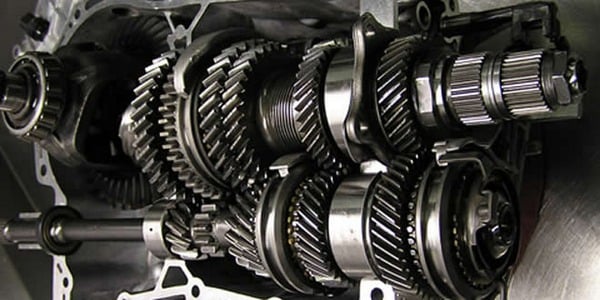
Low transmission fluid is one of the easiest rattling causes to handle, but it can still turn into a big problem if it keeps getting ignored. Transmission fluid lubricates and helps control internal moving parts. When fluid is low, those components can lose proper lubrication and damping, which increases vibration and rattling under load.
In many cases, you will notice symptoms along with the rattle. You might hear rough shifting, feel delayed engagement, or experience hesitation when you accelerate. Low fluid can also increase wear inside the transmission, so the rattle is not just an annoyance. It is a sign of stress.
Quick clues this is low fluid
- Rattle appears mostly when you put load on the drivetrain (acceleration, hills)
- Shifting feels rough or inconsistent
- Transmission fluid on the dipstick (if your model uses one) is below the correct level
- You may find evidence of fluid leaks under the front or center of the vehicle
Do not top off blindly for every rattling noise. First, confirm the level. Then look for leaks. If the fluid keeps disappearing, adding fluid without fixing the leak is only delaying the inevitable.
How to check and fix low transmission fluid
Start with the basics.
- Check transmission fluid level with the engine running in the correct temperature range, if your vehicle requires it.
- Make sure you are using the correct fluid type listed in the owner manual.
- Look for leaks by checking for dampness around the pan, cooler lines, and seals.
- After topping up, test drive and listen for changes.
If fluid is low because of a leak, you need the leak repaired. Fixing the fluid level is the first step. Fixing the cause is what prevents the rattle from coming back.
If you are not sure how to check transmission fluid on your exact model, do not guess. One vehicle may need the engine warm and idling. Another may need a specific drive cycle before checking. A correct check matters.
2) Bad Torque Converter
The torque converter is part of the automatic transmission system. Its job is to transmit engine power to the transmission smoothly. When the torque converter starts failing, the driveline can behave strangely. That can create rattling sounds that increase as the problem worsens.
Here is the key detail. Early torque converter failure often does not announce itself clearly. As it gets worse, rattling frequency increases, especially when you accelerate or shift under load.
Signs of torque converter trouble
- Rattle increases in frequency as the vehicle ages
- Shuddering or vibration during acceleration
- Slipping or delayed engagement into drive
- Noticeable changes in how the car feels when you accelerate from a stop
- Sometimes a transmission-related fault code appears
Torque converter problems can overlap with other transmission issues. That is why you want a proper diagnosis, not just fluid topping or guessing.
What the fix usually involves
In many cases, a failing torque converter requires repair or replacement. Some symptoms may improve if internal transmission issues are addressed as part of the broader transmission repair. Shops often perform tests using scan tools and road checks, not just inspection.
When torque converter failure is suspected, the smart next move is to have the transmission inspected by a shop experienced with automatic transmission diagnostics. The torque converter is not a simple “swap a part” job.
3) Failed Motor Mount
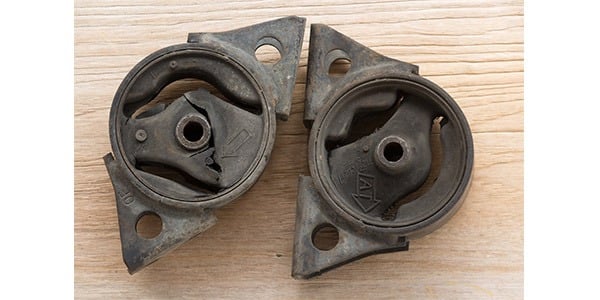
Motor mounts hold the engine in place and isolate vibration. When a mount fails, the engine shifts more than it should. That movement can cause the engine to contact components it normally clears. The result can be rattling, especially under acceleration when engine torque makes the engine move.
On many cars, a passenger-side motor mount is a common failure point. One big clue is oil leakage. When you see oil leaking uncontrollably from the mount area, you have a strong hint the mount is impaired.
How to tell a motor mount is bad
- Rattle increases when you accelerate or shift gears
- Engine movement is noticeable when you put the car in drive and release the brake
- Oil or fluid leaking around the mount area
- Visible cracking or separation in the mount
- Even if you do not see oil stains, a mount may still be failing due to internal deterioration
That last point matters. Sometimes you do not see the oil leak, and you still have a failed mount. In those cases, calling a trained professional is a good decision because mount inspection can require getting into tight areas safely.
What the fix usually involves
Motor mount replacement is a common repair. Depending on the vehicle, the shop may need to support the engine before removing the mount. After replacement, rattling should reduce noticeably, especially under acceleration and load changes.
Be alert for a common trap. People sometimes replace mounts without checking other worn parts that create the same symptom, like exhaust brackets or heat shields. A quick inspection saves money.
4) Broken Heat Shield
Heat shields protect nearby components from exhaust heat. They also prevent vibration and rattle by keeping metal panels firmly supported. When a heat shield becomes loose or breaks, it can vibrate against exhaust components or other parts. That vibration often becomes loud when you accelerate or reach higher engine RPM.
When the shields are loose or broken, they stop reflecting barriers in the exhaust system and other areas like the fuel line area and even the cabin components and gas tank proximity. That can lead to abnormal heat transfer, and the rattling becomes especially noticeable when driving or moving at top speed.
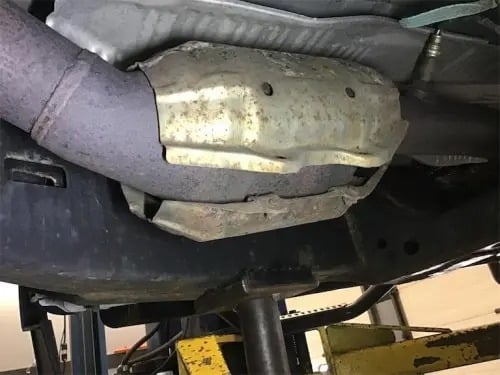
How to check heat shields safely
Heat shield inspection is one of the few checks you can usually do with basic tools, but you must be careful. Exhaust parts can stay extremely hot after a drive. The safest approach is to wait a few hours after shutting down, then inspect the underside.
Look for loose metal panels, broken mounting points, missing screws, or shields hanging with gaps. If you find a shield that is contacting other parts, the rattle often makes sense immediately.
What fixing a heat shield looks like
If the heat shield is loose, the repair is often tightening or replacing fasteners. If the shield is broken, it may require replacement. Either way, correcting the shield restores its support and reduces rattle.
Do not ignore heat shield issues. Heat shields are not just noise control. They protect wiring and fuel lines from heat soak.
5) Exhaust Leak
An exhaust leak can create rattling too. Exhaust systems vibrate, and leaks can cause parts to shake or buzz at the same time you accelerate. The engine may also run slightly differently because exhaust flow is disturbed, which can make the noise more noticeable under load.
The tricky part is that exhaust leaks can be hidden. Sometimes they are near joints, flanges, welds, or around worn gaskets. To inspect, many owners use a jack to access the underside. Some people try to inspect with the engine running, but that is risky because exhaust components can get extremely hot.
If you inspect exhaust components, keep it safe. Do not crawl under a vehicle supported only by a jack. Use proper stands. If you must use a running engine as a diagnostic aid, keep your hands and face out of danger and follow strict safety precautions. Otherwise, inspect when everything is cooled.
What to look for
- Cracks in exhaust pipes or manifolds
- Loose connections between exhaust sections
- Broken or defective cones and couplers between exhaust pipes
- So exhaust residue that indicates hot gas escaping
- Metal rubbing or contact points caused by movement
In some cases, owners attempt to “block all leaks” by removing or temporarily sealing components. The original approach often involves welding or using special sealing material. In real life, the best fix is the one that restores a secure exhaust seal with proper materials, because temporary patches can fail under heat cycles.
If you are unsure, have the exhaust system inspected by a muffler or exhaust specialist. They often find leaks quickly because they see these issues all day.
6) Loosened V-Belt Pulley
A loosened V-belt pulley can create loud rattling. When the belt is no longer aligned or when tension is not correct, parts can vibrate. That vibration turns into a rattling sound, especially when engine RPM increases during acceleration.
The pulley and belt work together to transmit power. When the pulley loosens, you can get friction and metal-on-metal contact. That friction is often what creates an alarming rattling. It also can damage the belt and related components quickly.
How to check the pulley and belt
You can start with a visual inspection. Locate the pulley belt area and check for frayed sides, cracks, and misalignment.
- Look for frayed or damaged belt edges
- Check whether the belt looks twisted or misaligned
- Inspect the pulley area for looseness or wobble
- Listen for changes when you rev slightly, only if it is safe to do so
- If the belt is damaged, plan on replacing it
If the pulley is only loose, tightening or replacing the mounting hardware may fix the rattling. If the belt has damage, you usually need a belt replacement so the problem does not return immediately.
What about serious symptoms?
If the rattling is loud and you feel vibration in the steering wheel or see slipping accessories like the alternator or power steering not working correctly, stop driving. A belt and pulley issue can turn into a more serious drivability problem quickly.
Rattling is often fixable. Neglect is what turns a fixable problem into an expensive one.
Video: How to Fix Rattling Noise in Your Car
Video: How to fix rattling noise in your car
Rattling at Low Speed Versus High Speed: Why It Matters
Rattling noise is not limited to top speed. Many drivers notice rattles at low speed too, like when accelerating from a stop or crawling in traffic. If the sound appears at low speed and also at higher speed, it often means the underlying part is loose or worn enough to vibrate across multiple operating conditions.
Here is the practical approach. Treat the low-speed rattle and high-speed rattle as connected until you prove otherwise. But also remember that different parts can start vibrating only in certain ranges. A heat shield can buzz at high RPM while a motor mount can rattle at low RPM under load.
When you are diagnosing, pay attention to gear selection and throttle position. If the rattle changes when you shift from Drive into Neutral, that is a huge clue. If it gets louder only when the transmission is engaged, focus on transmission-related causes first.
A Quick Priority Checklist Before You Start Replacing Parts
Most people make the same mistake. They hear a rattle and start buying parts. That can waste money and still not solve the noise.
Use this priority order. It is fast, practical, and it prevents expensive guesswork.
- Confirm the pattern: Does it happen in all gears, or mostly when the transmission is loaded?
- Check fluids: Transmission fluid level and signs of leaks.
- Check mounts and brackets: Look for engine movement and loose fasteners.
- Inspect heat shields: Underside metal panels and exhaust-area brackets.
- Inspect exhaust joints: Look for leaks, cracks, loose cones, and damaged gaskets.
- Check belts and pulleys: Belt condition, pulley looseness, and alignment.
If you follow that list, you will usually find the source without random part swaps.
What to Do Right Now If You Hear a Rattle When Accelerating
You do not need to panic. But you also should not keep driving like nothing is wrong. A rattling noise is often a “looseness or wear” problem, and those generally worsen with time.
Here is a sensible action sequence.
- Listen and note the pattern. When does it happen, and how does it change with throttle?
- Check for obvious issues. Loose heat shields, missing exhaust fasteners, or visible leaks.
- Check fluids if relevant. Confirm transmission fluid level and look for leaks.
- Inspect belts and pulleys. Look for belt damage, looseness, or misalignment.
- Do a safe road test after each fix. If the noise improves, you are on the right track.
- If you still cannot identify it, get a professional inspection. Do not keep guessing.
A good diagnosis is cheaper than repeated trial-and-error repairs.
When You Should Stop Driving and Get Help
Driving while a rattling issue is worsening can turn a manageable repair into an engine or drivetrain problem. Stop driving and get help if you notice any of these:
- Rattling becomes metal-on-metal loud quickly
- You feel shuddering or major vibration through the vehicle
- Transmission slipping or refusal to shift happens
- Oil warning light or transmission warning light appears
- Engine overheating or smoke appears
- Belt squeal, belt dust, or sudden accessory failures happen
- You hear additional noises that were not present before
If you see or hear any of those, treat it as a stop-til-fixed situation, not “drive it and see.”
Why Acting Quickly Saves Money
There is a reason “minor issue” problems can become “major repair” problems. Vibration and heat accelerate wear. Loose parts can fall out or damage adjacent components. Low fluid accelerates internal wear. A failed mount can worsen exhaust or bracket damage because everything starts rubbing more.
Act quickly so your fix stays in the “reasonable” category. Even if you pay for diagnostics, that cost is often smaller than replacing a damaged transmission component, exhaust sections, or warped parts caused by prolonged driving.
Common Questions About Rattling Noises When Accelerating
Can a heat shield cause only low-speed rattling?
Yes. Heat shields can vibrate at certain RPM ranges. If your rattle appears mainly when you are accelerating lightly, it can still be a heat shield even if you do not hear it at highway speed. The key is the pattern and whether the noise changes when the engine RPM changes.
Will topping off transmission fluid always fix the rattle?
Topping off can reduce the noise if low fluid was the direct cause. However, if the fluid is low due to a leak, the rattle will likely come back unless you repair the leak. Also, if the torque converter or internal transmission components are already damaged, topping off may not fully eliminate the noise.
Should I tighten the exhaust to stop the rattle?
Sometimes you can stop rattling by tightening loose exhaust components. But an exhaust leak can still exist. If the exhaust joint is cracked or the gasket is damaged, tightening alone might not seal it. You want to inspect the connection and confirm that the leak source is resolved.
What if the noise is worse after a fix?
Then you likely fixed one loose point but revealed another failing part, or the fix created a new vibration path. For example, tightening one bracket might cause another shield or bracket to touch. That is why road testing after each step is important.
Your Action Plan to Find Your Rattle Fast
Use this plan today. It is designed for real people in real garages, not just professional technicians.
Step 1: Start with a short test drive. Notice when it rattles. Step 2: Check transmission fluid level if your car has an automatic transmission and the rattle follows acceleration and shifting. Step 3: Inspect the underside for heat shields and exhaust hangers once things are cool. Step 4: Inspect belts and pulleys while the engine is off and safe. Step 5: If you cannot narrow it down, get diagnostics rather than random parts.
Here is the most important part. The rattle will rarely get better on its own. Your best move is to identify the source early, fix it correctly, and stop the wear before it becomes damage.
Question for you: Does your rattle sound more like metal buzzing from the engine area, or like something under the car vibrating near the exhaust? Your answer will tell you which of the six common fixes to check first.