
Your exhaust system has one job people rarely think about until it becomes loud. The car’s engine is built to do heavy work every time it runs. Fuel combustion happens inside the engine, and that process creates noise and exhaust gases that have to be managed for comfort, control, and emissions.
That is where the muffler comes in. A muffler is designed to reduce noise, especially the harsh sound produced during internal combustion. But some drivers look at that noise reduction and decide they want a louder, more aggressive sound instead, which is where muffler delete comes up.
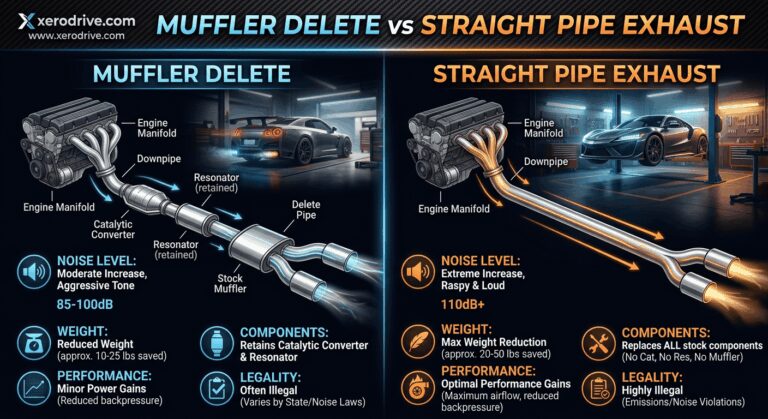
Another idea you hear is straight pipe exhaust. It sounds similar to muffler delete, but it is not the same setup. In real-world terms, muffler delete removes the muffler, while straight pipe exhaust removes the catalytic converter and muffler as part of the change.
Before you start cutting metal, you want to understand the difference, what each modification actually does to sound and performance, and what the risks are. That way, you can decide based on your goals and your local rules, not just because someone on the internet says it “feels faster.”
In this guide, I will explain muffler delete and straight pipe exhaust in plain language, compare the pros and cons, cover what you should expect from the sound, and walk through the common questions drivers ask before making the switch. Let us start with the basics of what a muffler is doing in the first place.
Why your car is noisy without an exhaust system doing the work
Internal combustion engines generate pressure waves as combustion occurs. Those pressure waves travel through the exhaust piping and show up as noise at the tailpipe. Without proper components in the exhaust path, the noise becomes harsh, droning, and sometimes annoying to other drivers.
That is why the factory exhaust system includes a muffler. The muffler acts as a noise-cancellation device, designed to reduce sound. It is not just about being quiet for comfort. It also helps keep the exhaust flow and sound character more manageable across different engine speeds.
So when someone removes the muffler through a “muffler delete” process, they change how noise travels. The exhaust still flows, but the sound reduction is removed. This can create an “exhilarating” sound to some owners, and a constant headache to others.
Now, straight pipe exhaust takes that idea further. A straight pipe setup is meant to allow gases to travel more directly out of the car. But the crucial point is that straight pipe exhaust is also typically tied to removing components like the catalytic converter and the muffler, which changes not only sound, but also emissions behavior.
Muffler delete vs straight pipe exhaust: the core difference that matters
Let us make the key differences crystal clear. Drivers confuse these two setups because both end with a different exhaust sound. But they differ in what is removed, what changes in power, and what happens to emissions.
| Feature | Muffler delete | Straight pipe exhaust |
|---|---|---|
| What gets removed | Removes the muffler as a whole | Removes both the catalytic converter and muffler |
| Power change | Does not increase power | |
| Power change | Performance can be reduced depending on the setup | Straight pipe can improve engine performance slightly |
| Sound character | Exhilarating exhaust sound | Original, crisp, and pleasant sound (as described) |
| Emissions impact | Does not remove the catalytic converter, so it is not the same emissions removal scenario | Emissions increase because there is no catalytic converter available |
That table is the decision point. If your goal is sound with minimal emissions changes, muffler delete is the common route. If your goal is a more free-flow exhaust with the catalytic converter and muffler removed, you are moving into straight pipe territory and accepting bigger emissions and legality risks.
Now let us unpack each option properly, including the advantages and disadvantages drivers actually report.
Muffler delete: what it is, what it does, and what to expect
A muffler delete is exactly what it sounds like. You remove the muffler component from the exhaust system. The goal is to reduce the amount of noise cancellation that the muffler provides, which usually makes the exhaust louder and changes the tone.
It should not be treated as the same thing as straight pipe exhaust. A muffler delete does not require you to remove the catalytic converter. So even though the sound gets more aggressive, the emissions setup is not automatically removed in the same way.
It is also useful to understand the “why” behind why people do it. Many drivers want less muffled sound and more engine character. Others want a louder high-RPM note and a more direct response when they accelerate.
Advantages of muffler delete
Here are the advantages typically claimed for muffler delete, keeping the key points you already saw in the original breakdown.
- Helps with droning noise
- Increases horsepower in high RPMs
- Not expensive when installing
But here is the practical interpretation. “Helps with droning noise” usually means the muffler delete changes the resonance pattern. Some cars drone more than others with certain mufflers, and removing the muffler can change the way sound frequencies bounce around. In some setups, owners feel the sound is less annoying at steady speeds.
For the “increases horsepower in high RPMs” claim, it helps to understand how performance is tied to exhaust flow. In many cases, removing restrictions can slightly affect flow behavior at higher engine speeds. Even so, you should not treat muffler delete as a guaranteed power upgrade, because the results vary by engine and by the rest of the exhaust design.
On the cost side, muffler delete is often cheaper than more extensive exhaust fabrication. That is why many people do it first when they want a new sound without spending as much as a full custom exhaust system.
Disadvantages of muffler delete
Now for the other side of the story. These disadvantages are the ones you should weigh before you decide.
- Car performance is low
- Causes gunk
Let me translate those disadvantages into something you can picture. “Car performance is low” does not always mean the engine is broken. It can mean the car feels weaker, especially in parts of the RPM range where the exhaust system no longer supports the factory tuning behavior.
“Causes gunk” is usually about deposits building up in the exhaust pathway. When exhaust components change, you can end up with more residue accumulation in places that previously stayed cleaner. Over time, that can affect exhaust flow and add cleaning or inspection work later.
So if you go muffler delete, plan to pay attention to what the car feels like, not just what it sounds like on the first drive home.
Straight pipe exhaust: what it is and why it changes more than sound
Straight pipe exhaust is often described as a system that transfers gases and noise from the engine straight to the tip of the exhaust. The idea is to reduce muffling and let the exhaust flow more freely.
In the common setup discussed here, the straight pipe system involves removing both the catalytic converter and the muffler. That matters because the catalytic converter is a major emissions control component. Removing it changes what comes out of the exhaust, not just how it sounds.
The original breakdown also notes that straight pipe exhaust is featured to help engine performance, produce the correct sound as per engine type, and increase emission rate. Those are not tiny details. They are the reason straight pipe setups are usually more controversial than muffler delete.
Advantages of a straight pipe exhaust
1. It gives the engine its right sound
The straight pipe exhaust system enables the engine to have the original sound. Some people assume it always means “too loud,” but for a lot of owners, the sound is enjoyable. It can be especially satisfying on vehicles with heavy engines or strong exhaust note character.
Another practical advantage is that an “original sound” can help you notice problems sooner. When the engine develops issues, the exhaust note can change. If you recognize how your car sounds when it is healthy, you become more aware when something is off and you take action earlier.
2. It can increase the car’s overall performance
Cars with straight pipe exhaust can be associated with high performance, especially when speed matters. The reasoning is that exhaust gases can flow freely, which reduces back pressure of the engine. In performance terms, less back pressure can help the engine breathe in some conditions.
As the engine can function more freely, the setup can lead to an increase in horsepower and torque because there are fewer exhaust flow hindrances. The original guidance also claims that this advantage is realized in fuel consumption, where usage is lowered while performance stays efficient.
Now, that is the part where real owners often report mixed experiences. Fuel consumption depends on how you drive, not only on exhaust. If you enjoy the sound and drive more aggressively, fuel usage typically climbs. If you keep driving smoothly and the engine feels more efficient, then you might see better consumption. The exhaust is not a magic fuel saver, but the effect can exist depending on your driving pattern.
3. The car will have less weight
Straight pipe exhaust removes components such as the catalytic converter and mufflers, which reduces weight. The original explanation is straightforward: removing the catalytic converter and mufflers enables the engine to operate freely with less weight.
Less weight is always a positive in performance terms, even if the weight difference is not the only factor determining speed. It can also make the exhaust setup simpler in some fabrication designs.
Disadvantages of straight pipe
- It leads the vehicle to produce excessive noise
- The emission of gases increases because there is no catalytic converter available
The noise part is predictable. Straight pipes lack the typical noise cancellation features of a muffler system. That usually creates a louder exhaust tone across more of the RPM range.
The emissions part is the bigger concern for the long term. Without a catalytic converter, exhaust gases are less filtered. That can increase the rate of emissions output, and it is also why inspections and regulations often target these modifications.
If you are considering a straight pipe setup, you should think about the driving environment you will be in. Daily commuting, long highway trips, and city driving are all different. The emissions and noise issues can become more annoying the longer you live with it.
What you notice day-to-day: sound, performance feel, and real-world downsides
Most owners decide based on sound first. But you should also expect changes in how the car feels and what you need to watch later. Here are the most common real-world areas that change when you choose muffler delete or straight pipe exhaust.
Sound: muffler delete is often “louder and exciting,” straight pipe is often “more raw”
The original breakdown says muffler delete makes the engine produce an exhilarating exhaust sound. Straight pipe exhaust is described as producing the engine’s original, sharp, and pleasant sound.
Those descriptions are consistent with what many drivers experience. Muffler delete can create a louder but still “muffled-less” tone that feels sporty. Straight pipe typically sounds more raw because there is less internal sound control, and the system is often designed to push exhaust out with less restriction.
But sound also depends on the engine type. A heavy V8 or a diesel has different exhaust note characteristics than a small turbo engine. So you might love the sound on one car and regret it on another, even with the same modification style.
Performance: straight pipe may improve performance slightly, muffler delete generally does not add power
In the original details, straight pipe exhaust improves engine performance slightly while muffler delete does not increase power. Muffler delete might affect the sound and may have some effects at high RPMs, but it is not presented as a guaranteed horsepower gain.
That matters when you evaluate your goals. If you want a visible acceleration improvement, straight pipe is the direction described as more likely to add performance. If you want sound changes and you are okay with performance staying close to stock, muffler delete is often chosen.
Fuel consumption: the claim exists for straight pipes, but driving style controls the final result
The original guidance states that straight pipe provides efficiency in performance and lowers usage, improving fuel consumption. That can happen in specific situations where exhaust flow and engine operating behavior feel more efficient.
However, you have to remember something in the real world. When the car sounds more aggressive, many owners drive it more aggressively too. That can cancel out any efficiency benefit. The best approach is to keep your driving habits steady for a few weeks after the install and compare actual results.
Gunk and maintenance: muffler delete can increase residue build-up
The original disadvantages list says muffler delete causes gunk. In everyday terms, that can mean residue buildup in the exhaust pathway or changes that cause deposits to accumulate more quickly.
If residue builds up, it can reduce exhaust efficiency over time. That can turn a fun sound into a weak-feeling exhaust experience. That is why it is smart to include inspections in your long-term plan.
Emissions behavior: straight pipe increases emissions because there is no catalytic converter
Straight pipe exhaust disadvantages explicitly mention increased emissions because the catalytic converter is not available. That is not only an environmental concern. It can also become a legal and inspection concern, depending on what your area checks for.
In addition, removing catalytic converters can change exhaust smell and may create issues during inspections. Some owners accept it for the sound. Others discover they cannot live with the consequences.
Installation considerations: what can go right and what can go wrong
People treat muffler deletes and straight pipes like quick weekend jobs. Sometimes they are. But exhaust work has its own dangers. Poor installation can cause leaks, vibration, and problems with fitment or heat exposure.
Also, the more you remove, the more you have to think about how parts connect. Straight pipe setups involve more change because you remove the catalytic converter too. That makes it more likely you will deal with fabrication, alignment, and exhaust clearance issues.
Here are common “smart owner” considerations before you allow any shop to cut and weld.
- Plan for a clean exhaust path: Exhaust should not contact wiring, plastic panels, or brake lines. Heat is real.
- Check for leaks: Exhaust leaks can add noise and fumes. You want a tight, sealed fit.
- Confirm the parts being removed: Muffler delete only removes the muffler. Straight pipe exhaust removes the catalytic converter and muffler as described.
- Ask what materials will be used: Exhaust systems respond to temperature and corrosion. Materials matter.
- Understand inspection rules first: Your region may treat these changes differently.
If a shop does not want to explain what they will remove, what they will install, and how they will finish joints, that is a red flag. You are changing how your car sounds and operates, so you deserve clear answers.
Costs: muffler delete is usually cheaper, straight pipe is usually much more expensive
Pricing varies based on your car model, the materials, and the mechanic. The original information gives clear ranges that you can use as a starting point.
How much does a muffler delete cost?
Muffler delete costs vary depending on the material used, the type of the car, and the mechanic who does the job. If you hire a mechanic, it may cost you more than $100, plus the required material which can cost more than $50.
That means muffler delete is usually the lower-cost option. People often choose it because they can change the sound without paying for a full exhaust rework.
How much does a straight pipe cost?
Installing straight pipe in your car will cost between $1000 and $1500 on average. The final cost changes depending on the car model, the mechanic, and the materials used.
The bigger price tag makes sense because straight pipe work usually involves more parts being removed and more fabrication time. You are also moving into a different legal and emissions category, which can affect what a reputable shop will even agree to install.
Do these mods actually increase horsepower?
This is where many conversations get messy. Drivers repeat claims like “it adds HP” without checking what type of exhaust restriction is removed and at what RPM range.
The original information makes two separate points. It says muffler delete does not add any power and some vehicles may feel reduced performance. It also says straight pipe increases horsepower by reducing backpressure, which makes the engine function harder, improving torque and horsepower.
Let us break that down in a practical way so you can interpret it when you hear it again at a shop.
Does muffler delete increase HP?
No, muffler delete does not increase horsepower in general, although it depends on the engine and model. The original note adds a nuance: in high RPM situations, a muffler is said to improve horsepower and torque, which is why removing it can reduce performance in some setups.
So if someone promises a major horsepower gain from muffler delete alone, you should be skeptical. The more reliable expectation is sound change, with possible performance trade-offs.
Does straight pipe increase HP?
Yes, straight pipe increases horsepower in the explanation provided because it reduces backpressure. When the engine works more freely from backpressure, both torque and horsepower increase.
This is the same general logic performance shops use when discussing exhaust flow. But again, real results vary based on the vehicle, the rest of the exhaust design, and engine tuning. Exhaust sound upgrades should not be treated as guaranteed performance upgrades unless you support the change with proper tuning and realistic testing.

How muffler delete and straight pipe actually affect sound quality
Sound is the main reason people do these modifications. The original guidance states that muffler delete produces an exhilarating exhaust sound. Straight pipe exhaust gives an original, sharp, pleasant sound as per engine type.
Here is the truth drivers learn after installation. Sound quality can be good or bad depending on what you like and where you drive. Some people love the raw tone at the start of the trip. Others find droning becomes tiring after an hour on the highway.
Also, driving at different speeds creates different exhaust notes. City driving and highway cruising do not “sound” the same. If you spend a lot of time in traffic, you might care more about low-RPM comfort. If you love the feel of high-RPM pulls, then you might focus on upper RPM sound.
If you are not sure, the best approach is to hear a similar setup in person before spending money. If you cannot, at least check videos and pay attention to drone at steady speeds.
Inspection and legality: why the rules matter as much as the sound
Even if your goal is just sound, the real-world decision depends on legality and inspection standards. The original information provides specific claims for muffler delete and straight pipe related to inspection and legality, and you should treat those as the baseline you must verify for your location.
Does muffler delete pass inspection?
Yes, without a muffler, your car will pass the inspection, according to the original information provided. Still, inspection rules differ by region, and it is smart to confirm before you install.
Is muffler delete illegal?
Muffler delete is considered illegal in some states because it is associated with unnecessary disturbances. That means having a muffler delete can break the law, and you can be filed a case.
Is a straight pipe illegal?
Installing a straight pipe may feel like it gives good performance, but is a straight pipe illegal? The provided explanation says straight pipes are connected with the muffler by cutting the inlet or outlet. Even so, inserting exhaust with holes like straight pipers, bypasses, and cutouts on mufflers are illegal.
That is why it is not enough to only think about “sound” and “power.” You have to confirm how your local regulations define these modifications and what is allowed or prohibited.
Reversibility: can you undo muffler delete?
One reason some drivers are comfortable with muffler delete is because it is described as reversible. The original guidance says yes, a muffler delete is reversible by cutting off the exhaust pipe that fits with the muffler inlet and outlet.
After that, the exhaust pipe should enter the inlet and outlet of the muffler again. Then you clamp or weld the joints to ensure they are tight.
So if you are worried about legal issues or resale value, reversibility can be a practical consideration. Still, you should be aware that welding and cutting can affect parts over time, so it is not always perfectly “cost-free” to reverse a modification.
Frequently Asked Questions about muffler delete and straight pipe exhaust
Is a muffler delete the same as a straight pipe?
No. Even though both systems involve engine sound and exhaust behavior, they are not the same. Muffler delete is removing the muffler, while straight pipes are a system designed to free the engine from backpressure by removing both the catalytic converter and muffler.
Is a muffler delete bad for your engine?
No, muffler delete is not bad for your engine in the explanation provided. It should not cause direct engine damage, though it can reduce engine performance depending on the engine and model.
Does a muffler delete affect performance?
Muffler delete does not add any power according to the original information. Instead, the engine performance can be reduced because horsepower is affected. The guidance also notes that not all cars behave the same, and some vehicles can improve their power.
Are straight pipes louder than mufflers?
Yes. Straight pipes are somewhat louder than mufflers because they lack a noise cancellation system. That also means the engine produces a more original sound. Mufflers are designed to reduce how much sound the engine exhausts, so they usually keep the noise lower than straight pipes.
Can you straight pipe a muffler delete?
Yes. You can straight pipe a muffler delete by cutting off the muffler delete system and replacing it with a straight pipe setup.
Does a muffler delete sound good?
With the muffler delete idea, you get an exhilarating exhaust sound. But whether it is good or bad depends on the owner. Some people prefer the original sound of their engine, while others like the changed sound that comes after muffler delete.
How much does a muffler delete cost?
Muffler delete costs vary depending on the material, the type of car, and the mechanic to do the job. If you are looking for a mechanic, it may cost more than $100 besides purchasing the required material, which can cost more than $50.
How much does a straight pipe cost?
Installing straight pipe costs between $1000 and $1500 on average. These costs vary depending on the model of the car, mechanics, and material choices.
Does muffler delete increase HP?
No, muffler delete does not increase horsepower, although it depends on the engine or model. The original note adds that at high RPM, a muffler is said to improve horsepower and torque.
Does straight pipe increase HP?
Yes. Straight pipe increases horsepower by reducing backpressure, which makes the engine function harder. By allowing the engine to work more freely without back pressure, both torque and horsepower increase.
Does the muffler delete pass inspection?
Yes, the original guidance says your car can pass inspection without a muffler.
Is a muffler delete reversible?
Yes, muffler delete is reversible. The process involves cutting off the exhaust pipe that connects to the muffler inlet and outlet, then installing the exhaust pipe back into the muffler inlet and outlet and using a clamp or weld to make sure the joints are tight.
Is a muffler delete illegal?
In some states, muffler delete is illegal because it is associated with unnecessary disturbances. That means it can break the law, and you may be filed a case.
Is a straight pipe illegal?
Straight pipe installations may give performance you like, but straight pipes can be illegal. The explanation provided says straight pipes are connected with the muffler by cutting the inlet or outlet. Even though no law directly points out straight pipes by name, exhaust inserts with holes like straight pipers, bypasses, and cutouts on mufflers are illegal.

So which one should you choose?
If your main desire is a louder, exhilarating exhaust sound without the full removal of emissions equipment, muffler delete is the option described here. It includes removing the muffler as a whole, and it is also presented as something not expensive to install.
If your main desire is a rawer, more original engine sound plus the chance of slight performance improvement through reduced backpressure, straight pipe exhaust is the option described here. Just remember what comes with it: removal of the catalytic converter and muffler, increased emissions behavior, and typically excessive noise.
Here is the part many drivers skip. Before you choose, check whether your state or country law allows what you want. Muffler delete can be illegal in some states due to disturbances, and straight pipe changes can also be illegal through how inspections and bans are enforced.
Do you want to make your car louder and more exciting, or do you also care about staying compliant and protecting long-term value?
Before you cut anything, make one smart decision first
If you are going to spend money on an exhaust change, do it with eyes open. Decide which goal you want most: sound, slight performance improvement, or keeping emissions equipment intact. Then confirm what is legal where you drive and only then choose the setup that matches that reality.
Which matters more to you right now: the sound at idle, the sound when you accelerate, or the ability to drive without worrying about legal trouble at the next inspection?