
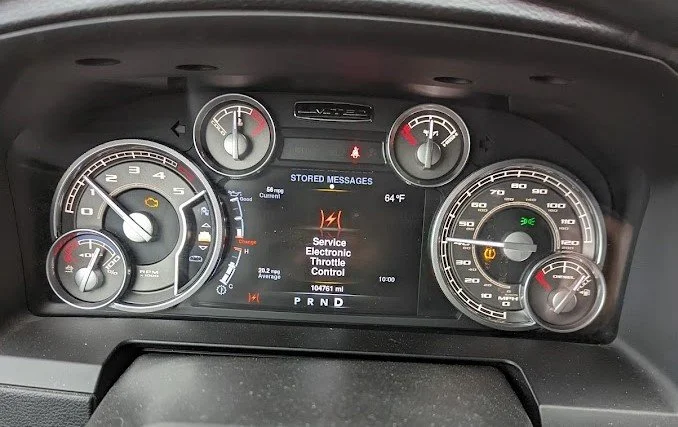
Seeing a “Service Electronic Throttle Control” warning light up on your Dodge Ram 1500 dashboard is not something you want to brush off. It is your truck telling you that something in its throttle system is not working the way it should. And depending on what caused it, you could be dealing with anything from a rough idle to a truck that barely responds when you press the gas pedal.
The good news is that this warning is not random. There are specific causes, identifiable symptoms, and real fixes. This guide walks you through all of it in plain language, so you can understand what is happening under the hood and make smart decisions about what to do next.
What the Electronic Throttle Control System Actually Does
Before getting into the warning message itself, it helps to understand what the Electronic Throttle Control system is and why it matters.
Older trucks used a mechanical cable that physically connected the accelerator pedal to the throttle body. When you pressed the gas, the cable pulled the throttle plate open. Simple and direct, but also limited. The ETC system replaces that cable with an electronic connection. No cable, no mechanical linkage. Just sensors, signals, and a small electric motor doing the work.
Here is how it works in practice. When you press the accelerator pedal, a sensor reads how far down you have pushed it and sends that information to the Engine Control Module (ECM). The ECM processes that data, calculates how much power is needed, and sends a signal to the electric motor in the throttle body. That motor then opens or closes the throttle plate to regulate how much air enters the engine.
It sounds more complicated than a cable, but it actually gives the truck far more precise control over acceleration, fuel delivery, traction management, and cruise control. The ETC system also allows other safety systems like stability control and traction control to intervene and reduce throttle when needed, something a mechanical cable cannot do.
But here is the trade-off. Because the system is entirely electronic, it is vulnerable to electrical faults, sensor failures, and software glitches. When something in that chain breaks down, the warning message appears and the system may go into a fail-safe mode to prevent engine damage.
What “Service Electronic Throttle Control” Really Means on a Ram 1500
When this warning message shows up on your Ram 1500, it means the vehicle’s computer has detected a fault somewhere in the electronic throttle control system. It is not vague. The computer knows something specific is wrong. What it cannot tell you without a scan tool is exactly which component is responsible.
The warning is often accompanied by the check engine light, and in some cases, the truck will enter what is called “limp mode.” Limp mode is a protective state where the ECM limits engine power to prevent further damage. The truck will still drive, but performance will be noticeably reduced. Acceleration will feel sluggish, top speed may be limited, and the engine may idle rough.
Think of limp mode as the truck protecting itself while telling you, “Something is wrong. Please stop driving me hard and get this looked at.”
Warning Signs You Should Not Ignore: Symptoms of a Failing ETC System
The warning message rarely shows up alone. In most cases, you will notice one or more of the following symptoms before or alongside the warning light. Paying attention to these signs can actually help narrow down the cause before you even touch a scanner.
- Rough or erratic idle when the truck is sitting still
- Hesitation when you press the accelerator, as if the engine is not responding immediately
- Sudden unexpected increase in speed without additional pedal input
- Jerking or bucking during acceleration, especially at lower speeds
- Noticeable drop in engine performance, particularly under load
- Poor fuel economy that seems to have gotten worse recently
- Strange noise coming from the throttle body area
- Check engine light appearing alongside or before the ETC warning
- Throttle warning light illuminating on the dashboard
- Engine stalling at idle or when coming to a stop
If you are experiencing any combination of these, the ETC system is almost certainly compromised. Multiple symptoms at once usually point to a more significant failure, like a damaged throttle body or a failed sensor, rather than something minor like a loose connector.
That said, do not try to diagnose based on symptoms alone. Overlapping symptoms can point to multiple different causes, and making the wrong assumption before you scan for codes leads to unnecessary part replacement.
The Real Reasons Your Ram 1500 Throws This Warning
There are several possible causes behind the “Service Electronic Throttle Control” message. Some are electrical. Some are mechanical. Some are as simple as a dirty sensor. Here is a detailed look at each one.
1. A Failed Electric Motor in the Throttle Body
The electric motor is the muscle of the ETC system. It physically moves the throttle plate based on instructions from the ECM. When this motor fails, the throttle plate can get stuck in whatever position it was in when the motor died.
If the plate is stuck closed or mostly closed, the engine will starve for air and barely run. If it is stuck open, the engine gets too much air and can idle high or surge unexpectedly. Either scenario is dangerous, and neither is something you want to find out about at highway speed.
Electric motor failures in the throttle body are less common than sensor failures, but they do happen, especially on higher-mileage trucks. The motor experiences a lot of small, repetitive movements over the life of the vehicle, and eventually those cycles add up.
2. A Damaged Throttle Position Sensor
The throttle position sensor (TPS) reads the exact angle of the throttle plate and reports that back to the ECM. This is how the computer knows how far the throttle is open at any given moment. Without that data, the ECM is essentially flying blind.
A failing TPS can send incorrect or inconsistent readings. The ECM might think the throttle is at 10% when it is actually at 50%, leading to all kinds of erratic behavior. In some cases, the sensor sends no signal at all, which immediately triggers the ETC warning.
Most modern throttle bodies actually have two TPS sensors built in as a redundancy check. If the two sensors disagree with each other beyond a set threshold, the ECM flags the fault. This dual-sensor design helps catch failures earlier and adds a layer of safety, but it also means a fault code can appear even when only one of the two sensors is bad.
3. A Dirty or Carbon-Clogged Throttle Body
This is one of the most overlooked causes of ETC problems, and it is entirely preventable. Over time, carbon deposits and oily residue build up inside the throttle body, especially around the throttle plate and bore. When this buildup gets thick enough, it physically restricts the plate from opening and closing freely.
The electric motor tries to move the plate to the position commanded by the ECM, but the buildup creates resistance. The motor may struggle, overheat, or fail entirely trying to fight through it. The TPS detects that the plate is not where it should be, and the ETC warning triggers.
The good news is that a dirty throttle body is one of the cheapest and easiest things to fix. A proper cleaning with throttle body cleaner and a brush can often resolve the warning without replacing a single part.
4. A Damaged Accelerator Pedal Position Sensor
Many people focus on the throttle body end of the system and forget that the accelerator pedal itself has a sensor. The accelerator pedal position sensor (APP sensor) tells the ECM how far down you have pressed the pedal. Without accurate data from this sensor, the ECM cannot properly command the throttle.
Like the TPS, most Ram 1500 trucks have redundant APP sensors built into the pedal assembly. If they disagree, the ECM flags an error. Symptoms of a bad APP sensor include an unresponsive accelerator, erratic throttle response, or a pedal that feels fine but produces no corresponding engine response.
APP sensor failures can be tricky to diagnose without a scan tool because the symptoms are similar to a bad TPS. This is exactly why reading the specific fault codes matters before assuming which sensor is the problem.
5. Wiring Problems and Connector Corrosion
The ETC system depends entirely on reliable electrical connections. Every sensor, every motor, every signal passing between the throttle body and the ECM travels through wiring. When that wiring is damaged, corroded, or loosely connected, the signals get distorted or disappear entirely.
Common wiring issues include:
- Frayed or broken wires caused by heat, vibration, or abrasion against engine components
- Corroded connector pins, especially in trucks exposed to moisture or road salt
- Loose connectors that have vibrated free over time
- Rodent damage to wiring harnesses
What makes wiring problems particularly frustrating is that they can be intermittent. The connection might be fine when the truck is cold but fail when the metal expands from heat. The warning message shows up, you pull over, let it cool down, and everything seems normal again. That intermittent behavior is actually a strong clue pointing toward a wiring or connector issue.
6. A Failing ECM or ETC Module
The ECM is the computer that runs virtually everything in your Ram 1500, including the ETC system. When the ECM itself develops a problem, it can produce all kinds of warning messages, including the ETC warning.
ECM failures can stem from:
- Water intrusion into the module
- Voltage spikes from a failing alternator or jump-starting the vehicle incorrectly
- Physical damage
- Software corruption that requires reprogramming
ECM failures are not the most common cause of an ETC warning, but they do happen. And because the ECM controls so many systems, a failing one often produces multiple unrelated warning messages at the same time. If your Ram 1500 is throwing several different warning lights that do not seem to be connected to each other, the ECM is worth investigating.
7. A Weak or Failing Battery
Just like with the ESC system, a weak battery can trigger ETC-related warnings. The ETC system requires stable voltage to operate correctly. When the battery cannot maintain adequate voltage under load, the ECM can misinterpret voltage drops as sensor faults and throw the ETC warning.
If the warning appears shortly after starting the truck, or tends to show up when running multiple electrical accessories, test the battery before spending money on sensors or throttle body components. A load test costs nothing at most auto parts stores and takes under five minutes.
How to Properly Diagnose the Problem Before Touching Anything
Diagnosis comes before repair. Always. Guessing at causes and replacing parts without confirmation is how people spend three times what the repair actually costs.
Here is a logical, step-by-step diagnostic approach for a Ram 1500 with a service electronic throttle control warning.
Step 1: Read the Fault Codes with an OBD-II Scanner
This is non-negotiable. Plug an OBD-II scanner into the diagnostic port under the dashboard and pull every stored code. ETC-related codes typically start with “P0120” through “P0229” for throttle and pedal position sensor faults, and “P2100” through “P2135” for throttle actuator and motor faults.
Write every code down. Do not just clear them and see if they come back. Read them first, understand what they point to, then start investigating that specific area.
A basic code reader will get you the fault codes. But for a deeper diagnosis, a scanner with live data capability is far more useful. Live data lets you watch the throttle position sensor reading and the accelerator pedal position sensor reading in real time while the engine is running. If one sensor is sending erratic numbers while the truck is idling, you can see it happen right there on the screen.
Step 2: Inspect the Throttle Body for Carbon Buildup
With the air intake removed, take a look inside the throttle body with a flashlight. A clean throttle body should have a smooth, relatively shiny bore with a throttle plate that moves freely and cleanly. If you see a dark, greasy, carbon-caked bore and a plate that is black with buildup, cleaning is your first move before anything else.
Spray throttle body cleaner into the bore with the engine off, work it with a soft brush, and wipe it clean with a lint-free cloth. Do not spray cleaner directly onto any sensors inside the throttle body. Spray the cloth or brush, not the sensor itself.
After cleaning, clear the fault codes, drive the truck, and see if the warning returns. Sometimes that is all it takes.
Step 3: Check the Wiring and Connectors
Locate the wiring harness connectors at the throttle body and at the accelerator pedal assembly. Unplug each one and inspect the pins carefully. Look for:
- Green or white corrosion on the metal pins
- Bent or pushed-back pins
- Signs of moisture intrusion inside the connector
- Cracked or melted connector housing
Clean corroded pins with electrical contact cleaner and a small pick or fine wire brush. Apply dielectric grease to the pins before reconnecting to prevent future moisture intrusion. Reconnect firmly and wiggle-test the connection to confirm it is seated properly.
Also trace the wiring harness visually as far as you can see it, looking for any sections that are rubbing against hot or sharp engine components. A wire that has chafed through its insulation against a bracket or exhaust component is a common cause of intermittent faults.
Step 4: Test the Battery and Charging System
Have the battery load tested and check the alternator output. A healthy battery should read around 12.6 volts at rest. With the engine running, the alternator should be maintaining between 13.5 and 14.7 volts. Numbers outside those ranges suggest an electrical supply problem that could be causing ETC faults.
Step 5: Monitor Live Sensor Data
If you have access to a scanner with live data, watch the TPS and APP sensor readings while the engine idles and while you slowly increase throttle. Both sensors should produce smooth, linear increases in their percentage readings as you press the pedal. Jumps, dropouts, or readings that do not change when you press the pedal point directly to a sensor fault.
How to Fix the Service Electronic Throttle Control Warning on a Ram 1500
Once you have identified the cause, here is how to address each one.
Cleaning the Throttle Body
This is the easiest fix and should always be tried first if the throttle body shows visible buildup. The process takes about 20 minutes and costs next to nothing.
- Remove the intake hose from the throttle body.
- With the engine off, spray throttle body cleaner into the bore.
- Use a soft brush to scrub away carbon deposits around the throttle plate and bore.
- Wipe clean with a lint-free cloth.
- Reinstall the intake hose.
- Clear fault codes and test drive.
One important note: after cleaning the throttle body, the ECM may need to relearn the throttle position. On some Ram 1500 models, this happens automatically after a few drive cycles. On others, you may need to perform a specific relearn procedure using a scan tool. Check your owner’s manual or a repair database for the correct procedure for your model year.
Replacing the Throttle Position Sensor or Throttle Body Assembly
On most Ram 1500 trucks, the TPS is integrated into the throttle body assembly and cannot be replaced separately. If the TPS is confirmed bad, the entire throttle body needs to be replaced.
This is an intermediate-level repair that most capable home mechanics can handle. The throttle body is typically held in place with four bolts and has one or two electrical connectors. The process:
- Disconnect the battery negative terminal before starting.
- Remove the air intake assembly to access the throttle body.
- Disconnect the electrical connector from the throttle body.
- Remove the four mounting bolts.
- Pull the old throttle body free and discard the old gasket.
- Install the new throttle body with a fresh gasket.
- Torque the bolts to spec.
- Reconnect the electrical connector and intake assembly.
- Reconnect the battery and perform the throttle relearn procedure.
Always use an OEM-quality replacement throttle body. Cheap aftermarket units can have sensors that do not meet the factory tolerances, which can cause the ECM to flag faults even after installation. Spend a little more on quality here and you will save yourself a repeat headache.
Replacing the Accelerator Pedal Position Sensor
The APP sensor is housed in the accelerator pedal assembly under the dashboard. Replacement usually involves removing two or three mounting bolts and unplugging the electrical connector. This is one of the easier replacements in the ETC system.
After installation, clear the codes and perform a pedal position relearn if required by your specific model year. This typically involves turning the key to “on” without starting the engine, slowly pressing the pedal to the floor and releasing it, then turning the key off.
Repairing Wiring and Connector Issues
Minor connector corrosion can often be resolved with cleaning and dielectric grease. For actual wiring damage, the repair needs to be done properly:
- Cut out the damaged section of wire.
- Splice in new wire of the same gauge using weatherproof butt connectors.
- Cover the splice with adhesive-lined heat shrink tubing.
- Route the repaired wire away from heat sources and sharp edges.
- Secure with cable ties.
If the damage is extensive or involves a major section of the wiring harness, replacing the entire affected harness is cleaner and more reliable than multiple splices. This is a job that benefits from professional experience if you are not comfortable with automotive wiring.
Addressing ECM or ETC Module Issues
If everything else checks out and the warning persists, the ECM may need attention. Start with a reset. Disconnect the negative battery terminal for at least 15 minutes to allow the ECM to fully discharge and reset. Reconnect, start the truck, and see if the warning returns after a drive cycle.
If the warning comes back and all sensors and wiring check out, take the truck to a dealer or a shop with the ability to reprogram ECMs. Sometimes a software update from Dodge addresses known ETC-related glitches. The dealer can check if a calibration update is available for your specific VIN.
If the ECM has physically failed, replacement and reprogramming is the fix. This is not a DIY job for most people. The new module must be programmed with the truck’s VIN and options, which requires dealer-level equipment.
What It Typically Costs to Fix This on a Ram 1500
Here is a general cost breakdown to help you plan. Prices vary by region and labor rate, but these ranges give you a realistic baseline.
| Repair Needed | Estimated Cost (Parts + Labor) |
|---|---|
| Throttle body cleaning | $20 – $80 (DIY is under $10) |
| Throttle body replacement | $250 – $600 |
| Accelerator pedal position sensor | $100 – $300 |
| Wiring harness repair | $150 – $700+ depending on damage extent |
| Battery replacement | $150 – $300 |
| ECM reprogramming / software update | $100 – $300 |
| ECM replacement and programming | $800 – $1,500+ |
As you can see, the difference between catching a dirty throttle body early versus letting it go until the motor fails is significant. A $10 can of throttle body cleaner used proactively every 30,000 miles can prevent a $400 throttle body replacement down the road.
Is It Safe to Keep Driving With This Warning On?
The honest answer is: it depends on how the truck is behaving.
If the warning appeared once and the truck is driving normally with no other symptoms, you can probably drive it carefully to a shop or for a short period while you arrange the repair. But do not ignore it for weeks.
If the truck is in limp mode, surging unexpectedly, stalling at idle, or the throttle is not responding normally, pull over safely and do not drive it. An unresponsive or unpredictable throttle is a safety issue, not just a mechanical inconvenience. A throttle stuck open at a traffic light or intersection is a dangerous situation.
When in doubt, have it towed rather than risk it.
Keeping Your Ram 1500 ETC System Healthy Long Term
Prevention is always cheaper than repair. A few simple habits can help keep the electronic throttle control system on your Ram 1500 working reliably for years.
- Clean the throttle body every 30,000 miles. It takes 20 minutes and prevents carbon buildup from becoming a problem. This single habit addresses one of the most common causes of ETC warnings.
- Check and replace the air filter on schedule. A clogged air filter means the engine pulls harder on the intake, which increases the velocity of air through the throttle body and accelerates carbon deposit buildup.
- Keep up with battery maintenance. Test your battery at every oil change after it hits four years old. Stable voltage keeps all electronic systems, including the ETC, operating within normal parameters.
- Inspect electrical connectors during routine maintenance. When you are already under the hood, a quick visual check of the throttle body connector and nearby wiring takes 30 seconds and can catch early corrosion before it becomes a fault.
- Do not ignore early symptoms. Occasional hesitation or rough idle might seem minor, but they are often early signs of a developing ETC issue. Catching it early means a simpler, cheaper fix.
When to Stop DIYing and Call in a Professional
There is no shame in knowing where your mechanical comfort zone ends. Some of these repairs are genuinely straightforward. Others require equipment and experience that most home mechanics do not have.
Take it to a professional if:
- You have replaced the obvious parts and the warning keeps coming back
- The fault codes point to the ECM or require dealer-level diagnostic equipment to read properly
- The truck is showing multiple unrelated warning lights simultaneously
- You suspect wiring damage but cannot locate the source
- The throttle response is unpredictable or dangerous
- Any repair requires ECM reprogramming
When you do take it to a shop, ask them to walk you through the specific fault codes they found and what component they are pointing to. A good mechanic will show you the data. If a shop wants to replace the throttle body without reading codes first or without explaining their reasoning, push back and ask for clarification.
The “Service Electronic Throttle Control” warning on your Ram 1500 is not a mystery. It has a cause, that cause is findable, and it is fixable. Start with a proper scan, work through the diagnosis methodically, and address whatever the data points to. The trucks that end up costing owners the most money are the ones where warnings get dismissed until something expensive finally breaks completely. Your Ram 1500 is telling you something right now. Pay attention to it.