
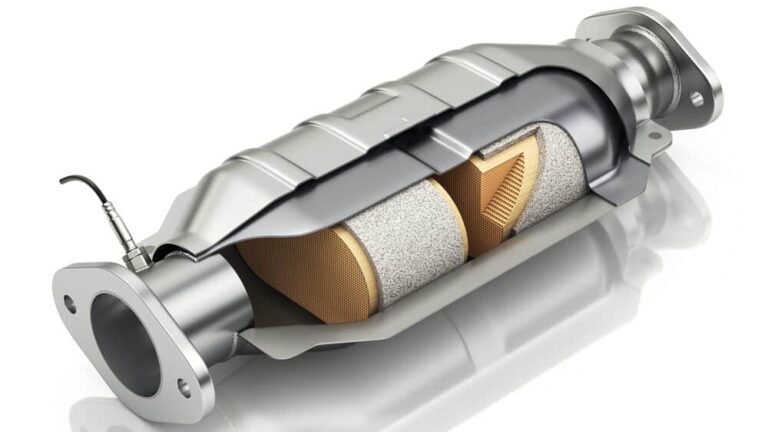
I get asked about this more than you’d think, usually by a younger customer who watched a video about removing the catalytic converter for more power and wants to know if it’s worth doing to their own car. My answer is always the same: yes, it changes how the engine behaves, but the tradeoffs are bigger than most of those videos let on, and the legal risk alone should factor into your decision before horsepower numbers do.
A catalytic converter sits in your exhaust system specifically to clean up the gases your engine produces before they leave the tailpipe. It’s not there to help the engine run better, it’s an emissions device, full stop. But because of how it’s built and positioned in the exhaust path, it does have real side effects on engine performance, and those effects go both ways depending on what you’re measuring.
Why a catalytic converter restricts the engine in the first place
Think of the catalytic converter as a physical obstacle sitting between your engine and the open air. Exhaust gas has to pass through its internal honeycomb structure to get converted into cleaner byproducts, and that structure, by its nature, slows the gas down and creates resistance, what we call backpressure.
An engine running with that backpressure in place deals with a handful of consistent side effects: somewhat reduced horsepower, a restriction on how freely it can breathe, slightly worse fuel economy compared to a fully open exhaust, more heat retained in the system, and an altered exhaust note compared to running straight pipe. None of this means the catalytic converter is a flawed design, it’s doing exactly what it’s supposed to do. It’s just that cleaning emissions and letting an engine breathe completely freely are two goals that pull in opposite directions, and the converter is the compromise point manufacturers land on.
What you gain, realistically, by removing it
I’ll walk through the actual upsides here, because they’re real, just often overstated in how dramatic they end up feeling in daily driving.
More horsepower, within a modest range
Removing the converter eliminates that backpressure restriction, letting exhaust gas exit more freely. The engine can then approach a bit closer to its mechanical potential since it’s not fighting as much resistance on the way out.
In practical terms, most cars see an average gain of around 15 horsepower from catalytic converter removal alone. Bigger engines tend to see more of a gain than smaller ones, since they’re moving more exhaust volume and benefit more from reduced restriction. If you pair the removal with an actual tune to recalibrate the fuel and timing maps for the new exhaust flow, that gain can roughly double, up to around 30 horsepower on some setups.
Fifteen to thirty horsepower sounds like a lot on paper, but on most daily-driven cars it’s a gain you’d struggle to feel seat-of-the-pants without a dyno confirming it. It shows up more clearly on cars already tuned for performance, or on engines where every bit of exhaust restriction removed makes a bigger proportional difference.
The exhaust note changes, a lot
Without the catalytic converter’s internal structure in the way, exhaust sound travels differently through the system. Most people describe the result as louder and more distinctive, closer to the engine’s raw, unfiltered note rather than the more muffled character a catalytic converter and muffler combination produces together.
Whether that’s a pro or a con depends entirely on what you’re after. Some people want that sound specifically and consider it the whole point of the modification. Others find it’s louder than expected and regret not test-driving a similar setup first before committing.
Slightly better fuel economy, in theory
With less backpressure resistance in the system, the engine doesn’t have to work quite as hard to push exhaust gas out and draw the next intake charge in. Less strain in theory translates to a small efficiency gain, meaning the engine isn’t spending extra effort just overcoming its own exhaust restriction.
I’d treat this one as a minor, inconsistent benefit rather than something to bank on. Real-world fuel economy is influenced by so many other factors, driving style, traffic, tire pressure, that the gain from converter removal alone is easy to lose in the noise of normal variation. If improving MPG is your main motivation, there are more reliable ways to get there.
Somewhat lower operating temperatures
Because exhaust isn’t being constricted and heated up as much by passing through the converter’s structure, overall system temperature can run a bit cooler. Less restriction, less heat buildup, less friction and load on nearby components, theoretically translating to a touch less wear and tear over time on parts in that heat zone.
This one’s real but modest. It’s not going to meaningfully extend your engine’s life on its own, and it’s worth weighing against everything on the downside list below before treating it as a strong selling point.
| Claimed benefit | Realistic magnitude |
|---|---|
| Horsepower increase | ~15 hp average, up to ~30 hp with a proper tune |
| Exhaust note change | Significant and immediate, louder and more raw |
| Fuel economy improvement | Minor, inconsistent, easy to lose in normal driving variation |
| Operating temperature | Slightly lower, modest reduction in heat-related wear |
What you’re actually trading away
This is the part I spend more time on with customers than the horsepower numbers, because it’s the part that actually bites people later.
It’s illegal in most places, and that’s not a minor detail
Removing a catalytic converter from a vehicle that originally had one is against federal emissions law in the United States, and most states layer their own regulations and inspection requirements on top of that. This isn’t a gray area or a technicality, it’s a straightforward violation that can result in fines, failed inspections, and in some cases, requirements to reinstall emissions equipment before the vehicle can be registered again.
The EPA’s vehicle and engine compliance page lays out the federal side of this clearly: tampering with or removing emissions control equipment on a vehicle intended for road use is prohibited, and that includes aftermarket “test pipes” or straight pipes sold specifically to bypass a converter. Enforcement varies by location and how aggressively your state’s inspection program checks for it, but “varies” doesn’t mean “safe to ignore.” I’ve had customers get hit with inspection failures specifically flagged as catalytic converter tampering, and fixing that after the fact costs more than just leaving the converter in place to begin with.
You’ll fail an emissions test, guaranteed
Any state or region that runs periodic emissions testing as part of vehicle registration is going to catch a missing catalytic converter immediately, either through a visual inspection or by the actual tailpipe gas readings coming back well outside legal limits. If your registration depends on passing that test, converter removal effectively disqualifies your car from being legally driven until it’s reinstalled.
You’re increasing your actual pollution output
The catalytic converter’s entire job is converting harmful combustion byproducts, carbon monoxide, nitrogen oxides, unburned hydrocarbons, into less harmful substances before they leave the tailpipe. Remove it, and all of that exits straight into the atmosphere unfiltered. This isn’t a theoretical downside, it’s the direct, immediate consequence of the modification, and it’s worth being honest with yourself about before treating the horsepower gain as a clean win.
Oxygen sensors and the check engine light
Modern cars run oxygen sensors both before and after the catalytic converter specifically to monitor how well it’s doing its job. Remove the converter, and that downstream sensor loses its reference point entirely, it’s now reading raw, unconverted exhaust instead of the cleaned gas it’s calibrated to expect.
This almost always triggers a check engine light, specifically codes related to catalyst efficiency (P0420 and similar). Some people try to work around this with sensor spacers or simulators designed to fool the computer into thinking the converter’s still there and functioning, but that’s layering one workaround on top of another, and it doesn’t change the legal status of what you’ve done to the car. It just hides the dashboard symptom.
Low-end torque loss
This is a detail that gets glossed over in a lot of the “removing your catalytic converter is free power” content online, but it’s a real tradeoff. While removing the converter can help top-end horsepower by reducing backpressure at high RPM and high exhaust flow, that same reduction in backpressure can actually hurt torque delivery at lower RPM, where a bit of backpressure was helping exhaust velocity and scavenging.
In practical terms, you might gain some power up top while the car feels slightly less responsive off the line or at low RPM cruising. Whether that tradeoff is worth it depends entirely on how and where you drive the car day to day.
| Downside | What it actually means for you |
|---|---|
| Illegal in most jurisdictions | Risk of fines, failed inspections, forced reinstallation |
| Automatic emissions test failure | Can’t legally register or renew in areas with testing programs |
| Increased pollution | Unfiltered harmful gases released directly into the air |
| Check engine light / fault codes | Oxygen sensor loses its reference, triggers catalyst efficiency codes |
| Low-end torque loss | Reduced responsiveness at low RPM despite top-end gains |
So does it actually hurt engine performance?
No, not in the sense of damaging the engine or making it run worse mechanically. If anything, the engine breathes a bit easier with the restriction gone, assuming you’re not introducing new problems through a bad installation or skipping a proper tune afterward. The honest performance story is: you gain some top-end power and lose a little low-end torque, and whether that net trade feels like an improvement depends on your driving style and what you’re optimizing for.
Where things actually go wrong isn’t the engine itself, it’s everything downstream of the decision: the check engine light, the failed inspection, the legal exposure, and the increased pollution. None of those are engine performance issues, they’re consequences of modifying emissions equipment on a vehicle that’s required to have it.
What I’d actually tell you if you’re considering this
If you’re building a dedicated track car or off-road vehicle that never sees public roads or emissions testing, that’s a different conversation entirely, and converter removal is a much more common and defensible modification in that context. For a daily driver that needs to pass inspection and stay legal on public roads, I’d steer you away from full removal.
If you’re chasing the sound and some of the power gain without crossing into outright illegal territory, look into a high-flow catalytic converter instead of full removal. A high-flow catalytic converter still does the emissions job, just with less internal restriction than a stock unit, giving you some of the breathing benefit without eliminating the emissions control entirely or guaranteeing an inspection failure. It’s a middle ground worth exploring before you jump straight to deletion.
If your actual complaint is that your current converter feels overly restrictive, clogged, or is making unusual noise, that’s often a sign of a failing converter rather than a reason to remove the category of part altogether. A clogged or deteriorating catalytic converter can genuinely choke an engine’s performance, and in that case, the fix is replacing it with a proper working unit, stock or high-flow, not deleting it.
DIY versus taking it to a shop
Physically removing a catalytic converter isn’t a complicated job mechanically, it’s cutting out a section of pipe and welding in a replacement section or straight pipe. Any shop with a lift and a welder can do it in under an hour in most cases. That mechanical simplicity is exactly why it’s tempting for people chasing quick power gains.
But the mechanical simplicity isn’t the actual issue here, the legal and emissions consequences are, and those apply the same whether you do the cutting yourself or pay a shop to do it. I’d rather point you toward a high-flow converter upgrade done by a shop that can also handle the tune afterward, getting you a meaningful chunk of the performance benefit without the legal exposure and guaranteed inspection failure that comes with full removal.
My actual takeaway: the horsepower and sound gains from catalytic converter removal are real but modest on most daily-driven cars, and they come bundled with genuine legal risk, a near-certain emissions test failure, increased pollution, and a check engine light you’ll either live with or work around. If you want more performance and a different exhaust note without that baggage, a high-flow converter and a proper tune gets you most of the benefit while keeping your car street legal. If your car’s still on public roads and subject to inspection, that’s the route I’d actually recommend over deletion.