
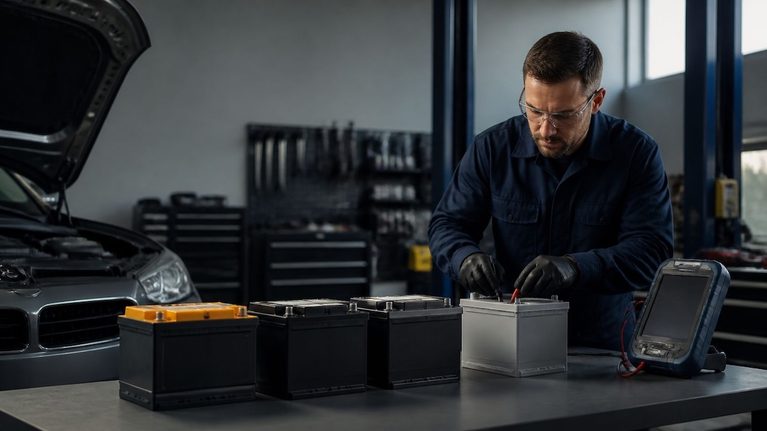
A regular came in last winter needing a battery after his dead one stranded him in a grocery store parking lot. He grabbed the cheapest option on the shelf without asking a single question about warranty length. Eighteen months later, same car, same problem, and this time he was out of pocket for a brand new battery because the warranty had already lapsed.
That’s the real value of paying attention to warranty length when you buy a battery. It’s not just a marketing number on the box, it’s a rough signal from the manufacturer about how confident they are in their own product. A company backing a battery for 5 years is usually telling you something about the internal construction, not just offering better customer service. Let’s get into which batteries actually carry longer warranties, what that warranty really covers, and how long you should realistically expect a battery to last.
Why warranty length actually matters when you’re shopping
Your car battery handles two jobs that everything else in the car depends on: cranking the engine over during starting and keeping your electrical systems fed when the alternator isn’t carrying the full load. When it fails, you’re not dealing with a minor inconvenience, you’re dealing with a car that won’t start at all, or one that’s slowly draining accessories while you drive.
Warranty length tends to track with build quality because manufacturers aren’t eager to eat the cost of replacing batteries that fail early. A company willing to put their name behind a battery for 5 years generally built it with better plates, better separators, and a more robust internal design than one they’re only willing to cover for 2 years. That’s a general rule though, not an absolute one, and there are exceptions on both ends worth knowing about before you buy.
Batteries that actually carry a 5-year warranty or longer
If you’re specifically hunting for a battery that comes backed for 5 years or more, here are a few that fit that criteria and what makes each one worth a look.
ACDelco Advantage AGM automotive battery
ACDelco’s AGM offering carries a 60-month warranty, which puts it right at the top of the pack for coverage length. It uses Absorbed Glass Mat (AGM) construction, a technology that holds the electrolyte in a fiberglass mat rather than letting it slosh around freely like a traditional flooded battery. That design tends to hold up better against vibration and provides more consistent power delivery, which is part of why ACDelco is comfortable backing it for that long.
Delphi Maxstart AGM premium automotive battery
Delphi’s AGM entry comes with a 5-year warranty and uses the same general AGM approach, built with compact internal components specifically engineered to resist vibration damage. If you do a lot of driving on rough roads or gravel, that vibration resistance is worth paying attention to since physical shaking inside a battery over years of driving is a real contributor to internal plate damage and premature failure.
Interstate Super Premium battery
Interstate backs this one with a 5-year manufacturing warranty covering defects, and it’s got one of the better real-world reputations for actually outliving its warranty period, with an average lifespan around 7 years according to the manufacturer. It’s rated at roughly 20 times more vibration resistant than a typical car battery, which lines up with that longer expected service life.
ODYSSEY automotive and LTV battery
ODYSSEY batteries come with a 5-year full replacement warranty and are built with a non-spill design plus strong vibration resistance against mechanical shocks. What stands out here is the temperature range, these batteries are rated to operate from -40°C to 45°C (-40°F to +113°F), a genuinely wide window that makes them a solid pick if you’re dealing with extreme seasonal swings, whether that’s brutal winters or scorching summers.
| Battery | Warranty | Notable feature |
|---|---|---|
| ACDelco Advantage AGM | 60 months | AGM construction for efficient, consistent performance |
| Delphi Maxstart AGM Premium | 5 years | Compact internals, strong vibration resistance |
| Interstate Super Premium | 5 years | Average 7-year real-world lifespan, 20x vibration resistance |
| ODYSSEY Automotive and LTV | 5 years full replacement | Non-spill design, rated -40°F to +113°F operating range |
A quick note on shopping for any of these: specs and warranty terms do get updated by manufacturers over time, so I’d always confirm current warranty language directly through the manufacturer’s own site or your local parts store before buying, rather than relying purely on packaging from a listing you saw online.
Can a battery actually last 5 years?
Yes, and it’s not even rare for a quality battery to stretch past that. Some genuinely make it to 7 years under the right conditions. The two biggest variables here are the quality of the battery you bought in the first place and your own driving habits.
If you buy a battery backed by a 5-year warranty from a reputable manufacturer and you’re reasonably consistent about driving habits that don’t abuse the electrical system (not leaving lights on, not making a string of extremely short trips that never let the alternator fully recharge it), you’ve got a real shot at getting 5 to 7 years out of it. That said, the honest average across most car batteries on the road, regardless of warranty length, lands somewhere in the 2 to 5 year range. A 5-year warranty is aspirational marketing backed by decent engineering, not a guarantee stamped in stone.
What actually shortens a battery’s life
- Short trips: driving distances too short for the alternator to fully replace the power used during starting leaves the battery chronically undercharged over time.
- Extreme heat: high ambient and under-hood temperatures accelerate the chemical breakdown inside the battery faster than cold does, even though cold is what actually causes starting failures.
- Parasitic drains: aftermarket accessories, a dome light left on, or a failing component quietly drawing power when the car’s off will drain and stress the battery repeatedly.
- Vibration: a loose battery hold-down clamp lets the battery bounce around on rough roads, which shakes internal plates loose over time and shortens lifespan significantly.
- Infrequent driving: a car that sits for long stretches without being driven or put on a maintainer slowly self-discharges and can sulfate internally, reducing capacity permanently.
I’ve pulled more than a few batteries out of cars where a loose hold-down bracket was the actual root cause of premature failure, not the battery itself being defective. It’s a 30-second check worth doing any time you’re under the hood for something else.
Should you replace your battery once it hits 5 years, even if it’s still working?
Generally, yes, unless the specific manufacturer’s documentation says otherwise for that battery. Batteries degrade gradually rather than failing instantly, and that gradual decline is exactly what makes it sneak up on people. By around the 3-year mark, most batteries are already running below their original efficiency, even though the car still starts fine every morning. By the 5-year mark, a lot of batteries are running on borrowed time and can fail with little or no warning, often at the worst possible moment, like a cold morning or after sitting in airport parking for a week.
Climate plays a real role in how fast that 5-year clock actually ticks. If you’re in a cooler climate, your battery is likely to hold up longer than the same battery would in a consistently hot region, since heat degrades the internal chemistry faster than cold does. Cold weather causes starting failures by thickening the engine oil and demanding more cranking power, but it’s heat that actually does the long-term chemical damage to the battery itself.
Signs it’s time to replace, even before full failure
- Slower engine cranking than usual, especially noticeable on cold mornings.
- Dimming headlights or interior lights at idle, particularly when other accessories are running at the same time.
- A battery warning light on the dash, though this can also point to an alternator or charging system issue worth ruling out first.
- Visible corrosion buildup around the battery terminals, which can indicate internal issues in addition to just a dirty connection.
- A battery case that looks swollen or bulged, a clear sign of internal failure that means immediate replacement, not a wait-and-see approach.
If you’re seeing any of these and your battery is past the 3-year mark, it’s worth having it load tested at a shop or parts store rather than waiting for it to die completely. Most auto parts stores will run this test for free in a few minutes.
What does a battery with a long warranty actually cost?
Batteries built to last 5 years or more are generally premium products, built with better internal materials, which naturally puts them at a higher price point than basic standard batteries. On average, expect to pay somewhere between $100 and $300 for one of these longer-warranty batteries, with the exact number shifting based on brand, the technology used (AGM versus standard flooded lead-acid), and your vehicle’s specific battery group size and power requirements.
Is the extra upfront cost worth it compared to a cheaper, shorter-warranty battery? In most cases, I’d say yes. A $100 battery that needs replacing every 2 years costs you more over a 6-year span than a $250 battery that actually lasts the full 5 to 7 years it’s rated for, not even counting the hassle of a surprise dead battery at an inconvenient time. Run the math on your own situation, but don’t automatically assume the cheapest option on the shelf is the better deal long term.
How long is a typical battery warranty, and why most are shorter than 5 years
Most standard car batteries carry a 2-year warranty from the date of purchase. That number lines up with the typical lifespan of a standard, non-premium battery, which usually runs somewhere between 2 and 4 years under normal conditions. Manufacturers aren’t going to warranty a product well past its expected service life, so the warranty length you see is a decent proxy for how long the manufacturer itself expects the battery to hold up.
A quick note on warranty fine print: some warranty documents do reference mileage limits alongside the time-based coverage. If your specific battery’s paperwork lists a mileage cap, read it carefully, since those figures and conditions vary a lot by manufacturer and aren’t standardized across the industry the way the time-based coverage generally is. When in doubt, call the manufacturer directly or check your paperwork rather than assuming a number you read somewhere online applies to your specific battery.
Once that warranty period runs out, any repair or replacement cost is on you, which is exactly why knowing the warranty length upfront matters more than people realize when they’re comparing batteries at the store.
What a car battery warranty actually covers
A standard battery warranty covers manufacturer defects, things like the battery failing to hold a proper charge due to an internal fault rather than external abuse or neglect. Depending on the brand, a defect claim within the warranty window might get you a complete free replacement, or it might require a prorated fee depending on how far into the warranty period you are.
If you think your battery has failed due to a genuine manufacturer defect and you want to use the warranty, here’s generally how that process goes:
- Get the battery tested, usually free at most auto parts stores or at a shop, to confirm it’s actually failing rather than a charging system or parasitic drain issue masquerading as a bad battery.
- Locate your proof of purchase and the battery’s warranty documentation, since most manufacturers require this to process a claim.
- Bring the battery and your documentation to the place of purchase or an authorized retailer for that brand, since warranty claims typically need to go through an authorized channel rather than just any shop.
- Follow the specific claim process outlined by the manufacturer, which might mean a direct replacement on the spot or a mail-in process depending on the brand and where you bought it.
Keep your receipt somewhere you’ll actually find it again. I’ve had customers show up convinced their battery is still under warranty with no way to prove the purchase date, and that makes the whole process a lot harder than it needs to be.
Not all battery warranties are structured the same way
This is the part that catches people off guard the most. There isn’t one universal warranty format across the industry, there are generally three different structures manufacturers use, and the differences matter quite a bit if your battery fails partway through the coverage period.
| Warranty type | How it works |
|---|---|
| Free replacement | Full replacement at no cost if the battery fails within the covered period, no prorating involved |
| Prorated | Replacement cost increases the further you are into the warranty period, you pay a percentage based on how much of the warranty term has elapsed |
| Combination | Free replacement for an initial window (say, the first 12-18 months), then prorated coverage for the remainder of the warranty term |
A prorated warranty can sound fine on paper until you actually need to use it. If a battery with a prorated 5-year warranty fails in year 4, you might only be covered for a fraction of the replacement cost rather than the full amount, even though it’s technically still “under warranty.” Read the actual terms before you buy, not just the headline number on the box. A shorter, fully free-replacement warranty can sometimes be a better deal than a longer prorated one, depending on how the math works out.
A few things worth checking before you buy, regardless of warranty length
- Confirm the correct battery group size for your specific vehicle, a longer warranty doesn’t matter if the battery physically doesn’t fit or isn’t rated for your car’s electrical demands. Your owner’s manual or the retailer’s fitment lookup tool will have this.
- Check the cold cranking amps (CCA) rating against what your manufacturer recommends, especially if you’re in a cold climate, since a battery that’s technically the right size but underpowered for CCA can struggle on winter mornings regardless of warranty length.
- Ask about the exact warranty structure, free replacement, prorated, or combination, before assuming a 5-year warranty behaves the same way across every brand.
- Keep your receipt and any warranty card somewhere reliable, ideally photographed or scanned so you’ve got a backup copy.
For general reference on battery maintenance and testing standards, AAA’s car battery resources are a solid plain-language source, and checking directly with manufacturers like ACDelco, Interstate, or Delphi through their official sites will give you the most current warranty terms rather than relying on secondhand listings.
Mistakes I see people make with battery warranties
- Buying based purely on price without checking warranty structure, then getting hit with a prorated replacement cost they weren’t expecting.
- Losing the receipt or warranty paperwork and having no way to prove purchase date when the battery fails.
- Assuming a longer warranty means the battery is bulletproof, when driving habits and climate still play a major role in actual lifespan.
- Waiting for a battery to die completely instead of having it load tested once it’s past 3 years old, missing the chance to replace it on their own schedule instead of being stranded.
- Not checking whether a loose hold-down clamp or a parasitic drain is the real cause of repeated early battery failure, and just blaming the battery brand instead.
DIY versus letting a shop handle it
Testing a battery and even replacing it yourself is one of the more approachable DIY jobs out there for most cars. Most auto parts stores will test your battery and alternator output for free, and swapping a battery yourself just takes a wrench, some basic care around terminal order (negative off first, negative on last), and a few minutes.
Where I’d bring in a shop is if you’re dealing with a vehicle that has a more complex battery setup, some newer cars route the battery through a computer module that needs to be reprogrammed or relearn parameters after a battery swap, or if the battery is located somewhere other than the engine bay, like under a seat or in the trunk, with wiring runs that aren’t straightforward to access. Also, if you suspect the real problem isn’t the battery itself but a parasitic drain or a failing alternator, that diagnostic work is better left to someone with the right test equipment.
My actual take: if you want a battery that’s genuinely likely to make it to 5 years or beyond, look at the AGM options from ACDelco, Delphi, Interstate, or ODYSSEY covered above, confirm the warranty structure (free replacement beats prorated, all else equal), and keep your receipt somewhere you’ll actually find again. Have it load tested once it passes the 3-year mark regardless of how it’s performing, since a battery that still starts the car fine can still be quietly failing underneath. The one clear takeaway here: a longer warranty is a decent signal of quality, but your driving habits and climate will do just as much to determine whether you get 2 years or 7 out of whatever battery you buy.