
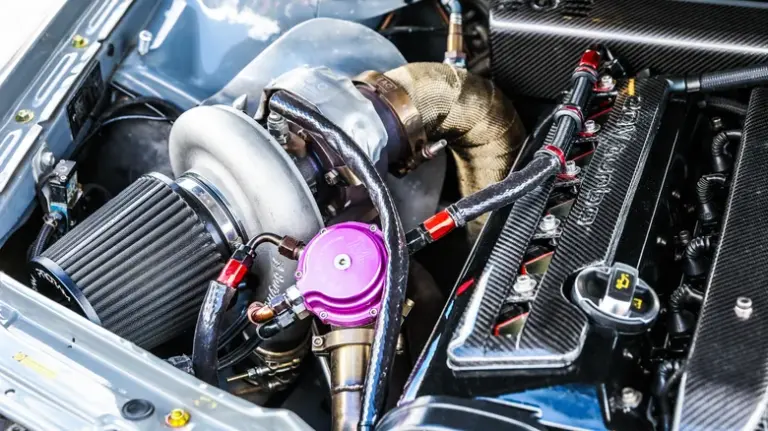
If you’re thinking about adding a turbo to a naturally aspirated engine, I get it. The idea sounds simple on paper, bolt on a turbo, and suddenly you’re making more power. In the real world, the bill gets big fast, and the reason is pretty straightforward: most small naturally aspirated engines weren’t built to take boost stress.
When you’re not a specialist, you also don’t see all the “support work” the car needs until you start collecting parts and planning the wiring, fueling, and exhaust fitment. Your power target is the big driver, and that decides whether this stays a budget project or turns into a full-on build.
Let’s talk about what actually limits these conversions and what you’ll usually end up paying for, especially if you’re aiming at a small budget and you don’t want to open the engine beyond the basics.
First, we have to talk about the engine you’re starting with. If you’re working with a small, simple motor like a 1.4 8v or a 1.6 16v, these engines are made for the ordinary driver. They’re designed to get you from point A to point B, not to have “hidden potential” waiting behind the stock calibration.
And I’m talking strictly about those simpler setups. I’m not treating the naturally aspirated engines that already have performance-oriented factory hardware as the same category, like Honda VTEC, Renault RS, or BMW M engines, because those have some potential built in.
Those smaller engines, the ones in the 1.4, 1.6, and 1.8 range, tend to withstand very little extra power beyond what the manufacturer already expects. They’re naturally aspirated engines with small torque, and the factory saves money where it can.
That shows up in the hard parts. The factory doesn’t “equip them with quality connecting rods” for the sake of performance, because it’s not the business goal. The result is that the bottom end usually becomes the weak link long before the pistons feel anything.
In plain shop language, the connecting rods are light and they don’t want to see a lot of extra cylinder pressure. And once you add boost, cylinder pressure rises, the stress rises, and the parts that were never meant for that workload are the ones that show it first.
That’s why turbocharging these engines usually ends up limited to something like 0.4 bar, 0.5 bar, or 0.6 bar. Maybe you can go a little more in some cases, but generally you stay below 1 bar turbo pressure, and the power you can realistically chase stays modest.
To turn a stock engine into a turbo engine, you’ll need multiple parts. Some pieces depend on your budget and how far you want to go with the engine internals, and not everything in a “full” build is needed for a limited-budget conversion.
The main idea, if you want a naturally aspirated engine to become a turbocharged one, is mainly to change the connecting rods. That’s where the conversion usually needs the most attention if you’re trying to avoid a build that lives on borrowed time.
People often assume pistons are the first problem. In your situation, connecting rods are the weak link. Pistons often handle more than the stock connecting rods, and those rod assemblies usually fail only when something goes wrong, like boost being higher than expected, fuel control being off, or other issues piling up.
Speaking of rods, if you’re shopping around for an “affordable” upgrade, MAXPEEDINGRODS rods are a common recommendation in budget circles. The pitch is that they’re accessible in price and have decent performance, including ARP2000 screws, and that they’re a considerable upgrade from stock.
These connecting rods start at the price of $ 240-250. There are higher-quality rod options too, but they’re also more expensive, with examples like FCP and Integrated Engineering mentioned as alternatives.
For the rest of this article, we’re going to assume a small budget for conversion. That means you’ll be choosing parts that fit the budget, not parts chosen for maximum headroom.
And since we’re talking about connecting rods being the vulnerable part, remember why it matters. The mechanical stress that comes from boosted power mainly hits the connecting rods, because they’re where the extra force transfers through the crank. If that part isn’t up to the job, everything else becomes pointless.
Parts you need for adding a turbo to a stock engine
Before you start clicking “buy,” one thing helps a lot: make sure you’re budgeting for the whole system, not just the shiny turbo. Exhaust changes, intercooler plumbing, intake tubing, fuel delivery, spark and coils, and ECU control all have to work together.
Here’s the same part list your source text is built around, but organized so you can scan it quickly. The numbers below are the ones already mentioned, so you can keep your budgeting aligned with the original ranges.
| Turbo conversion part | Typical budget ranges from the source text |
|---|---|
| Turbocharger (internal wastegate) | Start at $ 260 |
| Turbocharger (external wastegate) | $ 350-450 |
| Exhaust gallery (medium quality cast) | $ 250-350 |
| Custom exhaust gallery (welded/flange work) | $ 550-600 |
| Exhaust route | $ 360-400 |
| Single intercooler | $ 80-90 up to $ 300 or more |
| Intercooler route | Starting at $ 360 (can cost more) |
| Intake route (turbo to air filter) | $ 120-130 cheapest route |
| Intake kit | $ 400 depending on preferences |
| Boost controller (mechanical) | $ 40-50 |
| Boost controller (electronic) | $ 300-350 |
| Injectors (petrol, plug and play) | $ 150-250 to thousands for high efficiency |
| Gasoline injector ramp | $ 200 plus adapters if needed |
| Fuel pump upgrade (varies) | $ 80-120 up to $ 230 (Bosch 044 cited) |
| Pressure regulator | $ 10 clones to $ 100-200 quality |
| Coils and spark plugs | Change needed because stock ones don’t cope |
Turbocharger
Most people picture this part as, “Get the turbo, bolt it on, you’re done.” That’s not how it works with a conversion from naturally aspirated. With a universal turbo setup, the car has to be rethought from the exhaust side to the ECU side.
Since the engine didn’t come with turbo hardware from the factory, you generally need a turbo with an internal or external wastegate. For small engines, the turbo usually has an internal wastegate because it can handle the exhaust gas quantity the turbo needs. Bigger turbos tend to use an external wastegate.
Turbo prices with internal wastegate start at $ 260. For an external wastegate turbo, the text lists $ 350-450 as the range.
One detail that matters to a budget builder is the “lottery” factor. The source says that turbochargers at the lower price points are often clones of Garret or other turbo models, and that some work well while others fail. If you’re staying small budget, the suggestion is to try, but you should go in with eyes open.
In my shop, I see the same pattern with budget forced-induction parts. When the engine is naturally aspirated and everything is “simple,” the car already has stable fueling and air behavior. Once you add boost, tiny changes in turbo behavior can ripple into detonation risk, poor spool response, and weird drivability.
So yeah, you can buy a cheaper turbo and move forward, but treat tuning and verification as part of the turbo purchase, not something you “figure out later.”
Exhaust gallery
If you didn’t have a factory turbo, the stock exhaust manifold does not fit the conversion. That’s the basic problem: the hardware layout changes, and the turbo has to be positioned so it can route exhaust correctly.
The source lists $ 250-350 starting prices for medium quality cast exhaust galleries. If you can do custom work, like a welded exhaust gallery made with the flange, the cost is said to reach $ 550-600.
Here’s a practical point from experience. Even if the price looks good, you still want to make sure the manifold and turbo match the direction and clearance you have in the bay. A “fits on the internet” manifold can still fight your steering, heat shielding, or other lines once you actually hang the turbo.
That’s part of why turbo conversions get expensive. Not because the turbo itself is pricey, but because everything around it has to be correct.
Exhaust route
After the exhaust gallery, the exhaust route matters too. The source text is blunt here: with your conversion, you can not upgrade power with a stock exhaust.
For the exhaust route, the prices start from $ 360-400. Even if you keep the turbo pressure in the lower range, the exhaust still has to be able to move the gases the turbo pushes through.
Shop-wise, I think of exhaust route like airflow for the whole system. If your exhaust is too restrictive, the turbo works harder than it should. That can heat the car up more and create a tuning nightmare where the boost curve feels wrong.
So when you budget for an exhaust route, don’t treat it as optional “nice to have.” It’s part of making the turbo behave.
Intercooler
A turbo setup is basically compressing air, and compressed air can get hot. That’s why an intercooler shows up in almost every forced induction build, even if the goal is only moderate boost.
According to the source text, prices for a single intercooler start at $ 80-90 and can reach $ 300 or more. Installation is also more complicated, because if your engine was stock and did not have a turbo, you need to create an intercooler route from scratch.
I’ve seen cars where someone buys an intercooler and then discovers they didn’t budget for the pipes, clamps, and route planning. Suddenly it’s “almost done” for weeks, and the car sits there while you chase missing pieces.
If you plan to keep a small budget, the best move is to plan the route before you start mounting. That way you avoid re-buying tubing you didn’t fit the first time.
Intercooler route
To actually benefit from the intercooler, you need the intercooler route. The pipework and connections have to move compressed air from turbo to intercooler and then onward into the intake side.
The source puts starting prices for such an operation at 360 $, and says it can become even more expensive. That’s one of those “hidden” costs people forget because they focus on the intercooler itself.
When this route isn’t built right, you usually hear it. A boost leak tends to show up as hissing under load and weird throttle response. If you’re troubleshooting, you can start by checking for loose clamps and connections, then work your way toward the tubing route and any weld joints.
The intake route
The intake route is the path from the turbo to the air filter. This is another place where stock parts simply don’t match the new layout.
The text says the cheapest route starts from a price of $ 120-130. It also mentions that intake kits can be $ 400, depending on preferences.
One common mistake is picking “whatever fits” tubing without thinking about real placement. On a turbo swap, you often have to work around heat and sharp bends. A routing plan that keeps the intake tubing away from extra heat can make the tune easier and reduce the chance of hot air re-entering the intake.
Boost controller
Now the part that makes turbo pressure predictable: the boost controller. You need it to control the turbocharger behavior, not just the turbo itself.
Prices range from $ 40-50 for the mechanical ones, which are described as the cheapest option. The source also says that mechanical boost controllers tend to not be preferred by people who do this operation to the engine, and that electronic controllers can cost $ 300-350.
Electronic controllers can show you what pressure you’re going to and can manage multiple power maps. The text emphasizes that you can change power settings so you can go low, medium, or high pressure, while mechanical boost controllers have a certain pressure and nothing more.
In the garage, I’d call this a trade-off between cost and control. If your build is truly “small budget,” a mechanical controller might feel tempting. Just understand that fine control helps when you’re dialing in fuel and timing, and conversions often need that adjustment work.
Injectors
Fuel is where forced induction either works well or turns into a problem. The source text says injector costs depend heavily on what kind you want to put on the engine.
For petrol cars, the costs are described as cheaper, starting at $ 150-250 for plug and play injectors. It also notes that the price can reach thousands of dollars for very efficient injectors.
When owners ask about injectors, I usually shift the conversation toward the whole fuel system, not just injector price. Your turbo plan may be “small,” but if the injectors are mismatched, you end up chasing drivability issues, poor response, or overly risky fueling patterns.
Injector ramp
If you’re talking about cheap injectors, the text says there is generally no need to upgrade the ramp and adapters. But if you need a gasoline ramp, it starts at $ 200, plus other costs of the adapters if necessary.
This is one of those “it depends what you buy” areas. A plug and play approach can avoid the extra hardware, while other injector choices can force more changes to how the fuel is delivered.
Fuel pump
The source text points out that fuel pump prices for upgrades start from $ 80-120. It also says the price can reach $ 230, especially for the BOSCH 044 pump, which is described as the most used for this type of engine upgrade.
For me, fuel pump planning is about reliability under boost. A pump that can’t keep up doesn’t just hurt performance. It pushes the engine into conditions where you don’t want to run, and that’s where things get expensive quickly.
Pressure regulator
Pressure regulators are described as relatively cheap. The text says they start at $ 10 clones, but that something very quality is priced at $ 100-200.
If your regulator is off, you can end up with fueling that doesn’t match the tune. That’s why I treat the regulator as part of the “control loop,” not just another part to bolt on.
The supply route
The supply route is the plumbing and hoses that carry fuel where it needs to go. The text says that if this route is made with braided hoses and AN fittings, it’s more expensive.
The main point in the source is quality. You need something qualitative so the hose doesn’t disintegrate and so you don’t lose pressure. Even with a small budget, this is one place where you don’t want to gamble.
Coils and spark plugs
To upgrade a stock engine to a turbo, the source text says you need to change the coils and spark plugs. Stock parts don’t cope with the upgrade.
This makes sense in shop terms because forced induction pushes the engine into a higher stress range. When the spark system isn’t matched, you end up with weak combustion and drivability issues.
If you’re trying to keep it “small budget,” it’s still worth spending attention on spark and coil condition. Worn plugs and tired coil packs don’t become more reliable just because you added boost. They usually show up faster.
Let’s not forget about the electronic side
At this stage, we can’t ignore the electronics. Modern cars have a computer, the ECU, that manages absolutely everything under the hood. When you add new parts, you also change how the engine behaves, and the factory ECU wasn’t written for those changes.
Most ECUs on cars with a naturally aspirated engine “do not know” how to handle pressure the way a turbo setup does. They’re programmed from the factory to work on the vacuum side like naturally aspirated engines do, and you don’t have many ways to write software that properly controls the newly installed turbo parts.
That said, the source text notes that some ECUs on simple engines allow software for turbo engines. It’s not standard, though. Many builds need a PIGGYBACK ECU to manage everything and connect to the stock computer.
The simplest version of a PIGGYBACK ECU is described as about $ 300, but the source says functionality is relatively limited.
You can also mount a STANDALONE ECU, and that price starts at $ 900-1130. The source is clear that the prices above include only the computer, whether piggyback or standalone.
But the electronics never stop at the ECU. You also need different sensors that might not be included in the price, like oxygen sensors and so on. That’s another cost area that gets missed when someone budgets only for “the ECU box.”
In real life, I tell customers to think of the ECU as the “translator” between your engine sensors and your engine behavior. Stock calibration speaks naturally aspirated, vacuum-only logic. A turbo conversion requires the translator to learn the new language, or you supply a different translator entirely.
If you try to force a stock system to guess, you end up with weird feedback, unstable drivability, and a tune that never really settles down.
Additional ECU installation costs
Buying the ECU isn’t the end of it. The source text calls out additional installation costs, and this is where the project budget often surprises people.
For PIGGYBACK ECUs, prices start at $ 300. If you’re talking about a STANDALONE ECU and an installation that is not easy to do, it can reach and exceed $ 900.
And in addition to the ECU and installation price, you also add the new software part that is not included in those prices.
Whether you keep stock electronics or use the two ECU approach, the source says software can start at, for example, $ 300 for piggyback and $ 550 for standalone.
One reason forced induction tuning is expensive is how much work it takes. Turbo conversions are described as quite difficult to program because it’s not like a factory turbo car where values need to be increased and calculated. Here the software tables have to be calculated from 0, and that’s part of why the costs are high.
In the shop, I see why that matters. A factory turbo car has sensors, hardware layout, and calibration logic designed to work together. With an NA-to-turbo conversion, you’re building that logic from scratch around your exact parts, wiring, boost control strategy, and fueling setup.
So when you hear the “minimum costs” line in the source, believe it. The text says these are the minimum costs to expect when you want to put a turbo on a stock engine, and it frames everything as calculated at a minimum budget.
My advice, based on what I’ve seen over and over, is to take a hard look at the steps before you start buying parts. There are really two possibilities: you end up satisfied with the engine you have, or you decide it’s worth buying a turbo car from the factory and skip the conversion headaches.
Before you spend money, I’d also suggest doing one basic reality check that doesn’t cost much: verify your specific vehicle has no major safety issues tied to recall campaigns. You can use the NHTSA recall lookup at nhtsa.gov/recalls, and if you want to cross-check by brand, the manufacturer sites can help too, like Toyota’s owner resources at toyota.com/owners or Ford’s recall support at ford.com/support/recalls.
Expert verdict: If your goal is a “small budget” turbo conversion on a simple 1.4 8v, 1.6 16v, or 1.8 naturally aspirated engine, plan for the whole stack of parts and the ECU work, because connecting rods, exhaust routing, fuel delivery, spark, and tuning all have to match. If you want the simplest path to reliable boost, your best move is often buying a turbo car from the factory and keeping the stock calibration doing what it was built for.