
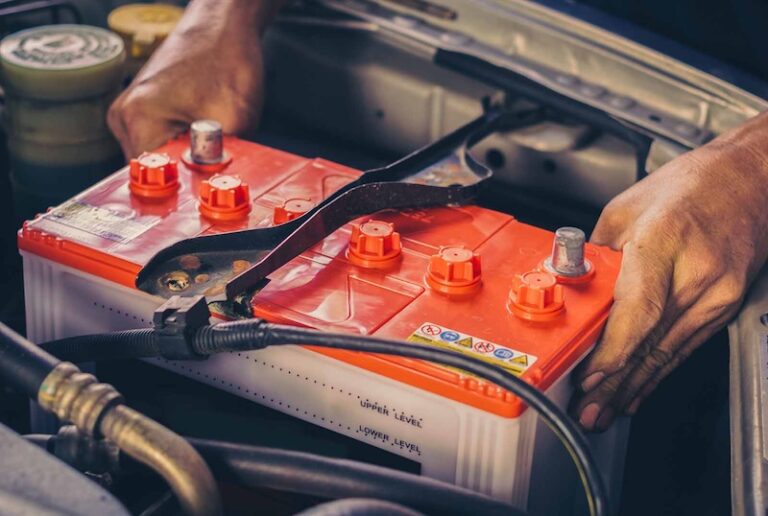
A guy had his Honda Accord towed into our shop on a Friday evening after it died in the middle of a left-turn lane with traffic honking behind him. When the tow truck driver dropped it in the lot, the owner swore up and down he needed a new fuel pump or an alternator because “once a car is running, the battery doesn’t do anything anyway.” Ten minutes later, I showed him the real problem on my digital battery tester: his five-year-old battery had a shorted internal cell, and every time he took his foot off the gas to brake for an intersection, system voltage plunged from 13.4 volts down to 8.9 volts and killed the engine computer.
Your car battery does a lot more than spin the starter motor for three seconds in the morning. When the engine is switched off, it runs your hazard lights, power locks, security alarm, and keep-alive computer memory; once the engine is running, it acts as the electrical cushion and reserve tank that keeps your wipers, air conditioning blower, airbag modules, headlights, fuel pump, and ignition coils running steady.
Shutting down in the middle of a busy road is one of the scariest things you can experience behind the wheel. Let’s look at how a bad battery can actually stall a running car, how to tell whether the battery or the alternator is to blame, and what else can make an engine quit while you’re driving.
So, can a dead battery cause a car to die while driving?
Yes, a dead or internally failing car battery can cause your engine to stop running while you are driving. When a car battery develops an internal short circuit, loses connection at the terminals, or drops so low that it drags down the charging circuit, the alternator gets overloaded trying to feed both the dead battery and the car’s electrical systems, and that voltage drop can make the car stall.
That catches a lot of old-school drivers by surprise. Thirty-five years ago, if you drove an old truck with a mechanical carburetor and a mechanical fuel pump, you could practically yank the battery out of the engine bay and the truck would keep chugging down the road on alternator output alone. Modern vehicles are wired completely differently.
Today’s cars rely on a network of sensitive electronic modules, electric high-pressure fuel pumps, coil-on-plug ignition systems, electronic throttle bodies, and electric power steering racks that demand clean, stable voltage every millisecond. When you see the red battery warning light pop up on your dashboard while driving, don’t try to push your luck for another thirty miles. Pull off the road into a safe parking lot as soon as you can, because a car running with a charging or battery fault is on a countdown timer before it stalls out.
How the battery and alternator share the job while you drive
Most drivers think of a bad battery as a driveway problem: you turn the key in the morning, hear a sad click-click-click, and call for a jump start. While a dead battery will definitely keep your car from starting, what happens when a car battery goes bad or gets jump-started and driven down the road is a whole different story.
Think of your alternator as a water pump and your battery as a pressurized storage tank connected to the same pipe. At highway speeds (say 2,200 RPM), a healthy alternator puts out plenty of amperage at 13.8 to 14.5 volts to run the entire car and top off the battery. However, when you take your foot off the gas pedal, hit the brakes, and drop down to a 650 RPM idle at a stoplight with your headlights, AC blower, radiator cooling fans, and brake lights all drawing heavy current at once, the spinning alternator slows down and its output drops.
In those low-RPM moments, your battery steps in to supply the extra amperage and smooth out voltage ripples. If the battery is dead, sulfated, or shorted inside, it can’t help carry that idle load. Instead, the dead battery acts like a giant electrical sponge, sucking every amp out of the alternator, overheating the alternator’s internal diodes, dragging a physical mechanical load onto the engine drive belt, and letting system voltage sag so low that the car will stall when braking or idling.
| What Happened to the Battery | What the Alternator & Voltage Do | How the Car Acts on the Road |
|---|---|---|
| Shorted internal cell (battery reads ~10.2V to 10.6V resting) | Alternator runs at 100% full output constantly, gets scorching hot, and still gets dragged down below 12V at idle | Engine runs rough at red lights, headlights dim when you step on the brake, and engine stalls when slowing down |
| Loose, cracked, or heavily corroded battery cable clamp | Battery disconnects from the circuit over bumps; alternator voltage spikes and drops wildly without a buffer | Dashboard gauges flicker, radio resets when hitting potholes, and engine cuts out suddenly on rough pavement |
| Deeply discharged battery after a jump start | Alternator tries to dump 60+ amps into the empty battery while also running fuel, spark, and cooling fans | Engine stumbles or dies if you turn on the AC, defroster, or headlights during the first 15 minutes of driving |
| Good battery drained while driving by a dead alternator | Alternator produces 0 amps; battery runs the whole car alone until voltage drops from 12.6V down below 9.0V | Red battery light comes on first; 15 to 40 minutes later ABS/airbag lights pop up, steering gets heavy, and engine dies |
What happens step by step if a battery dies while driving?
Whether your car battery fails internally on the highway or gets drained flat because the alternator stopped charging it, a modern car almost never shuts off out of nowhere without giving you warning signs first. The vehicle’s computers start shedding non-essential electrical loads one by one to keep the engine running as long as possible.
If you know what those stages look and feel like from the driver’s seat, you have enough time to get off the freeway and park safely instead of getting stranded in a live traffic lane. Here is the exact sequence I hear from customers almost every week.
Stage 1: the red battery icon and early electrical glitches
The first warning is almost always the red battery-shaped light (or a “Charging System Malfunction” / “Check Charging System” banner) lighting up on your instrument cluster. Despite the picture of a little battery on the icon, that light actually monitors system voltage and alternator charging output. The moment system voltage drops below roughly 12.5 volts (or spikes too high above 15.5 volts), that warning lamp comes on.
At this early stage, the engine still feels normal at cruising speed, which tricks people into thinking they can keep driving all the way across town. Under the hood, though, the alternator is either failing to charge or fighting a shorted battery, and your electrical reserve is shrinking by the minute.
Stage 2: dashboard Christmas tree and heavy steering
As system voltage falls down into the 10.5-volt to 11.2-volt range, the non-engine computers in your car start panicking because their internal microprocessors need a steady 5-volt reference supply derived from the 12-volt bus. Your ABS light, traction control light, tire pressure light, and airbag warning light will suddenly pop on one after another, even though nothing is mechanically wrong with your brakes or airbags.
Right around the same time, your infotainment screen and radio will black out, your power windows will crawl up at a snail’s pace, and your headlights will turn a dull, yellowish orange. If your car has Electric Power Steering (EPS), which pulls up to 40 or 60 amps during a turn, the steering assist module will shut itself off to save power and the steering wheel will suddenly feel heavy when you try to turn into a driveway.
Stage 3: transmission bucking, misfires, and the final stall
Once voltage drops below 9.5 to 9.0 volts, the engine itself runs out of enough electrical pressure to stay alive. Electronic automatic transmissions need steady voltage to hold their shift solenoids open; when voltage starves out, the gearbox may slam into a single limp gear or slip out of engagement.
Finally, the electric fuel pump in your gas tank slows down, fuel rail pressure drops, the fuel injectors can’t snap open cleanly, and the ignition coils lose the voltage needed to jump a spark across the spark plug gaps. The engine will sputter, cough when you touch the gas pedal, and stall out completely as soon as you slow down for a stop sign or red light. And once it stalls in this state, turning the key won’t even crank the starter over; you’ll just hear a dead click.
What else could cause a car to die while driving?
Even though a bad battery or charging fault is high on the suspect list, you never want to throw a $200 battery at a car that stalled on the road without checking the other common culprits. An engine needs four basic things to stay running: stable electrical power, clean fuel at the right pressure, a strong timed spark, and unrestricted air. When any one of those drops out, the engine quits.
1. A bad battery or loose battery terminal connections
Let’s start right at the battery tray. As we covered earlier, an aging battery with internal plate sulfation or a dead cell forces the alternator to run hot and heavy just to keep the car alive, stressing the engine at idle causing it to stall when electrical loads kick on. In fact, many modern cars with electronic throttle bodies will lose their idle speed calibration if a weak battery causes a deep voltage dip, making the RPM plunge below 400 RPM and die every time you come to a stop.
Don’t forget to grab both battery cable clamps with your hand and try to twist them! I can’t count how many cars have been towed into our bay for “dying on the highway” where the battery itself tested fine, but the negative or positive terminal clamp was loose enough to wiggle with two fingers, or packed with crunchy white and blue-green acid corrosion. When your tire hits an expansion joint on the highway and a loose cable loses contact for half a second while the alternator is under load, the sudden electrical interruption can shut the engine right down.
2. A failing alternator or snapped serpentine belt
Whenever a customer tells me their car died while driving and the battery was stone dead when they tried to restart it on the shoulder, my very first question is whether the alternator quit twenty minutes earlier. The alternator and the car battery are joined at the hip: a bad alternator kills a good battery by starving it, and a bad shorted battery can roast a good alternator by overworking its voltage regulator and diodes.
Also pop the hood and look at the rubber serpentine drive belt snaking around the front pulleys of the engine. If that belt snaps, shreds, or gets soaked with leaking engine oil and slips over the alternator pulley, the alternator stops spinning instantly. On cars that also run a belt-driven water pump, a broken serpentine belt will not only kill battery charging, it will overheat the engine within two or three minutes.
3. Too much moisture or water contamination in the gas
Fuel quality is another sneaky reason a car will stumble, buck, and die in the middle of a trip. Gasoline and water do not mix. Because water is heavier than gasoline, any moisture that gets into your fuel tank settles straight to the bottom pickup screen where the electric fuel pump sucks from.
How does water get into a sealed gas tank? Sometimes you get a bad batch of fuel from an older gas station whose underground storage tanks took on rainwater after a heavy storm. Other times, drivers leave a vehicle sitting for weeks with a quarter tank of E10 ethanol-blended gas in humid weather; ethanol absorbs moisture from the air through the tank vent system, and once it absorbs enough water, “phase separation” occurs and drops a layer of corrosive water-alcohol sludge right onto the bottom of the tank. When the fuel injectors spray droplets of water instead of gasoline into the cylinders, combustion stops cold, the engine misfires violently, and the car dies.
4. Issues with the distributor cap, rotor, or modern ignition coils
If you drive an older vehicle from the 1980s, 1990s, or early 2000s that still uses a mechanical ignition distributor, the distributor cap and rotor are classic stall triggers. The plastic distributor cap protects the spinning internal rotor and routes high-voltage electricity out to each spark plug wire in the exact firing order.
Over time, the brass or aluminum contact posts inside the distributor cap burn away and build up a crusty layer of white oxidation, or a hairline carbon crack forms inside the plastic cap. Add a damp, rainy morning when moisture condenses inside a cracked distributor cap, and the high-voltage spark shorts out instead of reaching the spark plugs, causing the engine to misfire and stall in traffic. On newer distributorless cars that use individual coil-on-plug ignition packs, that exact same stalling job is taken over by a failing Crankshaft Position Sensor (CKP), Camshaft Position Sensor (CMP), or main ignition relay that cuts out once it gets hot.
5. An issue with fuel pressure (especially stalling uphill or downhill)
Pay close attention to the road angle when your car stalls. If your car runs okay on flat streets at light throttle, yet sputters and stalls when climbing a steep hill, accelerating onto a highway ramp, or nosing downhill withless than a quarter tank of gas, you are almost certainly looking at a fuel pressure or fuel delivery problem.
Climbing a hill puts the engine under heavy load, which requires maximum fuel volume and steady rail pressure (typically 45 to 65 psi on port-injected engines, and hundreds or thousands of psi on direct-injected engines). If your electric in-tank fuel pump is worn out, if the fuel filter is clogged with rust, or if the fuel pressure regulator diaphragm is leaking and bleeding pressure back into the return line, the engine leans out under load and dies on the grade. And if the car stalls specifically on steep downhills or sharp turns when the fuel gauge is low, a cracked fuel pump pickup assembly or broken plastic baffle inside the tank can let the remaining fuel slosh away from the pump intake so the pump sucks air.
| How the Stall Happened | Most Likely Culprit | First Thing to Check | Typical Repair Cost Range |
|---|---|---|---|
| Red battery light came on first, headlights dimmed, car died 20 mins later | Failed alternator, broken serpentine belt, or internally shorted car battery | Check belt under hood; test battery and charging voltage with a multimeter | $160 to $320 for battery; $400 to $850 for alternator replacement |
| Car stalls only when braking to a stop or idling at red lights, restarts right away | Weak battery dragging down idle voltage, dirty throttle body, or vacuum/PCV leak | Load-test battery; inspect throttle bore for carbon buildup around plate | $15 to $120 for throttle cleaning & idle reset; $160 to $300 if battery is bad |
| Car sputters and dies when climbing hills or accelerating hard under load | Low fuel pressure (weak fuel pump, bad fuel pressure regulator, or clogged filter) | Connect a mechanical fuel pressure gauge or scan live fuel rail pressure PID | $120 to $280 for regulator/sensor; $450 to $950 for in-tank fuel pump assembly |
| Car cuts out instantly at highway speed like someone turned the key off, no battery light beforehand | Failing Crankshaft Position Sensor (CKP), loose battery cable, or bad ignition relay | Wiggle battery terminals; scan for P0335 crank sensor codes when engine is hot | $0 to $30 for terminal repair; $120 to $300 for crankshaft position sensor |
| Engine bucks, misfires badly, and stalls right after buying gas or driving through deep puddles | Water/moisture in the fuel tank, or moisture inside a cracked distributor cap / coil pack | Take a fuel sample in a clear glass jar to check for water separation; inspect cap/coils | $80 to $200 for distributor cap, rotor & wires; $200 to $600 to pump out contaminated tank |
Can remote start mess up your battery?
The short answer is yes, a remote starter can drain and shorten the life of your car battery, especially if it is an aftermarket unit that was wired poorly or develops an internal relay fault. Even a healthy factory remote start system can leave you with a dead battery if you use it the wrong way during freezing winter weather.
How a bad aftermarket remote starter drains a battery overnight
We pull at least a dozen botched aftermarket remote start and alarm boxes out of customer cars every winter. Modern cars have dozens of computers (body control module, instrument cluster, keyless entry receiver, amplifier) that are supposed to go into a deep “sleep mode” about 15 to 30 minutes after you park and lock the doors. Once every module is asleep, total parasitic battery draw should sit below 30 to 50 milliamps (0.03 to 0.05 amps).
When somebody installs a cheap aftermarket remote starter using Scotch-lok wire taps under the steering column, or when an older remote start module starts glitching, it can keep pinging the vehicle’s CAN communication bus all night long. That prevents the car’s body control module from ever going to sleep, leaving a continuous 0.4-amp to 1.2-amp parasitic drain on the battery. Within two or three days of sitting in the driveway, your battery is drained flat, and repeated deep discharges permanently sulfate the lead plates inside the battery so it can no longer hold a charge.
The winter remote-start idling trap
Even if your car came from the factory with a built-in remote start button on the key fob, how you use it matters. Cranking a freezing-cold engine at 15 degrees Fahrenheit takes a massive gulp of amperage out of your battery. If you remote-start your car in the driveway for ten minutes to warm up the heater, drive two miles to drop the kids at school, shut it off, and remote-start it again later, the alternator never gets enough highway RPM time to put back the energy the starter motor used.
After a week of ten-minute remote-start warmups and five-minute drives, your battery state of charge creeps down below 40%, and one cold morning (or at a low-RPM traffic light with the defrosters and heated seats blasting) the battery gives up completely.
Will a car still run with a dead battery?
Yes, a car can sometimes keep running for a short time after you jump-start a dead battery, but often not for long, and it is a gamble in heavy traffic. How far you get depends entirely on why the battery died in the first place.
Suppose your battery is only six months old and only went dead because your kid left the back-seat dome light switched on overnight. If you jump-start that healthy battery, let the jumper cables stay connected for five minutes to build a base charge, and then go for a steady 30-minute highway drive with the accessories turned off, the alternator will recharge the battery and the car will run fine.
On the other hand, if the battery is five years old and dead because its internal lead plates are sulfated or shorted out, jumping the car and immediately pulling out into stop-and-go city traffic is asking to get stranded. That dead battery won’t accept a normal charge, it will overload the alternator, and the first time you hit the brakes for a red light and the radiator cooling fans kick on, voltage can drop out and stall the engine right in the intersection.
Never disconnect the battery cables while the engine is running!
I have to put a big mechanic warning right here, because I still see people recommend this terrible old-wives’ tale on internet forums. Back in 1974, shade-tree mechanics used to test whether an alternator was working by starting the engine and pulling the negative or positive battery cable off the battery post; if the engine stayed running, they figured the alternator was good.
Never pull a battery cable off while a modern car is running. As soon as you disconnect the battery from a running alternator, you remove the system’s giant voltage absorber. Within milliseconds, the alternator’s output can surge into a massive “load dump” voltage spike of 40 to 100+ volts before the regulator can react. That high-voltage spike can instantly fry your Engine Control Module, Body Control Module, airbag computer, infotainment screen, and the alternator’s own rectifier diodes, turning a $180 battery diagnosis into a $2,500 electrical nightmare!
How to test your battery and alternator in 5 minutes with a $15 multimeter
Instead of pulling cables off or guessing whether you need a battery or an alternator, use a basic digital multimeter set to DC Volts (the 20V DC setting). This five-minute test in your driveway tells you right away what is failing without risking a single computer module in your car.
- Step 1: Test resting battery voltage (Engine OFF): With the ignition switched off and the headlights turned on for 30 seconds and then switched back off (to clear any temporary surface charge), touch the red multimeter probe to the positive (+) battery post and the black probe to the negative (-) battery post. A healthy, fully charged 12-volt battery should read 12.6 to 12.8 volts. A reading of 12.2V is roughly half discharged, 11.9V or lower is considered dead, and a battery that sits right around 10.4 to 10.6 volts even after charging almost always has a dead shorted cell and must be replaced immediately.
- Step 2: Watch cranking voltage drop (While starting): Have a helper crank the engine while you watch the multimeter screen. Voltage should stay above 9.6 to 10.0 volts while the starter motor is spinning; if it plunges to 7 or 8 volts during cranking, the battery’s Cold Cranking Amps (CCA) capacity is worn out.
- Step 3: Test no-load charging voltage (Engine idling): With the engine idling in Park and all accessories off, look at the multimeter across the battery posts. You should see 13.8 to 14.5 volts (some newer cars with smart computer-controlled alternators may vary between 13.2V and 14.8V depending on battery state). If the meter reads 12.4V or lower with the engine running, the alternator is not charging at all.
- Step 4: Test loaded charging voltage (High-load idle test): Leave the engine idling and turn on the high-beam headlights, the AC blower fan on high, and the rear window defroster, then raise engine speed slightly to about 1,500 RPM. A healthy alternator and battery should hold system voltage above 13.5 volts under full electrical load. If voltage drops down into the 11s or low 12s when you turn the headlights and blower on, either the alternator can’t keep up with the amperage demand or a shorted battery is dragging the circuit down.
What to do immediately if your car starts dying while driving
If you are driving down the road right now (or want to be ready if it ever happens) and you see the red battery light come on followed by dimming dash lights or a stumbling engine, the decisions you make in the next sixty seconds determine whether you coast safely into a parking spot or get stuck blocking a highway lane. Follow this exact emergency routine:
- Shut off every non-essential electrical load immediately: Turn off the air conditioner or heater blower fan, switch off the heated seats, unplug phone chargers, turn off the rear defroster, and shut off the radio. (Only keep your exterior headlights or hazard lights on if it is dark, raining, or necessary for safety.) Cutting 40 amps of cabin electrical draw can buy you an extra 10 to 15 minutes of ignition and fuel pump run time!
- Get into the right-hand lane and start looking for a safe exit or parking lot: Don’t stay in the fast left lane hoping the car will make it another ten miles. Signal early and move toward the right lane or a wide paved shoulder while you still have engine power and power steering assist.
- Prepare for heavy steering and a firm brake pedal if the engine stalls: If the engine cuts out while you are still rolling, your car will not lock the steering wheel as long as the ignition stays in the ON/RUN position, and your hydraulic brakes will still work, but losing power steering assist and vacuum brake boost means you will have to pull much harder on the steering wheel and press firmly with both feet if needed on the brake pedal.
- Do not shut the engine off at a red light if you are limping to a safe spot: Once a car running on a dying battery or failed alternator shuts off, it will not have enough cranking amps left to restart the starter motor. Keep moving smoothly into a safe parking lot away from traffic before you turn the key off.
You can review official roadside breakdown safety practices and check whether your vehicle has any open electrical, fuel pump, or stalling recalls on the National Highway Traffic Safety Administration (NHTSA) recall database.
Real-world shop stories: three cars that stalled on the road for different reasons
When a car stalls in traffic, drivers almost always blame the last part they read about online. To show you how we separate a bad battery from an alternator, a fuel pump, or a crank sensor in the shop, here are three real repairs from our service bays.
Case 1: the 2016 Ford Escape that stalled every time the cooling fan kicked on
A commuter brought in her 2016 Ford Escape after it died twice in the drive-thru lane at her morning coffee shop. Each time, a helpful stranger jumped her battery with a portable lithium booster pack, the car fired right up, and then it died again five minutes later at the next stoplight. An auto parts store clerk told her she needed a $650 alternator because the voltage read low at idle.
Before ordering an alternator, I disconnected the battery cables and ran a conductance and load test on her four-year-old battery by itself. One of the six internal cells inside the battery had developed a dead short after a hot summer, dropping the battery’s open-circuit voltage to 10.5 volts. Every time she idled in the drive-thru and the high-speed electric radiator fan kicked on (drawing nearly 35 amps), the shorted battery dragged the whole electrical system down to 8.8 volts and stalled the engine. Putting a fresh Group 48 AGM battery in the tray and resetting the Battery Management System cured the stalling completely, and her original alternator was still charging at a rock-solid 14.3 volts.
Case 2: the 2014 Toyota Camry with the loose negative clamp
Another customer came in with a 2014 Camry that would randomly cut out for a split second when crossing railroad tracks or highway expansion joints, flash every warning light on the dash, and sometimes die completely when turning into his neighborhood. He had already replaced the battery himself two weeks earlier at home, so he was sure the battery wasn’t the issue.
When I popped the hood and grabbed the negative battery cable clamp, I lifted it straight off the lead post with two fingers! Lead battery posts are tapered like a slight cone; when he installed the new battery, he had left the clamp sitting halfway up the post instead of tapping it down flush to the base before tightening the 10mm nut. Because the clamp was tightened at the narrow top of the post, it couldn’t grip the lead tightly, and every bump broke the electrical ground circuit. Loosening the nut, seating the clamp all the way down to the base of the post, and tightening it properly cost him zero dollars in parts.
Case 3: the 2001 Chevrolet Tahoe that died in the rain
We also see plenty of older trucks and SUVs that prove mechanical ignition and fuel issues are still alive and well. A contractor brought in his 2001 Chevy Tahoe 5.3L alongside an older 1998 Vortec shop truck that would run fine all week in dry weather, then sputter, misfire, and stall out whenever he drove through a heavy rainstorm or car wash.
On that 1998 Vortec truck, we popped the distributor cap off the back of the intake manifold and found deep white corrosion crusted onto the brass terminals inside the cap, plus a hairline crack near the center rotor button that let damp air short the spark straight to ground. And on a separate customer’s sedan that stalled right after filling up at a discount gas station during a flood watch, pulling a pint of fuel from the rail into a clear mason jar revealed three inches of cloudy water sitting underneath the gasoline. Neither truck had a battery problem at all, which is why testing beats guessing every single time.
Why modern start-stop cars and battery management systems are extra sensitive
If you drive a vehicle built within the last ten years, especially one equipped with automatic stop-start technology (where the engine shuts off at red lights and restarts when you lift your foot off the brake), your car’s electrical system is much pickier about battery health than older vehicles. Understanding how these systems work explains why a marginal battery causes weird drivability issues today.
Smart alternators and battery current sensors
Look closely at the negative battery cable clamp on almost any modern Ford, GM, Honda, Subaru, Toyota, BMW, or Volkswagen. You’ll see a small black plastic box or ring with a two-wire electrical plug clipped right onto the battery cable. That is the Battery Current Sensor (part of the Battery Management System, or BMS), which measures every amp flowing into and out of the battery along with battery temperature and voltage.
Instead of charging at a fixed 14.2 volts all day long like an old-fashioned alternator, the engine computer uses that sensor to vary alternator output anywhere from 12.5 volts (when cruising lightly to save fuel) up to 14.8 volts (during deceleration to capture regenerative braking energy). If your battery has an internal fault, or if someone replaces an Absorbed Glass Mat (AGM) battery with a cheap flooded lead-acid battery without resetting the BMS with a scan tool, the computer can miscalculate the battery’s state of charge, undercharge the system on the highway, or trigger a stall during an automatic stop-start event at a traffic light. You can read more about how vehicle onboard diagnostic monitors track system voltage and engine sensors on the EPA On-Board Diagnostics (OBD) overview page.
Why electronic throttle bodies hate weak batteries
Here is another reason a bad battery causes stalling even when the alternator is still spinning: almost every car built since the mid-2000s uses a drive-by-wire Electronic Throttle Body instead of a steel throttle cable connected to your gas pedal. A small electric motor holds the throttle butterfly plate open just a tiny crack (usually 2% to 4%) to maintain a smooth 650 RPM idle.
Over tens of thousands of miles, a thin ring of black carbon builds up inside the aluminum throat of the throttle body, so the computer slowly adapts by opening the plate a tiny bit wider (say 6%) to let enough air past the carbon. If your dying battery drops below 9 volts during a hard crank in the morning, or loses connection for a split second at a loose terminal, the Engine Control Module loses its volatile Keep-Alive Memory (KAM) and forgets that saved throttle offset! The very next time you drive down the street and step on the brakes, the throttle plate snaps back to its factory default 2% position, chokes off the airflow against the carbon ring, and stalls the engine right as you come to a stop.
How to keep your battery and charging system from stranding you
You don’t have to wait for your dashboard lights to flicker on the interstate to find out your battery is on its last legs. Car batteries give plenty of advance notice if you check a few simple details during routine oil changes and seasonal prep.
- Check the battery’s manufacture date sticker once it hits 3 years old: Most automotive lead-acid and AGM batteries last between 3 and 5 years (closer to 3 years in blistering hot climates like Phoenix, Dallas, or Lagos where under-hood heat bakes the battery plates, and 4 to 6 years in milder weather). Look for a small round sticker on the side or top of the battery with a letter and number (for example, “C 23” means March 2023, or “10/22” means October 2022). Once a battery passes its fourth birthday, have it conductance-tested before summer or winter hits.
- Clean white or green corrosion off the terminals right away: If you see fuzzy white or blue-green powder growing around the battery posts, mix a tablespoon of baking soda in a cup of warm water, scrub the terminals with an old toothbrush or wire terminal brush, rinse gently with a damp rag, dry thoroughly, and coat the outside of the clamped terminals with a thin smear of dielectric grease or battery terminal protector spray.
- Make sure the battery hold-down bracket is bolted tight: Never drive with a battery sliding around loose in its plastic tray! Road vibration shakes the internal lead paste off the battery grids (causing sudden internal short circuits that kill the car mid-drive) and fatigues the heavy copper battery cables.
- Listen for a slower morning crank or dimming headlights at idle: If the starter motor sounds slightly lazy (“rrr-rrr-rrr-vroom” instead of a brisk spin) on your first start of the day, or if your headlights noticeably brighten when you rev the engine and dim when you let off the gas at a stop sign, test your battery and charging system that same week.
- Have aftermarket electronics wired into proper fused ignition circuits: If you add a dashcam, aftermarket stereo amplifier, GPS tracker, or remote starter, make sure it uses a proper low-voltage cutoff hardwire kit or switched ignition fuse tap so it can never drain your battery while the car is parked.
A mechanic’s verdict: what to do next and when to visit a shop
So, can a dead battery cause your car to die while driving? Without question, yes. While the alternator carries the main electrical load once the engine is running, a battery with a shorted internal cell, a loose or corroded terminal clamp, or a deep discharge after a jump start can overload the charging circuit, drag down idle voltage, and stall a modern computer-controlled engine in the middle of traffic.
If your car has been stalling when you slow down for stop signs, if the red battery warning light has flickered on your dash, or if your battery is more than four years old and cranking slowly in the morning, don’t wait until it leaves you stranded in a turn lane. Start by popping the hood with the engine off and checking that both battery cable clamps are clean and tight enough that you can’t wiggle them by hand. Next, grab a $15 digital multimeter (or stop by a trusted shop for a quick load test) and verify that your battery holds 12.6 volts with the engine off and 13.8 to 14.5 volts with the engine running under load.
Cleaning corroded terminals, tightening a loose 10mm cable clamp, and swapping in a fresh battery are straightforward DIY jobs on most cars as long as you disconnect the negative (-) cable first and reconnect it last. However, if your car is stalling on hills from low fuel pressure, dying suddenly at highway speeds from a failing crankshaft sensor or alternator, or suffering from a hidden parasitic draw caused by a faulty aftermarket remote starter, bring it to a professional mechanic for a proper diagnostic scan and load test. Spending twenty minutes testing your battery and charging system in the driveway is a whole lot cheaper and safer than paying for a tow truck from the middle of the highway.