
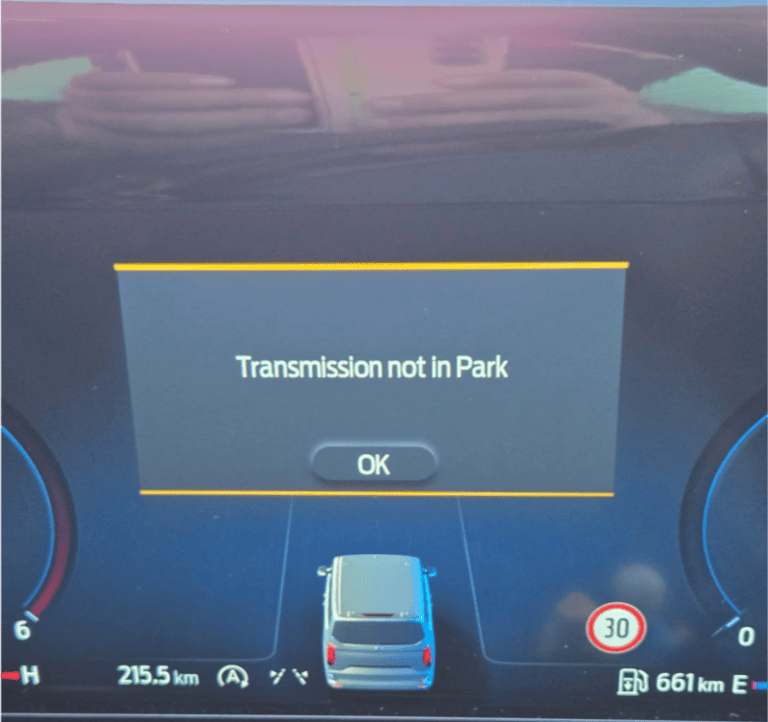
You are sitting in your driveway, ready to run an errand, and suddenly your dashboard lights up with a message that reads “Transmission Not In Park.” Your stomach drops a little. Did something just break? Is the car safe to drive?
Here is the good news. Sometimes this warning pops up simply because you opened the door before shifting the gear lever all the way into park, or because you unbuckled your seatbelt while the engine was still running. Nothing dramatic. Nothing expensive.
But here is the part you need to pay attention to. In other cases, this warning is your Ford trying to tell you that something inside the transmission system, often the electronic shifter, has gone wrong. Ignore that version of the warning long enough, and you could end up stranded on the highway shoulder wondering why your truck suddenly will not move.
In this guide, we are going to walk through exactly what this warning means, why it shows up, and what it actually takes to fix it. No jargon overload, no guessing games. Just straight talk from someone who has spent plenty of time under the hood of Ford vehicles.
What Does “Transmission Not In Park” Actually Mean on a Ford?
Most newer Ford vehicles, think Explorer, Escape, Edge, Fusion, and several F-150 trims, come equipped with a feature called Transmission Park Position, or simply “P” for Park. This is not just a fancy label on your gear selector. It physically locks the transmission so your vehicle cannot roll away on its own.
Picture yourself parked on a steep driveway. Without that Park lock engaging properly, gravity would happily pull your vehicle backward down the hill the moment you let go of the brake. That little “P” you shift into is doing serious mechanical work behind the scenes.
For that lock to engage, though, a few things have to happen in the right order. Your vehicle needs to come to a complete stop. You then need to shift the transmission into park correctly. Once that happens, an internal mechanism called the parking pawl clicks into place, physically preventing the wheels from turning.
Now here is where things get interesting. If any of the internal parts responsible for that process malfunction, especially the electronic shift mechanism found in many modern Fords, the system cannot confirm that Park has actually engaged. Since your car cannot verify that it is locked, it throws up the “Transmission Not In Park” warning as a safety measure.
Think of it like your phone’s fingerprint scanner failing to recognize your print even though your finger is right there. The system does not know for certain that everything checks out, so it refuses to unlock. Your Ford is doing something similar, except instead of a locked phone, you are dealing with a transmission that will not confirm it is safely parked.
Why Is Your Ford Throwing This Warning? Here Are the Real Culprits
There is no single cause behind this warning message. It could be something as harmless as forgetting to shift properly, or as serious as a failing transmission control module. Let us break down the most common reasons, starting with the more concerning ones.
1. A Failing Electronic Shifter
Many modern Ford models have ditched the old-school mechanical gear stick in favor of an electronic shifter. Instead of physically pulling a lever connected by cables to the transmission, you are pressing a button or rotating a dial that sends an electronic signal telling the transmission which gear to select.
It is a slick system when it works right. The problem is that electronic components fail differently than mechanical ones. A cable does not just stop transmitting force one day. But a circuit board, a sensor, or a faulty connector inside that shift module can absolutely stop communicating correctly, sometimes without warning.
When that shifter is damaged, your input, pressing “P,” does not always translate into the transmission physically moving into the park position. The car senses a mismatch between what you selected and what the transmission actually did, and up pops the warning.
Here is a real-world example. Say you are driving a Ford Explorer with a rotary shift dial. You turn the dial to Park, hear a soft click, and step out assuming everything is fine. If the internal shift motor inside that dial assembly is wearing out, though, the transmission might only partially engage Park, or fail to engage it at all. You might not even notice until the warning message appears, or worse, until your vehicle rolls slightly when you open the door.
2. A Faulty Interlock Switch
The interlock switch is one of those unsung safety features that most drivers never think about until it stops working. Its job is simple but important: it prevents your engine from cranking unless the transmission is properly in park (or neutral, on some models), and it will not let you shift out of park unless your foot is firmly on the brake pedal.
This switch is basically a gatekeeper. Without pressing the brake, you physically should not be able to move the shifter out of Park. That is intentional. It stops kids from accidentally shifting a parked car into drive, and it stops you from bumping the shifter while reaching for your coffee cup.
When this switch starts failing, a couple of things can happen. You might find that you cannot shift out of Park at all, even with your foot firmly on the brake. Or, in cases relevant to this warning message, the switch may fail to confirm that the transmission has locked into Park properly, triggering the same “Not In Park” alert even though everything else in the drivetrain is technically fine.
An interlock switch does not usually fail out of nowhere. Repeated hard shifting, getting the transmission stuck in a particular gear, or general electrical wear over years of use can all contribute to its decline.
3. A Glitching Transmission Control Module
Every modern transmission has a small computer dedicated to running the show. This is the Transmission Control Module, or TCM. It monitors sensor data, manages shift timing, and essentially acts as the brain telling the transmission what to do and when to do it.
When the TCM misbehaves, the effects can range from mildly annoying to genuinely dangerous. Sometimes it sends out a false alarm even when the transmission itself is working perfectly fine. Other times, the module’s confusion causes real shifting problems, delayed engagement, harsh shifts, or a refusal to lock into Park correctly.
Software glitches happen more often than people realize. Cars today run on more lines of code than some early spacecraft did. A minor software hiccup, a corrupted update, or a temporary sensor miscommunication can cause the TCM to throw warnings that do not necessarily reflect a physical, mechanical problem.
That said, do not assume every TCM issue is “just a glitch.” Sometimes the module itself is failing due to age, heat damage, or electrical surges, and no amount of resetting will permanently fix it.
4. Wiring Problems Hiding Behind the Scenes
Here is something a lot of car owners overlook. Your transmission is not just gears and fluid anymore. It is a network of sensors, solenoids, and electrical connections, all of which rely on wiring to communicate with the rest of the vehicle’s computer systems.
If a wire feeding information from the shifter to the TCM gets corroded, frayed, or disconnected, you get a communication breakdown. The transmission module does not receive an accurate signal about the shifter position, so it cannot confirm Park has been engaged, even if mechanically, everything shifted just fine.
Corrosion is a sneaky culprit here, especially if you live somewhere humid or near the coast where salt air speeds up rust. Rodents chewing through wiring harnesses is another surprisingly common issue that mechanics see more often than you would expect, particularly in vehicles that sit parked for extended periods.
5. Simply Forgetting to Shift Into Park
Now for the least dramatic cause on this list. Sometimes the warning shows up simply because the driver opened the door without fully shifting into Park, or unbuckled the seatbelt while the vehicle was still technically in gear.
This is your Ford’s way of nagging you, kind of like how your phone reminds you to update an app. It is not a mechanical failure. It is a built-in safety prompt designed to stop you from accidentally stepping out of a car that is still in Drive or Reverse.
A malfunctioning door switch can also cause a false version of this warning. That little switch detects whether your door is open or closed. If it is damaged or stuck, it might tell the car’s computer that the door is open even when it is shut tight, triggering the warning unnecessarily while you are driving down the road.
Other Contributing Factors Worth Knowing About
Beyond the five main causes above, a few other things can contribute to this warning showing up:
- Low transmission fluid: Insufficient fluid pressure can prevent internal components from engaging properly, including the parking pawl.
- Worn parking pawl: Over time, the physical mechanism that locks the transmission can wear down, especially if you have a habit of shifting into Park before the vehicle has completely stopped rolling.
- Battery voltage issues: A weak or failing battery can cause inconsistent power delivery to electronic components, including the shifter and TCM.
- Software that needs updating: Some Ford models have had documented software bugs related to shifter communication, later corrected through dealership updates.
Quick Reference: Causes, Severity, and What to Expect
| Cause | Severity | Typical Fix | Rough Cost Range |
|---|---|---|---|
| Damaged electronic shifter | High | Repair or replace shifter assembly | $300 to $900 |
| Faulty interlock switch | Moderate to High | Replace switch | $100 to $350 |
| Transmission control module issue | High | Reset, reprogram, or replace module | $200 to $800 |
| Wiring damage or corrosion | Moderate | Repair or replace affected wiring | $100 to $500 |
| Door opened before shifting to Park | Low | No repair needed, driver habit correction | $0 |
| Faulty door switch | Low | Replace door switch | $50 to $200 |
Keep in mind these costs vary depending on your specific Ford model, your location, and whether you go to a dealership or an independent shop. A Ford Explorer’s rotary shifter assembly, for instance, tends to cost more to replace than a simpler button-style shifter found in older Escape models.
How to Actually Fix a Ford That Will Not Shift Into Park
Figuring out the fix starts with figuring out the cause. That means a bit of detective work before any wrench touches a bolt. Do not just start swapping parts and hoping something sticks. That approach wastes money and rarely solves the actual problem.
Fixing the Electronic Shifter
Testing for a shifter problem is actually pretty straightforward. Start the vehicle, press the brake pedal firmly, and try shifting between Park and Drive a few times. If the transmission hesitates, does not respond at all, or takes multiple attempts before engaging, you are likely dealing with a failing electronic shifter.
Do not keep driving a vehicle with a confirmed bad shifter. Get it towed or driven directly to a shop instead. A shifter that fails to properly engage Park while parked on a slope is a genuine safety hazard, not just an inconvenience.
Repairing an electronic shifter usually means replacing the entire shift module rather than fixing individual components inside it. This is one of those repairs where paying for a professional makes sense. Yes, it costs more than a DIY attempt, but a mechanic with proper diagnostic tools can confirm the exact failure point and calibrate the new unit correctly, something that is genuinely difficult to do in your driveway with a basic tool kit.
Diagnosing the Interlock Switch
An OBD-II diagnostic scanner makes this part fairly easy. Plug it in, pull the stored codes, and look for anything referencing the interlock or shift lock system. Codes related to this switch typically point directly to the problem area.
One thing worth noting: a transmission that gets stuck in a particular gear repeatedly can actually cause damage to the interlock switch over time. If you have noticed rough or delayed shifting in the weeks before this warning appeared, that could be connected.
Just like the shifter itself, interlock switch replacement is best left to a professional. It involves working around the steering column and shifter assembly, areas where a wrong move can cause additional electrical issues.
Resetting or Replacing the Transmission Module
A scan tool can also pull codes related to the TCM. Sometimes, the fix is refreshingly simple. Disconnecting the battery for about fifteen minutes, or having a technician perform a proper module reset, clears out temporary glitches and gets things running normally again.
If the warning comes right back after a reset, that is a strong signal the problem runs deeper than a software hiccup. At that point, you are likely looking at either reprogramming the module with updated firmware or replacing it entirely.
Do not be surprised if a dealership recommends reprogramming first before jumping to full replacement. It is the cheaper and less invasive option, and Ford has released software updates in the past specifically addressing shifter communication bugs in certain model years.
Chasing Down Wiring Gremlins
Start by locating the wiring related to your transmission system. Your owner’s manual or a service manual for your specific model will usually include a wiring diagram showing exactly where these connections run.
Once located, visually inspect for the usual suspects: corrosion buildup, chewed insulation, loose connectors, or exposed copper strands. Any of these issues call for repair or full wire replacement, depending on how extensive the damage is.
A word of caution here. Automotive wiring work is not always as simple as splicing two ends together. Transmission wiring often carries specific voltage and signal requirements, and a botched repair can create new problems rather than solving the original one. If you are not confident working with automotive electrical systems, this is another job worth handing to a professional.
Simple Fixes and Habits Worth Building
Not every fix requires a trip to the shop. If your warning is triggered by opening the door before fully shifting to Park, the solution is refreshingly simple: build the habit of double checking your shifter position before unbuckling your seatbelt or reaching for the door handle.
If you suspect a faulty door switch, a mechanic can test it quickly using a multimeter, and replacement is usually a low-cost, low-effort repair compared to the other issues on this list.
Watch This Before You Attempt Any DIY Fix

This video walks through some of the diagnostic steps we covered above, giving you a visual sense of what a technician actually looks for when this warning shows up. Watching it before attempting your own diagnosis can save you from second-guessing yourself halfway through.
Should You Keep Driving With This Warning On?
Short answer: it depends on the cause, but leaning toward caution is always the smarter move.
If the warning appeared once after you opened the door slightly too early, and it has not returned, you are probably fine. That is your car nagging you about a habit, not reporting a mechanical failure.
However, if the warning persists, reappears frequently, or shows up alongside other symptoms like delayed shifting, unusual noises from the transmission, or the vehicle rolling slightly when you believe it is in Park, treat that as a red flag. Driving a vehicle that cannot reliably confirm Park engagement risks the car rolling unexpectedly, which is dangerous in a parking lot and downright hazardous on a hill or incline.
There is also the possibility of the transmission dropping into limp mode, a built-in protective feature that restricts your vehicle to a single low gear to prevent further damage. Getting stuck in limp mode on the highway is not just inconvenient, it can be genuinely unsafe depending on traffic conditions.
When in doubt, have the vehicle looked at before your next long drive. A quick diagnostic scan at a shop typically costs far less than dealing with a breakdown on the side of the road.
How to Keep This Warning From Coming Back
Prevention beats repair costs every single time. Here are a few habits and maintenance practices that reduce your odds of seeing this warning again:
- Come to a complete stop before shifting into Park. Shifting while the vehicle is still rolling, even slightly, puts extra strain on the parking pawl and shifter mechanism over time.
- Keep up with transmission fluid checks. Low or degraded fluid affects more than just shifting smoothness. It can interfere with the hydraulic pressure needed for proper Park engagement.
- Address minor warning messages early. A single warning that clears itself might be nothing. Repeated warnings deserve a diagnostic scan, not a shrug.
- Watch for battery health. A weak battery can cause inconsistent electrical performance across your vehicle’s computer systems, including transmission-related components.
- Stay current on manufacturer recalls and software updates. Ford has issued updates in the past specifically targeting shifter and TCM communication issues. A quick call to your dealership can confirm whether your VIN has any open recalls related to this problem.
Frequently Asked Questions
Can I still drive my Ford if this warning appears once and disappears?
Generally yes, especially if it happened right after opening the door or unbuckling your seatbelt while parked. If it does not return, there is likely no mechanical issue at play. Keep an eye on it over the next few drives just to be sure.
Is this warning covered under warranty?
If your Ford is still within its powertrain warranty period, transmission-related component failures, including the electronic shifter, interlock switch, and TCM, are often covered. Check your specific warranty terms or contact your dealership to confirm coverage before paying out of pocket.
How much does a full shifter assembly replacement typically cost?
Depending on your Ford model, expect somewhere between $300 and $900 for parts and labor combined. Models with rotary dial shifters, like certain Explorer and Edge trims, tend to sit on the higher end of that range.
Can a dead battery cause this warning message?
Yes, in some cases. Weak or inconsistent voltage can affect the electronic components responsible for confirming shifter position. If your battery is old or showing signs of weakness, replacing it might resolve the warning without any transmission-related repair needed at all.
Does this warning mean my transmission is about to fail completely?
Not necessarily. Many cases trace back to sensor, switch, or wiring issues rather than internal transmission damage. That said, ignoring the warning for an extended period increases the risk of it developing into something more serious.
Your Ford is not trying to annoy you with that “Transmission Not In Park” message. It is doing exactly what it was designed to do, alerting you before a small electrical hiccup turns into a stranded-on-the-highway situation. Get it scanned, figure out the real cause, and fix it properly the first time. Your future self, and your transmission, will thank you.