
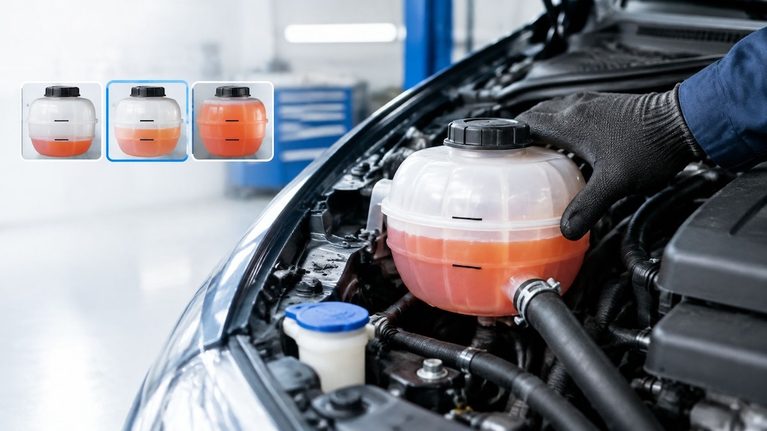
Winter has a way of sending people under the hood. The reservoir looks lower than it did in October, the heater takes its time, and you start wondering whether something is wrong.
With the engine fully cold, the coolant should sit between the MIN and MAX marks on the reservoir. On cars marked differently, that means between L (low) and F (full). If your tank has COLD and HOT lines, the COLD line is your target when the engine hasn’t run for a while. Too little or too much causes trouble in any season, not only in winter.
This guide covers how to read the reservoir, why the level changes with temperature, and when a drop is normal. It also covers when a drop points to a real problem, what happens if you keep driving low, and how to top up safely. I’ll share what I check first in the shop when someone tells me their coolant keeps disappearing.
The short answer
Check the level when the engine is cold, the car is parked on level ground, and the engine has been off for several hours. A reading taken after a drive is misleading, because hot coolant expands and pushes the level up. That’s the number people often panic about, or the one that gives them false comfort.
If the coolant is between MIN and MAX, you’re fine. If it’s at or just under MIN on a freezing morning, don’t assume there’s a leak yet, but do keep an eye on it. If it’s clearly below MIN, or you’re topping up again every week or two, something is losing coolant and it needs to be found.
A level above MAX is also worth fixing. There’s an expansion gap in the system for a reason, and overfilling can push coolant out through the overflow, which wastes it and leaves a sticky mess on the engine.
How to read the coolant reservoir
Most cars have a translucent plastic reservoir (some call it an overflow tank or expansion tank) near the radiator. It’s marked with two lines. Depending on the manufacturer, those lines say MIN and MAX, L and F, or COLD and HOT.
Marking styles vary, so open the owner’s manual and confirm which line applies to a cold engine on your car. If your reservoir has COLD and HOT lines, the engine should be cold and the coolant should reach the COLD line. The HOT line shows roughly where the level climbs once the engine reaches operating temperature.
On some cars the radiator itself has a filler neck you can open. When you top up there, the coolant should come up to just below the filler neck, as long as your manual doesn’t say otherwise. Many modern cars only want you to fill through the reservoir, so don’t open the radiator cap unless the manual tells you to and the engine is completely cold.
Plastic reservoirs get stained and cloudy with age, and the coolant color can be hard to see. Hold a flashlight behind the tank, or look from the side with the light angled through it. If you still can’t see a level, wipe the tank down first. Dirt on the outside fools more people than you’d expect.
What coolant does and why the mix matters
Coolant, also called antifreeze, does more than keep your engine from freezing. It carries heat away from the engine so the metal doesn’t overheat, and it protects the inside of the cooling system from corrosion and rust. It also keeps the water from boiling over on a hot day or towing a load.
Coolant is normally a mix of antifreeze and water, commonly about half and half. That ratio is what gives you protection against both freezing and overheating. Straight water freezes sooner and boils sooner, and it doesn’t protect the metal parts the same way.
Not every coolant is the same. Manufacturers specify certain types, and the right one for your car is listed in the owner’s manual. I’d rather you spend five minutes checking the manual than guess from the color of the bottle. If you aren’t sure what’s in your system, ask a shop or the dealer before adding something that might not be compatible.
Coolant is also toxic and has a sweet smell and taste that attracts pets, so wipe up spills and store it where animals and kids can’t reach it.
Why the coolant level drops when it’s cold
Liquids and metals both contract as they cool. After the engine sits overnight, particularly in freezing weather, the coolant in the system shrinks slightly and the pressure inside drops. The system can then draw coolant back from the reservoir into the radiator and engine passages, and the level in the tank goes down.
That’s normal behavior. Antifreeze keeps the coolant liquid in cold weather, but it doesn’t stop it from contracting. If the reservoir sits a bit lower on a freezing morning than on a mild day, you haven’t necessarily lost anything.
The test is where it sits compared to the lowest mark. Cold contraction shouldn’t pull the coolant below MIN (or L). If it does, there’s probably less coolant in the system than there should be, and it’s time to find out why.
Here’s a shop example. A customer once came in convinced his car was leaking because the level dropped every winter morning. It turned out the tank had never been topped up properly after a repair, so it sat right at the minimum and looked worse in the cold. We topped it up to the right line, and the level stayed put all winter.
Why the level rises when the engine is hot
The opposite happens as the engine warms up. Coolant expands when heated, which raises the pressure in the radiator and engine. The extra volume has to go somewhere, so it flows into the reservoir and the level rises.
That’s the system doing its job. The amount that moves is normally small, and it goes back into the engine when things cool down again. If you only ever check the level hot, you’ll see a higher reading than a cold check would give, which is one reason to stick to cold readings for your decisions.
If coolant is regularly pushed out of the reservoir and onto the ground, the system is under more pressure than it should be or the tank is overfilled. A worn radiator cap is a common culprit. Overheating can cause it too, and so can a deeper engine fault such as a head gasket problem, which I’ll cover below.
How to check your coolant level properly
- Let the engine cool completely. Leave the car for several hours, ideally overnight. A cold engine gives you the only reading you can trust, and it’s also the only safe time to open anything on the system.
- Park on level ground. A sloping driveway can make the level look higher or lower than it is. If your usual spot tilts, check somewhere flat before you decide you have a problem.
- Find the reservoir and read the marks. Look at the level from the side, not from above, and use a flashlight if needed. Compare the coolant to the MIN/MAX, L/F or COLD/HOT lines. Note where it sits, so you can compare next time.
- Look at the coolant itself. It should look fairly clean. Rusty brown liquid, oily film, or floating debris suggests the system needs attention. A milky look or oil traces in the coolant is a warning sign you shouldn’t ignore, since it can point to an internal engine problem.
- Look around the engine bay. Check the hoses, radiator, and the ground under the car for drips, crusty residue or wet spots. A small leak can dry before you see liquid, but it often leaves a colored or crusty trail.
- Top up only if the level is low. Use the correct coolant, add it slowly, and stop at the right mark. Recheck the level after the next few drives.
Never open the radiator cap or reservoir cap on a hot engine. The system is under pressure, and scalding coolant can spray out. If the engine has been running and you need to look, wait until it’s fully cool.
Winter coolant checks
Cold weather puts extra demands on the cooling system, so it’s smart to check the level more often in winter. A quick look every couple of weeks is plenty for most drivers, and it takes only a minute or two. Make it part of your routine when you check tire pressure or washer fluid.
The mix matters most when it’s cold. A weak antifreeze concentration can leave you with less freeze protection than you think, particularly if someone has topped the system up with plain water over time. If you aren’t sure what’s in the system, a shop can test it quickly.
A low level in winter also affects your heater. The heater core uses engine coolant to warm the cabin, so if there isn’t enough coolant, you may get weak or inconsistent heat. If your heater suddenly blows cold air, check the level before you assume the heater itself has failed.
Keep in mind that cold contraction should move the level only a little. If you’re adding coolant often, there’s a reason for it, and winter weather isn’t it.
Coolant level dropping with no visible leak
This is the one I get asked about most. You top up the tank, a few days later it’s low again, and there’s nothing on the driveway. Coolant can go missing without leaving a puddle, so the absence of a drip doesn’t clear the system.
Some of the usual causes are easy to find, and some need a proper test. I’ll go through them in the order I’d normally think about them.
A worn radiator cap
The radiator cap does more than seal the system. It holds the pressure at the right level and lets coolant move back and forth with the reservoir. When the cap wears out, it may let coolant escape or fail to draw it back in properly.
It’s cheap and easy to check, which is why I start there. If the cap’s seal looks cracked, hardened, or dirty, replace it with the correct one for your car. Do this only when the engine is cold.
Coolant overflowing without you noticing
A system that overflows regularly can lose coolant slowly. The liquid goes out through the overflow and evaporates or drips away, so you never see a pool. Overfilling, a weak cap, or an overheating engine can all cause this.
Keeping the level at the correct mark helps prevent it. If you find the tank is repeatedly pushed over the MAX line when hot and then drops, check the cap and watch the temperature gauge.
Internal leaks
Sometimes the coolant is leaking inside the engine, where you can’t see it. A blown head gasket, damaged cylinder bores, or a cracked cylinder head can let coolant escape into the combustion chamber or into the oil. These faults can make coolant disappear without any external sign.
Watch for white smoke from the exhaust, a sweet smell, overheating, rough running, or oil that looks milky. Any of those, combined with falling coolant, means you should stop driving and have the engine checked. Driving on can turn a repairable fault into an engine replacement.
Overheating
An engine that runs hot can push coolant out of the system. That makes the problem worse, because less coolant means more heat. If the temperature gauge climbs higher than usual, don’t keep driving to see what happens.
Pull over somewhere safe, switch the engine off, and let it cool. Then check the level, look for obvious leaks, and get the car diagnosed. A stuck thermostat, a failing fan, a blocked radiator, or a water pump problem can all cause overheating.
Driving style and load
How you drive affects the cooling system. Frequent uphill driving or hauling heavy loads puts more heat into the engine, and that can push coolant out or reveal a weak spot in the system. A car that’s fine in town may struggle when it’s loaded and climbing.
If the level drops mainly after towing or mountain driving, mention that to your mechanic. It helps narrow down whether the cooling system is struggling under load.
Other cooling system components
A worn water pump can leak coolant slowly, often from a weep hole or the seal, and it may not drip much. A faulty exhaust gas recirculation (EGR) system can also affect the cooling system on some engines. Air trapped in the system after a repair can cause level changes and heating problems too.
These issues need testing rather than guessing. A pressure test of the cooling system is a common first step, because it can reveal leaks that don’t show up while the engine is off. Ask your mechanic what they plan to check, and why.
Quick guide to common coolant level symptoms
| What you notice | Likely cause | What to do |
|---|---|---|
| Level slightly lower on a freezing morning, still above MIN | Normal contraction from cold | Recheck when mild and keep an eye on it. No top-up needed if it stays above MIN. |
| Level below MIN when cold | Coolant has been lost or the tank wasn’t filled properly | Top up with the correct coolant, then monitor. If it drops again, have the system tested. |
| Level rises when hot, then returns when cold | Normal expansion | No action needed if it returns to the cold mark. |
| Coolant keeps disappearing, no puddle | Worn cap, overflow, hidden or internal leak | Check the cap, look for residue, and book a pressure test and diagnosis. |
| Low coolant plus white smoke, milky oil or overheating | Possible head gasket or internal engine fault | Stop driving the car and get it inspected. |
| Weak heater and low coolant | Not enough coolant reaching the heater core, or air in the system | Check the level, top up if needed, and have the system checked if it continues. |
This table is a starting point. Symptoms overlap, and two problems can show up at once. If you can’t match what you’re seeing to a row, or it keeps coming back, that’s a good reason to bring the car in.
Topping up coolant the right way
Adding coolant is simple, but a few details matter. Do it with the engine cold, ideally first thing in the morning before you start the car. That gives you a true reading and avoids the risk of hot, pressurized coolant.
Use the coolant type your manual specifies. If it comes as a concentrate, mix it as the label directs. Pre-mixed coolant can go in as it is. Add a little at a time, check the level, and stop at the MAX mark, or at the COLD line on a tank marked that way.
Don’t worry if a small amount overflows into the expansion tank as the engine warms up. That’s normal behavior and it won’t hurt anything, as long as you haven’t filled well past the top mark. What you don’t want is a tank that’s regularly pushed over and spilling onto the engine.
After topping up, recheck the level over the next few days. If it stays where you left it, great. If it falls again, you’ve got a leak or loss to track down, and adding more coolant is only a temporary fix.
Mistakes to avoid
- Opening the cap on a hot engine. This is the most dangerous mistake. Let it cool fully.
- Using the wrong coolant. Check the manual. Mixing incompatible types can cause problems in the system.
- Topping up with plain water as a habit. A bit in an emergency may get you home, but it dilutes the antifreeze and weakens protection.
- Overfilling. The reservoir needs room to expand. Go to the correct mark and stop.
- Ignoring repeat top-ups. If you keep adding coolant, something is wrong. Find it before it gets worse.
- Checking the level hot. A hot reading is higher and tells you less. Check cold.
Does adding coolant raise the level more than it shows?
Some people worry that topping up will push the level too high once the engine warms up. That’s usually not an issue if you fill only to the correct mark when cold. The expansion that raises the level as the engine heats is built into the design of the system.
A little extra may flow into the expansion tank and back again, and that’s fine. If you overfill by a lot, you may see coolant coming out of the overflow after a drive, which wastes coolant and can leave residue. Fill to the right line and you’ll avoid it.
If the level keeps rising higher than it should when hot, or coolant is forced out repeatedly, treat that as a symptom. It may mean the cap is weak, the system is overheating, or there’s an internal fault pushing pressure into the cooling system.
What happens if you drive on low coolant
Driving with low coolant is a gamble, and the stakes are your engine. Coolant carries heat away from the engine, and without enough of it the temperature climbs quickly. Severe overheating can warp parts, damage the head gasket, and in the worst cases seize the engine so badly that pistons are wrecked.
A head gasket that fails from overheating can leave you with smoke from the exhaust, lost power and poorer efficiency. You may also hear knocking or rattling sounds as the engine struggles. By the time you hear noises, damage may already be underway.
Some vehicles may cut power or shut down when they overheat badly, but you can’t count on that to protect the engine. Even if your car does cut out, it could happen on a busy road or a slippery surface, which is dangerous for you and everyone around you. Checking the coolant level regularly is a far safer plan than finding out the hard way.
If the temperature gauge rises or a warning light comes on, pull over as soon as it’s safe, switch the engine off, and let it cool. Don’t open the cap while it’s hot. Once it’s cool, check the level, add coolant if needed to get you to a shop, and arrange a proper diagnosis.
Warning signs that need attention
- Temperature gauge climbing above normal. Stop and let the engine cool before you do anything else.
- A warning light for coolant level or temperature. Take it seriously, even if the car seems to run fine.
- A sweet smell from the engine bay or exhaust. That’s often coolant leaking somewhere.
- White smoke from the exhaust. It may suggest coolant is entering the combustion chamber.
- Milky or foamy oil. Coolant may be mixing with the oil, which needs urgent attention.
- Heater blowing cold or lukewarm air. Low coolant or air in the system can be the cause.
- Crusty residue on hoses or the radiator. That’s often dried coolant from a slow leak.
Any one of these may have a simple explanation. When several show up together, or the problem returns after you’ve topped up, stop guessing and get it checked.
DIY or see a mechanic?
Checking the level, topping up with the correct coolant, and inspecting for obvious leaks are all reasonable DIY jobs. They take little time, need almost no tools, and can save you from a breakdown. Replacing a radiator cap on a cold engine is also straightforward on most cars.
Bring in a mechanic if the level keeps dropping, if you see signs of an internal leak, or if the engine overheats. Pressure testing, finding hidden leaks, and checking for a head gasket problem need the right equipment and experience. Guessing at those can cost you more in the long run.
The same goes for anything involving the water pump, the thermostat or the radiator itself. Those repairs can be done at home by experienced DIYers, but the system must be refilled and bled properly afterward, or air pockets will cause problems. If you aren’t confident, let a shop handle it.
Costs depend on the fault, the car and where you live, so I won’t quote numbers here. Ask for a written estimate that separates diagnosis, parts and labor, and ask what testing led to the recommendation. A good shop will explain it clearly.
Common questions about coolant level in cold weather
Where should the coolant level be when the engine is cold?
It should be between the MIN and MAX marks, or between L and F, on the reservoir. If the tank has COLD and HOT lines, aim for the COLD line when the engine is cold. Check your manual if you’re unsure how your car is marked.
Is it normal for coolant to be low in winter?
It can sit slightly lower because the coolant contracts in the cold. It shouldn’t drop below the MIN or L mark. If it does, the system probably needs a top-up and a closer look.
Why does the coolant level go up when the engine is hot?
Coolant expands when it heats up, and the extra volume flows into the reservoir. That’s normal, and the level should drop back when the engine cools. Always judge the level on a cold engine.
Can coolant disappear without a visible leak?
Yes. It can be lost through a worn cap, regular overflow, a small leak that evaporates, or an internal fault such as a head gasket problem. Because the cause isn’t obvious, a pressure test and a proper inspection are the sensible next steps.
Can I add coolant when the engine is warm?
It’s best to wait until the engine is cold. A warm system can still be under pressure, and the reading you get won’t be reliable. If you must top up in an emergency, let the engine cool and open the cap carefully.
Can I use plain water instead of coolant?
In an emergency it may get you to a shop, but it isn’t a long-term solution. Water dilutes the antifreeze and reduces protection against freezing, overheating and corrosion. Have the mix corrected as soon as you can.
How often should I check the coolant?
A quick check every couple of weeks is a sensible habit, and it’s worth doing before long trips and at the start of winter. If you’re towing, climbing hills or driving an older car, look more often. Always do it with the engine cold.
The expert verdict
With the engine cold, your coolant should be between the MIN and MAX marks (or L and F), or at the COLD line if your tank is marked that way. A slight drop on a freezing morning is normal because the coolant contracts, and a slight rise when hot is normal because it expands. What isn’t normal is a level that sits below the minimum or keeps falling after you top up.
Your next step is simple. Check the level cold, look for leaks, residue and odd smells, and top up with the correct coolant if it’s low. If you’re adding coolant repeatedly, if the engine runs hot, or if you see smoke or milky oil, see a mechanic before the problem becomes an expensive engine repair.
DIY is fine for checking and topping up. Leave pressure testing, internal leak diagnosis and major cooling repairs to a shop, unless you’ve got the experience and tools to do the job properly.
One clear takeaway: check your coolant when the engine is cold, keep it between the marks, and treat any level that keeps dropping as a problem to diagnose rather than a habit to top up.