
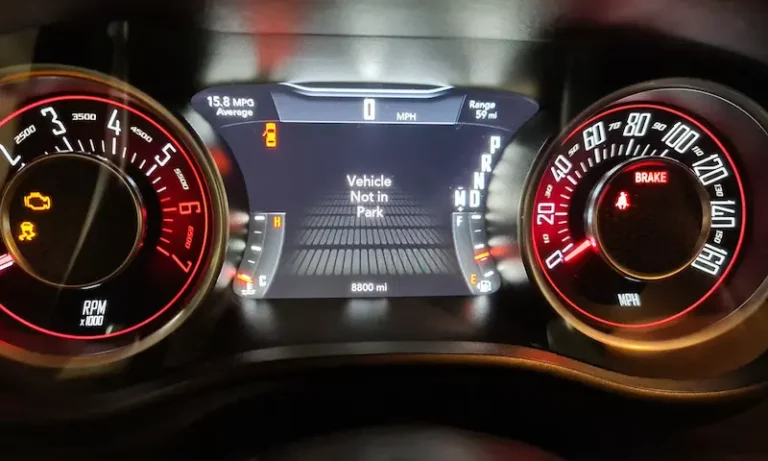
You turn off your Dodge, open the door, and the vehicle refuses to shut down completely. Or maybe the key will not come out of the ignition. The message on the dash says “Vehicle Not in Park,” but the shifter is sitting right where it always has been. Sound familiar?
This is one of those issues that catches people completely off guard because everything looks normal. The shifter feels like it is in park. The car is not rolling anywhere. But the vehicle’s computer disagrees, and it is not going to let you walk away until the situation is resolved.
The good news is that this problem usually has a straightforward cause, and in many cases you can fix it yourself without a tow truck or a dealership visit. Let’s go through exactly what is going on and how to handle it.
Why Your Dodge Thinks It Is Not in Park When It Obviously Is
Modern Dodge vehicles do not rely on a simple mechanical connection to determine whether the transmission is in park. They use sensors, switches, and electronic modules to confirm the shifter position and communicate that information to the vehicle’s computer. When any part of that communication chain breaks down, the vehicle cannot confirm it is in park, even when it physically is.
Here is why that matters. The “Vehicle Not in Park” message is a safety interlock. The system is designed to prevent the engine from shutting down while the vehicle could potentially roll. If the computer cannot verify the park position, it defaults to caution and keeps certain systems running or locks the ignition in a state that prevents normal shutdown. That is why some owners find they cannot remove the key, cannot power the vehicle completely off, or get repeated warning chimes.
Understanding this makes the diagnosis much easier. The problem is almost never that the car is actually not in park. The problem is that something in the detection and communication system has failed.
The Most Common Causes of the “Vehicle Not in Park” Message in Dodge Vehicles
Cause 1: A Faulty Transmission Range Sensor
The transmission range sensor, sometimes called the trans range level sensor or gear position sensor, is the primary component responsible for telling the vehicle’s computer what gear the transmission is currently in. It reads the position of the gear selector and sends that data to the ECU.
When this sensor fails or begins sending inaccurate readings, the ECU receives incorrect gear position data. The transmission might physically be in park, but the sensor is reporting something different, and the vehicle acts on what the sensor says, not what is actually happening mechanically.
Transmission range sensor failures can happen gradually or all at once. Gradual failures often show up as intermittent issues where the message appears occasionally and then goes away on its own. A complete failure results in a persistent warning that does not clear regardless of how many times you cycle the gear selector.
Connector issues are also common with this sensor. The electrical connector that plugs into the sensor can corrode, become loose, or develop a poor contact point over time. In many cases, the sensor itself is fine but the connection is not delivering a clean signal.
Cause 2: A Weak or Failing Battery
This one surprises a lot of people, but it is a well-documented cause of the “Vehicle Not in Park” warning in Dodge vehicles. The transmission range sensor and the shifting modules rely on stable electrical power to function correctly. When battery voltage drops below the threshold these systems need, they can start sending erratic signals or failing to communicate altogether.
Think about what happens at the end of a battery’s life. It can still start the vehicle and run basic functions, but voltage under load starts dropping in ways that affect sensitive electronic modules. The gear position communication system is one of those sensitive areas. A battery that reads 12 volts at rest might drop significantly under load, and that fluctuation is enough to confuse the system.
If your Dodge battery is more than three years old and this message has started appearing, the battery is the first thing worth checking. It is the cheapest diagnosis and the easiest fix if it turns out to be the cause.
Cause 3: A Faulty Neutral Safety Switch
The neutral safety switch is a safety device that prevents the engine from starting unless the transmission is in park or neutral. It works alongside the transmission range sensor, and in some Dodge configurations it is effectively part of the same assembly.
When the neutral safety switch fails, it can do one of two things. It can prevent the vehicle from starting at all, or it can cause the vehicle’s computer to incorrectly register the transmission position, leading to the “Vehicle Not in Park” warning. A faulty switch can also produce intermittent starting issues alongside the warning message, where the vehicle sometimes cranks normally and sometimes does not.
The neutral safety switch is a wear item. It has physical contact points that degrade over time, especially in vehicles with higher mileage. If you have been experiencing occasional no-start conditions in addition to the park warning, the neutral safety switch is a strong suspect.
Cause 4: Shifter Mechanism Problems
The shifter assembly itself can be the culprit. In some Dodge models, particularly those with electronic or push-button shifters, the internal components of the shift assembly can develop faults that prevent the system from properly confirming the park position.
In vehicles with traditional column or floor-mounted shifters, the mechanical linkage that connects the shifter to the transmission can become misadjusted or worn. When the linkage is slightly out of alignment, the shifter can feel like it is fully in park, but the transmission is actually sitting just short of the park position. The park pawl has not fully engaged, and the sensor reflects that.
This is more common on higher-mileage vehicles where the linkage components have had time to wear. It can also happen after transmission service work if the linkage was disturbed and not properly readjusted afterward.
Cause 5: Wiring or Connector Issues
Between the shifter, the transmission range sensor, the neutral safety switch, and the ECU, there is a network of wiring and connectors that carries all of this position data. Any break, corrosion, loose connection, or chafed wire in that network can interrupt the signal and trigger the park warning.
Wiring issues are particularly sneaky because they are often intermittent. The connection works fine most of the time but fails under certain conditions, like after the vehicle warms up, on bumpy roads, or in wet weather. If your “Vehicle Not in Park” warning comes and goes without any obvious pattern, wiring is worth investigating.
How to Fix the Dodge “Vehicle Not in Park” Problem: Step-by-Step
Work through these fixes in order. Each step is progressively more involved, and most people find their solution early in the list.
Fix 1: Cycle the Gear Selector and Try Again
Before doing anything else, try this. It sounds too simple, but it works often enough to always try first.
- Set the parking brake. This removes any rolling load from the transmission’s park pawl.
- Shift from Park to Reverse, then to Neutral, then to Drive, and back to Park. Do this slowly and deliberately, pausing briefly at each position.
- While cycling through, wiggle the shifter slightly in each position to ensure it is fully seated.
- Return to Park and hold the shifter firmly in position for two to three seconds before releasing.
- Try shutting the vehicle off and see if the warning clears.
What you are doing here is giving the transmission range sensor multiple opportunities to read the park position cleanly. If the sensor had a momentary communication error, this cycling often clears it.
Fix 2: Test and Address the Battery
If cycling the shifter did not clear the warning, check the battery next. Have it load-tested at any auto parts store. Most will do this for free. You are looking for a resting voltage of 12.6 volts or higher, and you want to see that voltage hold up under load during a cranking test.
If the battery is weak, charge it fully or replace it. After addressing the battery, try the following reset:
- Disconnect the negative battery terminal.
- Wait five full minutes.
- Reconnect the terminal and start the vehicle.
- Shift through all gear positions and return to Park.
- Check whether the warning has cleared.
The battery disconnect serves two purposes. It forces the ECU to restart fresh, clearing any stored temporary faults. And if low voltage was the root cause, restoring proper voltage often resolves the warning immediately.
One important note here: if your vehicle will not fully power down because of the “not in park” warning and you are worried about the battery draining overnight, disconnecting the negative terminal is a safe way to prevent a dead battery while you figure out the fix. Just be aware that disconnecting the battery will reset your radio presets and may require a relearn period for some engine management functions.
Fix 3: Inspect and Reseat the Transmission Range Sensor Connector
If the battery is fine, the next thing to check is the transmission range sensor and its electrical connector. This is a moderate DIY job on most Dodge vehicles.
- Locate the transmission range sensor. It is typically mounted on the side of the transmission, near where the shift linkage connects. Consult your vehicle’s service manual for the exact location on your specific model.
- With the vehicle off and battery disconnected, locate the electrical connector that plugs into the sensor.
- Carefully unplug the connector. Inspect the terminals inside for any signs of corrosion, green or white buildup, or pushed-back pins.
- If there is corrosion, clean the terminals with electrical contact cleaner and a small brush.
- Apply a small amount of dielectric grease to the connector terminals before plugging it back in. Dielectric grease prevents moisture from entering the connector and causing future corrosion.
- Firmly reseat the connector until you hear or feel it click into place.
- Reconnect the battery and test.
Many owners have resolved the “Vehicle Not in Park” warning simply by unplugging and reseating the transmission range sensor connector. A connector that has vibrated loose or developed a poor contact point over time can cause exactly this symptom, and reseating it restores the clean signal the ECU needs.
Fix 4: Check the Shift Linkage Adjustment
If your Dodge has a traditional mechanical shift linkage rather than an electronic shifter, a linkage adjustment may be the answer. This is most relevant on vehicles with column shifters or floor-mounted shifters connected to the transmission by a cable or rod.
Signs that the linkage is misadjusted include:
- The shifter feels like it is in park but requires more force than usual to reach that position
- The shift indicator on the dash or column does not align perfectly with the P marker when the shifter is in park
- The vehicle rolls slightly when the engine is running and the shifter is in park position
Linkage adjustment is typically done by loosening an adjustment nut or clip on the shift cable where it connects to the transmission, repositioning the cable so the park position aligns correctly, and then relocking the adjustment. This is a job that requires patience and access to your specific vehicle’s service manual for the adjustment procedure. If you are not comfortable doing this yourself, a transmission shop can handle it quickly and inexpensively.
Fix 5: Replace the Neutral Safety Switch or Transmission Range Sensor
If cleaning and reseating the connector did not help and the sensor is confirmed to be sending bad readings through a scan tool, replacement is the next step. The same applies if the neutral safety switch tests as faulty.
On most Dodge models, the transmission range sensor is accessible from underneath the vehicle. The replacement process generally involves:
- Safely lifting and supporting the vehicle on jack stands.
- Locating and disconnecting the shift linkage from the transmission.
- Removing the electrical connector and unbolting the old sensor.
- Installing the new sensor and reconnecting everything.
- Adjusting the sensor to the neutral position if required. Some sensors need to be aligned correctly after installation for the readings to be accurate. Your service manual will specify whether this is necessary for your model.
The transmission range sensor is not an expensive part on most Dodge vehicles. Depending on your specific model, you are looking at a parts cost of roughly $30 to $120 for a quality replacement. Labor at a shop typically runs one to two hours.
Fix 6: Check for a Recall or Technical Service Bulletin
Before spending any money on parts, do one more check. Some Dodge models have had technical service bulletins issued for exactly this issue, and in some cases there have been recalls related to shifter position detection. A technical service bulletin does not guarantee free repairs, but it does mean the dealership knows exactly what to do and has a defined fix already mapped out.
You can check for open recalls by entering your VIN at the National Highway Traffic Safety Administration website. You can also call your local Dodge dealer, give them your VIN, and ask specifically if there are any open recalls or technical service bulletins related to shifter position or the “Vehicle Not in Park” warning on your specific model year.
If there is an active recall, the repair is free regardless of mileage or warranty status.
Quick Reference: Symptoms, Causes, and Fixes
| Symptom | Most Likely Cause | Recommended Fix | DIY or Shop? |
|---|---|---|---|
| Warning appears and clears on its own | Intermittent sensor or connector issue | Reseat transmission range sensor connector | DIY |
| Warning appears after battery work | ECU needs reset after power interruption | Battery disconnect reset | DIY |
| Warning on older vehicle with weak battery | Low voltage causing sensor errors | Test and replace battery | DIY |
| Vehicle will not start and warning appears | Neutral safety switch failure | Replace neutral safety switch | Shop recommended |
| Shifter feels stiff going to park | Misadjusted shift linkage | Linkage adjustment | DIY or shop |
| Warning persistent despite all attempts | Failed transmission range sensor | Sensor replacement with scan tool diagnosis | Shop |
| Multiple warnings alongside park message | Wiring fault or module issue | Professional diagnosis with factory scan tool | Shop |
What Happens If You Ignore the Warning?
Some owners decide to live with the warning and keep driving. That is understandable if the vehicle seems to be operating normally, but there are a few real risks worth knowing about.
First, if the vehicle cannot confirm it is in park, the auto-park function on some Dodge models may not engage fully. This means if you are parked on any incline, you are relying entirely on the parking brake to hold the vehicle, not the transmission park pawl. That is fine if you always use the parking brake, but most people do not.
Second, the neutral safety switch interlock is connected to this system. If the switch is failing in a way that triggers the park warning, it can also cause intermittent no-start conditions. You might find yourself stranded somewhere because the vehicle will not crank, even though everything else seems fine.
Third, if the warning is being caused by a failing transmission range sensor, that sensor feeds data to the transmission control module for more than just park detection. It also informs gear shift timing and transmission operating parameters. A badly failing sensor can eventually affect shift quality and transmission behavior in ways that go beyond a dashboard warning message.
The bottom line is that this is not a warning you want to ignore indefinitely. The fixes are generally straightforward and not expensive. Take care of it before it turns into a bigger problem.
When You Absolutely Need a Professional
Most of the DIY steps above will cover the majority of cases. But there are situations where you need professional diagnosis with the right tools.
A standard consumer OBD-II scanner reads generic powertrain fault codes. But the “Vehicle Not in Park” warning in a Dodge often stores faults in the body control module or the transmission control module, not just the powertrain codes. Reading those module-specific codes requires a professional-grade scanner with enhanced Chrysler/Dodge module access, or the factory WiTech diagnostic software that the dealership uses.
If you have tried the battery disconnect, the connector reseat, and the shifter cycling, and the warning persists, take it to a shop with proper diagnostic capability. Ask them specifically to scan the body control module and the transmission control module for stored faults, not just pull generic codes. That data will tell you exactly which component is failing and eliminate all the guesswork.
Frequently Asked Questions
Why does my Dodge say “Vehicle Not in Park” when it clearly is in park?
The vehicle is using sensors and switches to confirm the transmission position electronically, not just mechanically. When one of those components sends a bad or missing signal, the vehicle cannot confirm the park position even if the transmission is physically locked in park. The most common causes are a faulty transmission range sensor, a loose connector, a weak battery, or a failing neutral safety switch.
Can I still drive my Dodge with this warning showing?
In most cases, yes. The vehicle can still be driven while this warning is active. But you should not ignore it long-term because the underlying cause can affect starting reliability and may impact transmission operation if the sensor is fully failing. Address it promptly rather than letting it go.
Will replacing the battery fix the “Vehicle Not in Park” warning?
It will if the battery was the cause. Low voltage is a documented trigger for this warning in Dodge vehicles. If the battery tests weak and the warning appeared around the same time the battery started degrading, replacing the battery often resolves the issue completely. If the battery is fine and the warning persists after replacement, the cause is elsewhere.
How much does it cost to fix the “Vehicle Not in Park” problem on a Dodge?
It depends entirely on the cause. A battery replacement runs $150 to $300. A transmission range sensor is typically $30 to $120 in parts and one to two hours of labor. A neutral safety switch is similar in price. Wiring repairs vary widely depending on the location and severity of the damage. Connector cleaning costs nothing if you do it yourself. Getting a professional diagnostic scan costs $100 to $150 at most shops but that fee is often applied toward the repair if you have the work done there.
Does this problem affect specific Dodge models more than others?
This warning has been reported across a wide range of Dodge vehicles including the Charger, Challenger, Durango, Ram trucks, and Journey. It is not limited to one model or one year range. Any Dodge vehicle with electronic gear position detection can experience this issue, though models with push-button electronic shifters do tend to have slightly different root causes than those with traditional mechanical shifters.
The Right Approach to This Problem
Start cheap and simple. Cycle the shifter, check the battery, reseat the connector. These three steps cost nothing and fix the problem more often than you might expect. If those do not work, move to the sensor and linkage checks. Only commit to parts replacement after you have confirmed which component is actually at fault, either through a proper scan or by systematically ruling everything else out.
And before spending a cent on repairs, check your VIN for recalls. If there is one open on your vehicle for this exact issue, the fix is free. Five minutes on the NHTSA website could save you a repair bill.
This is a solvable problem. Most owners resolve it within the first two or three steps without needing to set foot in a dealership. Work through it methodically and you will get there.