
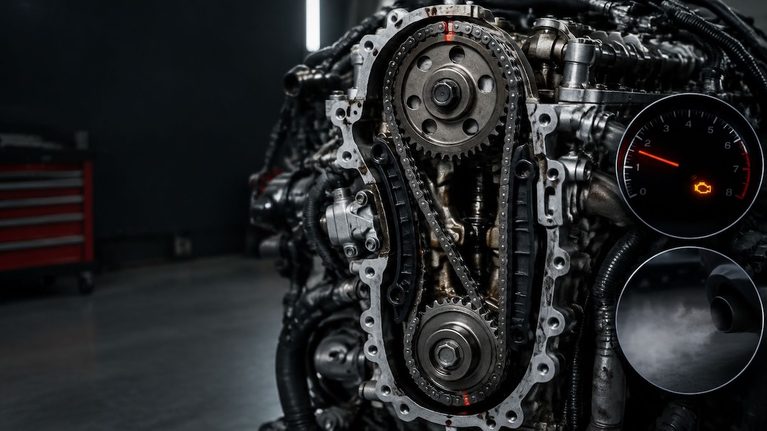
A timing chain that has jumped a tooth is one of those faults that can start out quiet and end up expensive. The engine might feel a little flat, or it might not start at all. Either way, the chain is no longer holding the engine’s moving parts in step with each other.
The timing chain is a metal chain that connects the crankshaft to the camshaft. Its job is to make sure the valves open and close at exactly the right moment compared with the piston movement. When the chain slips or jumps off position, that timing goes out, and performance suffers or the engine fails.
This guide covers the symptoms I’d watch for, the most common causes, and what actually happens inside the engine when the timing is off. It also explains whether you can keep driving, how a mechanic diagnoses the problem, and what the repair can cost. I’ll share what I’d do in the shop if a customer rolled in with this complaint.
The short answer
If you suspect your timing chain has skipped a tooth, stop driving the car and have it inspected. The usual signs are a change in throttle response and power, a check engine light, black smoke from the exhaust, and mechanical noises from the engine. If the chain has moved two or more teeth, expect misfiring, uneven running, a no-start, and strange sounds.
Common causes include a stretched or worn chain, a failing chain damper, engine overheating, and a badly installed chain. A foreign object getting into the chain area or a temporary jam in the timing mechanism can do it too. The repair can range from a few hundred dollars to several thousand, depending on how much damage the engine has taken.
Don’t treat this as something to monitor for a few weeks. The longer the engine runs out of time, the greater the chance that valves and pistons collide.
What the timing chain does, and what “jumped a tooth” means
Inside the engine, the crankshaft turns as the pistons move up and down, and the camshaft opens and closes the valves. The two must stay synchronized. The timing chain runs around gears (sprockets) on both shafts, and the teeth on those gears keep the chain from slipping.
When we say a chain has “jumped a tooth,” it means the chain has moved over by one or more teeth on a gear compared with where it should be. The crank and cam are now out of step by that amount. The valves open and close a fraction early or late, and the engine can’t burn fuel the way it was designed to.
A one-tooth jump can be subtle. The engine may still start and run, but it’ll feel off and the computer will probably notice. A larger jump, or a chain that has come off the gears entirely, is far more severe and often stops the engine from running at all.
Your timing chain sits behind covers and runs in the engine, so you can’t look at it casually like a drive belt. That’s part of why the symptoms matter. They’re often the only warning you get before the engine is in real trouble.
Main symptoms of a timing chain that jumped a tooth
Here are the most common signs. You won’t necessarily see all of them, and some overlap with other faults.
- A change in throttle response, power and torque. The car feels sluggish, hesitates, or doesn’t pull the way it used to.
- Black smoke from the exhaust. This points to unburned or poorly burned fuel when the timing is off.
- The check engine light comes on. The computer has noticed that something doesn’t match.
- Mechanical noise from the engine. That can be rattling, ticking or other sounds that weren’t there before.
If two or more teeth are skipped, the picture gets worse. You may see misfiring, uneven operation, a failure to start and extra noise from the engine. At that point, don’t use the car.
None of these symptoms prove the chain is the culprit. A rough-running engine can have many causes. What matters is that if several of these show up together, especially after a rattle or a sudden change, the timing system belongs near the top of the list.
Symptoms in detail
Reduced power and poor throttle response
If the car is down on power or reacts slowly when you press the pedal, the valve timing may be off. The engine can’t draw in air and push out exhaust at the right moments, so it doesn’t make the power it should. You’ll often notice it most when accelerating or climbing a hill.
A chain that has slipped slightly can cause this without stopping the engine. It’s easy to blame fuel quality or a tired spark plug, and I’ve seen people chase those for weeks. If the loss of performance came on suddenly or came with noise, think timing earlier.
Black smoke from the exhaust
Black smoke usually means the engine is running with too much fuel for the air available, or the fuel isn’t burning properly. When the valve timing is off, combustion becomes inefficient and the exhaust can show it. It’s a sign worth taking seriously alongside the other symptoms.
Black smoke on its own has other causes, so don’t jump to the conclusion that the chain is shot. Combined with poor power, a check engine light or noise, though, it supports the case for a timing inspection.
The check engine light
The engine computer compares signals from the crankshaft and camshaft. If those signals don’t line up the way they should, it can set a fault code and turn on the check engine light. Codes related to crankshaft and camshaft correlation are the sort of thing a scan tool may show when the timing has shifted.
A flashing light, or a light along with a rough-running engine, deserves immediate attention. Read the codes before clearing anything. Wiping them out throws away the information a technician needs.
Rattling, ticking and other mechanical noise
A rattling or ticking noise from the engine can be a warning that the chain is loose or the parts that control it aren’t working properly. A chain that has stretched or lost tension can slap against its guides. The noise may be most obvious at startup or at idle, but it can happen at any time.
Not every engine noise is the timing chain. Plenty of ticks come from other places. Still, a new rattle from the front or side of the engine, particularly with other symptoms, shouldn’t be ignored.
Misfiring and uneven running
When the valves open at the wrong time, cylinders don’t fire cleanly. The engine can shake, idle roughly, or run unevenly. If the chain has jumped two or more teeth, these signs are likely to be more pronounced.
Misfires from timing don’t behave like a bad coil or plug, which usually points at one cylinder. A timing problem can make the whole engine run poorly. That difference is often a clue.
Hard starting or no start
If the chain has jumped enough, the engine may crank but refuse to start. It can also stop running suddenly while you’re driving. A car that suddenly quits or won’t fire after showing the earlier symptoms may well have a chain that has jumped.
In that case, avoid repeatedly cranking the engine to see if it will catch. If the valves and pistons are in conflict, extra cranking can add to the damage. Have it towed and inspected.
Valve damage
Faulty or damaged valves can be a result of a timing chain that has jumped, not just a symptom you’d notice. If the valves have been struck by the pistons, they can bend. Then the engine loses compression, runs badly or won’t run at all.
You can’t see this from the driver’s seat, so it’s one reason a professional inspection matters. A mechanic can test for the damage with the right tools and tell you what the engine actually needs.
Why a timing chain jumps a tooth
A chain doesn’t usually jump for no reason. Something let it get loose, stressed or blocked. These are the main causes I look at.
A stretched or worn chain
Over time, the links in a timing chain wear and the chain stretches. A longer chain gets loose, and a loose chain can slip over the teeth of a gear. That’s the classic story: natural wear, plus operation over many miles.
Stretching can also happen during normal operation if the parts that keep the chain tight aren’t doing their job. If the chain shows signs of wear, it makes sense to replace it before it jumps instead of waiting for a failure.
A failing chain damper or tensioner
The chain runs with help from guides and a damper that keep it controlled and tight. If the damper malfunctions, the chain can whip around and lose its grip on the gears. On many engines, that tension depends on oil pressure, so a maintenance history that includes missed oil changes is worth checking.
When I see a worn chain, I look at the guides and damper too. Replacing only the chain and leaving a worn tensioner is a false economy, because the same problem will come back.
Engine overheating
Severe overheating can affect parts throughout the engine, and the timing system isn’t immune. Heat stress can damage components and change how the parts behave. If an engine has been through an overheating event, the timing components deserve a close look afterward.
Overheating is also something that can happen as a result of other faults, such as low coolant. If your car has overheated and now runs poorly, don’t assume the problem ended when the temperature gauge came back down.
Temporary jamming of the timing mechanism
Sometimes a part of the timing mechanism briefly sticks or binds. The chain doesn’t move the way it should, and it can skip over the teeth. The jam may clear itself, which makes the fault harder to track down.
A one-time event can leave the engine slightly out of time. The car may then keep running with symptoms, even though the original cause is gone.
Foreign objects in the chain area
Debris that gets into the area where the chain moves can interfere with it. A foreign object can catch the chain, block a gear or damage a guide. It can push the chain off position or hold it so it can’t move freely.
That kind of problem often follows a previous repair, so if the engine was recently worked on and symptoms started soon after, mention it to the mechanic. It can help narrow down the cause.
Camshaft misalignment
When the camshaft is out of alignment, it can put extra stress on the chain. That stress can lead to slippage and eventually a jump. It can be tricky in practice because a jumped chain also causes the camshaft to be out of position, so the mechanic has to work out which came first.
That’s why a technician checks the timing marks and the sensor data, not just the chain itself. Finding the root cause matters, or you’ll end up replacing parts and getting the same failure.
Improper installation
If a timing chain was installed incorrectly, it’s more likely to slip or jump. Timing marks, tension and component condition all matter during a replacement. A rushed job or a missed step can leave the chain waiting to fail.
If the symptoms started soon after timing work, or you’re unsure of the quality of an earlier repair, go back to a reputable shop and have the installation checked. Don’t wait for it to get worse.
Quick reference: causes at a glance
| Cause | What is going on | What it often points to |
|---|---|---|
| Stretched or worn chain | The chain has lengthened and become loose over time | Replace the chain, and check the guides and damper |
| Failing damper | The part that controls the chain isn’t doing its job | Replace the damper along with the chain |
| Overheating | Heat has stressed engine parts, including timing components | Inspect the whole engine and find the cause of the overheating |
| Temporary jam | The timing mechanism bound or stuck for a moment | Check timing and look for what caused the binding |
| Foreign object | Debris has interfered with the chain or gears | Remove the debris and inspect for damage |
| Camshaft misalignment | The cam is out of position and stresses the chain | Check timing marks and sensor data to find the root cause |
| Poor installation | The chain was fitted or set up incorrectly | Have the earlier work inspected and corrected |
Several of these causes can overlap. A worn chain and a failing damper often show up together, for example. The point of the table is to help you ask better questions when you talk to a mechanic.
What happens inside the engine when the chain jumps
The effects depend on how far the chain moved and what kind of engine you have. On some engines, the valves and pistons can occupy the same space if the timing is badly off. When that happens, the valves can hit the pistons, and the damage can be extensive.
Many articles talk about timing belts and chains as if they behave the same way, and the consequences can look alike. A belt and a chain are different parts, but when either one loses its position, the timing problem and the risk to the valves is similar. Whether your engine can suffer valve-to-piston contact depends on its design, so ask a mechanic about your specific engine.
These are the possible consequences of a jumped chain:
- Damage to the timing mechanism itself, including gears, guides and the chain.
- Damaged valves and parts of the piston group.
- An engine that locks up or seizes, a condition some people call a wedged engine.
- Loss of compression in one or more cylinders.
In some cases, the engine may need to be replaced altogether. That’s the worst-case outcome, and it’s why catching the problem early can save so much money. A small slip addressed quickly is one thing, but a chain that has been allowed to run out of time can destroy an engine.
Can you drive with a timing chain that skipped a tooth?
My advice is no. Even if the car seems to run, driving it with the timing off can cause serious damage. The engine isn’t operating the way it was designed to, and it may not give you much warning before something breaks.
If the chain has jumped two or more teeth, you’re likely to see misfiring, uneven running, a failure to start and unusual sounds. At that point, don’t use the car at all. Arrange for a tow instead of trying to limp it to a shop.
I had a customer once who heard a faint rattle on cold starts and kept driving for a few weeks, figuring it would go away. The rattle faded, and he took that as good news. Then the engine quit on the highway, and the repair went from a chain and tensioner job to a much bigger bill. The fading noise had been the chain wearing and skipping position, not the problem clearing up.
If you aren’t sure whether the engine has timing trouble, a short, gentle trip to a nearby shop may seem reasonable. Be honest with yourself about the risk. If you hear loud noises, the engine runs roughly or the light is flashing, the tow is cheaper than the gamble.
What to do if you suspect the chain has jumped
- Stop driving as soon as it’s safe. Pull over, switch off the engine and don’t keep trying to restart it. Repeated cranking can make damage worse if the timing is badly out.
- Note what happened. Write down the symptoms, when they started and what you heard or saw. Mention any recent engine repairs, overheating or oil change delays. That history helps the mechanic.
- Don’t clear the codes. If you have a scan tool, read the fault codes and record them. Clearing them throws away useful information.
- Get the car to a shop. If it runs badly or won’t start, arrange a tow. A professional can check the timing and the condition of the engine.
- Ask for a clear diagnosis. Ask what tests were done and what they found. Get an estimate that separates diagnosis, parts and labor.
How a mechanic diagnoses a jumped timing chain
A good diagnosis starts with the symptoms and the codes. The technician will read the engine computer for fault codes, especially anything related to the crankshaft and camshaft signals. They’ll also listen to the engine and ask about its history.
From there, the mechanic may check live data from the sensors to see whether the crank and cam signals agree. A compression test can show whether any cylinders have lost sealing, which can happen if valves have been damaged. In some cases, the technician will open the engine to inspect the chain, gears, guides and damper directly and check the timing marks.
Don’t be surprised if the shop wants to remove covers to see the chain. That’s the only sure way to confirm its condition on many engines. A shop that quotes a big repair without any inspection or testing is guessing.
The goal of the diagnosis is to find out two things. One is how far out of time the engine is, and the other is whether anything else was damaged. That tells you whether you’re looking at a chain kit or a much larger repair.
Repair options and costs
The cost of fixing a timing chain that has jumped depends on how severe the issue is. In some cases, only the timing chain kit needs to be replaced. That’s the best-case scenario, and it’s more likely if the problem was caught before the engine took damage.
In more serious cases, the valves or even the whole engine may need to be replaced. Repairs can range from a few hundred dollars to several thousand dollars. I won’t quote a more exact number, because the engine design, labor rates and the extent of the damage change the total so much.
A proper repair usually involves more than the chain alone. The gears, guides and damper are often replaced together, because they wear together. If the engine has suffered internal damage, the shop will tell you what else is involved.
When you get an estimate, ask these questions:
- What exactly did you find, and how did you confirm it?
- Does the repair include the guides, damper and gears, or only the chain?
- Is there any sign of valve or piston damage?
- What happens if we find more damage once the engine is opened up?
- What warranty comes with the repair?
If the estimate approaches the value of the car, you have a decision to make. A used or rebuilt engine may be an option, and in some cases it’s more sensible than a repair with an uncertain outcome. Ask the shop to lay out the alternatives clearly.
Mistakes to avoid
- Ignoring a new rattle. A noise that comes and goes isn’t always going away. It can be an early warning.
- Driving on after the symptoms appear. Every mile gives the engine more chance to damage itself.
- Cranking a no-start repeatedly. If the timing is badly off, that can make the damage worse.
- Clearing codes before a scan. You lose clues that help the technician.
- Replacing only the chain. A worn damper or guides can bring the problem right back.
- Choosing a repair on price alone. A cheap, rushed timing job can lead to the next failure.
- Assuming black smoke or a light means the chain. These can have other causes, so confirm with testing.
How to lower the risk of a jumped chain
You can’t make a timing chain last forever, but you can reduce the chances of trouble. Keep up with the engine maintenance your manufacturer recommends, and don’t stretch oil changes. Since some tensioners depend on oil, good maintenance helps keep that system working.
Take overheating seriously. If your engine overheats, stop driving and get it checked, and ask the shop to consider the timing parts as part of the follow-up. Heat damage can show up later.
Listen to the engine. A new rattle, especially on startup, is worth a diagnostic check. And if the chain does need replacing, have it done with the guides and damper by a shop that follows the correct procedure and timing marks.
If you’re buying a used car, ask about its maintenance records. A history of regular service and no overheating is a good sign. A car that has a cold-start rattle or unexplained engine codes should get an inspection before you hand over cash.
DIY or see a mechanic?
For this problem, I’d send almost everyone to a professional. Replacing a timing chain involves opening the engine, setting the timing precisely and often dealing with other parts that have to come off first. A mistake can destroy the engine, so there’s little room for guessing.
What you can do yourself is limited but useful. You can note your symptoms, read and record fault codes with a basic scan tool, and check your oil level and maintenance history. You can also stop driving the car, which is the most valuable thing a driver can do.
An experienced DIYer with the right tools, a service manual and the engine’s timing specifications might tackle a chain job. Be honest about your experience and the risks. If you’re unsure at any point, stop and bring in a pro.
Common questions about a timing chain that jumped a tooth
How do I know if my timing chain skipped a tooth?
Common signs are reduced power and throttle response, black smoke, a check engine light and mechanical noise from the engine. If it has skipped two or more teeth, you may also get misfiring, rough running and a no-start. A mechanic can confirm it by checking codes, sensor data and the timing itself.
Can a timing chain jump a tooth and the car still run?
Yes, particularly with a one-tooth jump. The car may start and run, but it’ll usually perform poorly and may set a fault code. Don’t take that as a sign it’s safe to keep driving.
What causes a timing chain to jump?
The usual causes are a stretched or worn chain, a failing damper, overheating, a temporary jam in the timing mechanism and foreign objects in the chain area. A misaligned camshaft or incorrect installation can also play a part. Often a mix of factors is involved.
Can I drive a car with a skipped timing chain?
It isn’t a good idea. Driving can lead to serious engine damage, and if two or more teeth are skipped, the car may not run properly at all. Have it inspected and towed if necessary.
Will a jumped chain damage the engine?
It can. The valves may hit the pistons, which can damage the valves, pistons and timing mechanism and cause a loss of compression. In severe cases, the engine can lock up or need replacement.
How much does it cost to fix a timing chain that skipped a tooth?
It can range from a few hundred dollars to several thousand. If only the chain kit is needed, the cost is on the lower side. If valves or the engine are damaged, expect it to climb.
Can I fix a jumped timing chain myself?
It’s not a good beginner job. The timing must be set precisely, and mistakes can wreck the engine. Most drivers are better off having a qualified mechanic handle it.
The expert verdict
A timing chain that has jumped a tooth throws the engine’s valve timing out of step, and the results can range from poor performance to a ruined engine. Watch for changes in power and throttle response, black smoke, a check engine light and new mechanical noise. If two or more teeth have skipped, expect rough running, misfires and a no-start.
Your next step is to stop driving, record any codes and symptoms, and get the car to a shop for a proper inspection. Ask for a clear diagnosis and a written estimate that covers the chain, guides, damper and any other damage. The sooner you act, the more likely you’ll be looking at a chain kit instead of an engine.
DIY is reasonable for noting symptoms, reading codes and checking oil and service history. The timing work itself belongs with a mechanic, unless you have real experience and the correct tools and specifications.
One clear takeaway: if you suspect a jumped timing chain, stop driving and get it inspected, because the chain is cheaper to fix than the engine it can destroy.