
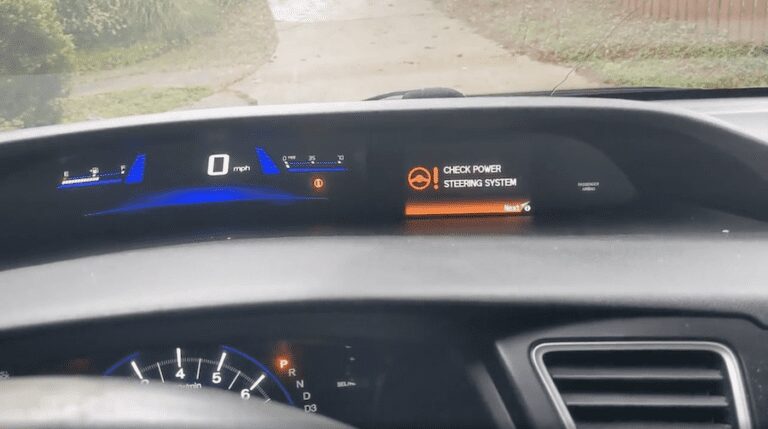
When that “Check Power Steering System” warning pops up on your Honda Civic’s dashboard, your stomach drops a little. And honestly, it should get your attention. That warning is not just a random glitch. It means something inside your steering system is off, and your car is telling you to deal with it before things get worse.
Here is the thing though. Not every driver who sees this warning ends up with a steering wheel that locks up on them. Some Civic owners report that the car still steers just fine even with the warning on. Others feel the steering go stiff almost immediately. The symptoms vary quite a bit depending on what is actually causing the problem.
Either way, ignoring it is not an option. This is your steering system we are talking about. It is the one thing that keeps you from swerving into the next lane or wrapping your car around a guardrail. So let us break this down the right way, from what the warning actually means, to what is causing it, to how you fix it.
What the “Check Power Steering System” Warning Actually Means
Before you can fix anything, you need to understand what you are dealing with. The Honda Civic, especially models from 2006 onward, uses what is called an Electric Power Steering system, or EPS for short.
Older cars used a hydraulic power steering setup, which relied on a pump, fluid, and hoses to help you turn the wheel. The Honda Civic ditched that in favor of an electric motor that does the heavy lifting for you. No fluid to leak, no belt-driven pump to wear out. Simpler in some ways. But it comes with its own set of problems when things go wrong.
The EPS system talks to the car’s Engine Control Unit, or ECU, through a network of sensors. When one of those sensors stops reporting correctly, or when the motor or wiring has an issue, the ECU detects the fault and throws up the “Check Power Steering System” warning. In some cases, it may just show a steering wheel icon with an exclamation mark. In others, you get the full text message on the display. Which one you see depends on the model year of your Civic.
What happens next depends on how serious the fault is. The ECU might reduce the assist to protect the system, or it could shut down the EPS entirely, leaving you with manual steering effort. That is manageable at highway speeds, but at low speeds or in a parking lot, it feels like you are wrestling with the wheel.
The Three Sensors That Run Your EPS System
The EPS does not just run blindly. It relies on three key sensors to function properly, and each one has a specific job.
1. Torque Sensor
This one sits in the steering column and measures how hard you are turning the wheel. Think of it like a pressure gauge for your steering input. When you crank the wheel hard to park, the torque sensor picks that up and tells the ECU to pump more assist power to the motor. When you are cruising on a straight highway, it backs off. If this sensor fails or sends garbled data, the ECU has no idea how much help to give you, and the system either panics or shuts off.
2. Steering Angle Sensor
The steering angle sensor tracks exactly where your steering wheel is pointed at any given moment. This information helps the ECU coordinate your steering wheel’s position with what your actual road wheels are doing. It also plays a role in stability control systems. A bad steering angle sensor can cause erratic behavior and trigger the warning.
3. Pressure Switch Sensor (PSS)
The PSS monitors the load on the power steering system. It reads how much demand is being placed on the setup and converts that into usable data for the ECU. When it fails, the system loses one more important input it needs to function correctly.
All three sensors feed information to the ECU constantly while you drive. The moment one of them goes quiet or starts sending incorrect signals, the ECU flags the issue and that warning light shows up on your dashboard.
The Real Causes Behind the Honda Civic Check Power Steering System Warning
Now let us get into what actually causes this warning to show up. There is not one single answer here. Several things can trigger it, and some are simpler fixes than others.
1. A Damaged or Faulty Sensor
This is probably the most common culprit. Any one of those three sensors we talked about can fail, get dirty, or develop corroded connections. And when they do, the EPS system loses the data it needs.
Here is a real-world scenario. Say your torque sensor develops some internal corrosion from moisture getting into the connector. It starts sending inconsistent signals to the ECU. On some days, the steering works fine. On others, the warning pops on and the assist cuts out. This kind of intermittent problem can be maddening to diagnose if you do not know where to look.
Sensor issues can stem from:
- Dirt or debris contaminating the sensor body
- Corroded wiring harness connectors
- Physical damage to the sensor housing from road debris
- Internal sensor failure from age and heat cycles
The good news is that sensors are usually not catastrophically expensive to replace, especially compared to replacing the entire steering rack.
2. Damaged Internal Steering Components
Your steering system is made up of more parts than just the motor. The whole assembly includes things like the steering rack, tie rods, column joints, and the EPS motor itself.
The steering rack is the long metal housing that runs between your front wheels. When you turn the wheel, the rack converts that rotational motion into side-to-side movement, which is what actually turns your wheels left or right. The tie rods connect the rack to the wheels and keep everything aligned.
Now, the EPS motor is bolted either to the steering column or the rack depending on the design. If the motor develops an internal fault, such as burned windings, a seized bearing, or a failing torque sensor built into the unit, the whole system can go offline.
When internal components get damaged or worn out, the ECU may detect abnormal electrical resistance or unexpected mechanical feedback, and it will throw the warning. Sometimes it will disable the assist entirely as a protective measure.
If your steering feels rough, clunky, or you hear grinding noises when turning, that is a sign the physical components may be involved, not just a sensor.
3. A Blown Fuse
This one is simple and often overlooked. The EPS system has its own fuse. When that fuse blows, the electrical supply to the whole power steering system gets cut off. No power, no assist.
Fuses blow for a reason. Usually it is because there was a spike of current somewhere in the circuit. That spike could come from a short in the wiring, a faulty component drawing too much power, or even a jump-start gone wrong.
Replacing a fuse is a five-minute job. But if the replacement fuse blows again shortly after, that is a sign there is a deeper electrical problem in the circuit that you need to find first.
4. Wiring Problems
The wiring harness that connects everything in the EPS system is a potential weak spot, especially on older Civics with high mileage. Wires can corrode from moisture exposure, especially around the steering column where road splash can reach. They can also get pinched, chafed, or outright broken if something in the engine bay or suspension shifts over time.
A corroded wire does not always cause a complete failure right away. Sometimes it just increases resistance in the circuit, which means the EPS motor gets less current than it needs. The motor may still work, but only partially. That leads to inconsistent steering assist, and of course, the warning message.
Loose or corroded connector plugs are another common spot for trouble. The connectors that plug into the sensors and the EPS control module can oxidize over time, especially in humid climates. A connection that looks fine visually might be causing signal dropouts that the ECU picks up as a fault.
5. ECU Failure or Software Glitch
This is the less common cause, but it does happen. The ECU is essentially the brain of your car. It controls dozens of systems simultaneously and processes thousands of inputs every second. Like any computer, it can develop glitches, corrupt software, or in rare cases, hardware failures.
When the ECU itself is the problem, it can generate false warning messages even when all the physical components are working perfectly. That is frustrating because you can chase down sensors and wires all day and never find anything wrong.
A failing ECU might also misinterpret correct sensor data as a fault, leading to the power steering system being disabled unnecessarily.
The tricky part about ECU diagnosis is that you need specialized tools and knowledge to determine whether the module itself is bad versus just a connected component. This is generally where most DIY mechanics hit a wall.
How to Diagnose the Honda Civic Check Power Steering System Warning
Before you start replacing parts, you need to figure out what is actually broken. Swapping parts blindly is a great way to waste money.
Step 1: Grab an OBD2 Scanner
Plug an OBD2 scan tool into the diagnostic port under your dashboard, on the driver’s side. Every car sold in the US after 1996 has one.
A basic scanner will read generic engine codes, but for power steering faults, you ideally want a scanner that can read Honda-specific codes. These will be labeled with a “U” or “C” prefix in some cases, covering communication faults and chassis-related systems.
The scan tool will point you toward which component or sensor has logged a fault. It might say something like “Torque Sensor Circuit Malfunction” or “EPS Motor Current Abnormality.” That gives you a starting point instead of a guessing game.
Some good options for Honda diagnostics include:
- Autel MaxiCOM MK808
- Launch CRP129E
- BlueDriver Bluetooth Pro (works well with Honda models)
Step 2: Visually Inspect the Fuse Box
Open the fuse box under the hood, on the driver’s side. Your owner’s manual will tell you which fuse belongs to the EPS system. Pull it out and hold it up to a light. A blown fuse will have a visibly broken metal strip inside the plastic housing.
If the fuse is good, move on. If it is blown, replace it with the exact same amperage rating. Do not use a higher-rated fuse to “fix” a blowing fuse problem. That is how you end up with a wiring fire.
Step 3: Inspect the Wiring and Connectors
Trace the wiring harness from the EPS motor and sensors. Look for:
- Wires that are visibly frayed, cracked, or melted
- Connectors that have green or white oxidation on the terminals
- Any signs that wires have been pinched by moving parts
If you find corroded connectors, you can try cleaning them with electrical contact cleaner and a small wire brush. Sometimes that alone solves an intermittent fault.
Step 4: Check for Physical Steering Problems
Get someone to slowly turn the steering wheel while the car is parked with the engine running. Stand outside and watch the front wheels. They should move smoothly and proportionally. Listen for any grinding, clicking, or clunking.
Also grab each front wheel with both hands and try to wiggle it. Excessive play or movement could indicate worn tie rod ends or other steering components.
Step 5: Test the Sensors
If you have access to a multimeter and a wiring diagram for your specific Civic, you can test sensor resistance and voltage values. Torque sensors and angle sensors have specified resistance ranges they should fall within. If a sensor reads open circuit or way outside spec, it is likely bad.
This step gets more technical, so if you are not comfortable with electrical testing, skip ahead to the fix section and decide whether to DIY or go to a shop.
How to Fix the Honda Civic Check Power Steering System Warning
Once you know what is causing the problem, the repair path becomes clearer. Here are the fixes for each major cause.
Fix 1: Replace a Faulty Sensor
If your scan tool points to a specific sensor, your job is to replace it. Here is a general process:
For the Torque Sensor:
The torque sensor is typically integrated into the steering column. On many Civic models, it comes as part of the EPS control module assembly. Replacing it usually means:
- Disconnecting the battery (safety first)
- Removing the steering column covers (a few screws and clips)
- Unplugging the harness connector from the sensor or module
- Unbolting and removing the faulty component
- Installing the new sensor and reassembling everything
- Reconnecting the battery and clearing the fault code with a scan tool
For the Steering Angle Sensor:
This sensor is often located in the steering column or near the base of the column. After replacement, it usually needs to be calibrated with a scan tool by performing a steering angle sensor reset. Skip this step and the warning may come right back even with a brand new sensor.
For the Pressure Switch Sensor (PSS):
This one is simpler to access. It typically plugs into the steering rack or the EPS system housing. Replacement is straightforward, but again, clear the codes afterward.
One important tip: always buy sensors from reputable suppliers. Cheap aftermarket sensors from unknown brands can fail quickly or cause more issues than the original. OEM Honda parts or well-known brands like Dorman are worth the extra few dollars.
Fix 2: Address Internal Steering Component Damage
This is where the repair complexity goes up significantly. If the EPS motor itself is failing, you are looking at either replacing the motor assembly or in many cases, replacing the entire steering rack assembly since the motor is integrated into it on some models.
Signs the EPS motor or rack assembly needs replacement:
- Steering assist works intermittently with no sensor codes present
- Grinding or humming noise when turning slowly that disappears with the EPS disabled
- The motor runs hot to the touch
- Scan tool shows motor current faults that persist after sensor replacement
Replacing a steering rack is a moderate to major repair. It involves:
- Lifting the car and supporting it safely on jack stands
- Removing the front wheels
- Disconnecting the tie rods from the steering knuckles
- Removing the intermediate shaft from the steering column
- Unbolting and sliding out the old rack
- Installing the new unit and reconnecting everything
- Getting a four-wheel alignment afterward, which is non-negotiable
Because of the alignment requirement and the complexity of the job, many owners choose to have a shop handle this one. The labor cost adds up, but a bad alignment after a rack replacement can chew through tires in a matter of months.
Fix 3: Replace a Blown Fuse
This might be the easiest fix on the list. If the EPS fuse is blown:
- Identify the correct fuse using your owner’s manual
- Purchase the same amperage fuse (usually 40A or 50A for EPS on Civics)
- Pull out the blown fuse with a fuse puller or needle-nose pliers
- Insert the new fuse
- Start the car and check if the warning clears
If the new fuse blows immediately or within a short time, stop and do not keep replacing fuses. There is an underlying short circuit that needs to be found before you risk damaging something more expensive.
Fix 4: Repair or Replace Damaged Wiring
Finding and fixing bad wiring takes patience. Once you locate a damaged section of wire:
- Minor corrosion on a connector: Clean with electrical contact cleaner and apply dielectric grease to prevent future corrosion
- A broken wire: Cut out the damaged section and splice in new wire using proper butt connectors or solder and heat shrink
- An extensively corroded harness section: The entire section may need to be replaced or rebuilt
Do not use basic electrical tape as the only protection on repaired wires. It dries out, falls apart, and leaves the repair exposed. Always use adhesive-lined heat shrink tubing.
After any wiring repair, clear the fault codes and drive the car to see if the warning returns.
Fix 5: Deal With the ECU
The ECU fix has three possible paths depending on what is wrong.
Path 1: Simple Reset
Sometimes the ECU throws a warning based on a temporary glitch, like a momentary voltage spike. A reset can clear it.
To reset the ECU:
- Disconnect the negative terminal of the battery
- Wait at least 15 to 30 minutes
- Reconnect the terminal
- Start the car
You can also use a scan tool to clear the codes directly. If the warning does not come back after normal driving, the reset did the job.
Path 2: Software Reprogramming
If the ECU has corrupt software or needs an update, it has to be reprogrammed. This requires a dealer-level diagnostic tool or a specialist with the right Honda software. Most independent shops that specialize in ECU work can handle this, often for less than the dealership charges.
Path 3: Full ECU Replacement
A truly failed ECU needs to be replaced and programmed to match your vehicle’s VIN. This is not a straightforward plug-and-play swap. The replacement module needs to be initialized to your car, and that requires a professional setup. Get this done at a Honda dealer or a reputable shop that handles module replacement.
What Happens If You Keep Driving With the Warning On?
Let us be straight about this. Driving with the “Check Power Steering System” warning on is risky, and the level of risk depends on what is causing it.
If the EPS motor is still providing assist despite the warning, you may not feel much difference right away. But the underlying fault is still there, and the system could cut out at any moment. Imagine your steering suddenly going heavy mid-corner or while merging onto a freeway. That is not a situation you want to be in.
If the system has already disabled itself, you are driving with manual steering effort. On a highway at 70 mph, that is manageable. At a parking lot or making a U-turn, it takes significant upper body strength. For some drivers, especially those with mobility limitations, it can be genuinely dangerous.
Beyond safety, ignoring the problem can turn a simple sensor replacement into a full rack replacement if the motor is being stressed by running outside its normal parameters.
Get it diagnosed promptly. Even if you cannot fix it that same day, at least know what you are dealing with.
How Much Does It Cost to Fix the Honda Civic Check Power Steering System?
Here is a rough breakdown of what you can expect to pay. Keep in mind that prices vary by region, model year, and whether you go to a dealer or an independent shop.
| Repair | Parts Cost | Labor Cost | Total Estimate |
|---|---|---|---|
| Torque Sensor Replacement | $80 – $200 | $80 – $150 | $160 – $350 |
| Steering Angle Sensor | $50 – $150 | $60 – $120 | $110 – $270 |
| EPS Fuse Replacement | $2 – $10 | $0 (DIY) | Under $15 |
| Wiring Repair | $20 – $100 | $100 – $250 | $120 – $350 |
| EPS Motor / Steering Rack | $400 – $900 | $250 – $500 | $650 – $1,400 |
| ECU Reprogramming | $100 – $300 | $100 – $200 | $200 – $500 |
| Full ECU Replacement | $400 – $900 | $150 – $300 | $550 – $1,200 |
The fuse is obviously the cheapest possible fix. A full rack replacement with alignment is at the top of the range. This is exactly why proper diagnosis matters before you start spending money.
Honda Civic Models Most Commonly Affected
While any EPS-equipped Civic can show this warning, certain model years seem to have more reported cases. The transition to EPS happened around the 2006 model year for the Civic, so earlier hydraulic steering models will not show this specific warning.
The eighth generation Civics (2006-2011) were among the first to use EPS in this lineup, and some of those early EPS setups have developed sensor and motor issues as they age. The ninth generation (2012-2015) and tenth generation (2016-2021) models are also commonly discussed in forums for EPS-related warnings, often tied to wiring issues or steering angle sensor faults.
If you own a later model Civic with a touchscreen display, the warning text will show more clearly. On older models, you may just see the steering warning light without a specific message.
Can You Reset the Warning Yourself?
Yes, in some cases. If the problem was a temporary glitch, disconnecting the battery for 15 to 30 minutes or using an OBD2 scanner to clear the codes can turn the light off. But here is the important part: if the underlying problem has not been fixed, the warning will come right back.
Think of it like covering a smoke detector with tape instead of finding the fire. The alert goes away, but nothing actually changed.
Only reset the warning if you have already repaired the fault that caused it. Otherwise, you are just hiding a problem and giving yourself a false sense of security.
When to Call a Professional
Some of these repairs are genuinely DIY-friendly if you have basic mechanical skills and the right tools. Replacing a fuse, cleaning a connector, or swapping out an accessible sensor are all reasonable tasks for a competent home mechanic.
But there are situations where you should hand it over to a pro:
- You scanned the car and the codes point to the ECU itself
- The fuse keeps blowing after replacement
- You hear grinding or feel clunking when turning (rack or motor issue)
- You replaced a sensor and the warning came back immediately
- The warning comes with other symptoms like the stability control light, ABS light, or the car pulling to one side
A shop with Honda-specific diagnostic tools will find the problem faster than you will chasing it down with a generic scanner and a flashlight.
Tips to Prevent Power Steering Problems on Your Honda Civic
You cannot prevent every problem, but you can reduce the odds of running into this warning unexpectedly.
- Keep your battery in good condition. Low voltage or a weak battery can cause all sorts of electronic gremlins, including EPS faults. Test your battery annually.
- Avoid jump-starting carelessly. Incorrect jumper cable polarity or voltage spikes from jump-starting can damage ECUs and EPS components.
- Watch for early warning signs. If your steering starts feeling heavier than usual, or you notice occasional hesitation in the assist, get it checked before the warning appears.
- Keep connectors clean. If you live in a salt-belt state where roads are treated in winter, moisture and road salt accelerate connector corrosion. Periodic inspection of accessible connectors helps catch this early.
- Do not ignore the first appearance of the warning. Some drivers dismiss it if it goes away on its own. That intermittent behavior is exactly how a developing fault starts.
A Quick Word on Aftermarket vs. OEM Parts
When replacing sensors or EPS components, you will run into a choice: OEM Honda parts or aftermarket alternatives. Here is the honest take.
OEM parts are manufactured to Honda’s exact specifications. They cost more, but they fit correctly and typically last longer. For sensors especially, the calibration and tolerances matter a lot.
Cheap aftermarket sensors from unverified suppliers can cause ongoing problems. There are stories all over Honda forums of owners replacing a torque sensor with a budget part, only to have the warning return within a few months. Sometimes the codes come back different, pointing to a “new” problem that is really just the bad replacement part.
Stick with OEM or reputable aftermarket brands like Dorman, TRW, or Moog for steering components. It is not worth the headache of doing the job twice.
Frequently Asked Questions
Can a low battery cause the Check Power Steering System warning?
Yes. A weak or failing battery can cause voltage drops that affect the EPS control module. If the warning appeared after battery trouble or cold weather, test the battery before replacing any steering parts.
Is it safe to drive with the Check Power Steering System warning?
It depends. If the steering assist is still working, you can drive a short distance to a shop, but do not put it off. If the assist has cut out and the steering is heavy, limit your driving and get it fixed as soon as possible.
Will the warning go away on its own?
Sometimes. If it was a temporary voltage issue or a loose connector that reconnected itself, the warning may clear. But treat any return of the warning as a sign that the root cause has not been resolved.
How do I know if my EPS motor is failing?
Common signs include inconsistent steering assist, a humming or grinding noise when turning slowly, the system cutting in and out, and scan codes pointing to motor current faults.
Can I drive a Honda Civic with no power steering assist?
Technically yes, but it takes a lot more effort than most drivers expect, especially at low speeds. Long-term driving without assist also puts extra strain on tie rods and other steering components.
The steering system is not something you get a second chance on. When that “Check Power Steering System” message shows up, treat it as your car making a formal complaint that demands a real answer, not a reset and a hope that it goes away. Grab a scanner, find the fault, and fix it properly. Your safety on the road depends on it.