
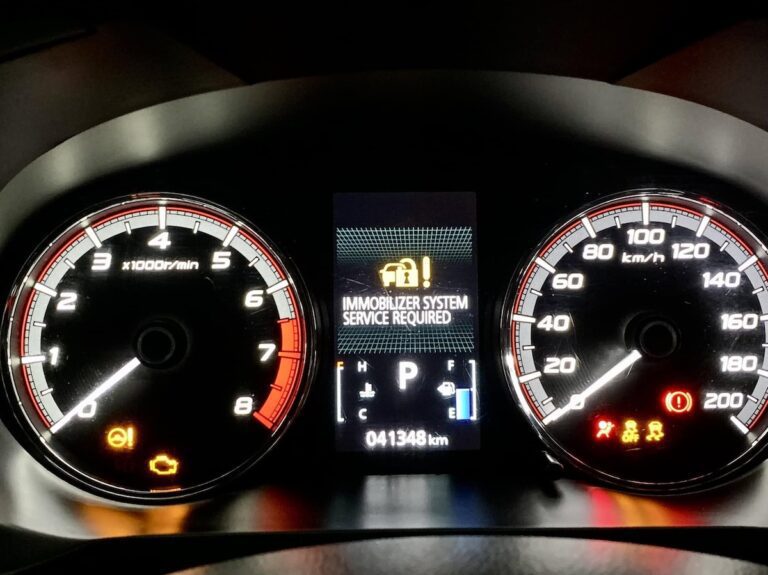
You slide into the driver’s seat, press the brake, and hit the start button. The dashboard lights up. Then you see it. Mitsubishi Immobilizer System Service Required. The engine will not turn over. Your car has effectively locked you out.
It is a frustrating situation. You are not alone. This warning pops up for many Mitsubishi owners, often at the worst possible time. Early morning commute. Grocery store parking lot. A dark driveway after a long shift. The message means the vehicle’s security system has detected a problem and is refusing to allow the engine to start.
But here is the thing. You do not always need a tow truck. Sometimes the fix is simple. Other times you need a professional with a scan tool and factory software. This guide breaks down exactly what this warning means, why it appears, and what you can do about it right now, before you spend a dime you do not have to spend.
What the Immobilizer Actually Does Inside Your Mitsubishi
Think of the immobilizer as a bouncer for your engine. It checks your key’s ID before letting the party start. Without the right ID, the engine stays silent. No fuel. No spark. No crank. Just a dashboard full of lights and a quiet engine bay.
When you turn the key or press the start button, a small transponder chip inside your key fob sends a unique code. The car’s computer, often called the ECM or ECU, receives this code. It then compares the code against a list of approved codes stored in its memory. That handshake happens in a fraction of a second. You never see it. You only notice it when it fails.
If the code matches, the computer sends a signal to allow fuel and spark. The engine starts. If the code does not match, or if the computer cannot read the code at all, the engine will not start. The system assumes a thief is trying to steal the car. From the computer’s point of view, you and a thief look identical if the signal is missing or garbled.
This system is a genuine anti-theft measure. It makes hot-wiring a modern Mitsubishi nearly impossible. Older cars could be stolen with a screwdriver and a few minutes of work. A current Outlander, Eclipse Cross, or Mirage will sit there dead no matter how many wires you twist together. That protection is the whole point.
That said, when the system malfunctions, it treats you, the rightful owner, like a thief. That is the root of the frustration. The car is doing exactly what it was designed to do. It is just doing it to the wrong person.
How the Immobilizer Fits Into the Rest of the Security Network
The immobilizer does not work alone. It is one piece of a larger security network that includes several modules talking to each other over the vehicle’s data bus. If any one of those modules goes silent, the whole chain breaks.
The main players are the Electrical Steering Lock (ESL), the Keyless Operation System (KOS), and the Engine Control Module (ECM). There is also an Immobilizer Control Unit on some model years, plus an antenna or receiver that actually listens for the key. All of these parts have to agree before the starter is allowed to spin.
Picture a group of coworkers who all have to badge into a secure room at the same time. If one badge reader is frozen, nobody gets in. That is your Mitsubishi on a bad morning. One module fails to answer, and the ECM shuts the party down.
This networked design is why a simple jump start often does nothing. You can put all the voltage you want into the battery. If the ESL never reports that the steering column is unlocked, the ECM will not authorize fuel or spark. Power is not the only requirement. Permission is.
The Most Common Reasons This Warning Shows Up
The warning light is a symptom, not a disease. It appears when the main computer loses communication with one of the key security components. In the real world, this often happens under very specific conditions, and knowing those conditions will save you a lot of guessing.
One of the most notorious triggers is extreme cold. Many owners report seeing this warning when temperatures drop to around -24°C (-11°F) or lower. The cold affects the electrical resistance in the modules, making communication sluggish or impossible. Plastic housings shrink. Solder joints get brittle. Motors inside the steering lock slow down. The computer expects a reply in milliseconds and does not get one.
Once the message is triggered, the car goes into a full security lockdown. You cannot bypass it with a jump start or by pumping the gas. The module needs to warm up, or the error needs to be cleared with a proper reset or a scan tool.
Other common triggers include a dying vehicle battery, a dead key fob battery, aftermarket chargers that dump electrical noise into the cabin, a recently cut key that was never programmed, and physical damage to the fob from a drop or a trip through the washing machine. We will walk through each of these in detail so you can match your situation to a cause.
Why Extreme Cold Turns Your Immobilizer Against You
Imagine trying to type on a keyboard with frozen fingers. Your commands are slow and messy. The same thing happens to car electronics in extreme cold. Semiconductors slow down. Voltage drops a little extra because the battery chemistry itself is sluggish. Sensors that normally snap to a position take longer to report.
The electrical steering lock is often the culprit here. When it gets too cold, the internal motor or position sensor does not respond the way the computer expects. The computer panics, assumes a fault, and disables the ignition. You are left sitting in a cold car, staring at a warning light, with a steering wheel that may or may not be locked.
If you live in a region with harsh winters, Minnesota, the Dakotas, Alberta, Maine, this is a scenario you might face more than once. Often, waiting for the temperature to rise or warming the cabin can temporarily resolve the issue. But it is a warning sign that a component is weak and may fail permanently the next time the mercury drops.
A healthy ESL handles cold without complaint. A worn ESL starts missing its deadline in the cold first, then starts missing it on mild days, then stops working altogether. Treat a cold-weather episode as an early warning, not a one-off fluke.
The Four Real Causes Behind the Warning
To fix the problem, you need to know what you are dealing with. The causes generally fall into four main categories. Let us look at each one closely, because the repair path is completely different depending on which category you land in.
1. Key Fob Problems That Break the Security Chain
Your key is the first link in the security chain. If the key is weak, the chain breaks. Most owners assume the car is broken when the fob is the actual problem. Start here before you blame a six-hundred-dollar module.
Dead key battery: This is the most common and easiest fix. The immobilizer chip in many modern fobs is passive. It does not need a battery to be read by the car at close range. However, if you have a push-button start, the car also needs to detect the fob’s presence in the cabin. A dead battery prevents this detection. The car thinks the key is missing, even though it is sitting in your pocket.
A typical key fob battery is a CR2032 coin cell. They last one to three years depending on how often you press the buttons and how extreme the temperatures get. If the little LED on the fob is dim or dead, replace the battery before you do anything else. It costs a few dollars and takes two minutes with a small screwdriver or a coin.
Damaged key: If you have dropped your key on concrete or run it through the washing machine, the internal components may be damaged. The transponder chip is a small glass or ceramic capsule. It is fragile. If it is cracked, the car will not recognize the key no matter how new the battery is. Water damage is just as bad. Corrosion on the circuit board will kill the radio signal even if the buttons still click.
Wrong key or unprogrammed key: If you recently got a new key cut at a hardware store, it might not be programmed. A cut key can open the door on models that still have a physical blade. It will not start the car unless it is paired with the immobilizer system. Programming requires a scan tool and, on many Mitsubishi models, dealer-level software. A twenty-dollar copy from the mall will leave you stranded.
If you have a spare key, try it right now. If the spare starts the car and the daily driver does not, you just isolated the problem to one fob. That is a cheap diagnosis.
2. Electronic Steering Lock Failure
The Electronic Steering Lock is a motorized bolt that locks the steering column when the car is off. It is a security feature. Before the car starts, the ESL must retract the bolt and report that the column is free. If that report never arrives, the ECM refuses to start the engine. It would rather leave you sitting than risk a steering wheel that locks at 40 miles per hour.
If the ESL motor is weak or the sensor inside fails, the car cannot confirm the steering is unlocked. A faulty ESL is a common issue on some Mitsubishi models, especially certain Outlander and Lancer years. It often starts with intermittent warnings. You might get the Service Required message, wait a few minutes, and then the car starts fine. Over time, the failures become more frequent until the car will not start at all.
You may also notice that the steering wheel feels stiff or locked even after you press the start button. Or you have to jiggle the wheel left and right to get a start. Those are classic ESL symptoms. Do not ignore them. An intermittent ESL becomes a permanent no-start, and it almost always picks the worst morning of the week to do it.
Replacing an ESL is not a driveway job for most people. The unit is mounted on the steering column behind trim, often held in with security bolts that have to be drilled out. The new unit has to be programmed to the vehicle. Skip that programming step and you have an expensive paperweight bolted to your column.
3. Immobilizer Hardware and Signal Problems
This is the technical side of the problem. It involves the hardware that reads the key signal and the module that decides whether that signal is valid.
Faulty antenna or receiver: The car has an antenna ring around the ignition barrel, or a receiver hidden in the cabin, often near the steering column or center console. This antenna picks up the weak radio signal from the key fob. If the antenna is damaged, disconnected, or its connector has corroded, the signal never reaches the computer. The computer assumes there is no key.
Defective Immobilizer Control Unit: The ICU is the brain of the security system on models that use a standalone unit. It processes the key’s code and tells the ECM whether to allow a start. If the ICU itself is defective, it cannot authorize anything. This is a more serious repair. It often requires replacing the unit and reprogramming every key that belongs to the car. Lose that programming step and none of your keys will work.
Signal interference: Sometimes aftermarket electronics interfere with the key signal. Dashcams, radar detectors, cheap phone chargers, and even some aftermarket remote starters can create electromagnetic noise. This noise can drown out the key fob’s already-weak signal. The antenna hears static instead of a code. The computer hears nothing useful and locks you out.
I have seen a five-dollar gas-station USB charger take down a perfectly healthy immobilizer. Unplugging it brought the car back to life in under a minute. Before you assume a module is dead, unplug every accessory in the cabin and try again.
4. Vehicle Battery and Electrical Problems That Look Like Security Failures
Your car’s main battery is the heart of the electrical system. If it is weak, nothing works right, and the immobilizer is one of the first systems to throw a tantrum. This category fools more owners than any other because the warning on the dash says immobilizer, not battery.
Low vehicle battery: The immobilizer system requires a stable voltage to operate. If the battery is low, the voltage may drop too much during the start attempt. The computer shuts down the ignition to protect itself. This is often mistaken for an immobilizer fault. The codes look similar. The symptoms look identical. The fix is a charged or replaced battery, not a new ICU.
A healthy battery should read around 12.6 volts with the engine off and all loads off. At 12.4 volts the battery is already partly discharged. At 12.0 volts or below, you are in the danger zone for electronics. Cold weather makes this worse because a weak battery loses even more capacity as the temperature drops.
Corroded terminals: Bad connections at the battery terminals can cause voltage drops even if the battery itself is healthy. White or green crust on the posts is a dead giveaway. The system sees a low voltage condition during cranking and triggers a warning. Cleaning the terminals with a wire brush and a baking soda solution is a ten-minute job that has saved more than one tow bill.
Blown fuses: The immobilizer system has its own fuse. If this fuse blows, the system loses power. The car interprets this as a security breach and locks you out. Check the fuse box for anything labeled Immobilizer, Security, or ECU. A broken metal strip inside the fuse means it is done. Replace it with the same amperage. If the new fuse blows immediately, stop. You have a short, and repeating the fuse swap is a fire risk.
How to Get Your Mitsubishi Running Again
Now for the part you came here for. Let us get your car running again. Start with the simple solutions first. You will save time and money, and you will avoid replacing parts that were never the problem.
Work these steps in order. Each one takes minutes. Skipping ahead to the expensive stuff is how people buy a new ESL when they needed a twelve-dollar battery for the fob.
Step 1: Warm the Cabin If It Is Freezing Outside
If you are in freezing temperatures, this is your first move. The system may just be too cold to function. Do not keep trying to start the car. You will drain the battery and add a second problem on top of the first.
Instead, try to warm the interior. If you have a garage, push the car inside if possible. If you are outside, you can try aiming a hair dryer at the dashboard near the start button or the steering column. A space heater aimed carefully at the same area works too, as long as you keep it a safe distance from plastic and fabric.
Wait for 10 to 15 minutes. Let the electronics thaw out. Then try starting the car again. In many cases, the warning disappears and the car starts normally. If it does, you still have a weak component. The warm-up bought you a drive to the shop. It did not permanently fix the ESL or the aging battery that struggled in the cold.
Step 2: Try the Key Fob Reset Sequence
There is a widely shared method for resetting the keyless system. It sounds strange, but it works for many people. It helps re-establish the connection between the fob and the car after a communication glitch.
Here are the steps:
- Stand right next to the driver’s door.
- Press the panic button (usually red) on your key fob. The horn will honk.
- Turn off the panic alarm by pressing the button again.
- Lock the car using the fob.
- Walk away from the car. Get at least 30 feet away. Stay away for a full 10 minutes.
- Walk back to the car.
- Unlock the car using the fob button.
- Check the little red light on the fob. If it flashes, the battery is good. If it does not, replace the fob battery before you continue.
- Get in, press the brake, and try to start the car.
This sequence often resets the communication between the keyless operation system and the ECU. It is a free fix worth trying before you call a tow truck. Even so, if it fails twice, move on. Repeating it a dozen times will not revive a dead ESL.
Step 3: Test the Vehicle Battery and Inspect the Fuses
A weak battery is a prime suspect. You need to check the voltage instead of guessing.
Use a multimeter. Set it to DC voltage. Connect the red lead to the positive terminal and the black lead to the negative terminal. A healthy battery should read around 12.6 volts with the engine off. If it reads 12.0 volts or lower, the battery is discharged. Try jump-starting the car. If it starts with a jump, your battery is likely the culprit. You may need a new battery, not a new immobilizer.
While you are there, check the battery terminals. If they are covered in white or green crust, that is corrosion. Clean them with a wire brush and a mixture of baking soda and water. Rinse, dry, and make sure the connections are tight. A loose negative cable can mimic every electrical fault in the book.
You should also check the fuse box. Look for a fuse labeled Immobilizer, Security, or ECU. Pull it out and inspect it in good light. If the metal strip inside is broken, replace it with a fuse of the same amperage. Keep a few spares in the glove box. They cost pennies and they close this chapter fast when the strip is the only problem.
Step 4: Kill the Electrical Noise From Aftermarket Gear
Unplug your accessories. That includes your phone charger, dashcam, radar detector, and anything else plugged into the 12V sockets or USB ports. Some cheap chargers emit a lot of electrical noise. This noise can block the signal from the key fob.
After unplugging everything, turn the car off, wait a minute, and try to start it again. If it starts, you have found your culprit. You may need to replace the noisy charger with a higher quality one. Name-brand chargers with proper shielding cost a little more and cause a lot less trouble.
If you recently installed a remote starter, aftermarket alarm, or stereo, that install is now a suspect. Poor grounding or a tap into the wrong circuit can confuse the immobilizer. A shop that understands Mitsubishi security systems can check those connections before you replace factory parts that were never bad.
Step 5: Inspect the Key and Try the Backup Read Method
Look at your key. Is it cracked? Is there moisture inside the case? If you have a spare key, try it. If the spare key starts the car, the problem is with your primary key. You will need a replacement and a programming session.
If you do not have a spare, try holding the key fob directly against the start button while pressing it. In some Mitsubishi models, this is a backup method. It allows the car to read the passive chip even if the fob’s battery is dead. The antenna around the start button can pick up the chip at point-blank range when the regular cabin receiver cannot.
You can also check the antenna receiver if you can see it. This is often located near the steering column or the center console. Look for loose wires or obvious damage. That said, this area is often buried deep in the dash, so a useful visual inspection can be difficult without removing trim. Do not start tearing the dash apart based on a hunch.
Step 6: Perform a Hard Reset by Disconnecting the Battery
Disconnecting the battery can clear temporary glitches in the car’s computer. It is like rebooting a frozen laptop. Residual voltage in the capacitors keeps old error states alive. Drain that voltage, and the modules come back up clean.
Here is how to do it safely:
- Turn the car completely off and remove the key fob from the cabin if you can.
- Open the hood.
- Disconnect the negative battery cable (black). Always pull the negative first.
- Leave it disconnected for 15 to 20 minutes.
- Reconnect the negative cable and tighten it properly.
- Turn the ignition to the On position (do not start) for 10 seconds. This lets the modules wake up and talk to each other.
- Turn it off, then try to start the engine.
This drains the residual power from the capacitors in the ECU. It forces the computer to reboot. This clears many false error codes. However, it will not fix a mechanical failure in the steering lock or a dead transponder chip. If the hardware is broken, a reboot just confirms it is still broken.
Be aware that a battery disconnect may reset the radio, the clock, and some learned idle settings. That is normal. The car will relearn idle after a few minutes of driving.
When the Driveway Fixes Are Not Enough
If you have tried all the steps above and the warning persists, you are dealing with a hardware failure. You need a scan tool to read the specific trouble codes. Guessing at this stage is how a three-hundred-dollar repair becomes a fifteen-hundred-dollar disaster.
Here are the signs you should call a mechanic:
- The warning appears every single time you try to start the car, not just on cold mornings.
- You hear a clicking sound but the engine does not crank.
- The steering wheel feels locked even when the key is in the ignition or the start button has been pressed.
- You have to jiggle the key or the steering wheel to get the car to start.
- Both of your programmed keys fail the same way.
- The fuse keeps blowing after you replace it.
These symptoms point to a failing Electronic Steering Lock or a defective Immobilizer Control Unit. These parts are not plug-and-play. They require programming with a specialized scan tool. Do not try to replace the ESL or ICU yourself unless you have the right software. You can easily brick the car. You could lock the steering column permanently or wipe the key memory. That turns a manageable repair into a nightmare that requires dealer intervention and a lot more money.
What a Qualified Technician Will Actually Do
A qualified technician will connect a scan tool to the OBD-II port. They will read the codes from the immobilizer system, the ESL, the KOS, and the ECM. Common codes include those related to the steering lock motor, the key transponder, communication timeouts, and ICU faults. The code tells them which module stopped talking, which is half the diagnosis.
If the ESL is bad, they will remove the old unit. This often involves drilling out security bolts. They will install a new ESL and program it to the car. They will also confirm your keys still match the new unit. If a key was borderline, this is the moment it gets reprogrammed or replaced.
If the ICU is bad, the process is similar but more involved. The new unit must be initialized and paired with the Engine Control Module. This requires access to Mitsubishi’s proprietary software in many cases. That is why some independent shops will send this job to the dealer even if they can do the mechanical work themselves. The software access is the bottleneck, not the wrench time.
Ask for the trouble codes in writing before you approve parts. A shop that will not show you the codes is a shop you should walk away from. You deserve to know whether you are paying for an ESL, an ICU, a key, or a battery that should have been caught in the first five minutes.
How to Keep This Warning From Coming Back
You can take steps to avoid seeing this warning again. None of them are complicated. Most of them cost less than a single diagnostic hour.
Maintain your battery. Replace your car battery every 3 to 5 years, sooner if you live in a climate with brutal summers or deep winters. Heat cooks batteries. Cold exposes weakness. A load test at any parts store is free or cheap and tells you the truth before you get stranded. A weak battery causes all sorts of electrical gremlins, and the immobilizer is one of the first systems to complain.
Keep keys dry. Moisture is the enemy of electronics. Do not leave your keys in the rain, in a cup holder full of melted snow, or on a sweaty gym bag. If a fob does get wet, open it, pull the battery, and let it dry completely before you put it back together. Rice is a last resort, not a plan.
Use quality accessories. Stick to reputable brands for phone chargers and dashcams. Cheap electronics can interfere with your car’s security system. If a new gadget showed up in the cabin the same week the warning started, that gadget is guilty until proven innocent.
Warm up in winter. If you live in a cold climate, consider using a block heater or parking in a garage. Keeping the car warm prevents the cold-related ESL and battery failures that trigger this warning. Even a magnetic oil-pan heater or a battery blanket can take the edge off a -25°C morning.
Replace the fob battery on a schedule. Do not wait for the LED to die. Swap the coin cell once a year if you use the fob heavily. Write the date on a piece of tape inside the fob so you remember.
Have a programmed spare. One key is a single point of failure. A second programmed fob in a drawer at home is cheap insurance. If your daily fob dies, you are not calling a locksmith at midnight. You are walking to the junk drawer.
A Real Morning in Minnesota: How a Weak Battery Wore an Immobilizer Mask
Let us look at a typical scenario. John owns a Mitsubishi Outlander. It is January in Minnesota. The temperature is -25°C. John goes out to start his car to warm it up before work.
He hits the start button. The dash lights up, but the engine does not crank. He sees Immobilizer System Service Required. Panic sets in. He tries again. Nothing. He tries a third time. The dash is a little dimmer now because he is cooking what is left of the battery.
John goes back inside and searches for a fix. He finds a video suggesting the 10-minute walk-away method. He tries it. The car still will not start. He is now late, cold, and convinced he needs a new immobilizer module.
He checks his battery. It is the original battery from 2018. It is weak. He hooks up a jump starter. The voltage jumps up. He tries the start button again. The car starts. The warning is gone.
In John’s case, the low voltage from the old battery caused the ECU to misread the key signal. The immobilizer warning was a false alarm triggered by a failing battery. Replacing the battery solved his problem. He spent about two hundred dollars and an hour at the parts store instead of a four-figure dealer visit.
This story repeats itself every winter in every northern state. The dash says immobilizer. The real villain is a five-year-old battery that cannot hold voltage in the cold. Check the simple thing first. John’s morning did not have to go that way, and neither does yours.
Another Scenario: The ESL That Cried Wolf Until It Did Not
Here is a second pattern I see in the shop. A driver gets the warning once on a cold Tuesday. The car starts after a five-minute wait. They shrug it off. Two weeks later it happens again, this time in a grocery store lot. Another wait, another start. They tell themselves it is just the weather.
By the third or fourth episode, the wait is longer. Sometimes they have to jiggle the wheel. Then one morning the wait does nothing. The ESL motor has given up. The bolt is stuck. The sensor is silent. Now they need a tow, a programmed ESL, and a day without a car.
Intermittent immobilizer warnings that involve a locked or stiff steering wheel are not random. They are a wearing motor asking for a replacement while it can still be scheduled. Waiting until it fails completely costs more because you add towing and rush labor on top of the same part.
What These Repairs Cost in the Real World
The price to fix this issue varies widely. The range below covers typical parts and labor in most of the United States. Big-city dealer rates sit at the high end. Independent shops in smaller towns sit at the low end.
| Repair Type | Estimated Cost | Difficulty |
|---|---|---|
| Key fob battery replacement | $5 to $15 | Easy (DIY) |
| Vehicle battery replacement | $150 to $300 | Easy (DIY) |
| Key fob replacement and programming | $150 to $400 | Professional |
| Steering lock (ESL) replacement | $400 to $900 | Professional |
| Immobilizer Control Unit (ICU) | $600 to $1,200 | Professional |
These are rough estimates. Labor rates vary by region. Dealerships tend to charge more than independent shops. However, for immobilizer work, the dealership often has the most up-to-date software. That software access can be worth the extra labor rate if the alternative is an independent shop that has to wait on a mobile programmer.
Get the diagnosis in writing. Approve the cheapest plausible fix first when the codes support it. A shop that jumps straight to the ICU without testing the battery, the fob, and the ESL is a shop that likes selling modules.
Models and Situations Where This Warning Shows Up Most
This warning is not limited to one Mitsubishi. Owners of the Outlander, Outlander Sport, Eclipse Cross, Lancer, Mirage, and some older Endeavor and Galant models have all reported it. Push-button-start vehicles seem to generate more complaints than traditional key-in-column cars, mostly because the KOS and ESL have more chances to fail the handshake.
High-mileage vehicles with original batteries are overrepresented. So are cars that sit for days at a time. A battery that never gets a full highway charge will sag, and a sagging battery is rocket fuel for false immobilizer faults. If your Mitsubishi is a short-trip grocery car, put a battery tender on it overnight once a week. That habit alone prevents a surprising number of no-starts.
Aftermarket remote starters are another cluster. A poorly integrated remote start can confuse the immobilizer every time it tries to wake the car. If your problems started the week after a remote start install, go back to that installer before you replace factory parts.
What Not to Do When the Warning Appears
A few well-meaning ideas make this worse. Avoid them.
Do not keep hammering the start button. Each attempt draws current and cooks a weak battery. Three tries is plenty. Then stop and diagnose.
Do not spray lubricant into the ignition or the steering column hoping to free a lock. The ESL is an electric motor and a sensor, not a mechanical tumbler you can soak with oil. Lubricant in the wrong place creates new electrical problems.
Do not buy a used ECM, ICU, or ESL off an auction site and bolt it in. These modules are married to the vehicle. A used unit from a junkyard will not talk to your keys without programming, and some units cannot be virginized at all. You will spend money twice.
Do not ignore a steering wheel that only unlocks when you yank it. That is the ESL begging for a replacement while it can still be scheduled instead of towed.
Your Next Move Starts With the Simple Checks
The Mitsubishi Immobilizer System Service Required message is a nuisance. But it is not the end of the world. It is a security system doing its job, even if it is being a bit overzealous on a cold morning or a weak battery.
Start with the basics. Check the cold. Check the battery. Try the reset. Swap the fob cell. Unplug the cheap charger. If those fail, do not throw parts at the car. Get a proper diagnosis. Throwing a new battery at a car with a bad steering lock will not fix anything. Throwing a new ESL at a car with a 12.0-volt battery is just as wasteful.
Understanding why the system locks you out is half the battle. The other half is knowing when to call in a professional who can read the codes and program the replacement the first time. So here is the only question that matters this morning: have you checked the battery voltage and the fob light yet, or are you still sitting in a cold driveway hoping the next press of the button will be different?