
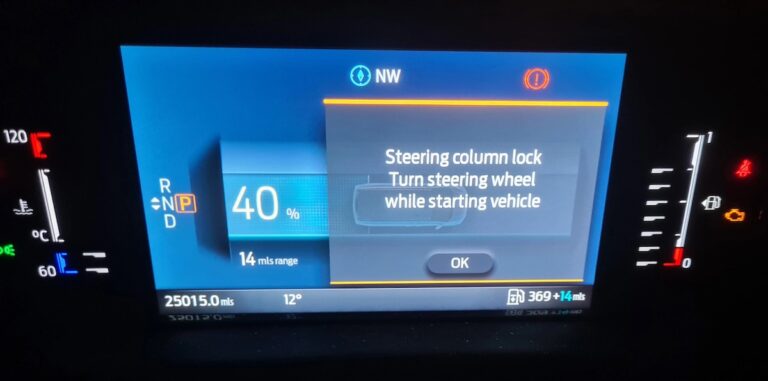
The moment your steering wheel locks up solid, refusing to budge, your stomach drops. You are sitting in the driver’s seat, key in hand or fob in your pocket, ready to head out, and the wheel feels like it is welded in place. The instrument cluster might flash a message you have never seen before. “Service Steering Column Lock.” What does that even mean, and how did a simple trip to the grocery store turn into a roadside crisis?
That message is not just an annoyance. It is a full-stop warning that your vehicle’s anti-theft system has clamped down on the steering column and refuses to let go. The steering column lock is a piece of hardware that has been keeping cars from being stolen since the 1970s. When it works, you never think about it. When it fails, you are not going anywhere without a tow truck or a very clever sequence of resets. Understanding why this lock fails is the first step toward fixing it without emptying your bank account.
The failure of the steering column lock can leave the steering wheel stuck in the locked position. The root cause is often something surprisingly simple, like a tired battery or a blown fuse. Sometimes the lock module itself gives up after years of cycling. On a handful of recent General Motors trucks, a software hiccup brings the whole system down. No matter the trigger, the symptoms are the same. No steering movement, a warning message on the dashboard, and maybe an engine that will not crank.
Why Your Car Has a Steering Column Lock in the First Place
Before the steering column lock became standard equipment, stealing a car required little more than jamming a screwdriver into the ignition and twisting. Once the engine fired, the thief simply drove away. Automakers added a mechanical lock inside the steering column that would engage a steel bolt into a slot the moment the key was removed. That bolt physically prevents the steering wheel from turning more than a few degrees, making the car impossible to steer under its own power. The lock works in tandem with the ignition cylinder. Insert the correct key, turn it, and the bolt retracts. Remove the key, and the bolt springs back into place.
This simple mechanism cut vehicle theft dramatically. For decades, it was purely mechanical. The driver’s hand provided the muscle. The key physically moved a tumbler, which pulled the locking pin back. Over time, though, manufacturers transitioned to electronic steering column locks controlled by the vehicle’s computer. These systems do not rely on the physical key blade to retract the bolt. Instead, the engine control unit or body control module sends an electronic signal to a small motor inside the steering lock module. That motor drives the locking pin in and out based on whether the authorized key fob is present inside the cabin.
The advantage is a tighter integration with modern push-button start systems and keyless entry. The disadvantage is that a weak battery, a corrupt software file, or a baked electrical component can tell the lock to stay engaged even when you are sitting in the driver’s seat with the correct fob in your pocket. The mechanical lock of the past could be forced or jiggled free with a bit of effort. The electronic lock can be absolutely unyielding when its electronics are confused.
What the ‘Service Steering Column Lock’ Message Is Telling You
When the vehicle detects that the steering column lock has not disengaged on command, it triggers a warning on the dashboard. The exact phrasing varies by manufacturer. On General Motors vehicles, you will likely see “Service Steering Column Lock.” On other makes, it might read “Steering Lock Active” or “Steering Wheel Locked.” The message is the vehicle’s way of saying, “I tried to unlock the steering, but something went wrong.” The problem may be in the lock module itself, in the wiring between the module and the computer, or in the computer’s ability to send the unlock command in the first place.
Often, the car will also refuse to start. That is because the anti-theft system cannot verify that the steering is safe to operate. The starting sequence requires the lock to be disengaged before the fuel injectors and ignition coils are activated. So even if the engine cranks, it will not fire. Or it may not crank at all. The vehicle is protecting itself, and you are the unintended casualty.
General Motors and the Long History of Steering Lock Headaches
Every major automaker has dealt with failing steering column locks, but General Motors seems to have earned a reputation with this specific gremlin. The fifth-generation Corvette, built from 1997 through 2004, became notorious for a “Service Column Lock” message that stranded owners in parking lots and on highways. The problem generated enough complaints that GM issued recalls and technical service bulletins over multiple years. The issue involved a combination of a weak lock actuator motor, voltage drops, and a programming strategy that was too quick to trigger the message.
More recently, the conversation shifted to GM trucks. Owners of certain fourth-generation Chevrolet Silverado and fifth-generation GMC Sierra models started reporting an intermittent “Service Steering Column Lock” message. The steering would lock up randomly, often after the vehicle had been sitting for a while or on the first start of a cold morning. GM traced the cause to a software glitch in the steering lock module and released a Technical Service Bulletin advising dealerships to reprogram the module with updated software. This fix addressed the vast majority of the complaints and showed that sometimes the problem is not mechanical at all. It is just bad code.
The Four Most Common Culprits That Lock Your Steering Wheel
When a customer rolls into the shop with a locked steering wheel and a warning message glowing on the cluster, I start with the basics. You would be amazed how often a dead battery or a popped fuse creates a symptom that feels catastrophic. Before you imagine worst-case scenarios involving flatbed trucks and weeks in the shop, work through these four common causes. The fix might cost you nothing but time.
A Weak or Dying Battery That Cannot Wake the Lock
Your vehicle’s battery does far more than crank the starter motor. It supplies a stable reference voltage to every module, sensor, and actuator in the car, including the steering column lock. The lock module contains a small electric motor that needs a solid spike of current to retract the locking pin. When the battery charge drops below a healthy threshold, that motor receives a weak signal. It either does not move at all or moves so slowly that the computer thinks it has failed and throws up the warning message.
A low battery can act up in cold weather. On a freezing morning, even a battery that started the car fine the day before might dip below 12 volts, especially if the vehicle was parked for a few days. The steering lock module’s self-test happens the moment the body control module wakes up. If the voltage sags during that test, the lock stays engaged, and the “Service Steering Column Lock” message appears. The engine might still crank, but the anti-theft system will not allow fuel or spark because the lock status is unknown.
Charging the battery or replacing it with a fresh unit often clears the problem instantly. You can also try a hard reset by disconnecting the negative battery cable for a few minutes. That gives all the modules a chance to reboot. When you reconnect and the battery is healthy, the lock module will run its initialization and usually disengage as soon as the key fob is recognized. Before you spend money on modules or fuses, put a multimeter on the battery terminals. You want to see at least 12.4 volts with the engine off. If you see 11.8 or lower, the battery is deeply discharged and is the prime suspect. Clean the terminals and tighten the clamps while you are there. A loose connection causes the same voltage drop as a weak battery.
The Fuse That Sacrificed Itself to Protect the System
Electrical systems in a car are protected by fuses designed to blow when current exceeds a safe level. The steering column lock module sits on its own fused circuit or shares a fuse with related security components. A sudden voltage spike, a short in the wiring, or even a brief moment of the lock motor drawing too much amperage can pop that fuse. Once the fuse is blown, the module loses all power. The lock cannot retract, and the computer triggers the warning message.
Finding this fuse is usually straightforward. Your owner’s manual will have a fuse box diagram that labels each circuit. Look for terms like “Steering Lock,” “Column Lock,” “Security,” or “BCM.” Pull the suspect fuse and hold it up to the light. If the thin metal strip inside is broken or the plastic appears cloudy or melted, the fuse is done. Even a corroded fuse can create enough resistance to prevent the module from working properly. Use electrical contact cleaner and a small wire brush to clean the terminals if the fuse is still intact but looks dirty. Sometimes simply removing and reinserting the fuse reboots the circuit and the lock springs back to life.
Always replace a blown fuse with one of the exact same amperage rating. Putting a higher-rated fuse in there is a recipe for melted wiring and a fire. If the new fuse blows immediately, you have an electrical short somewhere in the circuit, and a deeper diagnosis is needed.
The Steering Lock Module That Wore Out
Inside the steering column, a small module houses the locking pin, an electric motor, and a circuit board that communicates with the rest of the vehicle. Every time you park the car and shut it off, that module cycles the lock into place. Every time you get back in and press the start button or turn the key, the module retracts the lock. Year after year, those cycles add up. The motor brushes wear down. The plastic gears can crack. The circuit board solder joints can develop micro-fractures from temperature swings. Eventually, the module simply stops responding.
When the module fails, the steering wheel is usually stuck in the locked position. The vehicle sends the unlock command, but the module does not answer. The ECU records a fault code and illuminates the “Service Steering Column Lock” message. In some cases, the lock can fail in the unlocked position, which does not leave you stranded but triggers the warning light and may disable the remote start or other security features.
Replacing the steering lock module is the most reliable permanent fix. Repair is sometimes possible for someone comfortable with circuit board soldering, but the tight quarters inside the steering column make the job challenging. The module lives underneath the driver’s side dashboard, often bolted to the steering column with security fasteners. Reaching it typically requires removing the lower dash panels, the steering column covers, and sometimes the steering wheel itself. It is not a beginner-level weekend project. Many owners choose to have a shop handle the replacement, and that cost is still far less than the alternative of being stranded at the worst possible moment.
The Software Glitch That GM Engineers Had to Patch
On certain newer GM trucks, particularly the fourth-generation Silverado and fifth-generation Sierra, the steering column lock can fail without any physical defect at all. The lock module is functional, the battery is strong, the fuses are perfect, yet the “Service Steering Column Lock” message appears and the wheel stays frozen. GM identified the problem as a glitch in the module’s software. The module would essentially crash, losing its ability to process the unlock command. A scan tool might reveal a U0155 diagnostic trouble code stored in memory, indicating lost communication with the steering lock module.
The fix is a straightforward reprogramming. GM issued a Technical Service Bulletin with updated software that dealerships can flash onto the steering lock module using their factory scan tool. The process takes less than an hour. After the reprogramming, the lock behaves exactly as designed, and the message stops appearing. This is not a repair you can perform with a basic code reader or a smartphone app. It requires the dealer-level software and the correct calibration file. Attempting to reprogram the module without the proper equipment can corrupt the module permanently. So if you own one of these trucks and your steering lock acts up intermittently, a trip to the GM dealership is your best bet. The knowledge that it is a known software issue means you will not be paying for unnecessary parts. You will be paying for the right fix.

How to Diagnose the Problem Without a Shop Full of Tools
Before you call for a tow, you can run through a few simple checks that might save you an embarrassing flatbed ride and a diagnostic fee. Start with the obvious. Is the steering wheel truly locked, or is it just heavy because the engine is off? Try turning the wheel with moderate force while simultaneously pressing the start button or turning the key to the run position. Sometimes the lock pin catches on a tight spot and a slight wiggle frees it without any electrical fix. Do not yank with all your strength. You do not want to snap the lock pin and create a much bigger problem.
If the wheel refuses to move, check that the key fob battery is not dead. A weak fob signal can confuse the passive entry system, making the car think no authorized key is present. Hold the fob directly against the start button, which usually contains an NFC backup coil that reads the fob even when its battery is dead. If the steering lock disengages with the fob against the button, you just found a five-dollar battery as your savior.
Next, pop the hood and inspect the battery. Look for white or blue corrosion fluff around the terminals. A corroded terminal can drop enough voltage to send the steering lock module into a fault, even if the battery itself is healthy. Clean the terminals with a wire brush, baking soda, and water, reconnect them tightly, and try again. If you have a multimeter, measure the resting voltage. Below 12.4 volts, charge the battery or jump-start the vehicle. Once the vehicle is running, the alternator should be putting out between 13.7 and 14.7 volts. A low reading there points to a failing alternator that let the battery drain in the first place.
Pull the fuse box cover and locate the steering lock fuse using the diagram. Give it a visual check. Even if it looks fine, pulling it out for thirty seconds and reinstalling it can reboot the module and clear a glitch. This is the same principle as restarting a frozen smartphone. It works enough times that it is always worth trying.
If none of these steps get the steering released, the issue likely involves the module itself or its software. A scan tool can pull stored trouble codes that will narrow the diagnosis. The code U0155, as mentioned, is a strong indicator of a communication failure with the module, which could be a bad module, a wiring break, or the GM software fault. A different code might point to a voltage issue in the circuit.
What It Feels Like When the Lock Fails While You Are Driving
Steering column lock failures almost always happen when the vehicle is parked, because the lock only engages when the engine is off and the key is removed. A mechanical or electronic lock will not suddenly engage while the vehicle is moving at speed. That would be a catastrophic safety failure that the entire design works to prevent. The lock pin physically cannot spring into the slot if the steering shaft is spinning. But on rare occasions, a driver might notice a brief, unnerving stiffness after starting the engine if the lock did not fully retract. The wheel might require an extra bit of force to break free. That is the lock pin sticking in a partially retracted state.
If you ever feel resistance in the steering immediately after starting the car, do not force it harder than a normal parking maneuver. Cycle the ignition off and back on, and try again. If the resistance disappears, the lock just needed a second attempt. If it persists, shut the car down and investigate. Driving with a partially engaged lock can shear the lock pin or damage the steering column, turning a small problem into a major repair.
An Ounce of Prevention Keeps the Lock From Winning
Preventing a steering column lock failure is mostly about maintaining a healthy electrical system and staying on top of manufacturer software updates. A battery that is more than four years old lives on borrowed time. Have it tested at the start of every winter. A free battery test at an auto parts store will tell you the state of health and the cold cranking amps remaining. Replace a weak battery before it strands you. Clean the terminals and apply a protective spray to ward off corrosion.
If you own a GM vehicle that is known for steering lock software issues, check with your dealership to see if the reprogramming TSB applies to your VIN. Getting the update proactively means you will never have to sit in a parking lot with a locked wheel and a sinking feeling. Many dealers will perform the update during a routine oil change if you mention it. There is no need to wait for the message to appear.
Avoid adding aftermarket remote starters or alarm systems that splice into the ignition or CAN bus wiring. Poorly installed electronics create voltage drops, communication errors, and phantom current draws that can confuse the steering lock logic. If you want a remote start, use a factory-integrated system that does not cut into the vehicle’s original wiring.
When All Else Fails, Get the Right Help
There is no shame in handing a locked steering wheel over to a professional. The steering column houses airbag components, clock springs, and complicated wiring. Prying on the wrong piece can deploy an airbag or damage the column bearings. A mobile mechanic or a dealership technician with experience in anti-theft systems can diagnose the lock faster and more safely than most DIY attempts. They have the scan tool that can actively command the lock to cycle, isolating whether the fault is in the module, the wiring, or the computer.
The cost to replace a failed steering lock module varies by vehicle, but it often falls in the range of a few hundred dollars, including labor. That is a lot less than a tow truck, a rental car, and a week of missed work. If the fix is a simple software flash, your wallet will barely feel it. Either way, the peace of mind that your steering will unlock every single time is worth every cent.
The next time you see that “Service Steering Column Lock” message, you will not be staring at it in confusion. You will know exactly where to look. The battery, a fuse, a tired module, or a software bug. The steering column lock does a thankless job day after day, and when it stumbles, you are the one who has to guide it back to work. Now you have the roadmap. Will you check the simple stuff first, or will you let a ten-dollar fuse convince you that your car is broken beyond repair?