
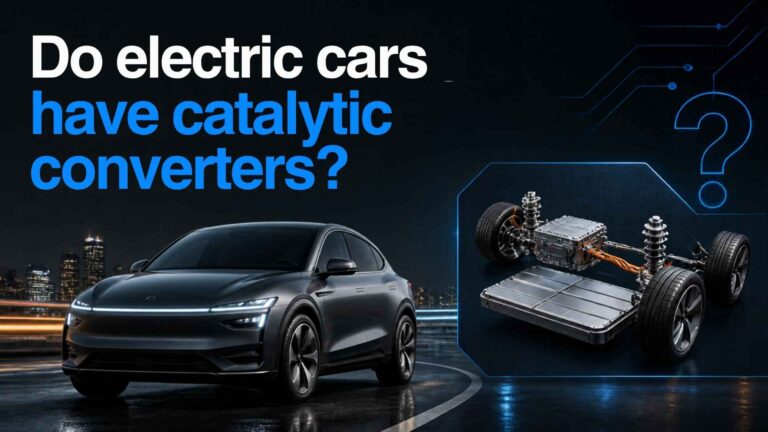
A customer brought in his wife’s new EV a while back, popped the hood for me to look at something unrelated, and asked why there was no exhaust pipe anywhere on the car. He wasn’t being dense, he just hadn’t thought about it before. No tailpipe means no catalytic converter, and once you understand why, the rest of the hybrid and EV emissions picture makes a lot more sense.
Catalytic converters became mandatory on new cars in the US starting in 1975, and from that point forward, basically every gas or diesel vehicle rolling off a lot had one bolted into the exhaust system. It’s a simple device in concept: exhaust gas passes through a honeycomb core coated in precious metals, a chemical reaction happens at high heat, and nasty gases like carbon monoxide and nitrogen oxides get converted into less harmful carbon dioxide, nitrogen, and water vapor before they hit the atmosphere.
Electric vehicles skip this part entirely, not because engineers decided it wasn’t worth including, but because there’s nothing for a catalytic converter to do on a car with no combustion happening anywhere under the hood.
Why a catalytic converter has nothing to work with in an EV
A catalytic converter only exists to clean up exhaust gas from burning fuel. No fuel burning means no exhaust gas, and no exhaust gas means there’s nothing flowing through a pipe for the converter to treat in the first place.
Electric cars run on motors powered by a battery pack, not an internal combustion engine. There’s no spark plug igniting an air-fuel mixture, no cylinders firing, no byproducts of combustion needing to be chemically converted before they leave the car. The entire exhaust system, the catalytic converter included, simply has no job to do, so manufacturers don’t build one in.
This is also why EVs don’t have a muffler, an oxygen sensor, an EGR valve, or any of the other exhaust-related hardware you’d find on a gas car. It’s not a cost-cutting decision or a missing feature, it’s just hardware with no function on a vehicle architecture that doesn’t produce exhaust at all.
What EVs produce instead
EVs aren’t entirely without emissions-adjacent byproducts, they’re just a different category of output than tailpipe gas.
- Brake dust: every car with physical brakes produces some particulate wear, though EVs tend to use their friction brakes less often thanks to regenerative braking doing a lot of the slowing down.
- Tire wear particles: heavier EVs, largely due to battery weight, can wear tires at a different rate than lighter gas cars, and tire wear is itself a source of road particulate matter.
- Upstream emissions: this is the big one people bring up in arguments about whether EVs are truly “zero emission,” and it’s worth its own section below.
Why hybrids still need one, even though they’re part electric
This is where I get the most questions in the shop, because people hear “hybrid” and assume it means “mostly exempt” from the stuff that applies to gas cars. It doesn’t work that way.
A hybrid combines an internal combustion engine with an electric motor, and depending on the system, they can work together or take turns depending on what the car needs at that moment. Cruising at low speed on a flat road, the electric motor might handle it alone. Need a burst of power to merge onto a highway, the gas engine kicks in, sometimes alongside the motor for combined output.
That gas engine, whenever it’s running, is burning fuel and producing the same basic exhaust byproducts any other combustion engine does. Carbon monoxide, nitrogen oxides, unburned hydrocarbons, all of it still needs to pass through a catalytic converter before it exits the car. The electric motor doesn’t somehow cancel that out or make the ICE side of the car exempt from emissions hardware.
The part that actually makes hybrid converters interesting to a mechanic
Here’s something that doesn’t get talked about enough. Hybrid engines cycle on and off far more frequently than a standard gas engine, because the car is constantly deciding whether to run on electric power, gas power, or both. Every time that ICE shuts off and restarts, the catalytic converter goes through a heat cycle, cooling down when the engine’s off and needing to climb back up to operating temperature once it kicks back on.
Catalytic converters work best at a specific operating temperature, and they’re at their least effective during that cold start window right after the engine fires up. A hybrid engine that’s starting and stopping all day is putting its converter through more of those cold-to-hot cycles than a conventional engine that just runs continuously once warmed up. I’ve seen this show up in diagnostic work as a converter that still reads fine on a scan tool’s long-term readiness monitors but takes noticeably longer to hit closed-loop operation compared to a traditional gas car’s setup.
This isn’t a flaw in hybrid design, manufacturers account for it with converter placement closer to the engine and other tuning tricks to help it heat up faster. It’s just a quirk worth knowing if you own a hybrid and wonder why the engine note sounds different on a cold morning compared to a gas-only car.
When the battery runs the show
Hybrids charge their batteries primarily through regenerative braking, which captures energy normally lost as heat during braking and feeds it back into the battery pack instead. Some hybrids also support wall charging (plug-in hybrids specifically), and all of them can top off the battery using the gas engine itself when needed.
When a hybrid is running purely on battery power, which happens a lot in stop-and-go city driving, it’s functionally as clean as a full EV for that stretch of driving. The catalytic converter sits there doing nothing, same as it would in a parked car. The moment the battery depletes enough or the car demands more power than the electric motor alone can provide, the gas engine wakes up and the converter goes back to work.
| Vehicle type | Catalytic converter | Why |
|---|---|---|
| Electric car (EV) | Absent | No combustion engine, nothing to convert |
| Gas or diesel (ICE) vehicle | Present | Combustion produces exhaust gas that must be treated |
| Standard hybrid | Present | Gas engine runs part of the time, still produces exhaust |
| Plug-in hybrid | Present | Same gas engine requirement, even with larger battery range |
Are EVs really zero emission? The honest answer
I’ll give you the straight version of this, because it comes up constantly and gets oversimplified in both directions.
At the tailpipe, yes, an EV produces zero emissions, because there’s no tailpipe and no combustion. That part isn’t up for debate. Where the argument gets more complicated is in where the electricity powering that EV actually comes from.
If the power grid in your area leans heavily on coal or natural gas plants, the electricity charging your EV battery did come from somewhere, and that somewhere produced emissions during generation. This is often called the “well-to-wheel” or “upstream emissions” argument, and it’s a legitimate point, not a myth. The EPA’s green vehicle resources break this down in more detail if you want the full picture of how regional grid mix affects an EV’s total emissions footprint.
That said, even accounting for a dirtier regional grid, EVs generally still come out ahead on total lifecycle emissions compared to a gas-only vehicle, mainly because power plants are large, centralized, and increasingly regulated and cleaned up over time, whereas every individual gas car on the road burns fuel independently with far less oversight on a per-vehicle basis. It’s not a perfectly clean argument in either direction, but “EVs are indirect polluters” isn’t the same claim as “EVs are just as dirty as gas cars,” and I’d push back gently anytime I hear someone collapse those into the same statement.
Brake-related particulate emissions on EVs get mentioned sometimes too, and it’s true that heavier EVs can produce some brake and tire wear particulates. But regenerative braking means EVs use their mechanical brakes less often than gas cars do in daily driving, which tends to offset a good chunk of that concern. None of this changes the core fact that EVs produce dramatically less direct pollution than anything with a combustion engine under the hood.
The catalytic converter theft problem hybrid owners should actually worry about
This is the part I think hybrid owners get caught off guard by more than anything else in this whole topic, and it’s not really covered in most articles about EVs and catalytic converters.
Hybrid catalytic converters have become a favorite target for theft in a lot of areas, and the reason comes right back to what we talked about earlier. Because a hybrid’s gas engine cycles on and off and doesn’t run continuously the way a standard ICE does, the converter doesn’t go through the same level of thermal stress and degradation over its lifespan. That means the precious metals inside (platinum, palladium, rhodium) tend to stay in better condition, making a used hybrid converter more valuable on the scrap market than a converter pulled off a conventional gas car that’s been cooking at full operating temperature for years.
Certain hybrid models, the Toyota Prius being the most commonly cited example, have been hit hard enough by this that it’s become a known pattern among shops and law enforcement in a lot of cities. A thief can slide under the car, cut the converter out with a reciprocating saw in under five minutes, and be gone before anyone notices.
Signs your converter has been stolen
- A sudden, loud roaring or rattling noise from underneath the car the moment you start it, often described as sounding like a race car.
- A noticeable drop in fuel economy or power, especially if the vehicle’s computer isn’t yet throwing a check engine light.
- Visible gap or missing section in the exhaust piping if you look underneath the car.
- Check engine light with codes related to oxygen sensor readings or catalyst efficiency once the car’s computer catches up to the missing hardware.
What it costs to replace one
Replacement costs on a hybrid catalytic converter vary a lot depending on the vehicle, but they tend to run higher than a comparable gas car’s converter because of that same precious metal content and the hybrid-specific exhaust routing some models use. Parts alone can run into the higher end of typical converter pricing, and labor adds to that depending on how accessible the unit is on your specific model. If you’re a hybrid owner and this happens to you, your insurance comprehensive coverage typically handles it, though you’ll still eat the deductible.
How to protect against it
- A welded-on catalytic converter shield or cage, a common aftermarket solution that makes cutting the converter out significantly more time-consuming for a thief.
- Parking in a garage when possible, or at minimum in a well-lit area if you’re parking on the street.
- Etching your VIN onto the converter itself, which some police departments offer as a free service, making a stolen unit harder to resell anonymously.
- A motion-activated alarm or dash cam angled to cover the undercarriage area, mainly useful for catching the theft on video for insurance and police reports.
The NHTSA’s vehicle safety resources and your local police department’s crime prevention unit are both decent places to check on current theft trends in your area if you’re trying to decide whether a shield is worth the investment on your specific hybrid.
Signs your hybrid’s catalytic converter is failing on its own
Theft isn’t the only way a hybrid converter gives you trouble. Like any gas-engine component, they can wear out or clog over time, same as on a conventional car.
| Symptom | Likely cause |
|---|---|
| Check engine light with a P0420 or P0430 code | Catalyst efficiency below threshold, converter no longer treating exhaust properly |
| Rotten egg smell from the exhaust | Converter failing to process sulfur compounds correctly |
| Reduced fuel economy or sluggish acceleration | Clogged converter restricting exhaust flow |
| Failed emissions test | Converter not reducing pollutants to required levels |
| Rattling noise under the car | Internal honeycomb substrate breaking apart inside the converter housing |
If you own a hybrid and get a P0420 or similar code, don’t assume it’s automatically a bad converter before checking a few cheaper possibilities first. A failing oxygen sensor can trigger the same code and costs a fraction of what a converter replacement does, so an OBD-II scan tool reading live sensor data is worth a look before anyone quotes you converter replacement.
What maintenance looks like differently across all three vehicle types
Since we’re already comparing EVs, hybrids, and gas cars on the emissions side, it’s worth a quick word on how that translates to actual maintenance differences you’ll notice as an owner.
EV owners skip oil changes, converter concerns, and exhaust system maintenance entirely, but they take on battery coolant system checks, brake fluid service (brakes still need fluid even if they’re used less), and tire wear monitoring since EV weight can accelerate tread wear. Hybrid owners deal with a hybrid version of standard ICE maintenance (oil changes, converter health, spark plugs) plus some EV-adjacent items like high-voltage battery health monitoring. Gas car owners are stuck with the full traditional maintenance list, converter included, with no electric motor picking up any of the slack.
None of these are “better” or “worse” lists, just different. If you’re cross-shopping and emissions hardware is part of your decision-making, know that going hybrid doesn’t get you out of catalytic converter concerns, it just changes how and when that converter gets used.
What I’d tell you if you’re trying to make sense of all this
If you’re buying an EV expecting zero exhaust-related maintenance, that part’s accurate, there’s genuinely nothing there to maintain or fail. If you’re buying a hybrid expecting it to be exempt from gas-engine emissions equipment because it’s “part electric,” that assumption is wrong, and worse, hybrid converters are actually a bigger theft target in a lot of areas than standard gas car converters are. That’s the one piece of this whole topic I’d make sure every new hybrid owner actually hears before it happens to them.
As for DIY versus a shop: diagnosing a catalytic converter code yourself with a basic OBD-II scan tool is reasonable and worth doing before you pay anyone for a diagnosis, since it rules out cheaper culprits like a failing oxygen sensor first. Actually replacing a converter, welding in an aftermarket anti-theft shield, or diagnosing anything involving the hybrid’s high-voltage system is shop territory, that’s not a safe or practical weekend project for most people.
My takeaway for you: if you drive an EV, the catalytic converter question simply doesn’t apply, enjoy not thinking about it. If you drive a hybrid, especially a Prius or similar commonly targeted model, spend the money on a converter shield now rather than finding out the hard way what a stolen converter costs to replace later.