
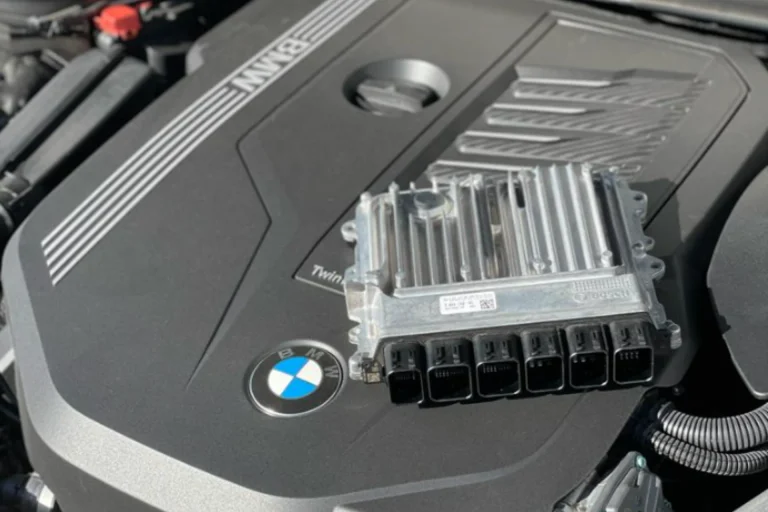
A guy had his BMW 335i towed into our shop last month with a trunk full of old parts and a receipt for $1,100 from another garage. His car had started shaking with a violent three-cylinder misfire on the highway, so he bought six brand-new Bosch ignition coils, six new spark plugs, and three expensive fuel injectors. None of it made a bit of difference: cylinders 1, 2, and 3 were still dead as a doorknob, and the car smelled like raw gasoline out the tailpipe. Twenty minutes after popping open the white plastic electronics box under his passenger-side windshield cowl, I showed him the real culprit on the workbench: a burned two-dollar MOSFET transistor soldered onto the circuit board of his BMW’s DME computer.
BMWs are fantastic driving machines when everything under the hood is happy, and the brain running the whole show is called the Digital Motor Electronics (DME) module. On gasoline-powered BMWs (while diesel BMWs call their computer the DDE, or Digital Diesel Electronics), the DME controls fuel injection, ignition spark timing, VANOS variable camshaft timing, Valvetronic variable valve lift, turbocharger boost, cooling fans, and emissions monitors so the car’s engine delivers strong power with clean emissions and low fuel consumption.
Like any complex circuit board living in a hot, vibrating engine bay, a BMW DME can fail from heat, water intrusion, or electrical overload. When it goes bad, it causes bizarre drivability problems that trick owners and inexperienced mechanics into throwing thousands of dollars of sensors and coils at the engine. Let’s walk through the five classic BMW DME failure symptoms, how to make sure a $25 relay isn’t fooling you, what causes a DME to fry in the first place, and how you can fix or clone one for a fraction of the $3,000 dealership price.
What are the main BMW DME failure symptoms?
You can spot a failing BMW DME by five classic symptoms: sudden low engine performance (or a “Drivetrain Malfunction” limp-mode warning), persistent engine misfiring or stalling of the engine that survives new coils and plugs, a crank-no-start or no-crank condition accompanied by a roaring radiator fan, a Check Engine Light with internal processor or driver fault codes, and rich exhaust smell with higher emissions and poor fuel economy.
Because those symptoms overlap with everyday tune-up parts, the trick is knowing the specific “tells” that point straight to the computer box rather than a worn spark plug. Let’s look at how each of these five symptoms shows up behind the wheel.
1. Low engine performance and “Drivetrain Malfunction” limp mode
When a circuit inside the DME starts breaking down, the computer can no longer control fuel pressure, turbo wastegate duty cycle, or Valvetronic intake valve lift accurately. On older E46, E39, and E90 BMWs, you’ll feel the engine go flat and sluggish when you step on the gas, or see the half-shaded yellow engine icon pop up on the cluster. On newer F-series and G-series BMWs, the iDrive screen chimes with the dreaded “Drivetrain Malfunction: Drive Moderately” banner.
One super common DME failure on N20, N55, and N52 engines involves the internal H-bridge driver chip inside the DME that powers the Valvetronic eccentric shaft servomotor. When a worn Valvetronic motor draws too much amperage, it burns out the driver section on the DME circuit board. Immediately, the DME locks the intake valves into a fixed backup position, cuts turbo boost, and leaves your BMW accelerating like a heavy lawnmower.
2. Misfiring or stalling of the engine (even with brand-new coils and plugs)
An engine misfire is one of the most frustrating problems a BMW owner can run into, especially when it comes and goes with under-hood heat or refuses to clear after a fresh tune-up. Inside your DME, there is a dedicated high-current switching transistor (called a MOSFET) for each individual ignition coil and each fuel injector. Every time a cylinder fires, the DME switches ground through that transistor to fire the coil and snap the injector open.
On BMWs equipped with the Continental MSD80 DME (such as 2007 to 2010 335i, 535i, 135i, and X6 models with the twin-turbo N54 engine) as well as Bosch MEVD172 DMEs (on N55 and N20 engines), those internal MOSFET transistors are notorious for burning out or cracking their solder joints as the board heats up. Sometimes the engine runs fine for the first ten minutes of a cold drive, then starts bucking, shaking, and stalling at stoplights once the DME board gets hot. Other times, an old ignition coil shorts out internally, sends a voltage spike backward up the wiring harness, and permanently fries the ignition driver chip inside the DME, so even after you bolt in six brand-new ignition coils, that cylinder stays 100% dead!
3. The car failing to start (and the jet-engine cooling fan clue)
Few moments ruin your morning faster than sitting in your BMW with half a tank of gas and a healthy 12-volt battery while the engine refuses to start. When a BMW DME fails completely, or loses its main power feed or CAN-bus communication, you’ll run into one of two no-start behaviors:
- Cranks strong, but never fires (Crank, No-Start): The starter motor spins the engine over normally because the CAS / FEM / BDC security module still triggers the starter, but because the DME is offline or its internal fuel/ignition circuit is dead, the fuel injectors and spark plugs never get a command to fire.
- Pushes Start button and nothing happens (No-Crank, No-Start): If the DME and the car’s immobilizer module (EWS, CAS, FEM, or BDC) lose their rolling security handshake (or if water corrodes the DME connector pins), the security module locks out the starter motor completely to prevent theft.
Here is my favorite 10-second mechanic shortcut when a BMW won’t start: turn the ignition ON (without starting the engine) and listen to the front grille. Does the electric radiator cooling fan immediately roar up to 100% full hurricane speed on a stone-cold engine? On almost every modern BMW, the electric cooling fan is designed with a fail-safe default: if it does not receive a steady Pulse-Width Modulated (PWM) heartbeat signal from the DME within a few seconds of key-on, the fan assumes the engine might be overheating and spins at 100% max speed! A roaring cooling fan with a cold engine and a no-start condition means your DME is either completely unpowered or dead on the network.
4. Check engine light (Service Engine Soon) and internal DME fault codes
While a thousand different sensor glitches can turn on your BMW’s “Service Engine Soon” or Check Engine light, a failing DME leaves very specific fingerprints when we plug a BMW-capable scan tool (like ISTA, Foxwell NT510/NT530, BimmerLink, or Autel) into the OBD-II port. You can read more about how onboard diagnostic computers monitor internal processor memory and output drivers on the EPA On-Board Diagnostics (OBD) portal.
Instead of normal sensor range codes, a dying DME often logs internal hardware codes or impossible combinations of codes all at once:
- `30BA` and `30BB` (on N54 MSD80 DMEs): Digital Motor Electronics, internal failure, specifically pointing to blown injector bank 1 (`30BA`, cylinders 1 to 3) or bank 2 (`30BB`, cylinders 4 to 6) MOSFET transistors on the DME circuit board!
- `2E84`, `2A98`, `2EFE`, or `DME Internal RAM / Checksum Error`: Indicates corrupted flash memory, internal processor fault, or water corrosion bridging traces inside the module.
- 5-Volt Reference Supply Faults (Multiple sensors failing together): Inside the DME are regulated 5-volt power rails that feed the camshaft sensors, crankshaft sensor, boost sensor, fuel rail pressure sensor, and accelerator pedal. If one internal 5V regulator fails (or gets shorted down by an oil-soaked external sensor), you’ll suddenly see five or six unrelated sensor codes pop up at the exact same second.
- “No Communication with DME / Engine Control Module”: Every other module in the car (transmission EGS, ABS/DSC, instrument cluster KOMBI) logs a fault saying it lost contact with the DME over the PT-CAN network.
5. Higher emissions, raw fuel smell, and terrible fuel consumption
Your DME is constantly adjusting fuel injector pulse width to the millisecond based on feedback from the upstream wideband oxygen (Lambda) sensors so the air-fuel mixture stays right at the stoichiometric sweet spot. When the DME’s oxygen sensor signal processor, injector driver, or coolant temperature circuit malfunctions, that precision fuel control goes out the window.
In the worst scenario, which I have seen happen more than once on shorted BMW DME drivers, a shorted transistor holds a fuel injector 100% wide open continuously the moment you turn the ignition on! That dumps raw liquid gasoline straight into the cylinder like a garden hose, washing oil off the cylinder walls, blowing white/grey clouds of raw fuel smoke out the tailpipe, spiking hydrocarbon and carbon monoxide emissions off the chart, and risking hydro-locking the engine or melting the catalytic converter in seconds.
| BMW Engine & DME Type | Where the DME Lives | Most Common DME Failure Mode | Signature Fault Codes / Clues |
|---|---|---|---|
| N54 Twin-Turbo 3.0L (Continental MSD80) (2007 to 2010 335i, 535i, 135i) | Passenger-side cowl E-box under hood | Burned internal injector MOSFET transistors (3 cylinders cut out at once) | Codes 30BA or 30BB with cylinder 1 to 3 or 4 to 6 misfires |
| N55 / N20 / N26 Turbo (Bosch MEVD172) (2011 to 2017 328i, 335i, 528i, X3, X5) | Bolted directly to the intake manifold (cooled by intake air!) or E-box | Failed ignition coil driver chip, Valvetronic servo driver burn-out, or solder heat fatigue | Persistent single-cylinder misfire after new coil/plug, or dead Valvetronic codes (`135808` / `2DCE`) |
| M54 / N52 Inline-6 (Siemens MS43 / MS45 / MSV70 / MSV80) (E46, E60, E90, X3, Z4) | Under-hood electronics box (E-box) near windshield cowl | Water intrusion from clogged cowl drains, or failed O2 / DISA / ignition drivers | No-start with radiator fan roaring at 100%, green corrosion on DME pins |
| N63 Twin-Turbo V8 & B48 / B58 (Bosch MEVD / MG1) (550i, 750i, X5, M340i) | Engine bay (often liquid-cooled or dual DME setup on V8s) | Oil wicking up wiring harness from oil pressure switch into DME connector pins! | Oily wet DME harness plug, random pressure/vanos codes, or ISM power module fault |
Why do BMW DMEs fail in the first place? (Check these before installing a new one!)
Here is the most important lesson I can give you from the shop floor: a BMW DME rarely dies of “old age” in a vacuum, because something else on the car usually killed it! If you spend $800 on a cloned DME or $2,500 at the dealership and plug it into the car without fixing the external problem that fried your original computer, you will blow up the replacement DME the very first time you start the engine.
Before you ever plug a repaired or replacement DME into your BMW, inspect these four notorious DME killers:
- Water flooding the under-hood E-box (Clogged cowl drains): On E46, E60, E63, E70 X5, E83 X3, and E90 3-Series BMWs, the DME sits inside a white or black plastic Electronics Box (E-box) tucked right under the windshield cowl gutters. When autumn leaves, pine needles, and mud clog the rubber drain flaps at the bottom of the fender wells, rainwater backs up and pours right inside the E-box, submerging the bottom half of the DME in two inches of water! Always clean out the cowl drains and check that the E-box lid gasket is sealed tight.
- Shorted ignition coils or Valvetronic servomotors back-feeding amperage: When an old ignition coil develops a primary-winding short (or when a seizing Valvetronic eccentric shaft motor draws 40 amps instead of 10 amps), it cooks the driver chip inside the DME. Whenever you repair a DME for a burned coil driver or Valvetronic driver, always replace the faulty ignition coil or Valvetronic motor at the exact same time so the bad part doesn’t fry your freshly repaired board!
- Engine oil wicking up inside the wiring harness (Capillary action!): This one blows people’s minds when I show it to them. On many N20, N55, N63, and B-series BMW engines, the oil pressure control valve solenoid, oil pressure sensor, or Valvetronic eccentric shaft sensor develops a tiny internal leak through its electrical pins. Pressurized engine oil actually gets pushed inside the copper wire insulation, travels three feet uphill through the wiring harness like kerosene up a lamp wick, and fills the DME computer socket with motor oil! Always unplug the DME connectors and inspect the pins with a flashlight for shiny motor oil or green water corrosion.
- Jump-starting directly on the trunk battery or running with a loose ground strap: Never clamp jumper cables or a high-amp shop charger directly onto the battery posts in the trunk of a BMW; always use the dedicated brass positive (`+`) and negative (`-`) jump posts under the hood so the Intelligent Battery Sensor (IBS) and power distribution modules are protected from voltage spikes. Even more critical: check the braided copper engine-to-chassis ground strap underneath the driver’s side motor mount! When that braided copper strap turns green and rots in half from road salt, the starter motor tries to pull 250 amps of ground path backward through the thin DME sensor wires, instantly melting the ground traces inside the DME!
Wait: make sure a $25 DME relay or power module isn’t fooling you!
Before you spend a single dollar mailing your DME off for repair, let me tell you about the #1 misdiagnosis in the BMW world. At least once a month, a BMW is towed into our shop because another mechanic scanned it, saw “No Communication with DME” and a roaring cooling fan, and told the owner they needed a $2,200 computer.
Why couldn’t the scan tool talk to the DME? Because nobody turned the lights on inside the DME’s house! Your DME gets its main 12-volt power through a replaceable relay or power supply module:
- On E36, E46, E39, E60, E83, E53, and E90 BMWs (The Sky-Blue or Green DME Main Relay): Right inside the under-hood E-box next to the DME sits a small square plastic relay (usually sky-blue or salmon/green, BMW part number ending in `6911222` or similar). After ten years of heat cycles, the tiny copper contacts inside that $25 relay pit and burn out. When that relay fails to click closed, the DME gets zero volts, the car cranks with no start, the cooling fan screams at 100%, and every module logs “Lost communication with DME.” Swapping in a $25 OEM BMW DME relay fixes the car in two minutes!
- On F-Series and E70/F15 X5, F30 3-Series, F10 5-Series BMWs (The Integrated Supply Module / IVM / ISM): Newer BMWs replaced the simple relay with a black plastic fuse-and-relay box called the Integrated Supply Module (IVM / ISM) mounted right near the DME. The solder joints inside that $110 to $160 plastic IVM box crack all the time, cutting power to the DME, ignition coils, and injectors intermittently and setting false DME faults. Always test for 12V power and clean ground at the DME connector pins before blaming the DME itself!
Solutions to a failed BMW DME (and how BMW security coding works)
Suppose you checked the DME relay, verified your engine ground strap is intact, checked for oil or water in the plugs, and confirmed that your DME circuit board is genuinely damaged. Why can’t you just hop on eBay, buy a used DME out of a wrecked BMW with the same part number for $120, plug it into your car, and turn the key?
Because of BMW’s anti-theft immobilizer system! Inside your DME is a unique, factory-encrypted security password called the ISN (Individual Serial Number). Every time you press the Start button, your car’s security module (called EWS on older BMWs, CAS on E-series, and FEM / BDC on F- and G-series) checks that secret ISN code against the DME. If you plug a raw used junkyard DME into your car without transferring your car’s exact ISN and VIN data into it, the immobilizer sees a mismatched password and refuses to let the engine start. That leaves you with three real-world repair solutions:
Option 1: component-level repair of your existing DME ($300 to $600)
If your original DME circuit board hasn’t been burned in a fire or dissolved by standing saltwater, repairing your existing DME is almost always the smartest, cheapest, and cleanest choice. Specialized automotive electronics labs test your DME on a bench simulator (diagnostic bench testing typically costs around $80 to $99, often credited toward the repair), desolder the blown injector or ignition MOSFET transistors, repair damaged voltage regulators or Valvetronic driver chips, and seal the board back up.
The biggest advantage of repairing your own DME? It stays 100% plug-and-play! Because it is still your car’s original circuit board with your original memory chips containing your VIN, mileage, software calibration, and secret ISN immobilizer code, you simply plug it back into the harness, reconnect the battery, and start the engine with zero dealer programming required.
Option 2: buying a used/refurbished donor DME and cloning it ($500 to $1,000)
What if your original DME flooded with two inches of rainwater and the multi-layer circuit board is corroded beyond repair? You still don’t have to pay $3,000 at the dealership! As long as the processor and EEPROM memory area on your damaged original DME can still be read on a bench programmer (like Autel IM608, HexProg, K-TAG, or Autohex), a BMW specialist or electronics service can buy a clean, matching used/refurbished donor DME and perform a 1-to-1 DME Clone.
Cloning copies the exact D-Flash (EEPROM) and P-Flash data (including your secret ISN security key and VIN) out of your old waterlogged DME and writes it directly into the replacement donor DME. Even if your old DME is completely unreadable, a skilled BMW specialist can read the ISN out of your car’s CAS / FEM / BDC security module and match the donor DME to your car. Total cost for a tested donor DME plus bench cloning typically runs between $500 and $1,000.
Option 3: brand-new DME from a BMW dealership ($2,000 to $3,500+)
The third option is ordering a brand-new, VIN-coded DME directly from BMW AG through an authorized dealership or master independent shop with an active BMW AOS / ISTA programming subscription. Because the DME is a federally regulated security and anti-theft part, BMW orders the module matched to your vehicle’s VIN and chassis files, installs it, and runs a full vehicle programming and synchronization session.
While a brand-new factory DME gives you a fresh two-year parts warranty and the latest factory software revision, it is by far the most expensive path: the bare DME module alone typically retails for $1,400 to $2,400, bringing the total bill with diagnostic time and programming labor to $2,000 to $3,500+. (Before paying out of pocket for an emissions-control computer on a newer BMW, always check your state and federal emissions warranty! Under federal EPA rules, the Engine Control Unit / DME is covered as a major emissions defect part for 8 years or 80,000 miles from the car’s original in-service date, and checking your VIN on the NHTSA recall database ensures you don’t miss a factory service campaign.)
How much does it cost to fix BMW DME issues? (Side-by-side comparison)
To help you compare your choices before approving a repair estimate, here is how every DME fix stacks up in cost, turnaround time, and coding requirements:
| Repair Path | What It Fixes | Typical Total Cost | Programming Required? |
|---|---|---|---|
| DME Main Relay or IVM / ISM Power Supply Module Swap | False “dead DME / no communication” caused by loss of 12V power to the computer | $25 to $180 (DIY) or $150 to $350 (Shop) | None (100% plug-and-play) |
| Bench Diagnostic Test Only (Mail-in or local specialist) | Confirms whether your DME hardware is actually faulty before you buy parts | $80 to $120 (Often applied toward repair) | None |
| Repairing Your Existing Original DME (MOSFETs, coil/injector/Valvetronic drivers) | Burned injector/coil drivers (`30BA`/`30BB`), Valvetronic driver faults, minor solder issues | $300 to $600 | None! Retains your original VIN & ISN security data |
| Refurbished / Used Donor DME + Bench Cloning | Water-damaged, corroded, or burnt circuit boards where the original board can’t be saved | $500 to $1,000 (Part + cloning service) | Bench cloning transfers ISN/VIN so it plugs in ready to start (may need simple injector coding check) |
| Brand-New Dealership BMW DME + ISTA Programming | Complete replacement when desired or required on newest encrypted platforms | $2,000 to $3,500+ ($0 if under 8yr/80k federal emissions warranty!) | Full BMW ISTA/P or ISTA+ programming, coding, and immobilizer sync required |
Can I remove the DME from my BMW myself?
Yes, you can remove the DME from your BMW in your own driveway to inspect the plugs or mail it out for bench repair/cloning, and doing the removal yourself easily saves 1.5 to 3 hours of shop labor ($200 to $450). However, you have to treat those multi-pin connectors with respect, because bending one hair-thin brass pin inside a 96-pin BMW connector will turn a simple repair into a massive headache.
Follow this exact mechanic checklist to remove and reinstall a BMW DME safely without sparking a circuit or bending a pin:
- Disconnect the negative (-) 12-volt battery terminal in the trunk FIRST: Never unplug or plug in a BMW DME while the car battery is connected! Open the trunk (leave the trunk lid propped open or flip a towel over the latch so you don’t lock yourself out of an electric trunk latch with the battery disconnected!), use a 10mm socket to loosen the negative battery clamp, and wrap the negative cable end in a shop rag so it cannot spring back and touch the battery post. (On hybrids or dual-battery BMWs, disconnect the auxiliary 12V battery as well.)
- Locate your DME based on your engine family:
- E-Series (E46, E39, E60, E90, E70): Remove the cabin microfilter housing cowl tray at the base of the windshield and unclip or unbolt the lid of the white or black plastic Electronics Box (E-box) on the passenger side (or driver’s side on certain models).
- F-Series / G-Series (N20, N26, N55, B48, B58): On many N20 and N55 models, the Bosch DME is bolted directly onto a cooling plate integrated into the top/side of the plastic intake manifold right under the acoustic engine cover! On B48/B58 models, it typically sits vertically beside the intake manifold/strut tower on the driver’s side.
- Unlock the sliding bail levers on each connector, and NEVER pry the plugs with a screwdriver: BMW DME connectors use a cam-lever locking slider. Press the small plastic release tab and swing or slide the grey/black locking lever all the way across through its full 90-degree arc; as the lever swings, its geared tracks automatically push the connector straight up and out of the DME socket with zero prying force!
- Take a clear smartphone photo of the connectors and inspect the pins: Before sliding the DME out of its aluminum carrier slots, snap a photo so you know where every harness branch routes. Shine a bright flashlight into both the female harness plugs and the male pins on the DME to check for green water crust, bent pins, or shiny motor oil wicking out of the wires.
- When reinstalling, let the locking lever pull the plug down evenly: Never mash a BMW DME connector down by hand if it feels crooked! Set the plug gently into the socket with the locking lever fully open, then swing the locking lever closed smoothly so it draws the plug down flat and clicks locked. Reconnect the negative battery cable in the trunk last.
Real-world shop cases: three “bad DME” BMWs from our service bays
To show you how these symptoms play out on real cars, here are three BMWs that came into our shop with suspected DME failures, and what it actually took to fix each one.
Case 1: the 2008 BMW 335i (N54) with the $320 MOSFET fix
Remember the 335i owner from the beginning of this article who had already spent $1,100 on coils, spark plugs, and piezo injectors? When we scanned his Continental MSD80 DME, it immediately displayed `30BA` (DME digital motor electronics, internal failure) alongside misfire codes for cylinders 1, 2, and 3. On the MSD80 circuit board, six surface-mount MOSFET transistors control the high-voltage piezo injectors, and when one transistor fails, the DME shuts down that entire 3-cylinder bank to prevent fuel washdown.
Instead of selling him a $2,400 dealer computer, we pulled his MSD80 DME out of the passenger cowl box in twenty minutes, opened the aluminum housing on our ESD bench, and tested all six injector MOSFETs with a multimeter in diode mode. One MOSFET on bank 1 was shorted dead across its source and drain legs. We desoldered all six original factory MOSFETs and soldered in six upgraded, higher-amperage replacement MOSFETs along with a fresh bead of silicone case sealant. Total bill was under $380, no coding was needed because it was his original board, and all six cylinders fired up smooth as glass on the first press of the button.
Case 2: the 2011 BMW 328i (N52) that “needed a $2,000 DME”
A college student had her 2011 E90 328i towed to us after it refused to start in her apartment parking lot. The starter cranked strong, the radiator fan roared like a leaf blower the instant she put the key fob in the dash slot, and a mobile mechanic told her the DME was dead because his scanner said “No Communication with ECM.”
Before touching the DME itself, I opened the white plastic E-box under the passenger side of the hood and pulled out the sky-blue K6300 DME Main Relay. When I popped the plastic cap off the relay, the internal copper contact arm was black and pitted from eleven years of arcing, and tapping the relay on the fender made it intermittently lose continuity! I plugged a brand-new $28 genuine BMW sky-blue relay into the socket, pressed the Start button, and the N52 inline-six purred to life immediately. Her DME didn’t have a single thing wrong with it.
Case 3: the 2014 BMW X3 xDrive28i (N20) with the floodedValvetronic driver
Another customer brought in a 2014 X3 2.0L turbo that threw a “Drivetrain Malfunction” warning, ran in reduced-power limp mode, and made a weird clicking sound from the top of the valve cover whenever he unlocked the doors. Scanning the Bosch MEVD172 DME showed Valvetronic servomotor power supply and position faults (`135808` and `133E10`).
When we checked the Valvetronic actuator motor inside the valve cover with a megohmmeter/multimeter, we found the electric motor had shorted internally to ground, and in the process of dying, it had burned out the Valvetronic driver circuit inside the DME! If we had only replaced the Valvetronic motor, the car still wouldn’t have worked; and if we had only cloned a replacement DME without replacing the shorted Valvetronic motor in the valve cover, the bad motor would have fried the new DME in five seconds. We installed a new OEM VDO Valvetronic actuator motor and gasket set, cloned his original DME data onto a clean tested Bosch donor DME ($650 for the cloned unit), ran the Valvetronic end-stop calibration in ISTA, and restored 100% boost and power. Standards for automotive CAN-bus diagnostics and module memory management are published by SAE International.
Frequently asked questions about BMW DME failure and repair
Can a weak BMW car battery or jump-starting the car damage the DME?
Yes, and it happens every single winter! Jump-starting a BMW directly at the trunk battery terminals (instead of using the dedicated under-hood jump posts!) or connecting jumper cables with reversed polarity for even half a second sends a massive voltage surge across the chassis network. That spike frequently blows the Integrated Supply Module (IVM), corrupts the rolling security handshake between the DME and CAS/FEM immobilizer, or shorts the 5-volt voltage regulator inside the DME itself.
How do I know if my BMW misfire is a bad ignition coil or a blown DME coil driver?
Before blaming the DME for a single-cylinder misfire (for example, `P0304` or `29D0` Cylinder 4 Misfire), always do the free “swap test” first: swap the Cylinder 4 ignition coil to Cylinder 1, and swap the Cylinder 4 spark plug to Cylinder 2. Clear the codes and start the car. If the misfire stays locked on Cylinder 4 even with a known-good coil and spark plug, unplug the battery, check the continuity of the signal wire between the Cylinder 4 coil plug and the DME connector, and check the resistance of the DME’s internal coil driver pin relative to the other five cylinders. If that single DME pin shows an open circuit or a dead short to ground compared to the other five pins, the internal ignition driver transistor inside the DME is blown.
Do I need to re-code fuel injectors after repairing or cloning a BMW DME?
If you have your original DME circuit board repaired (like replacing blown MOSFETs), all of your 6-digit or 7-digit fuel injector flow calibration numbers remain stored inside your DME’s memory, so no injector coding is needed. When a shop performs a full 1-to-1 bench clone onto a donor DME, those injector calibration numbers transfer over automatically with the EEPROM data, though I always spend two minutes verifying them on the scan tool after startup just to be 100% certain.
A mechanic’s verdict: what to do next and when to call a specialist
When your BMW’s Digital Motor Electronics (DME) module starts acting up (dropping cylinders into a dead misfire, triggering “Drivetrain Malfunction” limp mode, running rich, or refusing to start while the cooling fan roars at full speed), it’s easy to think your car is totaled. In real life, you almost never need to pay a dealership $3,000 for a brand-new computer.
Follow a smart, step-by-step diagnostic order so you don’t waste a dime. First, scan the car with a BMW-specific diagnostic tool (not a generic $20 code reader) and write down the exact hexadecimal BMW fault codes. Second, if the car won’t start and the scanner can’t communicate with the DME, check the cheap stuff first: test the $25 DME Main Relay (or the $130 IVM power supply module on newer models), check all engine fuses, and verify that the braided copper ground strap under the engine mount isn’t rotted in half. Third, unplug the DME connectors (with the trunk battery disconnected!) and check for rainwater in the E-box or motor oil wicking up the wiring harness.
If your DME board genuinely has a blown injector MOSFET (`30BA`/`30BB`), a fried ignition coil driver, or water damage, removing the DME yourself takes about thirty minutes with basic hand tools. Send your original DME to a reputable automotive electronics repair lab for a $300 to $600 component-level repair (which requires zero programming when you plug it back in!) or a $500 to $1,000 cloned donor DME, and make sure you replace any shorted ignition coil or Valvetronic motor that caused the failure before you fire the engine back up.