
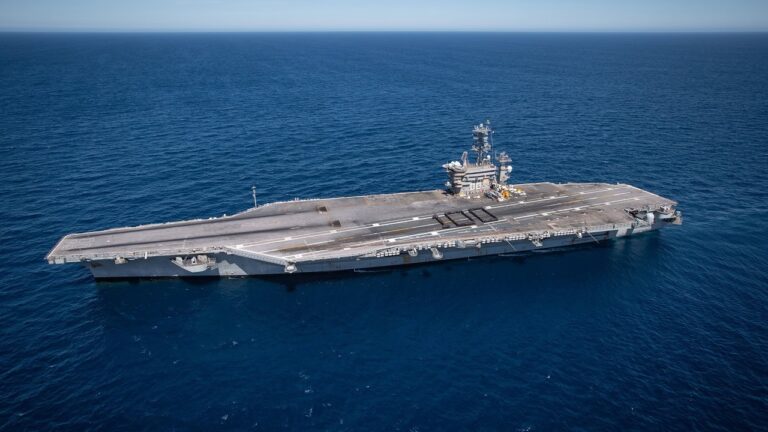
When most people picture a large ship, they think of something like a cruise liner or maybe a cargo freighter. Then you see an aircraft carrier for the first time, and every other ship you have ever seen suddenly feels small. These are not just big ships. They are floating cities that happen to have a runway on top.
But exactly how big is an aircraft carrier? And what makes something this enormous not only float but also operate as a fully functional military airbase in the middle of the ocean? The answers are genuinely staggering, and understanding them gives you a whole new level of appreciation for what these machines represent.
Let us get into it from the ground up.
What Is an Aircraft Carrier, Really?
At its most basic level, an aircraft carrier is a naval warship that functions as a sea-based airfield. Think of it as a floating runway that happens to be armed, armored, crewed by thousands of people, and capable of sailing anywhere in the world under its own power.
The flight deck on top is where the action happens. Aircraft take off and land from this deck, which is why the size of the carrier matters so much. You need serious deck space to operate fast-moving military jets safely, especially when that deck is moving with the ocean beneath it.
Carriers use catapult systems built flush into the flight deck to assist aircraft during launch. Without a catapult, a jet fighter would need a much longer runway to build up enough speed to lift off. On a carrier, the catapult essentially gives the aircraft a powerful initial push, allowing it to get airborne in a fraction of the distance a land-based runway would require.
Landing is handled differently. Aircraft approaching a carrier have retractable tail hooks, and those hooks are designed to catch one of several steel arresting wires stretched across the landing area of the deck. When the hook catches a wire, the aircraft goes from landing speed to a full stop in about two seconds. It is one of the most violent and technically demanding maneuvers in all of aviation, and carrier pilots do it routinely.
The carrier’s control center, called the island, sits on one side of the flight deck rather than in the middle, leaving the runway clear. Radio systems, radar equipment, and visual landing signals all work together to guide pilots onto the deck in conditions that range from clear skies to pitch darkness and heavy seas.
The Different Types of Aircraft Carriers and What They Do
Not every aircraft carrier is built for the same purpose, and the differences between carrier types go well beyond size. Understanding the categories helps explain why some carriers are enormous while others are relatively compact.
Fleet Carriers: The Big Offensive Platforms
Fleet carriers are designed to work alongside a main naval battle group and project offensive power far from home. These are the largest and fastest carriers, built to operate dozens of aircraft and support sustained combat operations over extended periods. When people picture a modern aircraft carrier, they are usually picturing a fleet carrier.
The U.S. Navy’s Nimitz-class and Gerald R. Ford-class carriers fall into this category. They are nuclear-powered, enormous in scale, and built to dominate any theater they enter.
Escort Carriers: Smaller, Slower, and Built for Protection
Escort carriers served a very different function, particularly during World War II. Their primary job was protecting ship convoys from attack, not launching offensive strikes. They were smaller and slower than fleet carriers, carried far fewer aircraft, and were often built on commercial or merchant ship hulls rather than dedicated military designs.
Speed and raw firepower were never the priority for escort carriers. Reliability and coverage were. They kept the sea lanes open during wartime by providing air cover where it was needed most.
Merchant Aircraft Carriers: A Wartime Improvisation
This category represents one of the more creative solutions to emerge from the pressures of wartime necessity. Merchant aircraft carriers were essentially bulk cargo ships with a flight deck built directly on top of them. They continued to carry commercial cargo while also operating a small number of aircraft for convoy defense. Practical, if not elegant.
Light Aircraft Carriers: The Middle Ground
Light carriers occupy the space between escort carriers and full fleet carriers. They were fast enough to keep pace with the main fleet, which made them more tactically flexible than escort carriers. But they carried fewer aircraft than fleet carriers and had less overall combat capability. They filled a useful role when full fleet carriers were in short supply or when a mission did not require the full weight of a fleet carrier deployment.
The Soviet Approach: Aircraft-Carrying Cruisers
Here is an interesting piece of naval history. The Soviet Union developed carriers that were officially classified not as aircraft carriers but as large aircraft-carrying cruisers. The most well-known of these is the Admiral Kuznetsov, which remains in Russian service today in various states of operational readiness.
This classification was not just a matter of naval doctrine. It was a legal workaround. The Montreux Convention, which governs transit through the Turkish Straits connecting the Black Sea to the Mediterranean, placed restrictions on aircraft carriers. By classifying its carriers as cruisers, the Soviet Union could move these ships between its Black Sea ports and the open ocean without running into the Convention’s limitations.
Beyond the paperwork, these ships were genuinely different in design philosophy. They were built to operate independently or with escorts, carried heavy offensive anti-ship missiles comparable to what you would find on a guided-missile cruiser, maintained strong defensive weaponry systems, and still supported a complement of jet fighters and helicopters. They were designed for a different kind of warfare than American carrier doctrine called for.
Key Features That Make Aircraft Carriers Unique Warships
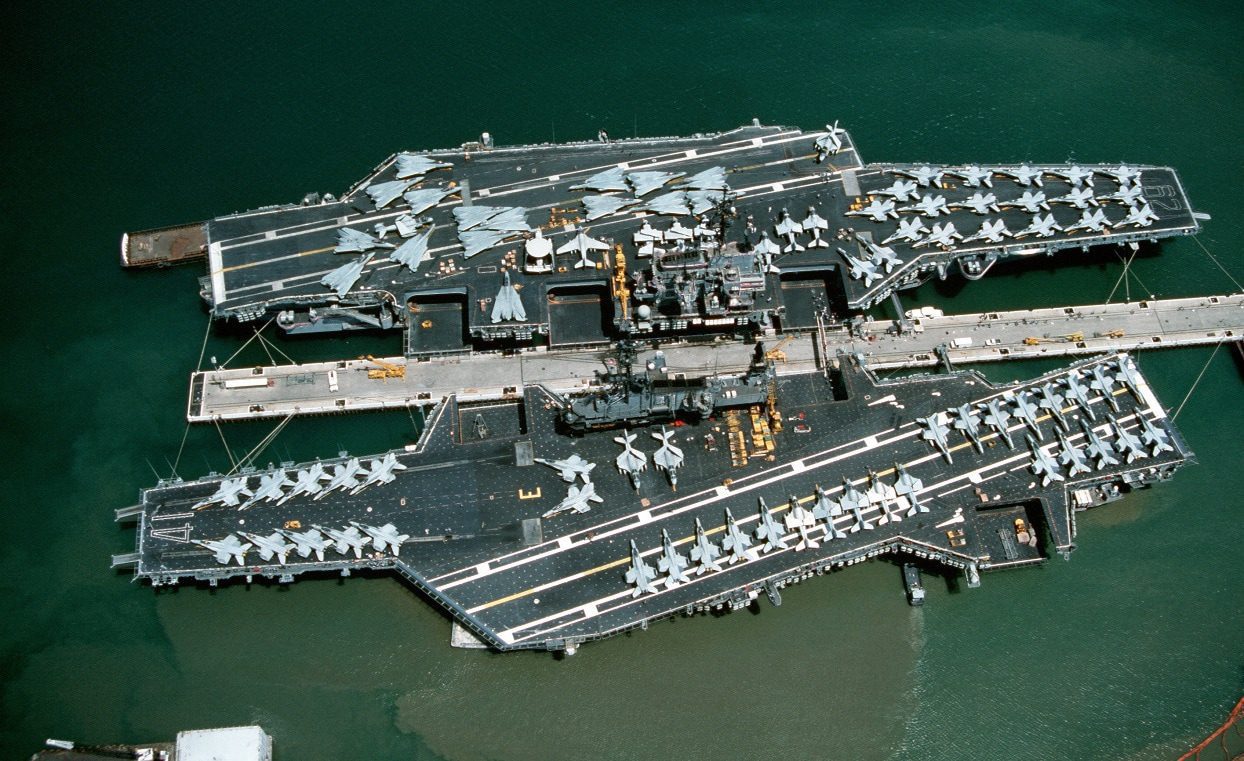
Aircraft carriers are not just big. They are specifically engineered to do things that no other warship can do. Here are the characteristics that set them apart from every other vessel on the water.
- Speed and global reach: Carriers need to move fast. The ability to rapidly reposition anywhere in the world is a core part of their strategic value. A carrier that can reach a crisis zone within days puts military airpower exactly where it is needed without requiring land-based airfields.
- Sheer physical size: The flight deck alone requires an enormous amount of space to function safely. Aircraft need room to maneuver, position for launch, and land without interfering with each other. That requirement drives the overall size of the ship upward in ways that have no equivalent in other naval vessels.
- Mission flexibility: A modern carrier air wing can conduct air superiority missions, strike ground or naval targets, provide close air support to troops, perform surveillance and reconnaissance, conduct search and rescue operations, and deliver electronic warfare capabilities, all from the same platform.
- Dual-wing capability: Carriers can operate both fixed-wing aircraft like jet fighters and rotary-wing aircraft like helicopters simultaneously. Managing both types of aircraft on the same deck requires careful choreography from the flight deck crew, who are among the most skilled and specialized personnel in any navy.
A Brief History of How Aircraft Carriers Became the Dominant Naval Weapon
The story of aircraft carriers is inseparable from the story of World War II. Before the war, battleships were considered the ultimate expression of naval power. Big guns, heavy armor, and massive displacement were how navies measured their strength. Aircraft carriers existed but were generally seen as supporting players.
December 7, 1941 changed that permanently.
When Japan launched its attack on Pearl Harbor using carrier-based aircraft, the results demonstrated something that no naval strategist could ignore. A fleet of carriers operating hundreds of miles away had just destroyed the core of the U.S. Pacific battleship fleet without a single Japanese surface ship coming within gun range of an American target. The age of the battleship as the preeminent naval weapon was over before most people fully understood what had happened.
The Pacific theater of World War II became essentially a sustained argument about aircraft carrier doctrine, fought out in engagements like the Battle of the Coral Sea, the Battle of Midway, and the Battle of Leyte Gulf. In all of these engagements, carriers and their air wings determined the outcome. Surface ships were important, but carriers were decisive.
The Technological Challenges That Came With Jet Aircraft
After the war ended, carriers got bigger, heavier, and more heavily armored. Their flight decks were reinforced. And then jet aircraft arrived, and everything that had worked for propeller-driven planes suddenly became a problem.
Jets were faster, heavier, and needed more runway to reach takeoff speed. They landed at higher speeds and needed more distance to stop. The carrier designs that had worked perfectly well for propeller aircraft were struggling to keep up with the demands of the jet age.
Three British innovations solved the core problems:
- The steam-powered catapult: Replacing earlier hydraulic catapults with steam-driven systems provided far more launch energy, enough to get heavy jet aircraft airborne in the short distances available on a carrier deck.
- The angled flight deck: By offsetting the landing area at an angle from the ship’s centerline, designers created a system where a landing aircraft that missed the arresting wires could simply apply full power and fly off the angled deck for another approach, without crashing into aircraft parked forward on the deck. This single innovation made jet carrier operations dramatically safer.
- The mirror landing system: A system of lights and mirrors that gave pilots a precise visual reference for the correct approach angle during landing. Pilots could now see in real time whether they were coming in too high, too low, or on the right glidepath, without relying solely on signals from a landing signal officer.
These three technologies, all developed in Britain and quickly adopted by the U.S. Navy, transformed what was possible on a carrier deck.
Nuclear Power Changes Everything
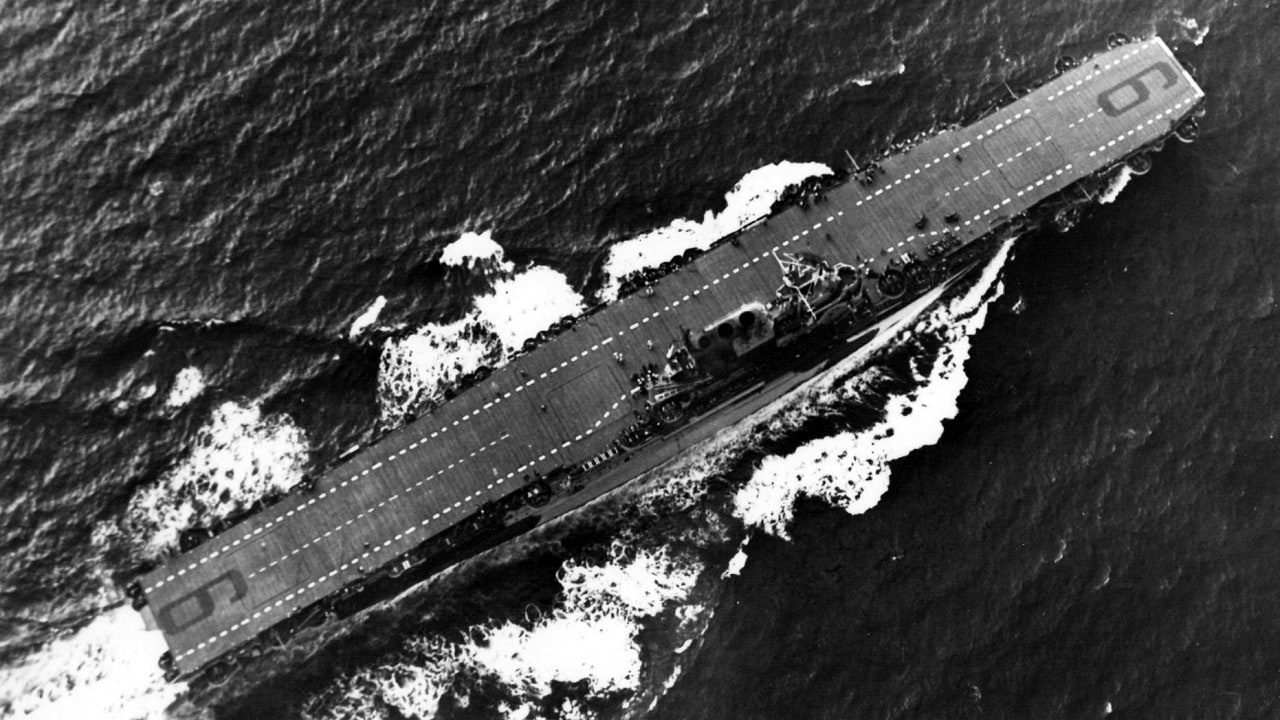
On September 24, 1960, the United States commissioned the USS Enterprise, the world’s first nuclear-powered aircraft carrier. This was a fundamental change in what a carrier could do.
Conventionally powered carriers needed to carry enormous quantities of fuel for their own propulsion. That fuel took up space, added weight, and meant that carriers needed regular replenishment at sea or in port. Nuclear power eliminated all of that.
Without fuel bunkers for propulsion, nuclear carriers freed up vast internal space. They no longer needed the smokestack systems and exhaust gas ducting that had been standard on all previous carriers. That recovered space could be used for additional aircraft, more aviation fuel, more ordnance, better crew accommodations, and more sophisticated systems of all kinds.
A nuclear-powered carrier can also operate at high speed for extended periods without worrying about fuel conservation. Conventional carriers have to balance their speed against their fuel reserves. Nuclear carriers essentially do not have that constraint in the same way.
Specialization Continues After the War
The postwar period also saw carriers evolve into specialized forms beyond the standard fleet carrier design. Some carriers were converted or purpose-built with heavy electronic equipment for anti-submarine warfare, allowing them to hunt submarines using a combination of sensors, helicopters, and fixed-wing patrol aircraft.
Helicopter carriers emerged as a distinct type, optimized for amphibious assault operations. Rather than fast jets, these ships carry large numbers of helicopters and landing craft that can deliver Marines and equipment directly onto a hostile shore.
Anti-aircraft gun systems that had been standard on wartime carriers were progressively replaced by guided missile systems that offered greater range and effectiveness against the faster aircraft and missiles of the postwar era.
Multipurpose carrier designs eventually emerged that could perform several of these roles from the same hull, giving naval commanders more flexibility without requiring multiple specialized ships for every deployment.
So How Big Is an Aircraft Carrier? Here Are the Real Numbers
Let us get to the specific dimensions, because the numbers themselves tell the story better than any description can.
The Nimitz Class: Ten Giants That Dominated the Late 20th Century
The Nimitz class represents the backbone of U.S. carrier power from the mid-1970s all the way into the present day. Ten nuclear-powered carriers make up this class, and all ten were constructed at the Newport News Shipbuilding Company in Virginia.
The class takes its name from Fleet Admiral Chester W. Nimitz, who commanded the U.S. Pacific Fleet during World War II and was the last serving officer to hold the rank of Fleet Admiral in the United States Navy.
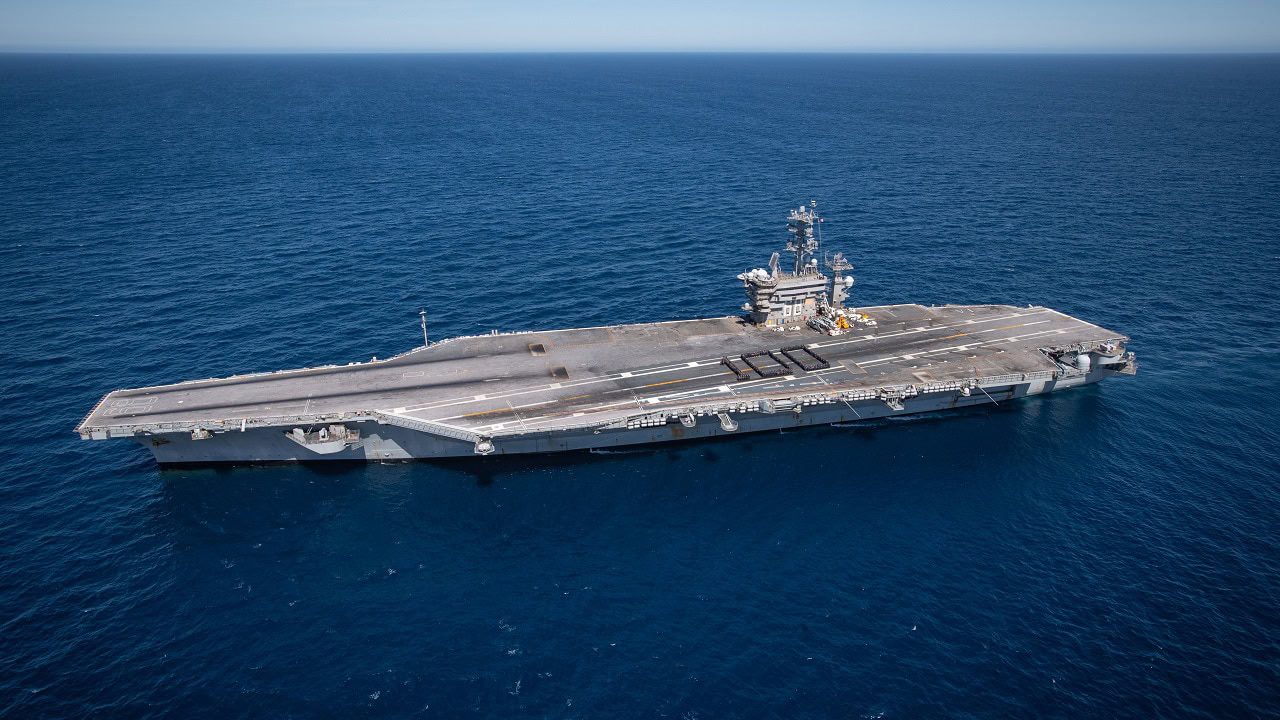
Here are the key dimensions that define just how large these ships are:
| Specification | Measurement |
|---|---|
| Overall length | 1,092 feet (333 meters) |
| Flight deck width | Approximately 252 feet (77 meters) |
| Full-load displacement | Nearly 100,000 long tons |
| Aircraft capacity | Up to 90 aircraft |
| Crew complement | Approximately 6,000 personnel including air wing |
| Propulsion | Two nuclear reactors, four shafts |
To put that 1,092-foot length in perspective, the Eiffel Tower stands 1,083 feet tall. A Nimitz-class carrier laid on its side would be longer than the Eiffel Tower is tall. If you parked four standard American city blocks end to end, you would come close to matching the length of one of these ships.
The lead ship of the class, USS Nimitz, was commissioned on May 3, 1975. The final ship in the class, USS George H.W. Bush, was commissioned on January 10, 2009. For more than three decades, Nimitz-class carriers were the largest warships ever built and placed in active service.
These ships have been deployed in virtually every major U.S. military operation since the mid-1970s. From the Persian Gulf to the Adriatic to the waters off the Korean Peninsula, Nimitz-class carriers have shown up wherever American military power needed to be projected at maximum scale.
The Gerald R. Ford Class: Even Bigger, Even More Advanced
In 2017, the USS Gerald R. Ford joined the U.S. Navy and officially became the largest warship ever constructed. The Ford class builds on the foundation of the Nimitz design but incorporates significant advances in propulsion, weapons handling, launch systems, and crew efficiency.
The Ford class ships are slightly larger than Nimitz-class carriers, with enhanced nuclear reactors that produce three times the electrical power of the Nimitz design. That extra power supports new systems like the Electromagnetic Aircraft Launch System, which replaces the old steam catapults with a more controllable electromagnetic version that is easier on both aircraft and pilots.
The Ford class also reduces the required crew size compared to Nimitz-class carriers through automation and redesigned operational systems, which has significant long-term cost implications for running these ships over their decades-long service lives.
Understanding Scale Through Real-World Comparisons
Numbers on paper only go so far. Here are some comparisons that make the scale of a modern fleet carrier genuinely register:
- The flight deck of a Nimitz-class carrier covers approximately 4.5 acres of usable surface area.
- The ship contains over 2,500 compartments spread across multiple decks below the flight deck level.
- A fully crewed carrier with its air wing aboard houses roughly as many people as a small town.
- The propellers on a Nimitz-class carrier are 21 feet in diameter. Each one weighs approximately 66,000 pounds.
- The anchor chain links on a carrier weigh approximately 360 pounds each. A single anchor assembly weighs about 60,000 pounds.
- The ship contains its own hospital, dental facilities, multiple dining facilities serving thousands of meals per day, a post office, a TV station, and a newspaper.
When sailors say that getting lost on a carrier during your first week is practically guaranteed, they are not exaggerating. These ships have dozens of miles of passageways running through them at multiple levels. New crew members genuinely need time to learn the internal geography of the ship before they can navigate it reliably.
What Life Actually Looks Like on an Aircraft Carrier
Understanding the size of a carrier also means understanding the human reality of operating one. These ships do not run themselves. Everything that happens on a carrier, from launching aircraft to feeding the crew to maintaining the nuclear reactors, requires people with highly specialized skills working in close coordination around the clock.
The flight deck alone is one of the most dangerous workplaces on earth. Aircraft are launching and landing at high speed. Jet engines are running at full power just feet away from people working the deck. Fuel lines run across the surface. Ordnance is being loaded and unloaded. All of this happens simultaneously, and the margin for error is essentially zero.
Flight deck personnel wear color-coded jerseys that identify their specific role in the operation. Yellow jerseys handle aircraft movement and launch. Green jerseys work on the catapults and arresting gear. Red jerseys handle ordnance and firefighting. Purple jerseys manage fuel. Blue jerseys move aircraft and operate elevators. White jerseys handle safety and medical. The color system exists because there is no time to read a name tag or ask what someone’s job is in the middle of flight operations.
Below the flight deck, the ship operates in shifts around the clock regardless of what is happening above. Engineering spaces, combat information centers, maintenance shops, and hundreds of other specialized spaces keep functioning whether or not flight operations are running. A carrier at sea is never fully at rest.
How Does Something This Big Actually Move?
Nuclear propulsion is the answer, at least for American carriers, and it is worth understanding what that actually means in practical terms.
A Nimitz-class carrier is powered by two nuclear reactors that drive four propeller shafts. The nuclear reactors generate heat, which produces steam, which drives turbines, which turn the propellers. The nuclear fuel itself lasts for approximately 20 years before the reactors need to be refueled, which is a process that happens during a major overhaul period called a Refueling and Complex Overhaul.
The practical result of nuclear propulsion is that these carriers can sustain high speeds for extended periods without stopping to take on fuel for propulsion. Top speed for Nimitz-class carriers is listed as officially over 30 knots, which works out to roughly 34 miles per hour. That sounds relatively modest until you remember that this is a ship displacing nearly 100,000 tons moving through the water at that speed.
The aviation fuel for the aircraft, food for the crew, and ordnance for the weapons systems all still need to be replenished regularly at sea through a process called Underway Replenishment, where supply ships come alongside the moving carrier and transfer supplies while both ships maintain speed. But the carrier itself never needs to slow down and refuel its own propulsion system during a deployment.
Aircraft Carriers From Other Nations: How Do They Compare?
The United States operates the largest and most capable carrier fleet in the world by a considerable margin, but other nations operate carriers that are significant in their own right. Understanding how they compare in size and capability puts the American approach in context.
| Country | Carrier | Length | Displacement | Propulsion |
|---|---|---|---|---|
| United States | USS Gerald R. Ford | 1,106 ft (337 m) | ~100,000 tons | Nuclear |
| United States | Nimitz class (10 ships) | 1,092 ft (333 m) | ~97,000 tons | Nuclear |
| China | Fujian | ~1,050 ft (320 m) | ~80,000 tons | Conventional |
| Russia | Admiral Kuznetsov | 999 ft (305 m) | ~58,500 tons | Conventional |
| United Kingdom | HMS Queen Elizabeth | 920 ft (280 m) | ~65,000 tons | Conventional |
| France | Charles de Gaulle | 858 ft (261 m) | ~42,000 tons | Nuclear |
| India | INS Vikrant | 860 ft (262 m) | ~45,000 tons | Conventional |
France is the only country other than the United States that operates nuclear-powered carriers. Every other nation with carrier capability uses conventional propulsion, which requires more frequent refueling stops and limits sustained high-speed operations.
China has been aggressively expanding its carrier program in recent years. The Fujian, launched in 2022, is China’s first carrier equipped with electromagnetic catapult launch systems, bringing it closer to parity with American carrier technology than any previous Chinese carrier design.
Why Aircraft Carriers Matter Today More Than Ever
Some military analysts periodically question whether aircraft carriers have become too large, too expensive, and too vulnerable to be worth building in the modern era. Precision anti-ship missiles with extended range, quiet submarines, and drone swarms have all been cited as potential threats to the carrier’s future relevance.
Those are legitimate questions that naval strategists take seriously. But the carrier’s ability to put airpower anywhere in the world within days, without needing permission from any nation for basing rights, remains a capability that nothing else in a military inventory can replicate. Land-based airpower requires agreements with host nations, fixed installations that can be targeted, and supply chains that extend across national borders. A carrier group brings everything it needs with it.
For that reason, aircraft carriers continue to be the centerpiece of American and increasingly Chinese naval strategy. The specific technologies on board will continue to evolve. The aircraft will change. The launch systems will be updated. But the fundamental idea of a mobile, self-sufficient floating airbase projecting power across thousands of miles of ocean has proven its value repeatedly over eight decades of modern naval warfare.
If you want to understand why nations with serious global ambitions invest so heavily in carrier programs, look at the map. Two thirds of the Earth’s surface is ocean. The carrier is the only warship ever built that can dominate that much geography simultaneously.