

Picture this. Your headlights start flickering at idle, your radio cuts out randomly, and your gauge cluster occasionally acts like it has a mind of its own. You check the battery, you check the alternator, everything tests fine on paper, yet the gremlins keep showing up. Nine times out of ten in situations like this, the real culprit is hiding in plain sight: a bad ground strap.
Ground straps do not get much attention because they do not do anything flashy. There is no dial to watch, no light to glow, no sound to listen for. They just sit there quietly, completing electrical circuits by connecting your engine, transmission, and body panels back to the vehicle’s frame. When one of them corrodes, loosens, or snaps, the electrical system does not fail all at once. It fails in weird, inconsistent, maddening little ways that send a lot of Ram owners chasing the wrong problem for weeks.
This guide walks through where these straps actually live on your Dodge Ram, how to tell when one has gone bad, and what it takes to replace them properly. Grab a flashlight, because you are about to become a lot more familiar with the underside of your truck.
Why Ground Straps Matter More Than Most Ram Owners Realize
Every electrical component in your truck needs two things to work: power going in, and a clean path for that power to return to its source. That return path is the ground. Without a solid ground connection, electricity takes the path of least resistance, which sometimes means it flows somewhere it should not, or it simply does not flow well enough to power whatever it is supposed to power.
Ground straps are the physical wires and cables that make this return path possible. They connect the engine block, the transmission, and various body panels back to the truck’s frame or chassis. Think of them as the return leg of a relay race. If that leg is weak, slow, or missing entirely, the whole race falls apart, even if every other runner performed perfectly.
In the real world, this shows up as symptoms that seem completely unrelated to each other. Dim headlights, a radio that cuts in and out, a check engine light that comes and goes, a starter that cranks slowly on some days and fine on others. All of these can trace back to a single corroded ground strap tucked away somewhere you would never think to look.
Where to Find Ground Straps on Your Dodge Ram
Ground strap locations vary a bit depending on your engine size and model year, but the general layout stays fairly consistent across most Dodge Ram trucks. Let’s go section by section.
Under the Hood: The Engine Compartment
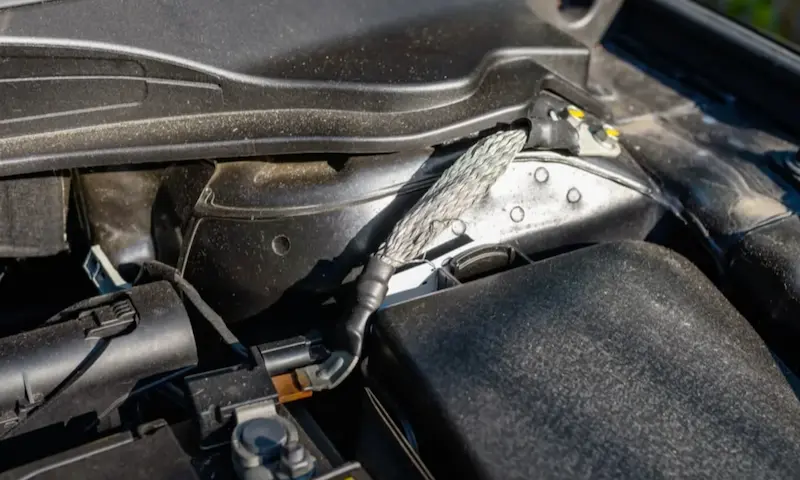
The engine compartment holds some of the most important ground connections in your entire truck, mainly because the engine itself generates so much electrical activity through the alternator, starter, and ignition system.
- Engine block ground strap: Usually attached to the back of the cylinder head, most commonly on the driver’s side. This strap connects the engine directly to the chassis.
- Battery-to-chassis ground: Look near the battery itself. This shorter, thicker cable connects the negative battery terminal to the frame or body.
- Alternator area straps: Additional grounding points often sit near the alternator, helping complete the charging circuit.
If you have ever popped the hood and wondered what that thick black cable running from the battery down to a bolt on the frame actually does, now you know. That is one of your most critical grounds, and it takes a beating from heat, vibration, and road grime every single day.
Underneath: Transmission and Chassis Grounds
Crawl underneath your Ram, or get it up on a lift if you have access to one, and you will find another set of ground straps working quietly between the drivetrain and the frame.
On trucks equipped with the 4.7 liter engine, ground strap placement can shift slightly depending on the exact model year, but you will typically find connections running from the engine block down to the chassis, along with a dedicated ground near the starter motor. That starter ground matters quite a bit, since a weak connection here often shows up as slow cranking or, in worse cases, a truck that simply will not start despite a perfectly healthy battery.
| Location | Connects | Common Symptom If Failed |
|---|---|---|
| Engine block to chassis | Engine and frame | Flickering lights, rough idle, stalling |
| Starter ground | Starter motor and chassis | Slow cranking, no-start condition |
| Transmission to chassis | Transmission housing and frame | Erratic shifting, dash warning lights |
Inside the Cab: Firewall and Steering Column Grounds
Not every ground strap lives under the hood or beneath the truck. Several important ones run through the firewall and into the cab, where they support electronics like your radio, gauge cluster, and fuel sending unit.
One key strap typically attaches to the firewall on the passenger side. Another commonly sits near the steering column or close to the valve cover, depending on your specific engine layout. These cab-area grounds are often overlooked because they are less visible than the ones under the hood, yet they are directly responsible for a lot of the “electrical gremlin” symptoms drivers complain about, things like a radio that mutes itself randomly or a fuel gauge that jumps around for no clear reason.
Even so, the exact location can shift slightly from year to year and engine to engine. If you cannot locate a specific strap by sight, your owner’s manual or a service manual specific to your Ram’s model year will save you a lot of guesswork.
How to Tell If a Ground Strap Has Actually Gone Bad
Here’s the thing about ground strap failure: it rarely announces itself clearly. You will not see a warning light that says “bad ground detected.” Instead, you get a collection of odd little symptoms that seem to have no obvious connection to each other. That is actually one of the best clues that a ground issue is at play.
Start With a Simple Visual Inspection
Grab a flashlight and get familiar with the straps you just located in the sections above. You are looking for a few specific red flags.
- Corrosion: A greenish or white crusty buildup on the metal connection points, especially common in areas exposed to road salt and moisture.
- Fraying or cracking: Physical damage to the strap itself, often caused by years of heat cycling and vibration.
- Loose connections: Bolts that have backed out slightly over time, reducing the contact pressure needed for a clean electrical path.
A loose or corroded ground connection does not always cause a total failure right away. More often, it creates intermittent problems, meaning everything works fine most of the time until vibration, temperature, or moisture pushes the connection just past its tipping point. That intermittent behavior is exactly why so many drivers spend weeks chasing the wrong repair before finally discovering a ground strap issue.
Confirm the Problem With a Multimeter
Visual inspection catches a lot of issues, but not all of them. Some ground straps look perfectly fine on the outside while corrosion eats away at the connection underneath. This is where a multimeter earns its keep.
- Set your multimeter to measure resistance, usually the ohms setting.
- Touch one lead to the ground strap itself.
- Touch the other lead to a clean, unpainted section of the engine block or chassis.
- Check the reading. A healthy ground should measure close to zero ohms.
If you see a noticeably higher resistance reading, that strap is not doing its job properly, even if it looks perfectly intact to the naked eye. High resistance in a ground path translates directly into weaker electrical performance for whatever components rely on that connection, which explains symptoms like dim or flickering headlights that seem to have no obvious cause.
Replacing a Worn or Corroded Ground Strap
Once you have confirmed a ground strap is the actual problem, replacing it is a fairly approachable job for most home mechanics. You do not need specialized tools, just some patience and attention to detail.
What You Will Need Before Starting
- Wrench set: For removing and reinstalling the mounting bolts.
- Replacement ground strap: Matched to your specific Ram model and engine.
- Wire brush: For cleaning corrosion off the connection points.
- Dielectric grease: Applied after installation to help resist future corrosion.
The Replacement Process, Step by Step
- Find the strap: Use the location guidance above to identify exactly which ground strap needs attention.
- Remove the old strap: Loosen and remove the mounting bolts with your wrench, then set the old strap aside.
- Clean the contact points: Use the wire brush to scrub away corrosion or grime from both the mounting surface and the bolt threads. A clean metal-to-metal contact is what makes a ground connection actually work.
- Position the new strap: Line it up correctly and hand-tighten the bolts to hold it in place.
- Apply dielectric grease: A thin layer helps seal out moisture and slows future corrosion without interfering with the electrical connection.
- Torque the bolts properly: Tighten with a wrench, but avoid overtightening, which can strip threads or crack the strap’s mounting eyelet.
If any of this feels outside your comfort zone, there is no shame in handing it off to a professional. Ground straps are simple in theory, but getting the connection points genuinely clean and properly torqued makes a real difference in how long the repair actually lasts.
Getting the Technical Details Right
Ground strap replacement is not just about bolting on any cable you find at the parts store. Wire gauge, length, and torque specifications all play a role in whether the new connection performs as well as it should.
Choosing the Correct Gauge and Length
Ground straps on a Dodge Ram typically range from 4 AWG up to 0 AWG, with the exact gauge depending on your model and its electrical demands. Thicker gauge wire, remember, means a lower number, so 0 AWG is actually heavier duty than 4 AWG.
| Connection Point | Typical Length |
|---|---|
| Engine to chassis | 12 to 18 inches |
| Battery to chassis or engine | 18 to 36 inches |
| Transmission to chassis | 12 to 24 inches |
Getting the length right matters more than people expect. A strap that is too short can stretch under normal engine movement and eventually snap. One that is too long tends to sag, rub against nearby components, and wear through its insulation over time.
Torque Specifications Worth Knowing
If your Ram runs the 4.7 liter engine, torque specifications for related bolts follow a specific multi-step process. This typically starts with an initial torque value, followed by a final torque value, and sometimes an additional angle-turn on top of that.
- Initial torque: Around 20 ft-lbs (27 Nm)
- Final torque: Around 70 ft-lbs (95 Nm)
- Angle-turn: An additional 90 degrees beyond final torque
These numbers can shift slightly depending on your exact model year, so always cross-check with your service manual before tightening anything down. Under-torquing a ground connection leaves it loose and prone to resistance buildup. Over-torquing can crack mounting points or strip bolt threads entirely, which creates a whole new problem you did not have before.
Common Symptoms Traced Back to Ground Strap Problems
It helps to see the full range of issues a bad ground can cause, because the connection between “loose bolt on a strap” and “my radio keeps cutting out” is not exactly intuitive at first glance.
- Flickering or dimming headlights, especially noticeable at idle or when other electrical accessories are running.
- Intermittent stereo or infotainment glitches, including random muting, screen freezes, or volume fluctuations.
- Slow or inconsistent engine cranking, often mistaken for a weak battery or failing starter.
- Erratic gauge cluster readings, such as a fuel gauge that jumps around or a temperature gauge that reads inconsistently.
- Random check engine lights that come and go without a clear pattern, sometimes clearing themselves after a drive.
In the real world, a lot of these symptoms get misdiagnosed. Someone replaces their battery, then their alternator, then eventually their entire radio, all chasing a problem that a fifteen dollar ground strap and twenty minutes with a wire brush would have solved from the start. That is not to say every electrical issue traces back to grounding, but it absolutely deserves a spot near the top of your troubleshooting checklist.
Preventive Habits That Keep Ground Straps Healthy Longer
Ground straps are not something you need to obsess over daily, but a little proactive attention during routine maintenance goes a long way toward avoiding surprise electrical gremlins down the road.
- Inspect during oil changes: Since you are already under the hood, take thirty seconds to glance at the visible ground straps for corrosion or looseness.
- Clean connection points periodically: A light scrub with a wire brush once or twice a year prevents corrosion from building up to problematic levels.
- Reapply dielectric grease: If you notice the grease has worn away or dried out, a fresh application helps maintain protection against moisture.
- Address rust early: If you drive in a region with heavy road salt use during winter, ground straps near the frame deserve extra attention, since salt accelerates corrosion significantly.
Even so, ground straps are not something that need constant fussing. A quick visual check a couple of times a year, paired with attention whenever you notice odd electrical behavior, is usually enough to catch problems before they snowball into something more frustrating.
When to Call In a Professional
Most ground strap diagnosis and replacement work falls solidly within reach of a confident DIYer. That said, there are situations where handing the job to a professional makes more sense.
- If you have replaced a strap and the electrical symptoms persist, since this suggests a deeper wiring issue beyond a simple ground connection.
- If corrosion has spread into the wiring harness itself rather than just the connection point.
- If you are not comfortable working with a multimeter or interpreting resistance readings accurately.
- If the affected ground strap sits in a hard-to-reach location requiring lift access or specialized tools.
A skilled technician can also run more advanced diagnostics if the ground issue turns out to be part of a larger wiring harness problem, something a basic multimeter check at home might not fully reveal.
Frequently Asked Questions
Can a bad ground strap actually prevent my truck from starting?
Yes. A corroded or loose ground strap near the starter motor can reduce the current available for cranking, leading to slow starts or, in more severe cases, no start at all despite a healthy battery.
How often should I inspect my ground straps?
A quick visual check once or twice a year, ideally during routine maintenance like oil changes, is generally sufficient unless you are already experiencing electrical symptoms.
Are aftermarket ground straps as reliable as factory ones?
Quality aftermarket straps can work just as well, provided they match the correct gauge and length for your specific application. Stick with reputable brands rather than the cheapest option available.
Can I use any dielectric grease, or does it need to be a specific type?
Standard automotive dielectric grease from any auto parts store works fine for ground strap connections. There is no need for anything specialized here.
Ground straps rarely get the credit they deserve, right up until one fails and your truck starts acting possessed. Now that you know where to look, what to check, and how to fix it, that flickering dash light or mysterious radio glitch does not have to stay a mystery. Grab that flashlight, check your connections, and give your Ram’s electrical system the clean, solid ground it has been quietly asking for.