
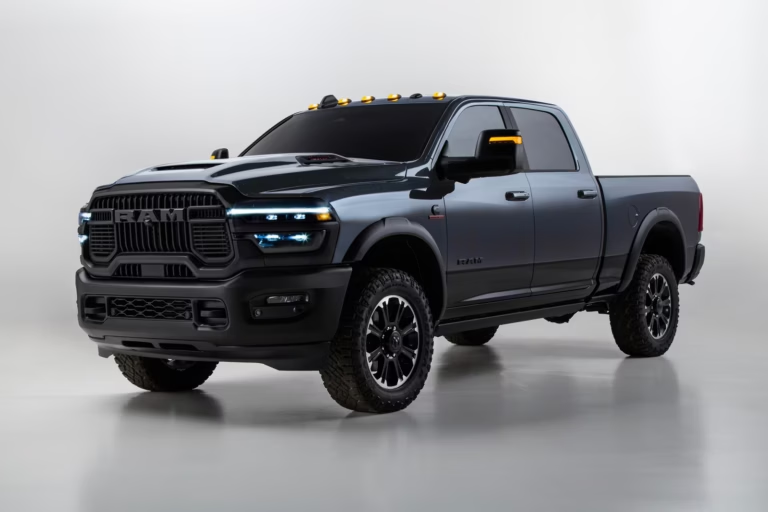
The check engine light comes on, you scan for codes, and the scanner returns P1D73. If you have not heard of this one before, you are not alone. It is not one of the more common fault codes that gets talked about regularly, but on newer Dodge Ram trucks, it shows up often enough that it is worth understanding properly.
The P1D73 code relates to the Active Grill Shutter (AGS) system, and while it might not sound as serious as a transmission or engine code, ignoring it affects your truck’s aerodynamics, fuel economy, and engine cooling. It also leaves you with a check engine light that is not going away on its own.
This guide breaks down what the P1D73 code means in plain terms, what causes it, and how to diagnose and fix it step by step.
What Is the Active Grill Shutter System and Why Does It Matter?
Before getting into the code specifics, it helps to understand what the Active Grill Shutter system actually does, because it is a relatively recent technology that many truck owners are not familiar with.
The AGS system consists of a set of louvers or shutters positioned behind the front grille of the truck, in front of the radiator. These shutters are controlled by an electric actuator motor that opens and closes them based on commands from the Powertrain Control Module (PCM).
Here is the logic behind it. When the engine is cold and does not need maximum airflow for cooling, the shutters close. This reduces aerodynamic drag significantly at highway speeds, which improves fuel economy. It also helps the engine reach operating temperature faster, which reduces cold-start emissions and wear. When the engine needs cooling, or when the truck is working hard and heat is building up, the PCM opens the shutters to allow full airflow through the radiator.
The system sounds simple in concept, but it involves an electric actuator, position feedback, a physical linkage to the shutter blades, wiring, and PCM monitoring. Any fault in that chain can trigger the P1D73 code.
What Does the P1D73 Code Specifically Mean?
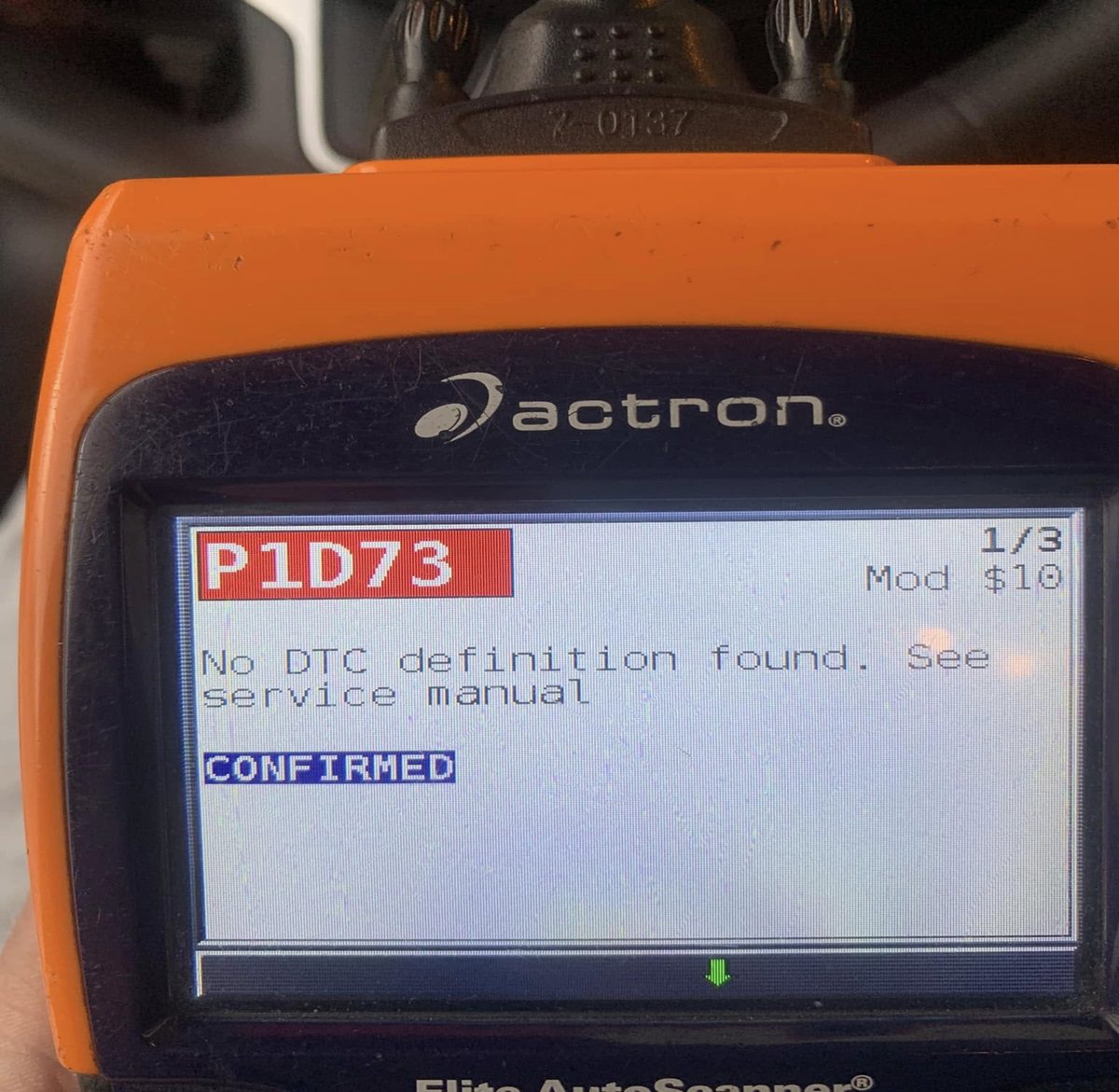
The P1D73 code is defined as “Active Grill Shutter Performance.” More specifically, it is triggered when the PCM detects one of two conditions:
- The AGS actuator’s travel from the open position to the closed position (or vice versa) exceeded 100 degrees of rotation. This means the actuator is moving through a range that is outside of what the system expects, suggesting the mechanism is not calibrated correctly or has lost its physical stop.
- The actuator reached a mechanical stop before it reached the position the PCM commanded. In other words, something is physically blocking the shutters from moving to where the PCM told them to go.
Either condition tells the PCM that the shutters are not behaving as they should. Since the PCM cannot trust the shutter position, it stores the P1D73 code, triggers the check engine light, and may default the shutters to an open or safe position to prevent overheating.
Symptoms of the P1D73 Code on a Dodge Ram
Some of these are obvious and some are subtle, but they all trace back to the AGS system not functioning correctly.
Check Engine Light
The check engine light is the most consistent symptom. When the PCM stores the P1D73 code, the Malfunction Indicator Lamp (MIL) illuminates and stays on until the fault is resolved and the code is cleared. It will not clear on its own even if the shutters begin working again temporarily.
Reduced Fuel Economy
If the shutters are stuck open when they should be closing at highway speeds, you lose the aerodynamic benefit the AGS system is designed to provide. The drag increase at 65 to 75 mph may not be dramatic, but over time you will notice a measurable drop in fuel economy compared to what the truck delivered before the fault appeared. Some owners notice this as the first symptom before the check engine light even comes on.
Slower Engine Warm-Up in Cold Weather
If the shutters are stuck open rather than closing during cold starts, the engine takes longer to reach operating temperature. You might notice the temperature gauge staying low for longer than usual in cold weather. This is not just a comfort issue for cabin heat. An engine running below its optimal temperature for extended periods experiences more wear and produces more emissions.
Potential Overheating Risk (If Shutters Are Stuck Closed)
This is the most serious symptom scenario. If the shutters fail in the closed position and the PCM cannot override them, airflow to the radiator is severely restricted. Under normal driving conditions this might not cause immediate problems, but under load, towing, or in slow-moving traffic on a warm day, the engine cooling system would be working with dramatically reduced airflow. Watch the temperature gauge carefully if you suspect the shutters may be stuck closed.
Most AGS system failures default the shutters to the open position as a safe mode, but this is not guaranteed in all failure scenarios.
What Causes the Dodge Ram P1D73 Code
1. Faulty AGS Actuator Motor
The actuator is the electric motor assembly that physically opens and closes the shutter blades. If the motor itself has failed, is binding internally, or the internal position feedback mechanism has failed, the PCM will detect that the actuator is not reaching commanded positions or is traveling out of its expected range. This is the most common hardware cause of the P1D73 code.
The actuator motor on Dodge Ram AGS systems is a relatively compact unit that contains both the motor and a position sensor. When the motor fails, both the movement and the position reporting go down together since they are a single assembly. Replacement requires sourcing a new actuator specific to your Ram’s model year and trim configuration.
2. Physical Obstruction of the Shutter Blades
The shutters are located behind the grille and in front of the radiator. In that position, they are directly in the path of road debris, insects, ice, and anything else that gets into the grille opening. A large enough piece of debris lodged between the shutter blades, or ice buildup in winter conditions, can physically prevent the blades from moving to the commanded position. The actuator motor tries to move the blades, hits the obstruction, and the PCM detects that the mechanical stop was reached before the commanded position.
This is actually a common cause of temporary P1D73 codes, particularly in winter. Ice can build up in the shutter mechanism during cold weather driving, cause the fault code, and then thaw out. The code remains stored even after the ice melts.
3. Wiring Harness Damage or Open Circuit
The AGS actuator is connected to the vehicle’s wiring system through a harness that runs from the actuator through the front end of the truck. This harness is exposed to road conditions, temperature extremes, and potential damage from debris impacts. If the harness develops an open circuit, a short to ground, or a short to power, the PCM cannot communicate properly with the actuator and will store the P1D73 code.
The connector at the actuator is also a common point of failure. Corrosion inside the connector pins, especially in regions where road salt is used heavily in winter, can increase circuit resistance to the point where the actuator does not receive adequate power or return adequate position signals.
4. Damaged Shutter Linkage or Broken Shutter Blade
The actuator motor connects to the individual shutter blades through a physical linkage mechanism. If a link in that mechanism breaks, bends from a debris impact, or disconnects, the motor may move freely past its expected range without actually moving the shutter blades, which would cause the travel to exceed 100 degrees. Alternatively, a broken blade that is caught in an unusual position can create a mechanical stop that the actuator reaches before completing its commanded travel.
5. PCM Software Issue or False Fault
In some cases, particularly on trucks that have not had a PCM software update applied, the AGS system calibration parameters may be incorrect, causing the PCM to flag a fault based on thresholds that do not accurately reflect normal system behavior. Dodge has released software updates for some Ram configurations that addressed false AGS fault code generation. If the actuator, wiring, and physical shutters all check out correctly, a PCM calibration issue is worth investigating at the dealership.
How to Diagnose the P1D73 Code on Your Dodge Ram
Step 1: Visually Inspect the Shutter System
Start with the simplest and most accessible check. With the engine off and the truck parked safely, look through the front grille to see the shutter blades. On most Ram trucks, they are visible without removing any panels. Here is what to look for:
- Are the shutter blades in an open or closed position? If you can see them clearly, they are likely open. Fully closed blades will block most of your view through the grille to the radiator.
- Are any of the blades visibly damaged, bent, or broken?
- Is there any debris lodged between the blades, such as leaves, plastic film from road debris, or insect accumulation?
- In winter conditions, check for ice buildup in the shutter mechanism.
If you see obvious debris or ice, remove it carefully and see if the shutters can move freely by hand (with the ignition off). If the blades move through their full range without resistance, clear the code, drive the truck, and see if the code returns.
Step 2: Check the Actuator Connector and Wiring
Locate the AGS actuator. On most Dodge Ram trucks, it is mounted to the shutter frame assembly behind the grille, accessible by removing the upper grille trim or working through the grille opening depending on the specific model year. The actuator will have a small electrical connector attached to it.
- Disconnect the connector and inspect both sides. Look for green or white corrosion on the pins, bent pins that are not making full contact, and any signs of melted plastic from an electrical fault.
- Inspect the wiring from the connector back toward the main harness. Look for any sections where the insulation has been abraded, cut by a sharp edge, or melted from heat.
- Clean any corrosion with electrical contact cleaner and a small brush. Apply dielectric grease before reconnecting to slow future corrosion.
- Reconnect the connector firmly, clear the code, and test.
Step 3: Test the Actuator Operation
With a scan tool that can access the PCM’s bidirectional controls, you can command the AGS actuator to open and close positions. This is sometimes called an active test or component test depending on the scan tool’s interface. While commanding the actuator to open and close, listen and watch for the following:
- Does the actuator produce a smooth motor sound as it moves?
- Do the shutter blades actually move in response to the command?
- Does the actuator reach the fully open and fully closed positions without apparent strain?
- Does the PCM report the correct position feedback from the actuator?
An actuator that produces no sound at all when commanded may have an electrical failure. One that sounds like it is straining or grinding may have a mechanical failure internally. One that moves freely but the blades do not follow has a linkage disconnection between the motor and the blades.
Step 4: Inspect the Linkage and Shutter Frame
If the actuator is electrically functional but the blades are not moving correctly, access the shutter frame assembly and inspect the physical linkage that connects the actuator to the shutter blades. Look for:
- Any plastic linkage arms that have cracked or broken at their pivot points
- Disconnected linkage connections where the arm has popped off its ball or pin mount
- Individual shutter blades that are cracked, warped, or have separated from their pivot points on the frame
- Any foreign object caught in the blade mechanism that was not visible from the front
How to Fix the Dodge Ram P1D73 Code
Fix 1: Remove Physical Obstructions
If the diagnosis found debris or ice causing the blades to reach a mechanical stop before the commanded position, remove the obstruction and verify the blades move through their full range freely. Clear the fault code with a scan tool. Drive the truck and monitor for code return. This is a zero-cost fix when it is the cause.
Fix 2: Clean and Repair the Electrical Connector and Wiring
If corrosion or a wiring fault was identified, clean the connector thoroughly with electrical contact cleaner, apply dielectric grease, and ensure the connector is fully seated and locked. For any damaged wiring, perform proper automotive-grade repairs using solder and heat-shrink tubing rather than tape splices. Clear the code and retest.
Fix 3: Replace the AGS Actuator Motor
If the actuator is confirmed to have failed electrically or mechanically, it needs to be replaced. Here is the general replacement process:
- Disconnect the negative battery terminal before beginning any electrical work.
- Remove the upper grille or grille trim as necessary to access the AGS assembly. On some Ram models this requires removing a few clips or bolts. Consult your service manual for the specific access procedure for your year.
- Disconnect the actuator’s electrical connector.
- Remove the fasteners securing the actuator to the shutter frame. There are typically two or three small bolts or screws.
- Disengage the actuator’s output shaft from the shutter linkage. The connection method varies by configuration but is usually a simple slip-fit or snap-fit connection.
- Install the new actuator, ensuring the output shaft engages correctly with the linkage.
- Secure the actuator with the mounting fasteners, reconnect the electrical connector, and reinstall any grille trim removed for access.
- Reconnect the battery, clear the fault code with a scan tool, and perform an actuator functional test using the scan tool’s active test function to confirm the new unit is operating correctly.
Make sure the replacement actuator is the correct part for your specific Ram model year and engine configuration. AGS actuators are not universal across all Ram configurations.
Fix 4: Repair or Replace Damaged Shutter Linkage or Blades
If the actuator is functional but a linkage arm has broken or a shutter blade is cracked, the shutter frame assembly may need to be replaced as a unit, since the individual internal components are not always sold separately. On some Ram configurations, replacement shutter assemblies are available as complete units that include the frame, blades, and linkage but not the actuator. The actuator from the old assembly can often be transferred to the new frame.
Fix 5: PCM Software Update
If the hardware checks out completely and the code keeps returning, take the truck to the Dodge dealership and ask specifically whether there is a PCM calibration update available for the AGS system on your truck. The service advisor can check by VIN. If an applicable update exists, it can be applied during the same visit and may resolve the false fault generation without any additional parts.

What Does It Cost to Fix P1D73 on a Dodge Ram?
| Repair | Estimated Cost |
|---|---|
| Debris or ice removal | Free (DIY) |
| Connector cleaning and wiring repair | $20 to $150 |
| AGS actuator replacement (part only) | $50 to $200 |
| AGS actuator replacement (shop labor included) | $150 to $400 |
| AGS shutter assembly replacement | $200 to $600 |
| PCM software update (dealership) | $100 to $200 |
The P1D73 code is generally on the less expensive end of fault code repairs. Even the most involved repair, replacing the full shutter assembly, is a moderate cost job compared to transmission or engine repairs. The key, as always, is confirming what has actually failed before purchasing parts.
Should You Drive With a P1D73 Code Active?
In most cases, yes, you can continue driving with a P1D73 code, with one important caveat. Verify that the shutter blades are defaulting to the open position. If they are open, full airflow to the radiator is maintained and there is no overheating risk. You will lose some fuel economy, but the truck is safe to drive.
If you have any indication the shutters might be stuck closed, such as the engine temperature running higher than normal, reduce your driving to short local trips and have it addressed promptly. Restricted airflow under load conditions, towing, or in warm weather can lead to overheating, which is a far more serious and expensive problem than a faulty shutter actuator.
For most Ram owners, the P1D73 code is a manageable issue that can be traced to something straightforward: debris in the shutter mechanism, a corroded connector, or a failed actuator motor. Work through the visual inspection first, check the connector, and you will likely find the answer without needing special tools or a dealer visit. If the actuator itself has failed, it is an accessible, reasonably priced fix that you can handle in a few hours with basic mechanical confidence.