
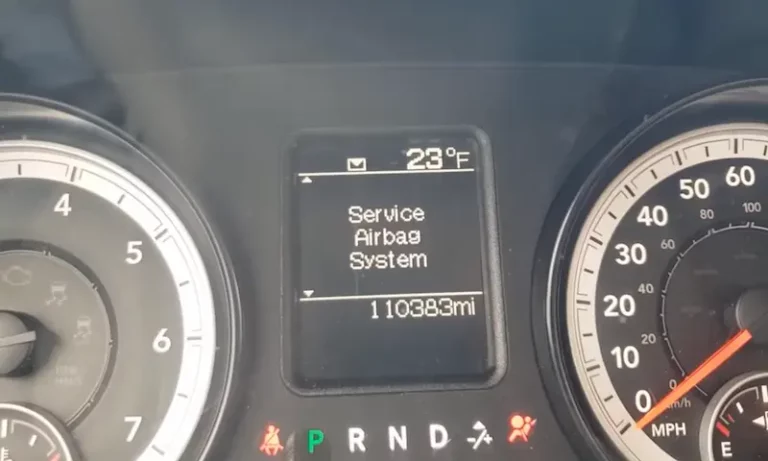
When your Ram 1500 flashes a “Service Airbag System” warning on the dash, that is not a message you scroll past and forget about. Your airbag system is one of the few components on your truck whose entire job is to keep you alive in a crash. When it flags a problem, it means something in that chain of components is not working the way it should, and in a real collision, a compromised airbag system can mean the difference between walking away and being carried away.
This guide is going to walk you through exactly what this warning means, what causes it, and what needs to happen to fix it. No sugarcoating, just the information you need to understand the situation and handle it correctly.
What Does “Service Airbag System” Actually Mean on a Ram 1500?
The Service Airbag System message means the airbag system’s electronic control unit (ECU) has detected a fault somewhere within the airbag system. When that fault is detected, the system logs a diagnostic trouble code and lights up the warning to get your attention.
Here is why that matters beyond just a warning light. The airbag ECU is the brain of the entire system. It continuously monitors sensor data, manages communication between all airbag system components, and controls the split-second timing of airbag deployment during a collision. When an impact occurs, the ECU receives signals from crash sensors in the crumple zones of the vehicle, calculates the severity of the impact, and triggers a chemical reaction that inflates the front, side, and curtain airbags in milliseconds.
That entire sequence has to work flawlessly. There is no room for partial function here. If a sensor is sending bad data, if a connector is corroded, if the clock spring is failing, the ECU may determine it cannot deploy airbags reliably. In that case, the system may be disabled entirely until the fault is resolved.
That is what the warning is telling you: right now, your airbags may not deploy in a crash. Get it fixed.
How the Ram 1500 Airbag System Works
Understanding the system helps you understand why failures happen and why certain components are so critical to replace or repair correctly.
The Ram 1500 airbag system is a network of sensors, wiring, control modules, and the airbag inflators themselves. Here is how the pieces fit together:
- Crash sensors positioned at the front, sides, and rear of the vehicle detect rapid deceleration and impact forces.
- The airbag ECU receives data from those sensors and determines whether the impact meets the threshold for airbag deployment.
- If the threshold is met, the ECU sends an electrical signal to the airbag inflator, which ignites a chemical propellant that rapidly fills the airbag with nitrogen gas.
- The clock spring inside the steering column maintains the electrical connection between the steering wheel airbag and the rest of the system as the wheel rotates.
- The seat belt pretensioners often work in conjunction with the airbag system, tightening automatically during a collision to keep occupants properly positioned for airbag protection.
All of that happens in roughly 30 to 50 milliseconds during a crash. For reference, the average human blink takes about 150 milliseconds. The system has to work faster than you can react, which means every component in that chain has to be reliable and in communication with every other component at all times.
What Causes the Ram 1500 Service Airbag System Warning?
There are several different failure points that can trigger this warning. Some are more common than others, and some are more serious than others. Let us go through each one.
1. Faulty Airbag Sensors
The crash sensors throughout your Ram 1500 are responsible for detecting impact and feeding that data to the ECU. They sit in the crumple zones at the front and sides of the vehicle, areas specifically designed to absorb and deform during a collision. That placement exposes them to significant stress, vibration, and environmental exposure over time.
A sensor can fail from physical damage, corrosion at its connector, or internal electronic failure. When a sensor stops sending reliable data, the ECU loses a critical input it needs to make deployment decisions. Rather than guessing, it shuts down the affected circuit and flags the warning.
It is also worth noting that after any collision, even a minor one that does not deploy the airbags, crash sensors should be inspected. An impact can physically damage a sensor even if the force was not enough to trigger deployment. A visually undamaged sensor can still be internally compromised after an impact.
2. Clock Spring Failure
The clock spring is one of those components that most people have never heard of until it fails. It is a coiled ribbon of electrical wire housed inside the steering column, and its job is to maintain continuous electrical contact between the stationary wiring harness of the vehicle and the rotating steering wheel.
Think about what happens when you turn your steering wheel. The wheel rotates, but the wires connecting to the horn, airbag, cruise control buttons, and other steering wheel functions cannot simply twist with it indefinitely. The clock spring solves this by winding and unwinding its coiled ribbon as the wheel turns, maintaining the connection through a full range of steering motion.
Over time, that ribbon can wear out, crack, or break from repeated flexing. When it does, the electrical connection to the steering wheel airbag is lost. The ECU detects the broken circuit and immediately flags the airbag warning. Other signs of a failing clock spring include the horn stopping working, steering wheel controls becoming unresponsive, or a grinding or crackling sound when turning the wheel.
Clock spring failure is actually one of the more common causes of airbag warnings in Ram trucks, particularly on higher-mileage vehicles where the component has gone through years of steering cycles.
3. Airbag Control Module Issues
The airbag control module, also called the airbag ECU or SRS (Supplemental Restraint System) module, is the central processor of the entire airbag system. It runs continuous self-diagnostics, monitors all sensor inputs, manages the deployment logic, and stores fault codes when problems are detected.
Modules can fail from physical damage, water intrusion, corrosion, or internal electronic component failure. They can also develop software-related issues that cause erratic behavior or false fault codes. On Ram 1500 trucks that have been in a collision, the airbag module often stores crash data (sometimes called a “hard code” or crash event record) that cannot be cleared by simply disconnecting the battery. A module with stored crash data needs to be either reprogrammed or replaced, as the stored event effectively locks the module in a fault state.
This is a common issue on trucks purchased used. If the previous owner was in a collision, even one that did not deploy the airbags, the module may have stored crash event data that now has the airbag light on. Buyers often do not know about prior accidents, so a stored crash code in the module can be a surprise discovery during a scan.
4. Physical Damage from a Previous Accident
Any collision, major or minor, can damage airbag system components in ways that are not visible from the outside. Even a low-speed impact that did not deploy airbags can stress sensors, crack component housings, shift components out of position, or damage wiring connections at the areas of impact.
If your Ram 1500 has been in any kind of accident and the airbag warning appeared afterward, the physical damage from that event needs to be assessed by a technician before anything else. Sensors, wiring, and mounting brackets in the impact zone should all be inspected, not just the visually obvious body damage.
5. Damaged or Corroded Wiring and Connectors
The airbag system wiring harness runs throughout the vehicle, connecting sensors, the control module, seat belt pretensioners, side curtain airbag inflators, and the steering wheel airbag. That is a lot of wiring in a lot of different locations, all of which is exposed to heat, cold, moisture, vibration, and the general wear that comes from years of driving.
Corrosion at connectors is a particularly common problem. The airbag system connectors are often yellow or orange-colored to distinguish them from other vehicle wiring, but that does not protect them from moisture intrusion and terminal corrosion over time. A single corroded pin in an airbag connector is enough to break a circuit and trigger the warning.
Rodent damage is another real-world culprit, especially on trucks that are parked outside or in storage. Rodents are drawn to the soy-based insulation used on modern vehicle wiring, and chewed airbag system wiring is more common than most people would expect.
6. A Faulty Passenger Airbag On/Off Switch
Some Ram 1500 configurations include a passenger airbag on/off switch, typically located on the dashboard or in the glove box area. This switch allows the passenger airbag to be disabled when a rear-facing child seat needs to be used in the front seat. If this switch develops a fault or is left in an unintended position, it can trigger the airbag warning system. This is worth checking as a quick first step before assuming a more complex fault.
How to Fix the Ram 1500 Service Airbag System Warning
Before we go through the fixes, there is one thing that needs to be said clearly: airbag system repairs are not DIY territory for most people. This is not because the work is necessarily complicated in all cases, but because the stakes are uniquely high. An airbag inflator contains a controlled explosive charge. An improperly handled airbag component can deploy accidentally, causing serious injury. The wiring in the airbag system uses specific low-resistance connectors and yellow-coded circuits for a reason. Disturbing these incorrectly can cause accidental deployment or render the system non-functional in ways that are not obvious.
With that said, here is what the repair process looks like for each cause.
Fix 1: Start With a Proper Diagnostic Scan
Every airbag system repair starts here. Do not skip this step and do not guess at the cause. The airbag ECU stores specific fault codes that identify exactly which component or circuit is reporting the problem. Without reading those codes, you are working blind.
Be aware that not all generic OBD-II scanners can read airbag system fault codes. You need a scanner that can access the SRS (Supplemental Restraint System) module specifically. A dealer-level diagnostic tool will give the most complete information, but many capable aftermarket scanners can also access airbag codes. If you take your truck to an auto parts store for a free scan, confirm that their scanner can read SRS codes, not just powertrain codes.
Here are some common airbag fault codes you might encounter on a Ram 1500:
| Fault Code | What It Typically Indicates |
|---|---|
| B1001 | Airbag control module internal fault |
| B1005 | Clock spring circuit fault |
| B1014 | Driver airbag circuit fault |
| B1015 | Passenger airbag circuit fault |
| B1021 / B1022 | Side airbag circuit fault (driver or passenger) |
| B1028 | Seat belt pretensioner circuit fault |
| B1046 | Crash sensor fault |
| B2205 | Airbag module stored crash data |
The code points you directly at the problem area. That is where the repair focus needs to go.
Fix 2: Replace Faulty Airbag Sensors
If the fault code points to a crash sensor, a qualified technician will locate the specific sensor identified by the code, test it to confirm the fault, and replace it with a new OEM or OEM-equivalent sensor.
Sensor replacement involves accessing the sensor mounting location (typically in the front bumper area or door pillars for side sensors), disconnecting the yellow airbag wiring connector, and installing the new sensor to factory torque specifications. After installation, the fault codes must be cleared and the system verified to confirm proper function.
After any sensor replacement, the system needs to go through a complete self-check cycle, which happens automatically when the ignition is cycled on. The airbag warning light should illuminate briefly when the ignition turns on as part of the system self-test, then go out within a few seconds if everything checks out. If it stays on, there is still an active fault in the system.
Fix 3: Repair or Replace the Clock Spring
Clock spring replacement requires removing the steering wheel airbag, which involves working directly with an airbag inflator. This is not a job for the uninitiated. The airbag system must be properly disabled before any work begins on the steering column, which means disconnecting the battery and waiting a minimum of 10 to 15 minutes for the system capacitors to discharge. Skipping this step risks accidental airbag deployment.
Once the system is safely disabled, the steering wheel airbag is removed, the steering wheel is removed, and the clock spring assembly is accessed and replaced. The new clock spring must be installed in its center (neutral) position and the steering wheel must be in the straight-ahead position during installation, otherwise the ribbon inside can be damaged on the very first turn of the wheel.
This is genuinely a job to leave to a professional. The clock spring part itself is not expensive, typically $50 to $200 for the part. But the risk of accidental airbag deployment during improper installation makes professional labor worth every dollar here.
Fix 4: Address the Airbag Control Module
If the airbag control module is at fault, there are a few possible paths depending on what the diagnostic reveals:
- Software glitch or minor electronic fault: In some cases, a reflash or software update from a dealer-level diagnostic system can resolve the issue without replacing the module.
- Stored crash event data: A module with a stored crash code from a prior accident needs to either be reset (which requires specialized programming equipment) or replaced. Many shops and online services offer airbag module reset services where you send the module out, they clear the crash data and any stored hard codes, and return the reprogrammed unit. This is often cheaper than buying a new module.
- Physical module damage or internal failure: A module damaged beyond repair needs replacement. New modules from Ram dealers often require programming to match the vehicle’s VIN, which means the job needs to be completed at a dealer or a shop with the appropriate programming capability.
Do not install a used airbag module from a salvage yard without verifying it can be cleared of any stored crash data from its previous vehicle. A used module with stored crash history will simply transfer the problem to your truck rather than solving it.
Fix 5: Repair or Replace Damaged Wiring and Connectors
Wiring repairs in the airbag system must follow specific protocols. The yellow airbag system wiring cannot be spliced or repaired using standard wire connectors because any added resistance in the circuit can affect the precise timing of airbag deployment. Wiring repairs in airbag circuits must restore the original low-resistance connection, typically using OEM repair pigtails or by replacing the affected section of harness entirely.
Corroded connectors can sometimes be cleaned with electrical contact cleaner and careful terminal manipulation. But if the corrosion has significantly compromised the metal of the terminal itself, the connector needs to be replaced. Cleaning over severe corrosion just delays the inevitable return of the fault.
If rodent damage is found, the full extent of the damage needs to be traced before any repair is made. Rodents rarely chew one spot and stop. Check the entire section of harness in the affected area for additional damage points before assuming the visible damage is the only issue.
Fix 6: Verify the Passenger Airbag Switch Position
If your Ram 1500 has a passenger airbag on/off switch, check its position and make sure it is set correctly for your current situation. Confirm the switch itself is functioning properly by checking for any stored fault codes related to the switch circuit. A switch that is failing internally can cause the airbag warning to appear even when the switch appears to be in the correct position.
Fix 7: Post-Repair System Testing
This step is not optional. After any airbag system repair, the entire system needs to be tested to confirm that all components are communicating correctly and no fault codes remain. A proper post-repair verification includes:
- Clearing all stored fault codes after the repair is complete.
- Cycling the ignition and observing the airbag warning light. It should illuminate briefly during the self-test and then go out.
- Running a full diagnostic scan to confirm no new or remaining fault codes are present.
- Verifying that all airbag system components are reporting correctly, including sensors, pretensioners, and any side or curtain airbags.
Do not accept a repair as complete until the post-repair scan comes back clean and the warning light is confirmed off with no remaining faults.

Why You Should Never Ignore This Warning, Even Temporarily
Some dashboard warnings give you a buffer. A low tire pressure warning, for example, does not mean you are going to have an accident in the next mile. You have time to address it safely.
The airbag warning is different. The airbag system does not have a gradual performance curve where it works somewhat well even when partially compromised. It is either working correctly or it is not. And you will not know which situation you are in until the moment you actually need it, which is exactly when you cannot afford for it to fail.
There is also the question of accidental deployment. While less common than non-deployment failure, a malfunctioning airbag system can in some cases deploy unexpectedly, particularly if wiring is damaged or shorted. An airbag deploying while you are driving is an extremely dangerous event. It is not a theoretical risk worth dismissing.
Get the diagnostic done as soon as you can. Not next week. Not after the weekend. Get it in and get it read. The fault code will tell you how serious the specific issue is and how urgently it needs to be addressed.
Approximate Costs for Ram 1500 Airbag System Repairs
Airbag system repairs are not cheap in most cases, but the cost needs to be understood in context. You are paying to restore a system that exists specifically to prevent fatalities and serious injuries.
| Repair Type | Approximate Parts Cost | Approximate Total Cost (with labor) |
|---|---|---|
| Airbag diagnostic scan | N/A | $80 to $150 (often applied toward repair) |
| Crash sensor replacement | $50 to $200 per sensor | $150 to $400 per sensor |
| Clock spring replacement | $50 to $200 | $200 to $500 |
| Airbag module reset (mail-in service) | $50 to $150 | $50 to $150 plus shipping |
| Airbag module replacement (new) | $400 to $900+ | $600 to $1,400+ |
| Wiring harness repair | $50 to $200 (materials) | $200 to $600 depending on location and complexity |
| Passenger airbag switch replacement | $40 to $150 | $100 to $300 |
These are estimates. Actual costs vary based on the specific Ram 1500 model year, trim level, and the labor rates at your local shop or dealership. Always get the diagnostic done before authorizing any parts replacement so you know exactly what is needed.
Choosing Where to Get This Fixed
For airbag system repairs specifically, the choice of where to take your truck matters more than it does for routine maintenance.
Ram Dealership
A Ram dealership has the manufacturer-specific diagnostic tools, trained technicians, access to Ram’s technical service bulletins (TSBs), and OEM parts. For airbag module programming or any repair that requires VIN-specific programming, a dealership is often the most straightforward option. The cost is typically higher than an independent shop, but for a safety-critical system, the expertise and OEM tooling are worth considering.
Independent Shop with SRS Experience
A reputable independent shop with technicians who have specific experience working on supplemental restraint systems can handle most airbag system repairs very competently. The key is confirming they have the proper diagnostic equipment to access Ram’s airbag system codes and the ability to perform any required module programming. Ask directly before booking the work.
General Repair Shops
A general repair shop without specific SRS experience or proper airbag diagnostic equipment is not the right choice for this repair. Airbag systems require specialized tools and knowledge that not every shop has. Going to the wrong shop here risks misdiagnosis, unnecessary parts replacement, and potentially unsafe repairs on a system that you are trusting with your life.
Common Questions About the Ram 1500 Service Airbag Warning
Can I clear the airbag warning light by disconnecting the battery?
Sometimes a battery disconnect will temporarily clear a soft fault code and the warning light may go out for a short time. But if the underlying cause is still present, the fault will be re-detected as soon as the system runs its next self-check, and the warning will come back. For serious faults like stored crash data or a failed component, a battery disconnect will not clear the code at all. Always address the root cause rather than trying to reset the light.
Can I drive my Ram 1500 with the airbag warning on?
The truck will still run and drive. But you are driving without knowing whether your airbags will deploy in a crash. That is a risk that only you can decide to accept, but it should be an informed decision rather than a casual one. The longer the warning is present, the more urgently it should be addressed.
Does a Ram 1500 with the airbag light on fail inspection?
In most US states that have vehicle safety inspections, a vehicle with an active airbag warning light will fail inspection. This is because the airbag system is classified as a safety system, and states that conduct safety inspections require it to be functional. Check your specific state’s inspection requirements, but in most cases, yes, you will need to resolve the airbag warning before the vehicle will pass.
Is the airbag warning the same as the SRS light?
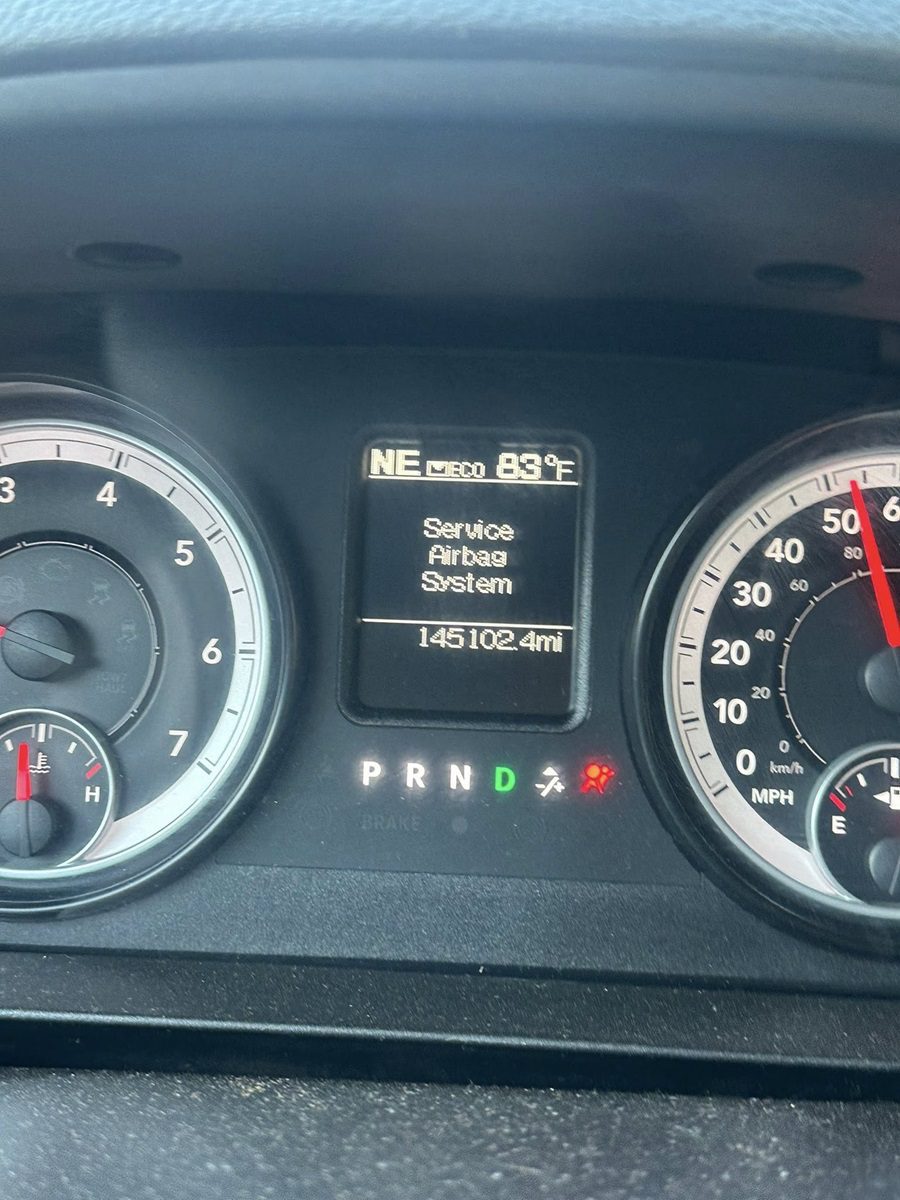
Yes. SRS stands for Supplemental Restraint System, which is the technical term for the airbag system. Some vehicles display the warning as “SRS,” others as “Airbag,” and Ram trucks typically show the “Service Airbag System” text message along with the airbag warning indicator. They are all referring to the same system.
Final Thought
Your Ram 1500 is a capable, durable truck. But none of its capability matters if the system designed to protect you in a crash is offline. Get the fault code read, find the specific cause, and get it fixed by someone with the right tools and training to handle it properly. This is one warning light where the fastest path from problem to solution is always the right one.