
Owning a car means accepting the occasional surprise. You can be driving along on a perfectly normal Tuesday morning and suddenly something sounds wrong, feels wrong, or starts leaking onto your driveway. Most of these problems give you warning signs long before they become emergencies, and the driveshaft is no different.
The problem is that most drivers have no idea what the driveshaft actually does, so when it starts failing, they either ignore the symptoms or misdiagnose them as something else entirely. By the time the real source of the problem becomes obvious, the repair bill has grown considerably larger than it needed to be.
Today we are going to break down exactly what the driveshaft does, what it looks and sounds like when it begins to fail, and what you should do the moment you notice any of these warning signs.
What Is a Driveshaft and Which Cars Have One?
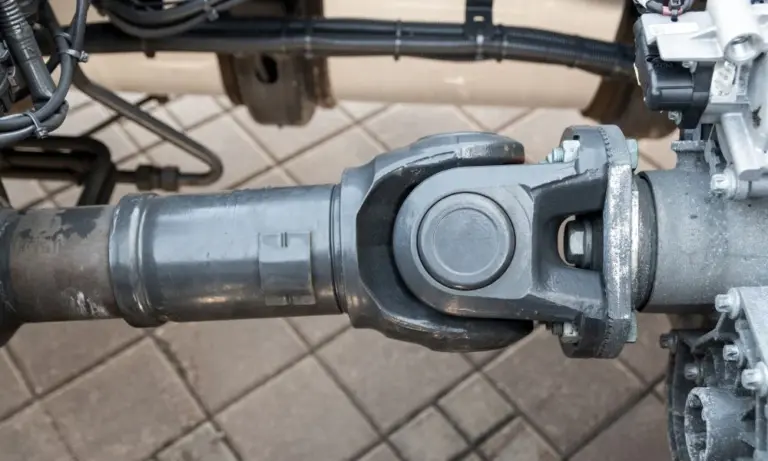
The driveshaft, sometimes called a propeller shaft or prop shaft, is a long rotating tube that runs underneath the length of the vehicle. Its job is to transfer rotational force from the transmission to the rear axle, or in some configurations, to all four wheels. Think of it as the mechanical messenger that delivers power from the engine and gearbox to the wheels that actually push the car forward.
You will not find a driveshaft in a standard front-wheel-drive vehicle. In those cars, the engine, transmission, and driven wheels are all clustered together at the front of the car, so there is no need for a long shaft running the length of the vehicle. Instead, front-wheel-drive cars use CV axles to transfer power directly to the front wheels.
The driveshaft is specific to the following drivetrain configurations.
- Rear-wheel-drive (RWD) vehicles where the engine sits in the front but drives the rear wheels.
- Four-wheel-drive (4WD) vehicles where both axles are driven, often with a transfer case distributing power front and rear.
- All-wheel-drive (AWD) vehicles where the system continuously or automatically distributes power to all four wheels.
The driveshaft can also serve as the connecting link between the clutch and the gearbox when the transmission is mounted remotely inside the vehicle rather than directly attached to the engine. In all configurations, the driveshaft has one fundamental purpose: transmit driving force efficiently and without distortion to the components that need it.
Like every mechanical component in your car, it wears down over time. When it does, it sends very clear signals. You just need to know what to listen and look for.
6 Symptoms of a Failing Driveshaft You Should Never Ignore
1. A Squeaking Noise When the Car First Starts Moving
This is often the first symptom drivers notice, and because it tends to be subtle at low speeds, many people dismiss it as road noise or a minor quirk of their vehicle. That is a mistake.
Most of the joints and bearings that make up the driveshaft assembly are lubricated at the factory during manufacturing. This lubrication is not designed to last forever. The driveshaft operates under constant rotational stress, supporting speed changes, directional forces, and vibration with every single mile you drive. Over time, that factory lubrication dries out, breaks down, or gets contaminated.
When the lubricant is gone, the metal components within the shaft assembly begin moving against each other without any protective barrier between them. Metal on metal friction generates heat and noise. The result is a high-pitched squeak that is most audible at startup or during slow-speed maneuvers, before road noise and engine sound mask it at higher speeds.
You will typically hear this squeak when pulling away from a complete stop, either moving forward or reversing out of a parking space. The moment you hear it, start paying attention. This is your driveshaft asking for lubrication before the situation gets worse.
A mechanic can lubricate the universal joints and carrier bearing on the driveshaft in a relatively short service visit. Catching it at this stage is by far the cheapest point in the driveshaft failure timeline.
2. A Clunking Sound Specifically When Shifting Into Reverse
This symptom is more advanced than the squeak described above, and it points to a specific mechanical problem. When you hear a distinct clunk or thud the moment you shift from park or drive into reverse, it means the internal clearances within the driveshaft bearings or universal joints have worn beyond their acceptable tolerance.
Here is what is happening mechanically. As the bearings wear, they develop play, which is extra space or looseness that should not be there. When the car is moving forward, the rotational forces keep everything loaded in one direction. The worn components are still in contact and the slack is taken up. The moment you shift into reverse, the rotational load reverses direction. The worn bearings have to travel across their worn clearance before they hit the opposite contact point, and that physical impact is the clunk you hear and feel.
This is no longer just a lubrication issue. Bearing wear means the components need to be inspected and likely replaced. Continued driving with this symptom will accelerate the wear of surrounding components, particularly the universal joints, and bring you closer to a much more expensive repair.
3. Unusual Vibration Through the Floor or Seat
Any vibration that you cannot explain through normal road conditions or tire issues deserves serious attention. When the vibration is connected to a failing driveshaft, it typically becomes more pronounced at higher speeds and during long highway runs rather than in city traffic.
The cause is bearing wear that has progressed to the point where the driveshaft itself can no longer maintain a perfectly centered rotation. When the worn bearings allow the shaft to move off its true axis, even by a small amount, the shaft becomes unbalanced. An unbalanced rotating shaft generates vibration. The faster the shaft spins, the more severe the vibration becomes.
Here is something important to understand about driveshaft rotation speed. The driveshaft rotates three to four times faster than your wheels do. This means a small amount of imbalance generates vibration at a much higher frequency than, say, an unbalanced tire would. If the vibration feels fast and persistent rather than rhythmic and slow, the driveshaft is a strong suspect even if your tires appear to be fine.
This symptom is also a warning that the problem has moved beyond the driveshaft itself. When the shaft begins vibrating significantly, it transfers that vibration into the transmission output shaft and the rear differential input. Those components are not designed to absorb constant vibration loads. If you continue driving with significant driveshaft vibration, you will eventually be repairing the transmission or differential as well, which is a considerably more expensive outcome.
4. Transmission Fluid Leaking From the Rear of the Transmission
If you notice a red or brownish fluid pooling under the car near the middle or rear of the vehicle, and your coolant and oil levels are normal, you are likely looking at a transmission fluid leak. When this leak is coming specifically from the rear of the transmission housing where the driveshaft connects, a failing driveshaft is a very likely contributor.
Here is the connection. As driveshaft vibration worsens, it exerts lateral stress on the transmission output shaft, which is the point where the driveshaft plugs into the gearbox. This stress can damage the output shaft seal, which is a rubber seal designed to keep transmission fluid inside the housing. Once that seal is damaged, fluid escapes.
Transmission fluid serves two essential purposes. It lubricates the internal gears and bearings inside the transmission, and in automatic transmissions, it also acts as the hydraulic fluid that controls gear shifting. Running your transmission low on fluid damages the internal components rapidly and can result in complete transmission failure.
A fluid leak underneath your car is never something to monitor and keep an eye on. It needs to be investigated and repaired immediately. A mechanic needs to identify the source of the leak, replace the damaged seal, refill the transmission fluid to the correct level, and inspect the driveshaft that caused the seal failure in the first place.
5. Loud Metallic Banging or Clunking Noises From Under the Car
If the squeaks and clunks described in the earlier symptoms were the driveshaft asking for help, this symptom is the driveshaft screaming. A loud metallic banging sound, similar to someone hitting two heavy metal objects together, coming from underneath the vehicle indicates that there is now significant free movement between driveshaft components.
At this stage, the universal joints or center support bearing have failed to the degree that the driveshaft is physically impacting other components beneath the car during rotation. The forces involved are substantial. A driveshaft rotating at highway speed with failed joints can contact the vehicle’s underbody, exhaust system, or fuel lines. This is not just a mechanical concern. It is a safety concern.
If you hear this sound, you need to get the car to a mechanic as quickly as safely possible. Do not continue driving normally and wait for a convenient appointment slot. The driveshaft needs to be replaced urgently at this point, and the longer you wait, the greater the risk of catastrophic failure while the vehicle is in motion.
6. The Driveshaft Separates From the Vehicle
This is the worst-case scenario and the outcome of ignoring every warning sign that came before it. When the driveshaft completely fails and separates from its mounting points, you will lose all power to the driven wheels instantly. The vehicle will coast to a stop with no ability to accelerate. In the absolute worst case, the separated shaft can dig into the road surface and act as a pole vault, lifting the rear of the vehicle off the ground.
If you experience a sudden and complete loss of drive power accompanied by a violent impact from underneath the vehicle, pull to the side of the road carefully using your remaining momentum, activate your hazard lights, and call for a tow truck. Do not attempt to drive the vehicle further.
The repair at this stage is extensive. It is not just the driveshaft that needs replacing. The separation typically causes collateral damage to the transmission output shaft, the rear differential, the exhaust system, and potentially the floor pan of the vehicle. What could have been a few hundred dollars in preventive maintenance has now become a repair bill measured in thousands.
How Much Does Driveshaft Repair or Replacement Actually Cost?
The honest answer is that cost varies significantly depending on what specifically failed, how far the damage has progressed, your vehicle’s drivetrain configuration, and the make and model of the car. Here is a general framework to set your expectations.
| Repair Type | Estimated Cost Range | Notes |
|---|---|---|
| Driveshaft lubrication service | $50 to $150 | The cheapest intervention. Only effective if caught very early. |
| Universal joint replacement | $150 to $400 per joint | Parts are inexpensive. Labor time varies by accessibility. |
| Center support bearing replacement | $200 to $450 | Common on two-piece driveshaft assemblies found in larger vehicles. |
| Full driveshaft replacement (FWD car) | $500 to $1,000 | Parts typically run $400 to $800. Labor adds $200 to $250. |
| Full driveshaft replacement (RWD or 4WD) | $700 to $2,400 | Higher cost reflects longer shaft, more complex installation, and higher parts pricing on trucks and SUVs. |
| Transmission output shaft seal replacement | $150 to $350 | Often needed alongside driveshaft work if vibration caused seal damage. |
These figures represent the cost of addressing the driveshaft itself. If the vibration or separation caused secondary damage to the transmission or rear differential, add those repair costs on top. This is exactly why catching the problem at the squeak or clunk stage rather than the complete failure stage makes such an enormous financial difference.
How Often Should the Driveshaft Be Inspected?
For passenger cars, the driveshaft should be professionally inspected at least once a year as part of a routine undercarriage inspection. Most shops will inspect the shaft, universal joints, and center bearing during an oil change or annual service without charging extra for the visual check.
For buses, heavy-duty trucks, and commercial vehicles that cover significantly more miles under load, a driveshaft inspection every six months is the more appropriate interval. These vehicles place considerably more stress on the drivetrain components due to their weight and the demands of commercial operation.
Between professional inspections, pay attention to the symptoms described in this article. Your car will tell you when something is wrong long before the problem becomes critical. The question is always whether you are listening closely enough to catch it early.
The driveshaft is not a component that fails silently or without warning. It communicates its distress through squeaks, clunks, vibrations, and leaks, each symptom progressively more urgent than the last. Address the first symptom and you spend a little. Wait for the last one and you spend a lot. The choice is yours every time you hear something unusual from underneath your vehicle.