
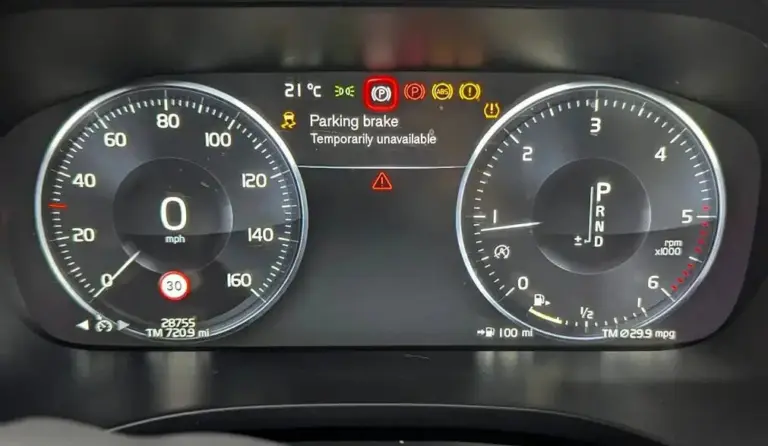
You hop into your Volvo, and before you even pull out of the driveway, your dashboard throws up a “Parking Brake Temporarily Unavailable” warning. Maybe the car even shuts itself off a moment later. It is unsettling, especially when you are not sure whether it is safe to drive or whether something serious is failing underneath you.
Here is the short version: this warning means your Volvo’s Electronic Parking Brake system has detected a fault and has disabled itself as a precaution. It is not always a catastrophic problem, but it is absolutely something you need to address before getting back on the road. Driving around with a non-functional parking brake is a safety risk, plain and simple.
Let us walk through exactly what causes this warning, what you might experience when it appears, and how to go about fixing it.
What Is the Electronic Parking Brake and Why Does Volvo Use It?
Newer Volvo models have moved away from the traditional handbrake lever that most drivers grew up with. In its place is the Electronic Parking Brake, commonly abbreviated as EPB. Instead of pulling a lever connected to a cable, you simply press a button. The system does the rest.
When you activate the EPB, a signal is sent from the button through the EPB module to small electric actuator motors mounted at the rear brake calipers. Those motors clamp the brake pads against the brake discs, holding the vehicle stationary. On many Volvo models, the EPB activates automatically when you shift into Park or switch the engine off, removing any chance of the car rolling away unintentionally.
On paper, the EPB is a significant upgrade. It is more precise, takes up less cabin space than a lever, integrates with other safety systems like hill start assist, and removes the mechanical cable that traditional handbrakes rely on, which was its own source of maintenance headaches. But because the EPB is entirely electronic, it depends on several components working correctly. When one of those components develops a fault, the whole system can go offline and that warning appears.
What Happens When the Warning Appears
The “Parking Brake Temporarily Unavailable” message does not always appear in isolation. Depending on the underlying cause and the severity of the fault, you might experience any of the following alongside the warning:
- The vehicle shuts itself off shortly after the warning appears
- Difficulty restarting the car after it has stalled or been switched off
- The EPB button on the center console becoming unresponsive
- Additional warning lights appearing on the dashboard alongside the EPB message
- The car rolling slightly when parked on an incline, since the parking brake is not engaging
The shutdown behavior is particularly alarming for Volvo owners who encounter this for the first time. What is happening in those cases is that the vehicle’s safety logic has detected a fault severe enough that it considers continued operation unsafe. Volvo’s engineering philosophy is built around safety above everything else, and the system would rather stop the car than allow it to be driven without a functioning parking brake.
Every Reason Your Volvo Is Showing This Warning
1. A Weak or Failing Battery
This is the most common cause by a significant margin, and it is the first thing you should investigate. The EPB system is entirely electrically powered. It relies on the vehicle’s battery to supply stable, adequate voltage to the actuator motors and the EPB module. When the battery voltage drops below what the system needs to operate confidently, the EPB disables itself and displays the warning.
An aging battery is the typical culprit here. Car batteries have a lifespan of around three to five years under normal conditions. As they age, their ability to hold and deliver adequate voltage deteriorates. You might not notice it affecting the engine start since modern starters can work with surprisingly low voltage, but precision electronic systems like the EPB are much less forgiving of voltage instability.
Other battery-related factors that can trigger this warning include:
- Corroded or loose battery terminals restricting current flow
- A battery that has been deeply discharged, for example from leaving lights on overnight
- A failing alternator that is no longer adequately recharging the battery while the engine runs
- A parasitic drain somewhere in the electrical system slowly pulling the battery down over time
Start here before anything else. Test the battery voltage with a multimeter. With the engine off, a healthy battery reads between 12.4 and 12.7 volts. With the engine running, it should read between 13.5 and 14.8 volts, which confirms the alternator is charging it properly. If either reading falls outside these ranges, the battery or charging system is the problem.
Many auto parts stores offer free battery testing. If the battery is more than four years old and testing shows it is holding less than 70% of its rated capacity, replace it proactively. This single repair resolves the EPB warning in a large percentage of cases.
2. A Failed or Contaminated EPB Module
The EPB module is the computer that controls the entire electronic parking brake system. It receives input from the EPB button and various sensors, processes that information, and sends the appropriate commands to the actuator motors at the rear calipers. Without a functioning module, the system has no brain, and the EPB cannot operate.
Module failures can happen in a few different ways. Moisture intrusion is one of the more common causes. If water finds its way into the module housing, which can happen after flooding, pressure washing the engine bay, or in some cases through a deteriorated seal, it can cause short circuits within the module’s circuitry. Minor moisture exposure might only slow or intermittently disrupt the module’s function, but significant water damage typically means the module is done and needs replacement.
Dust and debris contamination can also affect the module over time, particularly in vehicles used in particularly dusty environments. In early stages, cleaning the module may restore function, but once contamination has caused internal damage to the circuit board components, replacement is the only reliable fix.
A failed EPB module is not a cheap repair. Replacement modules for Volvo vehicles typically range from $300 to $800 for the part alone, with labor adding to that total. The module also usually requires programming to match the vehicle after installation, which is another reason this repair is best handled by a Volvo-authorized dealer or a shop with Volvo-compatible diagnostic software.
3. Wiring Faults Within the EPB System
The EPB system relies on a network of wiring to communicate between its components. Current flows from the battery to the EPB module, and from the module to the actuator motors at each rear caliper. If there is a break, short, or high-resistance connection anywhere in this wiring network, the system cannot function correctly.
Wiring problems in the EPB circuit commonly include:
- Corroded connector pins at the EPB module or at the actuator motors
- Wires that have been chafed or damaged by rubbing against other components, often where wiring passes through tight spaces or near moving parts
- Rodent damage, particularly in vehicles stored for extended periods where rodents have chewed through insulation
- Disconnected or loose connectors resulting from previous repair work where a connector was not fully reseated
- A broken ground connection causing the system to receive inconsistent reference voltage
Diagnosing wiring faults requires methodical inspection with a multimeter to check for continuity and proper voltage at each point in the circuit. Start by visually inspecting all accessible wiring related to the EPB system, focusing on areas where wires pass through grommets, near heat sources, or alongside moving components. If you find obvious damage, that is your starting point for repair.
Wiring repairs range from inexpensive connector cleaning to more involved harness repairs depending on what is damaged and where it is located. A qualified auto electrician or Volvo technician can trace these faults efficiently using the vehicle’s wiring diagrams.
4. An EPB Software Glitch or Corrupted Firmware
The EPB module runs on software, and like any software, it can occasionally develop glitches. This is particularly common in vehicles that are due for a software update or have experienced a software corruption event, such as an incomplete update installation or a voltage drop during a previous programming session.
When the EPB software is running on corrupted or outdated firmware, it may send incorrect signals to the actuators or fail to process inputs from the EPB button correctly. The system then flags a fault and the warning appears, even though all the physical hardware is in perfectly good condition.
The fix here is a software update or reflash of the EPB module, which requires a dealer-level diagnostic tool that can communicate directly with the module and push new firmware to it. A basic OBD-II scanner will not be able to perform this function. If you suspect a software issue, particularly if the problem appeared suddenly without any other changes to the vehicle, a dealer visit is the most direct path to a solution.
Volvo regularly releases Technical Service Bulletins addressing known software issues across their model range. Ask the service advisor at your dealership to check whether any TSBs related to EPB software exist for your specific model year and VIN.
5. A Missing or Unfastened Seatbelt
This one genuinely surprises most people when they hear it. Volvo takes safety integration seriously enough that in some models, not wearing a seatbelt while the car is in motion can actually trigger the parking brake warning. The vehicle’s safety systems are designed to communicate with each other, and in certain situations, an unbuckled driver can cause the car to initiate a controlled stop.
If you received the warning and cannot identify any hardware fault, check something simple first: was the driver’s seatbelt buckled? If not, buckle up, restart the vehicle, and see whether the warning clears on its own. It sounds almost too simple, but this is a documented cause on certain Volvo models and takes about 10 seconds to rule out.
6. Faulty EPB Actuator Motors
Each rear brake caliper on a Volvo with EPB contains a small electric motor that physically clamps the brake pads when the parking brake is engaged. If one or both of these actuator motors fails, seizes, or develops an internal fault, the EPB system cannot complete the parking brake engagement cycle and will display the warning.
Actuator motor failures are less common than battery or wiring issues, but they do happen, particularly on higher-mileage vehicles or in regions where road salt and moisture accelerate corrosion within the caliper assembly. Symptoms of an actuator fault often include a grinding or clicking sound when attempting to engage or release the parking brake, or the EPB engaging on one side but not the other.
Replacing EPB actuator motors typically means replacing the entire rear caliper assembly since the motors are integrated into the caliper design on most Volvo models. This is a more significant repair cost, usually ranging from $300 to $600 per caliper including parts and labor, but it is necessary if the actuators have failed.
How to Diagnose and Fix the Warning Yourself
Not every cause of this warning requires an immediate dealer visit. Work through these steps in order, starting with the simplest and cheapest possibilities.
- Check the seatbelt. If the driver’s seatbelt was not fastened when the warning appeared, buckle up and restart the vehicle. Takes 10 seconds and rules out one known cause immediately.
- Test the battery voltage. Use a multimeter to check battery voltage with the engine off (should read 12.4 to 12.7 volts) and with the engine running (should read 13.5 to 14.8 volts). Any reading outside these ranges points to a battery or charging system problem.
- Inspect the battery terminals. Look for corrosion, looseness, or damage at the battery terminals. Clean any corrosion off with a wire brush and baking soda solution. Ensure both terminals are tight and making solid contact.
- Try recharging the battery. If the battery tested low, connect it to a quality battery charger for several hours and bring it back to full charge. Then retest voltage and see whether the EPB warning clears once the vehicle is restarted.
- Run an OBD-II diagnostic scan. A scan tool will pull any stored fault codes related to the EPB system. Basic readers available at auto parts stores will access general codes, but a Volvo-specific or advanced scanner is needed to read module-level EPB codes. The codes will tell you which component the system has flagged as faulty.
- Inspect accessible EPB wiring. Look at wiring near the rear brake calipers, under the rear of the vehicle, and around the EPB module location. Check for obvious damage, exposed wires, disconnected connectors, or corrosion at connector pins.
- Check for a software update. Contact your local Volvo dealer and provide your VIN. Ask whether any software updates or TSBs exist for the EPB system on your specific model and year. If one is available, a software update may resolve the issue without any parts replacement.
Repair Cost Overview
| Cause | Estimated Repair Cost |
|---|---|
| Battery terminal cleaning | Free to $20 |
| Battery replacement | $100 to $250 |
| Alternator replacement (if charging system is at fault) | $300 to $700 |
| Wiring repair (minor, connector cleaning or short repair) | $50 to $250 |
| Wiring harness repair or replacement (major) | $300 to $800 |
| EPB software update or reflash | $75 to $200 |
| EPB module replacement and programming | $400 to $1,100 |
| EPB actuator or rear caliper replacement (per side) | $300 to $600 |
Is It Safe to Drive with This Warning Active?
The short answer is no. The parking brake is a critical safety component. Without it functioning properly, you cannot safely secure the vehicle when parked on any incline, and in some cases you lose the ability to slow the car in situations where the primary braking system has a separate issue.
That said, there is a difference between “do not drive this car at all” and “drive carefully directly to a mechanic.” If the warning just appeared and your primary brakes are working normally, you can typically drive the vehicle a short distance to reach a repair facility. But do not park it on any hill without additional precautions, such as using wheel chocks, and do not drive it on a long trip or in situations where you might need the parking brake function.
If the car is shutting itself off alongside the warning, do not attempt to continue driving until you have identified the cause. A vehicle that shuts down unexpectedly at speed is a serious hazard to you and everyone else on the road.
When to Go Straight to a Volvo Dealer
Some repairs associated with this warning are straightforward enough for an independent shop or even a confident DIYer. Others specifically require dealer-level tools and access. Go directly to an authorized Volvo dealer when:
- The battery tests fine and there are no obvious wiring issues, but the warning persists
- A diagnostic scan points to an EPB module fault or software error
- The EPB module needs replacement and programming
- You need a software update or reflash applied to the EPB module
- The vehicle is shutting itself off and you cannot identify a clear cause
- Your Volvo is still under warranty, in which case dealer diagnosis and repair costs may be covered
Independent shops can handle battery replacements, wiring repairs, and even caliper swaps on these vehicles. But anything involving EPB module programming or Volvo-specific software requires access to Volvo’s proprietary diagnostic platform, which independent shops typically do not have.
How to Keep the EPB System Working Reliably
Preventing this warning from appearing in the first place comes down to a handful of consistent maintenance habits.
- Replace your battery on a proactive schedule. Once your battery is three to four years old, have it load-tested annually. Do not wait for it to fail completely. A failing battery is the leading cause of EPB warnings in Volvo vehicles, and replacing it on schedule is the single most effective preventive measure.
- Keep battery terminals clean and tight. Check them at every oil change. A clean, solid connection ensures the EPB system receives the stable voltage it needs to operate correctly.
- Do not pressure wash the engine bay aggressively. Directing high-pressure water at electrical modules and connectors can force moisture into sealed components, including the EPB module. Use a gentle spray and avoid direct contact with electrical components when cleaning the engine bay.
- Stay current on software updates. When your Volvo is in for routine service, ask the dealer to check for any pending software updates. Keeping the vehicle’s software current prevents known bugs from affecting systems like the EPB.
- Include the rear brakes in your regular inspection routine. When brake pads are inspected, ask the technician to also check the condition of the EPB actuators and the wiring running to the rear calipers. Catching corrosion or wear at the actuator level early is far cheaper than dealing with a full caliper replacement later.
The EPB system on your Volvo is genuinely better technology than a traditional handbrake, but it demands more from the vehicle’s electrical system and requires that electrical system to be in good health. A well-maintained battery and clean wiring connections resolve the majority of EPB warnings before they ever reach the point of a module or actuator replacement. Start there, work systematically, and you will spend far less time and money getting the problem resolved.