
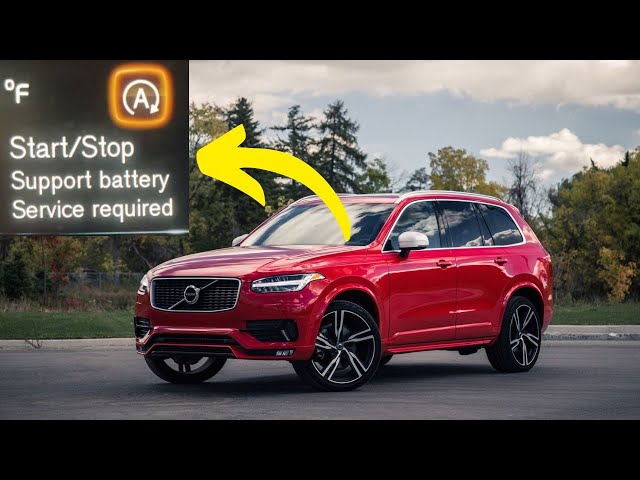
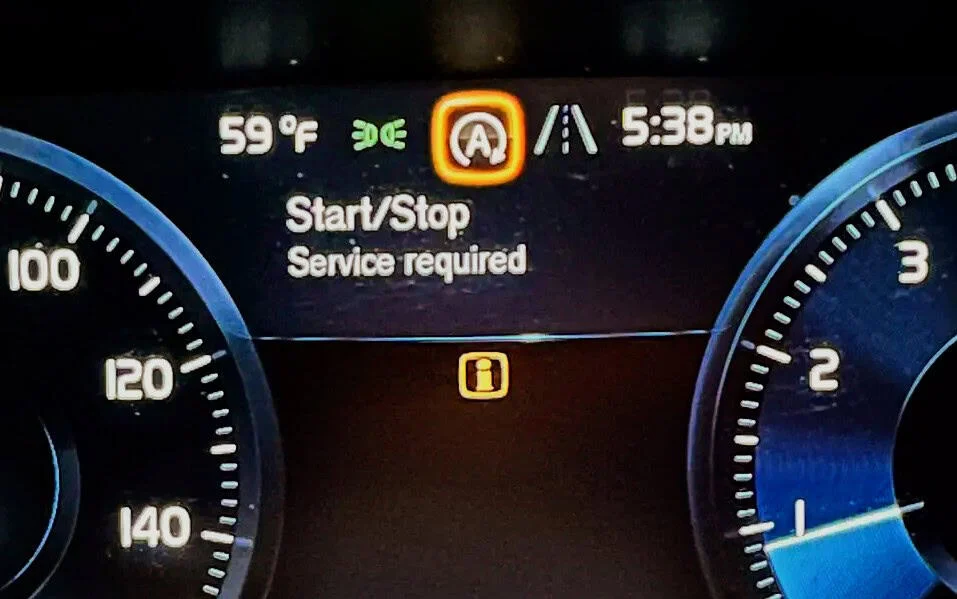
You are driving your Volvo and that “Start-Stop Service Required” message pops up on the dashboard. Your first instinct is probably to wonder whether something serious is wrong, or whether you can just keep driving and deal with it later.
Here is the honest answer: it depends on what triggered it. Sometimes it is a minor issue that clears itself up. Other times, it is pointing to a battery problem that will only get worse if you ignore it. Either way, it is worth understanding what the system is actually telling you before deciding how to respond.
What the Start-Stop System Actually Does
Before getting into the causes and fixes, it helps to understand what the start-stop system is and why Volvo uses it. The start-stop system automatically shuts the engine off when the car comes to a stop, like at a red light or in traffic, and restarts it the moment you release the brake pedal. The whole point is fuel efficiency and reduced emissions. Instead of idling away fuel at every red light, the engine simply switches off and comes back on when you need it.
Sounds simple, but the system relies on a surprisingly complex network of components working in sync. The battery needs to hold adequate charge, the sensors need to be functioning correctly, the software needs to be current, and the overall electrical system needs to be stable. When any of those variables falls outside acceptable limits, the system disables itself and throws the warning message.
When the warning is active, the start-stop function is offline. Your engine will not switch off at stops anymore. The car is still fully drivable, but you are not getting the fuel economy benefit the system is designed to provide.
Why Your Volvo Is Showing “Start-Stop Service Required”
The Auxiliary Battery Is the Number One Suspect
This is the most common cause by a significant margin, and it catches a lot of Volvo owners off guard because most people do not know their car has two batteries.
Your Volvo has a main battery under the bonnet, which handles starting the engine and powering most of the car’s electrical systems. It also has an auxiliary battery, typically located in the front left corner of the engine bay behind the bumper. The auxiliary battery supports the start-stop system specifically. It provides the burst of power needed to restart the engine when the system brings it back online at a stop, which is a demand that would wear out the main battery very quickly if it had to handle the job alone.
The auxiliary battery tends to have a shorter service life than the main battery, and when it degrades or fails, the start-stop system has nowhere to draw the power it needs. The result is the warning message on your dashboard.
Signs that the auxiliary battery is the cause include:
- The start-stop system worked fine previously but stopped functioning gradually over time.
- The warning appears consistently rather than intermittently.
- The car has higher mileage or is a few years old and neither battery has been replaced.
- A voltage test on the auxiliary battery shows low or inconsistent output.
The Main Battery May Also Be the Issue
Do not assume it is always the auxiliary battery. The main battery is just as capable of causing this warning when it starts to fail. If the main battery is not holding a proper charge or is not being charged efficiently by the alternator, the overall electrical system voltage drops. The start-stop system monitors voltage closely and will disable itself if it detects the system cannot support a reliable engine restart.
Check for corrosion on the battery terminals, loose cable connections, and run a proper load test on the main battery. A battery that shows 12 volts sitting still can still fail under the load of restarting the engine repeatedly, which is exactly what the start-stop system requires it to do.
Outdated or Corrupted Software
Modern Volvos run on highly complex software that manages dozens of systems simultaneously. Like any software, it can develop bugs over time, particularly if updates have not been applied. A software glitch in the start-stop control module can trigger the warning message even when the hardware itself is perfectly fine.
This is more likely if the warning appeared suddenly without any gradual deterioration, if the car recently came back from a service where software was touched, or if the warning disappears and comes back intermittently rather than staying on constantly.
Volvo releases software updates periodically, and some of these specifically address known issues with start-stop system behavior. An authorized Volvo workshop can check whether your car’s software is current and apply any available updates.
A Worn or Failing Ignition Switch
This one is less common but worth knowing about. Some Volvo V40 owners specifically have reported Start-Stop Service warnings that persisted even after battery replacements, with the eventual culprit turning out to be a worn ignition switch. The ignition switch plays a role in the startup sequence that the start-stop system relies on, and a failing switch can send inconsistent signals that confuse the system.
If you have already addressed both batteries and the warning is still there, and particularly if you also notice any other issues related to starting the car or intermittent electrical gremlins, the ignition switch is worth investigating.
Sensor or Brake System Issues
The start-stop system uses data from multiple sensors to decide when it is safe to shut the engine off and when to restart it. The brake pedal sensor tells the system when you have come to a complete stop. The battery management sensor monitors charge levels in real time. If any of these sensors are sending incorrect data, the system may disable itself as a precaution.
Brake system issues can also be a factor. Some Volvo models disable the start-stop system if a fault is detected in the braking system because the system needs to be confident that the brakes are fully functional before allowing the engine to shut off at a stop.
How to Fix the “Start-Stop Service Required” Warning
Step 1: Try a System Reset First
Before doing anything else, try a simple restart. Turn the car completely off, remove the key, wait a few minutes, and restart. If the warning was triggered by a temporary software hiccup or a momentary voltage drop, it may clear on its own.
If the warning comes back immediately or returns within a short drive, something physical is causing it and the restart was not a fix, just a temporary mask. Move on to the next steps.
Step 2: Test Both Batteries
This is where you start the real diagnosis. You need a voltage test and ideally a load test on both batteries. Many auto parts stores offer free battery testing. You can also do a basic voltage check yourself with a multimeter:
- A healthy, fully charged battery should read around 12.6 volts at rest.
- A reading below 12.4 volts indicates a battery that is not fully charged or is starting to fail.
- A reading below 12.0 volts means the battery is significantly discharged or failing.
Check both the main battery and the auxiliary battery. Also inspect the terminals and cable connections on both for corrosion or looseness. A corroded terminal can cause voltage drop even if the battery itself is healthy.
Step 3: Replace the Auxiliary Battery If Needed
If the auxiliary battery tests weak or fails the load test, it needs to be replaced. This is a job that many mechanically confident owners can handle themselves. Here is how to do it:
What you will need:
- A compatible replacement auxiliary battery (Volvo OEM or equivalent). Expect to pay around $100 to $130 for a quality replacement.
- An 8mm socket with a ratchet and extension.
- Safety gloves to avoid direct contact with battery terminals and cables.
Step by step replacement process:
- Turn the car completely off and remove the key from the ignition.
- Pop the hood and locate the auxiliary battery. It sits in the front left corner of the engine bay, tucked behind the bumper. It is notably smaller and flatter than the main battery.
- Using the 8mm socket and ratchet with the extension, remove the bolt securing the negative (black) battery cable first. Always disconnect negative before positive to avoid short circuits.
- Remove the bolt securing the positive (red) cable next.
- Carefully lift the old auxiliary battery out. Note its orientation before removing it so you can install the replacement in the exact same position.
- Place the new battery in position, matching the orientation of the old one exactly.
- Reconnect the positive cable first, then the negative cable. Tighten both bolts securely with the 8mm socket.
- Start the car and check whether the warning message has cleared from the dashboard.
If the warning clears after replacement, you are done. Drive normally for a short period and confirm it does not return. If the warning persists after a new auxiliary battery is installed, the issue is elsewhere, either the main battery, a sensor, a software issue, or something less common like the ignition switch or battery management sensor.
Step 4: Check for Software Updates
If the batteries are both testing fine and the physical inspection has not turned up any obvious problems, software is worth looking at. This step requires a visit to an authorized Volvo workshop or a mechanic with Volvo-compatible diagnostic software. They can check your car’s current software version, compare it against the latest available, and apply updates as needed.
If your car is still under warranty, software updates should be covered at no cost. Even out of warranty, this is a relatively low-cost diagnostic step that can save you from chasing hardware problems that do not actually exist.
Step 5: Visit an Authorized Volvo Workshop
If you have worked through the steps above and the warning is still showing, or if you are not comfortable doing the battery work yourself, an authorized Volvo workshop is the right next move. Volvo technicians have the proprietary diagnostic tools needed to communicate directly with all of the car’s control modules, which gives them a level of insight that generic OBD-II scanners cannot match.
A professional diagnosis will identify exactly which component or system is triggering the warning. Whether it turns out to be a sensor, a software fault, a battery management issue, or something less common, the technician can address it with the correct fix rather than a process of elimination.
Be specific when you speak to them. Tell them what you have already checked, what the car was doing when the warning appeared, and whether it is constant or intermittent. The more information you provide, the faster and more accurately they can diagnose the problem.
Quick Reference: Causes and Fixes at a Glance
| Cause | How Common | Recommended Fix |
|---|---|---|
| Failing auxiliary battery | Very common | Test and replace the auxiliary battery |
| Weak or failing main battery | Common | Load test; replace if failing; check terminal connections |
| Software glitch or outdated firmware | Moderate | System restart; software update at authorized workshop |
| Worn ignition switch | Less common | Professional inspection and replacement if confirmed |
| Faulty battery management sensor | Less common | Professional diagnostic scan; sensor replacement |
| Brake system fault | Less common | Professional diagnosis; address underlying brake issue |

What Happens If You Just Ignore the Warning?
Technically, your Volvo will continue to run with the start-stop system offline. You will not be stranded, and the engine will not shut down unexpectedly. What you will notice is that the start-stop function simply stops working at lights and in traffic, which means the fuel-saving benefit disappears entirely.
The risk of ignoring it comes down to what is causing the warning in the first place. If it is a failing battery, that battery will continue to degrade. A main battery that is declining puts more strain on the alternator. An auxiliary battery that has failed entirely may eventually affect other systems that depend on stable voltage. What starts as a start-stop warning can gradually turn into broader electrical issues if the root cause is not addressed.
The smarter play is to diagnose it sooner rather than later. In most cases, especially if it is the auxiliary battery, the fix is not expensive and does not take long. Catching a failing battery before it causes wider electrical problems is always cheaper than waiting until it does.
If the warning clears after a restart and has only appeared once, keep an eye on it. One occurrence without recurrence may genuinely be a temporary software hiccup. But if it comes back, treat that as the car telling you something needs attention, because it usually is.