
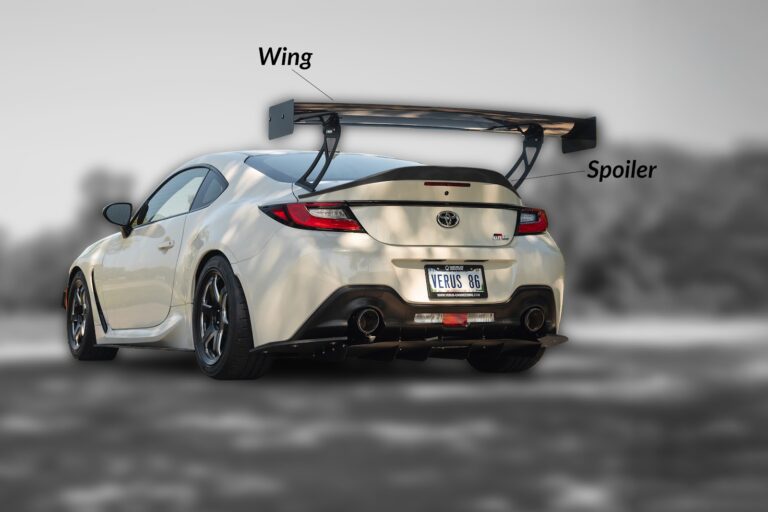
Walk into any car meet and you will hear people use “spoiler” and “wing” like they mean the same thing. They do not. And if you are thinking about adding one to your car, or you just want to understand what is actually happening aerodynamically when you see a race car blast down a straight, this breakdown is for you.
Both parts sit at the back of a car. Both look vaguely similar at a glance. But the way they interact with airflow is completely different, and that difference matters a lot more than most people realize.
Let’s get into it properly.
How Aerodynamics Actually Works on a Moving Car
Before we even get to spoilers and wings, you need a quick picture of what air is doing to your car while it moves. Think of your car punching through a wall of air every time you drive. That air has to go somewhere, and how it travels around, over, and under your vehicle determines whether your car stays planted or starts floating.
At low speeds, this barely matters. But push past 60 or 70 mph, and things start getting interesting. Air moving under the car creates lift, which is the exact opposite of what you want. It reduces tire grip, makes the car feel light and nervous, and in extreme cases on the track, it can be genuinely dangerous.
On top of that, there is drag, which is the resistance the air creates against your car’s forward movement. Drag slows you down and burns more fuel. So engineers and racers have spent decades figuring out how to manage both lift and drag at the same time.
That is exactly where spoilers and wings come in. They both address aerodynamic problems, but they do it in completely different ways.
Spoiler vs. Wing: The Core Difference You Need to Understand
Here is the simplest way to think about it. A spoiler spoils the airflow. It acts like a wall or a barrier that breaks up the stream of air traveling over your car’s roof before it can create lift at the rear. It does not generate any significant force on its own. It just interrupts a problem.
A wing, on the other hand, generates force. It works exactly like an airplane wing, except upside down. An airplane wing pushes the aircraft up into the sky. A car wing pushes the car down onto the road. That downward force is called negative lift, or more commonly, downforce.
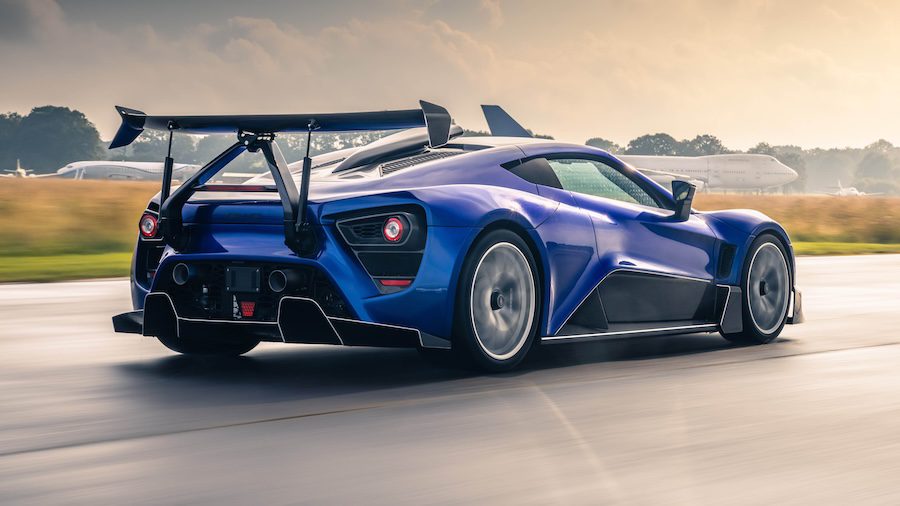
You can also spot the difference visually if you know what to look for. A wing stands up off the body of the car on two posts or end plates, with a clear gap between the wing itself and the car’s surface. That gap is not decorative. It is functional. Air needs to flow both over and under the wing to generate that downforce.
A spoiler sits directly on the car. It is attached to the trunk lid, the rear window, the roofline, or the rear bumper with no gap underneath it. It is part of the body, essentially. That structural difference tells you everything about how each one works.
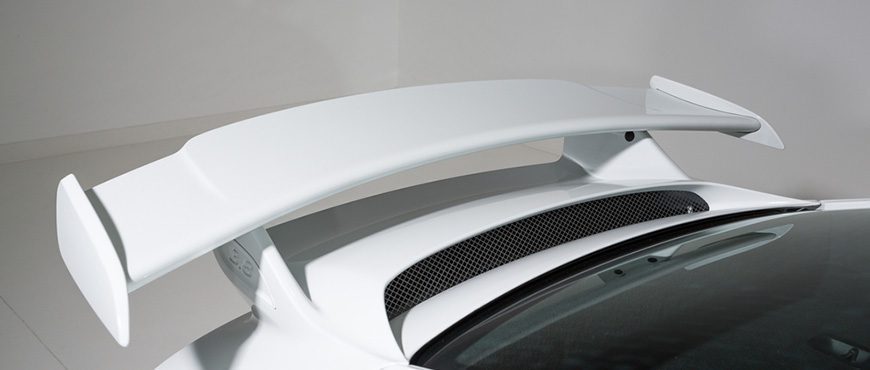
What a Spoiler Actually Does to Airflow
Picture air flowing smoothly over your car’s roofline as you drive down the highway. When that air reaches the end of the roof and starts falling toward the trunk, it speeds up. Fast-moving air creates low pressure. Low pressure at the rear of the car is what pulls the back end upward, creating lift.
Left unchecked at higher speeds, this can make a car feel unstable, especially in crosswinds or during hard braking. The car’s rear starts to feel loose, and your tire contact patches lose grip on the road.
A spoiler sits right at that transition point and physically disrupts the airflow before it can accelerate and create that low-pressure zone. It breaks up the clean stream of air, reduces the speed of the airflow, and in doing so, reduces both lift and drag. It does not generate downforce the way a wing does. Think of it less as a tool that pushes the car down and more as a tool that stops something bad from happening.
That is actually why most regular production cars use spoilers instead of wings. At typical highway speeds, a spoiler does what needs to be done without the added drag or the visual aggression of a full wing setup. It is a practical solution for everyday driving.
What a Wing Actually Does to Airflow
A wing is a different beast altogether. It is shaped like an airfoil, which is that curved, teardrop-like cross-section shape you see on airplane wings. On an airplane, the curve faces upward, and the physics of the shape push the aircraft skyward.
Flip that shape over, and you have a car wing. The curved surface faces downward, and the physics now push the car into the ground. Air moving over the top of the wing travels faster than air moving under it, creating a pressure difference. High pressure builds under the wing and low pressure forms on top. That pressure difference is what generates downforce.
More downforce means more grip. More grip means you can corner faster, brake later, and put power down more effectively coming out of turns. This is why you see massive wings on Formula 1 cars, GT racers, and dedicated track cars. At race speeds, the downforce from a properly engineered wing can actually exceed the weight of the car itself, effectively pinning it to the road.
But here is the thing. Wings come with a cost. That downforce also means increased drag. The more aggressively a wing is angled, the more downforce it generates, and the more drag it creates. At 180 mph on a closed circuit, that is a worthwhile trade. On the freeway at 75 mph, you are just making your car work harder for no real benefit.
At What Speed Do These Parts Actually Make a Difference?
This is the part that most people glosses over, and it is important. Aerodynamic forces scale with speed, and they do not scale in a simple straight line. They scale with the square of velocity, which means that doubling your speed quadruples the aerodynamic forces at play.
At 30 mph, aerodynamics barely matter. At 60 mph, they start to be noticeable. At 120 mph, they become the dominant factor in how a car behaves.
So if you are fitting a big adjustable wing to your daily driver that you take to work and occasionally push to 80 mph on the highway, you are mostly adding weight and drag with very little functional benefit. The aerodynamic forces at those speeds are not strong enough for a wing to work the way it is designed to.
A modest trunk spoiler, though, can make a small but measurable improvement in stability for a street car, and it looks good doing it. Which is honestly why most people fit them anyway.
If you are tracking your car or doing autocross at higher speeds, that is when an actual wing starts pulling its weight, literally and figuratively.
The Different Types of Spoilers and What Each One Does
Spoilers are not one-size-fits-all. There are several different designs, each suited to a different part of the car and a different purpose. Some are built for genuine aerodynamic improvement. Others are mostly aesthetic. Knowing the difference saves you money and keeps you from bolting something useless onto your car.
1. Front Spoiler (Air Dam)
The front spoiler goes under the front bumper, and it is often called an air dam. Its job is to reduce the amount of air that flows under the car, which reduces lift at the front axle and decreases aerodynamic drag. Less air under the car also means less turbulence, which keeps the airflow cleaner around the rest of the vehicle.
Front spoilers also help direct air toward the radiator and brakes, which keeps cooling efficient at higher speeds. They are typically made from lightweight plastic or metal, and you will see them on a lot of performance-oriented production cars right from the factory.
The downside? They sit low, and if you have any kind of raised driveway, speed bump, or parking curb to deal with, a front air dam will take the hit. Many of them crack or scrape off entirely on cars that were never meant to be lowered in the first place.
2. Pedestal Spoiler
This is probably the most recognizable spoiler style to most people. The pedestal spoiler bolts directly onto the trunk lid and stands up slightly, like a small wing without the gap underneath. It is not a wing, because it sits on the trunk surface rather than being elevated on supports.
Pedestal spoilers interrupt the turbulent airflow at the rear of the car, reducing drag and providing a small amount of downforce. They became hugely popular through the 1990s and 2000s on sport compact cars, and you still see them everywhere on entry-level performance cars today.
They are functional at highway speeds, but the improvement is modest. At track speeds, they are outclassed by a proper wing setup.
3. Lighted Spoiler
Lighted spoilers incorporate brake lights or LED strips into the spoiler body itself. This is more of a visibility and safety addition than a performance upgrade. The idea is that by raising the brake light higher, trailing drivers get an earlier, clearer warning when you slow down.
Some factory cars actually come with this from the manufacturer, particularly hatchbacks and wagons where the roofline drops sharply. It is a practical feature, but do not expect it to do anything meaningful for your lap times.
4. Roof Spoiler
Roof spoilers sit right at the trailing edge of the roofline, just before the rear window. Their job is to manage the airflow as it transitions from the roof to the rear of the car. By disrupting that airflow early, they can reduce the amount of lift generated at the rear and also cut down on the turbulent wake the car creates behind it.
You see these on a lot of hatchbacks and fastbacks because the roofline shape of those cars tends to create a particularly messy aerodynamic wake. Some roof spoilers also incorporate a high-mounted stop light, combining safety and aerodynamics in one piece.
5. Lip Spoiler
Lip spoilers are the subtle option. They are a small extension of either the front or rear bumper edge, adding just a slight lip or flare to the car’s body. Front lip spoilers give the illusion of a lower, more aggressive stance while also doing a mild job of reducing air getting under the car.
Rear lip spoilers attach to the lower edge of the trunk lid or bumper. They are more cosmetic than functional in most real-world applications, but they do add a cleaner look to the rear of the car without being too aggressive.
If you want a subtle upgrade that looks factory and does not scream “modified,” a rear lip spoiler is often the move. It is the kind of thing that makes people say “that car looks nice” without being able to put their finger on exactly why.
6. Truck Spoiler
Truck spoilers are designed specifically for pickup trucks and mount across the cab’s rear edge. They serve a similar aerodynamic purpose as roof spoilers on passenger cars, managing the airflow at the transition between the cab and the open bed.
Trucks have a notoriously terrible aerodynamic profile thanks to that open bed, which acts like a sail catching air. A spoiler at the cab’s trailing edge can help reduce some of that drag. Many truck spoilers also incorporate a third brake light, making them a popular factory option on a lot of modern pickups.
The Different Types of Wings and How They Work
Wings do not have quite as much variety as spoilers, but the differences between wing types matter quite a bit from a performance standpoint. The two main configurations you need to know about are the whale tail and the Gurney flap setup.
1. Whale Tail Wing
The whale tail wing gets its name from exactly what it looks like. The edges curl upward and sweep out from the trunk like the tail of a whale breaching the water. The Porsche 911 Turbo made this design famous back in the 1970s, and it became one of the most recognizable shapes in automotive history.
Whale tail wings are primarily cosmetic on most street cars. The shape looks dramatic, but because the wing sits close to the car’s body and is not particularly well-optimized for generating downforce, its aerodynamic effect is relatively modest compared to a properly elevated, adjustable wing.
That said, on cars like the original 930 Turbo, the whale tail also served a cooling function, channeling air toward the rear-mounted engine’s intake. So it was never purely decorative, even if its aerodynamic performance was secondary to the engineering requirements of the car behind it.
2. Gurney Flap
The Gurney flap is named after American racing legend Dan Gurney, who reportedly came up with the idea in the 1970s. It is a small right-angle tab that gets attached to the trailing edge of a wing, sticking straight up.
It sounds almost too simple to work, but it is genuinely effective. The Gurney flap increases the pressure difference between the top and bottom surfaces of the wing, boosting downforce without dramatically increasing the wing’s overall size or complexity. It is a small addition with a significant performance payoff.
You will see Gurney flaps on serious racing setups, including endurance racers, single-seater open wheel cars, and high-downforce track cars. At street level, they are less common and largely unnecessary, but they occasionally show up on enthusiast builds where every bit of downforce matters.
Fixed Wings vs. Adjustable Wings: Which One Makes Sense?
On a race car, wings are almost always adjustable. The angle of the wing relative to the oncoming airflow, called the angle of attack, directly determines how much downforce and how much drag the wing generates.
At a slow, twisty circuit, a team might run a higher angle of attack for maximum downforce and grip in the corners, accepting the drag penalty because there are no long straights to worry about. At a high-speed oval or a track with long straights, they will flatten the wing out to reduce drag and gain top speed, sacrificing some cornering grip.
Adjustable wings let you tune the car for the specific demands of each circuit. Fixed wings, by contrast, are set to one angle and you live with whatever compromise that creates. For street use, fixed wings are standard because there is no real need to swap between downforce settings when you are driving to the grocery store.
Some modern high-performance road cars, like certain versions of the McLaren and Lamborghini lineup, actually feature active aerodynamic wings that adjust automatically based on speed and driving mode. But that is a factory engineering solution, not something you bolt on from an aftermarket catalog.
Do Aftermarket Spoilers and Wings Actually Work on Regular Cars?
Here is where a lot of people end up disappointed after spending money on parts. The honest answer is: it depends heavily on what you are buying, what car it is going on, and how you drive.
A factory-designed spoiler on a performance car, like the trunk spoiler on a Subaru WRX STI or the ducktail spoiler on a Porsche 911 GTS, has been engineered specifically for that car’s aerodynamic profile. It has been tested in a wind tunnel. It works as intended.
An aftermarket spoiler from a generic catalog that gets bolted onto a family sedan? That is a different story. Without proper aerodynamic engineering behind it, an aftermarket spoiler can actually make things worse, increasing drag without meaningfully reducing lift. Or it can have essentially zero effect either way beyond changing how the car looks.
The same goes for wings. A cheap wing from an online auto parts store, bolted onto a car that was never designed to have one, is almost certainly going to do very little for your lap times and might add enough drag to slightly hurt your fuel economy on the highway.
If you are serious about aerodynamics, you need purpose-built parts designed for your specific platform. Companies like Seibon, Voltex, Varis, and APR Performance make wings and body components that are actually engineered with aerodynamics in mind, not just appearance.
Other Aerodynamic Upgrades Worth Knowing About
Since we are already in this territory, it is worth zooming out and understanding where spoilers and wings fit in the bigger picture of vehicle aerodynamics. Because they are not the only tools in the box.
Front Splitters
A front splitter is a horizontal panel that extends from the front bumper close to the ground. It works by separating the high-pressure air in front of the car from the low-pressure air underneath it. This pressure difference actually pushes the front of the car down, generating front-end downforce and improving steering response and front tire grip.
On a well-balanced performance car, you want downforce at both ends. A big rear wing without a front splitter can create a situation where the rear has more grip than the front, leading to understeer. Front splitters address that balance.
Rear Diffusers
A rear diffuser sits under the car at the rear and is shaped to gradually expand the airflow that has traveled under the vehicle. As the air expands, it slows down and its pressure increases, which pulls air out from under the car more efficiently and reduces drag.
Done right, a diffuser can generate meaningful downforce without the drag penalty of a large wing. Formula 1 teams spend enormous amounts of time and money optimizing their diffuser designs because the potential performance gains are so significant. On road cars, diffusers are often as much cosmetic as functional, but high-performance models use them seriously.
Side Skirts
Side skirts run along the rocker panels between the front and rear wheels. They reduce the amount of air spilling out from under the car sideways, keeping the underbody airflow more controlled. Combined with a front splitter and rear diffuser, they help create a sealed aerodynamic package under the car.
On their own, side skirts do relatively little. But as part of a complete aerodynamic system, they contribute meaningfully to keeping airflow where it belongs.
Canards
Canards are small winglet-like fins that attach to the front bumper or front fenders. They generate small amounts of downforce locally and help manage airflow around the front wheels, reducing turbulence that would otherwise interfere with the underbody airflow.
You see a lot of canards on Japanese time attack cars and track-prepared machines. At street level, they are mostly aesthetic, but they are a legitimate aerodynamic tool at serious speeds.
A Quick Side-by-Side Comparison
Since we have covered a lot of ground, here is a clean comparison to make it easy to remember the key differences:
| Feature | Spoiler | Wing |
|---|---|---|
| Primary function | Disrupts airflow to reduce lift and drag | Generates active downforce |
| How it mounts | Attached directly to car body | Elevated on posts with gap below |
| Gap from car body | No gap | Clear gap underneath |
| Works best at | Highway speeds and above | High and very high speeds |
| Common on | Production and street cars | Race cars, track cars |
| Drag created | Reduced overall drag | Increased drag (trade-off for downforce) |
| Adjustable versions | Rare | Common in racing |
| Visual clue | Sits flush on body panels | Stands elevated above body |

What Does Your Car Actually Need?
If you drive a daily car on public roads and occasionally take it on the highway, a factory-style trunk spoiler or lip spoiler is almost certainly the right call. It will modestly improve stability at higher speeds, look clean, and not add any meaningful drag penalty to your everyday driving.
If you track your car regularly and you are pushing it hard through corners at sustained high speeds, a proper wing is worth investigating. But do your research. Get something designed for your specific car. Talk to people who run the same platform at track days and find out what actually works rather than what just looks aggressive in photos.
If you are purely after looks and have no intention of ever pushing the car aerodynamically, just be honest with yourself about that. Pick whatever looks best to you and enjoy it. There is nothing wrong with modifying a car for appearance, as long as you are not convincing yourself a decorative wing is giving you a lap time advantage it is not actually delivering.
Common Mistakes People Make When Adding Aerodynamic Parts
A few things that trip people up consistently:
- Running a big wing with no front downforce: If you add a high-downforce rear wing without also addressing the front of the car, you will create an imbalanced setup where the rear grips harder than the front. This leads to understeer, which means the car wants to push wide in corners rather than turning properly. It actually makes the handling worse, not better.
- Buying a wing designed for looks rather than function: A lot of cheap aftermarket wings are stamped out of thin sheet metal or low-quality fiberglass with no real engineering behind them. They might add drag and almost no downforce, which is the worst of both worlds.
- Mounting a spoiler or wing incorrectly: If the mounting hardware is not solid, a wing can vibrate at highway speeds, creating noise and potentially failing structurally. This is a safety issue, especially for larger wings at higher speeds.
- Expecting miracles from aerodynamic parts on a slow car: If your car makes 150 horsepower and you drive it at 65 mph, aerodynamic modifications will have almost no measurable effect on performance. Get the fundamentals right first, tires, alignment, suspension, brakes, before spending money on aero.
Real-World Examples Worth Looking At
Want to see how spoilers and wings play out in real applications? A few worth paying attention to:
The Porsche 911 GT3 RS runs a large adjustable swan neck rear wing that generates serious downforce, balanced by a large front splitter and ducted hood. It is a complete aerodynamic system, not just a wing bolted on for show.
The Honda Civic Type R uses a complex rear spoiler setup that actually incorporates a small integrated wing within its design. The engineers at Honda spent significant time in the wind tunnel getting the balance right for both track performance and highway stability.
The Subaru WRX STI has had its iconic large rear wing since the original Impreza WRX STI days. That wing is functional at rally and track speeds, though at normal street speeds, much of the benefit is in stability rather than outright downforce generation.
The Toyota GR86 introduced a subtle ducktail spoiler on its rear trunk that is a masterclass in understated, functional design. It generates a useful amount of rear downforce without looking overdone and without destroying the car’s drag coefficient.
These are all examples where the aerodynamic element was designed as part of the whole car rather than stuck on as an afterthought. That is the key distinction.
Should You Care About This If You Just Drive to Work?
Honestly? From a pure performance standpoint, probably not. Most driving that happens on public roads never gets close to the speeds where aerodynamic modifications produce meaningful results.
But understanding the difference between a spoiler and a wing matters for a few reasons. It helps you make smarter buying decisions when you are modifying your car. It stops you from spending money on parts that will not do what you think they will do. And it gives you the vocabulary to have an informed conversation about your vehicle rather than just nodding along when someone at the car meet talks about downforce.
If your car came with a spoiler from the factory, it was probably put there for a real reason. Trust the engineering. If you want to add something aftermarket, take the time to understand the aerodynamics of your specific platform and choose parts that were actually designed with that in mind.
The cars that look truly purposeful are almost always the ones where every modification was chosen with intention, not just because it looked cool on someone else’s car at the last car show.
So before you pull the trigger on that wing or spoiler, ask yourself one question: is this solving a real aerodynamic problem my car has at the speeds I actually drive, or am I just buying it because it looks aggressive? There is no shame in either answer, but knowing which one it is will save you a lot of money and a lot of disappointment.