
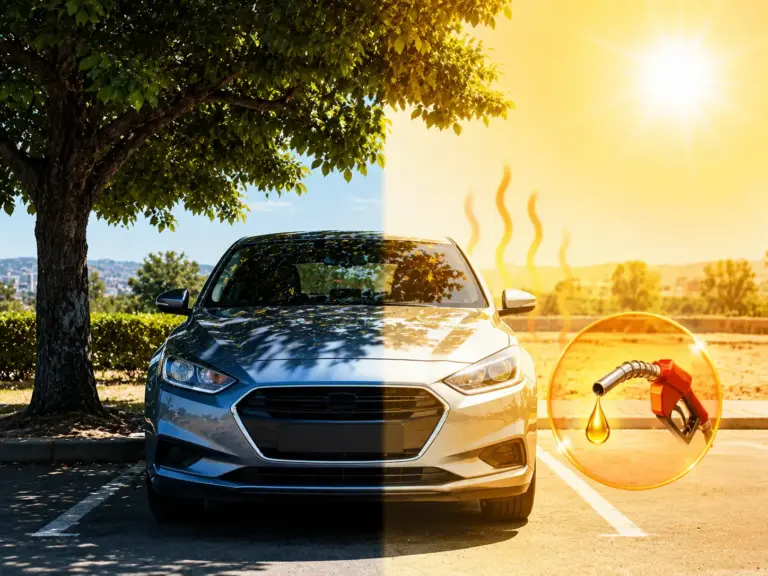
You park your car on a Friday after a long week, head inside, and do not touch it again until Monday morning. When you check the fuel gauge, it looks like the needle has dropped slightly. You start questioning yourself. Did you actually drive somewhere over the weekend and forget? Is the gauge just being inaccurate? Or did some of your gas literally vanish into thin air?
This is one of those car questions that sounds almost silly until you actually think about it. Gasoline is a liquid, and liquids evaporate. So is your expensive fuel slowly disappearing out of the tank while you sleep?
The honest answer is yes, gasoline can and does evaporate from a fuel tank. But modern vehicles are engineered specifically to prevent this from becoming a meaningful problem, and the actual amount of fuel you lose under normal conditions is small enough that most drivers will never notice.
Even so, there are situations where evaporation becomes significant enough to cost you money, hurt your fuel economy, or even create safety concerns. Understanding when and why gas evaporates helps you take simple steps to prevent it. Let us walk through the whole picture.
How Modern Fuel Systems Are Built to Keep Gas From Evaporating
Before getting into what goes wrong, it helps to understand what is supposed to keep your fuel where it belongs.
Every vehicle built since the 1970s in the United States, and earlier in some markets, includes what is called an EVAP system, short for Evaporative Emission Control System. This is a closed network of hoses, valves, and a charcoal canister designed to capture fuel vapors before they can escape into the atmosphere.
Here is how it works in plain terms. As fuel sits in your tank, some of it naturally vaporizes. Instead of letting that vapor vent out into the air, the EVAP system routes it through a charcoal canister, where the activated charcoal traps and stores the vapor. Then, when the engine is running, the system pulls that stored vapor into the intake and burns it as part of the normal combustion process.
That means in a properly functioning vehicle, the fuel that evaporates from the tank does not get lost. It gets recycled back into the engine and used as fuel. The whole system is sealed, monitored by the ECU, and triggers a check engine light if pressure is not where it should be.
This is why modern cars lose so little fuel to evaporation under normal conditions. The engineering specifically prevents it. But the system is not bulletproof, and there are several situations where evaporation losses become real.
The Main Reasons Your Gas Evaporates From the Tank
Hot Weather Pushes Evaporation Into Overdrive
Gasoline is what chemists call a volatile liquid. That means it has a strong tendency to transition from liquid to vapor at relatively low temperatures, especially compared to other liquids like water. The hotter it gets, the faster gasoline evaporates.
On a 95-degree summer afternoon, the fuel inside your tank, especially in a vehicle parked in direct sunlight, can heat up significantly. The metal or plastic tank conducts heat from the surrounding environment, and the fuel inside warms up along with it. As the fuel temperature rises, more of it converts to vapor.
If your EVAP system is healthy, most of that vapor still gets captured by the charcoal canister and burned later. But the canister has a finite capacity. On extremely hot days with the vehicle sitting unused for hours, the canister can saturate, and excess vapors may eventually find their way past the system or simply remain unrecycled.
Beyond the financial cost of fuel evaporation, this also contributes to atmospheric hydrocarbon emissions. Those evaporated hydrocarbons are part of what regulators target with stricter EVAP requirements, because they contribute to ground-level ozone and smog.
Practical Steps to Reduce Heat-Related Evaporation
You do not need to obsess over this, but a few simple habits genuinely help:
- Park in a garage whenever possible. An enclosed, shaded space keeps fuel temperatures dramatically lower than an open driveway in direct sun.
- Ventilate the garage if it tends to heat up. A garage that traps heat is almost as bad as parking in full sun. Cross-ventilation or a small fan can make a real difference.
- Use shaded street parking when a garage is not available. Even partial shade reduces tank temperature noticeably.
- Park with the fuel filler side away from direct afternoon sun when possible. The side of the tank exposed to the most direct heat is where evaporation accelerates fastest.
- Avoid topping off your tank in summer. Overfilling can push liquid fuel into the EVAP system and compromise its ability to handle vapor properly.
A Loose or Damaged Fuel Cap Is a Bigger Deal Than You Think
The fuel cap is one of the most overlooked components on the entire vehicle. People treat it like a throwaway part. But it plays a real role in keeping the fuel system sealed and preventing vapor loss.
The cap contains a rubber seal that creates an airtight connection between the cap and the fuel filler neck. When that seal is intact and the cap is properly tightened, vapor cannot escape from the filler opening. When the seal is cracked, dried out, or the cap is just loose, vapors leak directly out into the air.
A loose or failing fuel cap is actually one of the most common causes of a check engine light in modern vehicles. The EVAP system monitors pressure in the fuel system, and if it detects a leak, it triggers a diagnostic code. The cap failing is often the source.
Signs your fuel cap might need attention include:
- Check engine light comes on with EVAP-related fault codes (commonly P0440, P0455, P0457)
- You can smell gasoline near the filler area
- The cap does not click multiple times when you tighten it (most caps should click three times to indicate proper seal)
- The rubber seal looks cracked, hardened, or deformed
- The cap feels loose even when fully tightened
Replacement fuel caps are inexpensive, often under $20, and you can usually replace one in about thirty seconds without any tools. Compared to the fuel you lose from a leaking cap over time, plus the inconvenience of a check engine light, replacing a worn cap is one of the easiest wins in car maintenance.
Old Gas vs. New Gas: Which One Evaporates Faster?
Here is an interesting wrinkle in the evaporation conversation. Not all gasoline evaporates at the same rate. The age of the fuel matters.
Fresh gasoline contains a balanced mix of light hydrocarbons and heavier compounds. The lighter hydrocarbons are responsible for easy starting and quick ignition, but they are also the most volatile. They evaporate first.
Older gasoline that has been sitting in a tank for weeks or months has already lost many of those light, volatile compounds. What remains is the heavier, less volatile portion of the fuel blend. That older fuel evaporates more slowly, but it also burns less efficiently, ignites less reliably, and produces lower power output.
So while old gas does evaporate at a reduced rate compared to fresh gas, it is not really good news. The reason it evaporates more slowly is exactly the reason it makes a poor fuel: the good stuff is already gone.
Most experts recommend not letting gasoline sit in a tank for more than three to six months without use. Beyond that, the fuel begins degrading noticeably. After about two years, gasoline is generally considered too degraded for reliable use, even with fuel stabilizer added.
Can Old Gas Still Evaporate Completely?
Yes, it can. Old gasoline still evaporates, just at a slower rate than fresh gasoline. Given enough time at room temperature, even old gas will reduce in volume through evaporation.
This becomes a real concern for vehicles that sit unused for long periods, like seasonal vehicles, project cars, or vehicles in long-term storage. Letting gasoline sit in those tanks for extended periods leads to:
- Gradual evaporation, reducing the volume of fuel in the tank
- Oxidation, which makes the remaining fuel less combustible
- Varnish and gum formation inside the tank, fuel lines, and fuel injectors
- Potential moisture contamination as the tank breathes air in and out with temperature changes
For any vehicle that will sit unused for more than a few months, adding a quality fuel stabilizer to a full tank is the right move. A full tank reduces the air space inside, which reduces the surface area for evaporation and limits moisture infiltration. The stabilizer keeps the fuel chemically intact for an extended period.
The Temperature at Which Gasoline Actually Evaporates
Gasoline does not have a single boiling point the way water does, because it is a mixture of many different hydrocarbons, each with its own boiling characteristics. But the general benchmark is that gasoline begins vaporizing significantly at around 140 degrees Celsius (284 degrees Fahrenheit).
That sounds like a high temperature, and it is. Your fuel tank under normal conditions never gets anywhere close to that. So why does evaporation happen at all?
The answer is that gasoline has such weak intermolecular bonds that some portion of the liquid is converting to vapor at virtually any temperature above freezing. The full boiling point is the temperature at which the entire liquid would vigorously vaporize. But surface evaporation happens constantly, even at room temperature, just at a slower rate.
Compare this to water. Water has very strong hydrogen bonding between molecules, which is why it requires significantly more energy to evaporate. Gasoline molecules slip out of the liquid state with much less encouragement.
When gasoline accidentally mixes with water, the gasoline evaporates faster because its molecular bonds are weaker. Water’s hydrogen bonding holds the molecules together tightly even when exposed to air.
Seasonal Gasoline Blends and How They Affect Evaporation
Something many drivers do not realize is that the gasoline sold at your local station actually changes throughout the year. Refineries produce different fuel blends for summer and winter, and those blends have different evaporation characteristics.
Winter Gasoline Blend
Winter blend gasoline is formulated to evaporate more readily at cold temperatures. This helps cold engines start reliably and run smoothly when ambient temperatures are low. The blend includes more volatile compounds like butane, which vaporize easily even in freezing weather.
Winter gas works well in its intended season. But if winter blend fuel sits in a tank during warm spring weather, it evaporates significantly faster than summer blend would. That is part of why fuel economy sometimes seems off during the seasonal transition periods.
Summer Gasoline Blend
Summer blend gasoline is formulated to resist evaporation in hot weather. It has lower vapor pressure, which helps reduce smog formation and emissions during the warmer months. It also tends to deliver slightly better fuel economy than winter blend.
The transition between summer and winter blends happens twice a year, typically in spring and fall, and is one reason gasoline prices sometimes shift seasonally. The summer blend is more complex to produce, which is part of why it sometimes costs more.
You generally cannot choose between blends at the pump. Whatever the local stations are selling at that time of year is what you get. But knowing this exists helps explain seasonal variations in evaporation rates and fuel economy.
What Happens When Gasoline Spills on the Ground
Spilling gasoline is not just an inconvenience. It is a genuine environmental and safety problem.
Environmental Impact
When gasoline spills on the ground, some of it evaporates into the air, but a significant portion seeps into the soil. From there, it can work its way down into groundwater systems, potentially contaminating well water and aquifers. Even small spills add up over time when they happen repeatedly at gas stations, parking lots, and driveways.
Soil contamination from gasoline is genuinely difficult to remediate. The hydrocarbons persist in soil for years and can harm plant life, soil microorganisms, and any water systems they reach. This is why proper fuel handling and prompt cleanup of any spills matters.
Fire Risk
Spilled gasoline is also a serious fire hazard. Gasoline vapors are heavier than air, which means they pool in low areas and spread outward from the spill site. Those vapors can ignite from a flame, spark, or even static electricity source up to 12 feet away from the actual liquid spill.
That distance is important to understand. People sometimes think they can light a cigarette or use a phone “safely” away from where they spilled fuel. But invisible vapors are spreading across the ground in every direction. The ignition source does not need to be near the puddle. It needs to be away from the vapor cloud.
One thing worth noting is that liquid gasoline itself does not ignite easily under direct sunlight. The liquid needs an ignition source. But the vapors are extremely flammable and can ignite from sources you would not initially consider dangerous.
If you spill gasoline, here is what to do:
- Eliminate all ignition sources immediately. No smoking, no electronics, no engines starting nearby.
- Use absorbent material like cat litter, sand, or commercial absorbent to soak up the liquid.
- Scoop the contaminated absorbent into a metal container with a lid.
- Dispose of it at a hazardous waste facility, not in regular trash.
- Ventilate the area thoroughly before any normal activity resumes.
Gasoline Oxidation: The Slow Death of Old Fuel
Evaporation is not the only thing happening to fuel that sits unused. Gasoline also oxidizes when exposed to air over time.
Oxidation is a chemical reaction between the fuel and oxygen in the air. The reaction produces gum, varnish, and acidic compounds that did not exist in the original fuel. This causes several problems:
- The fuel becomes less combustible, leading to reduced engine power
- Varnish deposits coat fuel system components, restricting fuel flow
- Acidic compounds can corrode metal components in the fuel system
- Gum can clog fuel injectors and carburetor jets
If you leave an open container of gasoline exposed to air on a hot day, the volume will decrease noticeably within weeks due to evaporation, and within a few months the container could be nearly empty. But the fuel that remains would also be heavily oxidized and largely unusable.
This is why gasoline storage best practices include using sealed containers, keeping them in cool dark places, and using fuel stabilizers for longer-term storage. It is also why old gas you find in a long-stored mower or generator often will not run the equipment properly, even if there appears to be plenty of fuel in the tank.
How Much Gas Actually Evaporates in Real-World Conditions?
This is the practical question most drivers care about. How much fuel are you really losing to evaporation in a typical situation?
The honest answer for a modern vehicle with a functioning EVAP system is: very little. Estimates vary, but most studies suggest that a properly sealed, well-maintained vehicle loses less than a few ounces of fuel per week to evaporation, even in hot weather. That is barely noticeable on the fuel gauge.
However, the picture changes significantly under certain conditions:
| Condition | Estimated Weekly Loss |
|---|---|
| Modern vehicle, sealed EVAP, cool garage | Negligible (less than 2 oz) |
| Modern vehicle, hot driveway, full sun | 2 to 6 oz |
| Loose or damaged fuel cap | 4 to 12 oz |
| Cracked or damaged EVAP hose | 8 to 20 oz |
| Open container of gasoline, hot conditions | Several gallons over weeks |
These are rough estimates and actual losses depend on many factors. But the takeaway is clear: a well-maintained vehicle loses a tiny amount of fuel to evaporation. A vehicle with EVAP system problems can lose significantly more, and the financial impact compounds over time.
Signs Your EVAP System Has a Problem
Since the EVAP system is what prevents most evaporation losses, knowing when it has a problem helps you address evaporation issues before they get expensive.
Watch for these symptoms:
- Check engine light with EVAP-related codes (P0440 series codes are the common ones)
- Fuel smell around the vehicle, especially after parking or refueling
- Difficulty refueling, where the pump keeps clicking off even though the tank is not full
- Reduced fuel economy that cannot be explained by driving conditions or maintenance
- Hissing sound when removing the fuel cap that lasts longer than normal
EVAP system repairs vary widely in cost. A new fuel cap is under $20. A failed purge valve might run $100 to $250 installed. A damaged charcoal canister can cost $300 to $600 or more, depending on the vehicle. Any of these repairs is worth doing both for the fuel savings and to clear the check engine light, which is required for vehicle emissions inspections in many states.
Smart Habits That Reduce Fuel Evaporation and Save You Money
None of these are complicated, but they add up over time:
- Always tighten the fuel cap until it clicks at least three times. This confirms the seal is fully engaged.
- Replace your fuel cap every five to seven years or whenever the rubber seal looks worn. They are cheap and easy to swap out.
- Park in shade or a garage during hot weather whenever possible.
- Do not top off the tank after the pump automatically clicks off. Overfilling damages the EVAP system over time.
- Address check engine lights promptly. EVAP codes that go unfixed mean fuel is escaping that you paid for.
- For seasonal or stored vehicles, fill the tank completely and add fuel stabilizer before extended storage.
- Avoid storing gasoline in poorly sealed containers or leaving fuel cans exposed to direct sunlight.
- Run the vehicle regularly if it sits for long periods, ideally for at least 20 minutes to fully cycle the EVAP system.

The Bigger Picture on Gasoline and Evaporation
Gasoline evaporation is one of those issues that sits in the background of car ownership. You probably do not think about it much. Most of the time, you do not need to. Modern fuel systems handle it without your involvement, and the losses under normal conditions are too small to notice.
But the systems that prevent evaporation are not invincible. Fuel caps wear out. EVAP hoses crack. Charcoal canisters fail. Vehicles park in brutal summer heat. Gas sits unused for too long in storage tanks. Any of these situations can turn a non-issue into a real source of wasted fuel and unnecessary cost.
The good news is that the steps to prevent meaningful evaporation are simple, cheap, and easy to maintain as habits. A properly tightened gas cap, a garage parking spot, and prompt attention to EVAP warnings will handle the vast majority of situations that would otherwise cost you fuel.
Next time you fill up, take an extra second to make sure that cap clicks. Such a small action, but over the life of the vehicle, it pays back many times over.