
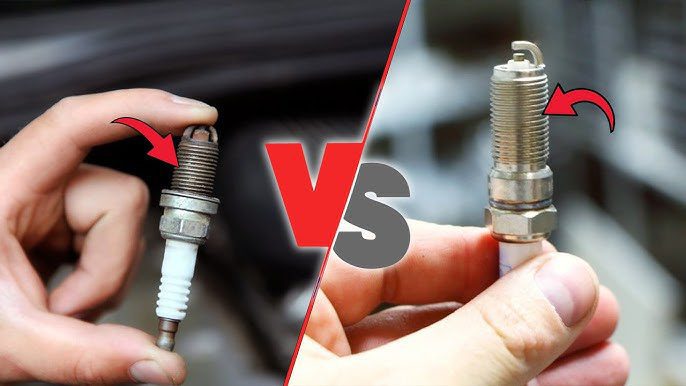
Every time you turn the key or push the start button, your spark plugs are already working. In the fraction of a second before the engine settles into its idle, each plug has fired multiple times, igniting compressed fuel and air to get the pistons moving. It is the most basic combustion event in automotive engineering, and it happens thousands of times per minute for the entire time your engine is running. The question of which spark plug material is doing all that work, copper or iridium, matters more than most drivers realize.
Walk into any parts store and the shelf is full of options at wildly different prices. A set of copper plugs might cost you ten dollars. A set of iridium plugs for the same application could run eighty dollars or more. Are the expensive ones worth it? That depends on your engine, your driving habits, and what you are actually trying to achieve. Neither material is universally better. Each has a legitimate role, and understanding the real differences between them helps you make a decision based on your actual situation rather than marketing claims.
What Copper Spark Plugs Actually Are and Where They Belong
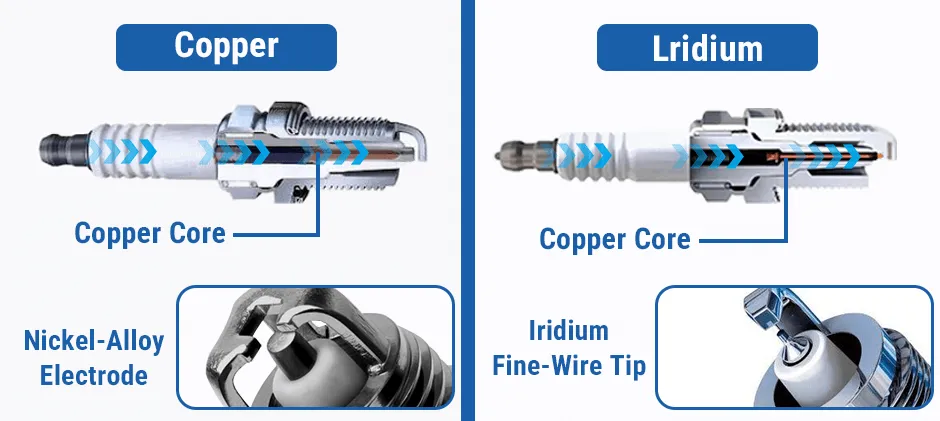
The name “copper spark plug” can be slightly misleading. The entire plug is not made of copper. The outer shell, the threads, and the ground electrode are made of nickel alloy, which handles the heat and corrosion of the combustion environment. What is copper is the center electrode’s core, which provides the electrical conductivity that makes this design distinctive. That copper core is then wrapped in a nickel alloy casing to protect it from the combustion heat it could not otherwise survive directly.
Copper conducts electricity exceptionally well. Among common metals, it is one of the best electrical conductors available, which is why it was chosen for this application in the first place. That high conductivity means the plug requires less voltage to fire reliably. Lower required voltage means the ignition system can produce a strong, consistent spark even when conditions inside the combustion chamber are not ideal, such as during cold starts, hard acceleration, or high compression events.
Copper plugs also run cooler than most alternatives, which is a meaningful advantage in high-performance and high-compression applications. High-compression engines, including many turbocharged and supercharged setups, generate intense combustion heat. A plug that runs too hot in these environments causes pre-ignition, where the fuel charge ignites before the spark fires, an event that destroys pistons and bearings rapidly. Copper’s lower operating temperature provides a safety margin in these demanding conditions. This is exactly why many high-performance factory engines and aftermarket builds specify copper plugs as original equipment.
The trade-off is straightforward. Copper is soft. The center electrode tip wears relatively quickly as the thousands of high-energy sparks erode its surface. Copper plugs typically need replacement between 10,000 and 20,000 miles, depending on the engine and driving conditions. For a daily driver, that means a plug change every year or two, an additional maintenance cost that does not apply to longer-life alternatives.
What Iridium Spark Plugs Bring to the Table
Iridium is a platinum group metal with physical properties that make it exceptionally well-suited for the spark plug electrode environment. It is roughly eight times harder than copper and has a melting point around 4,435 degrees Fahrenheit, compared to copper’s 1,984 degrees. That extraordinary hardness and thermal stability allow the electrode tip to maintain its shape and gap dimension for far longer than copper can manage. Iridium plugs are generally rated for 50,000 to 100,000 miles of service life, with some manufacturers claiming even longer intervals under ideal conditions.
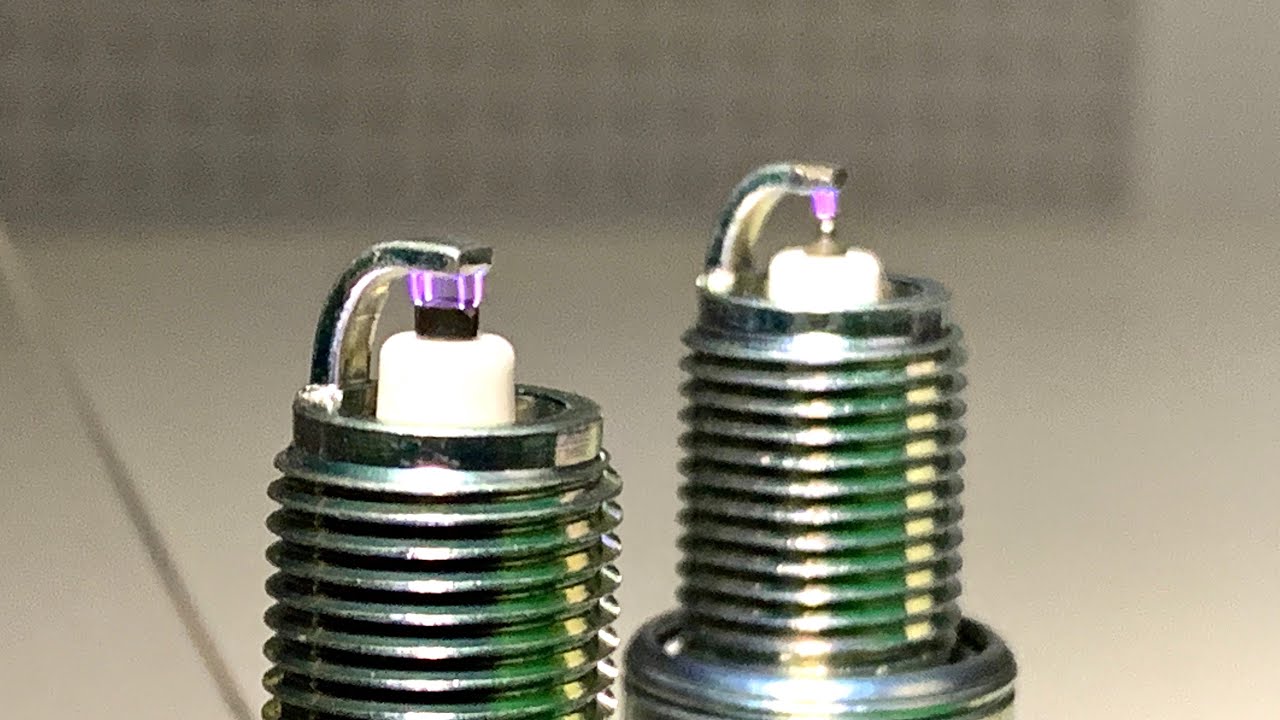
Because iridium is so hard, manufacturers can make the center electrode tip very fine, often less than a millimeter in diameter. A fine tip concentrates the electrical field at a point, which reduces the voltage required to initiate a spark and allows for a more precisely aimed, focused spark event. The result is more complete combustion of the fuel charge. More complete combustion means more energy extracted from each combustion event, which contributes to the improved fuel economy and reduced emissions that iridium plugs are known for.
The iridium electrode tip also maintains its original geometry far longer than copper. As a copper electrode wears, the tip rounds and the gap widens. A wider gap requires more voltage to bridge and produces a less consistent spark. Iridium’s resistance to wear means the plug continues firing with its designed parameters for a vastly longer service period. The engine runs with consistent ignition quality throughout the plug’s life rather than gradually degrading as the copper erodes.
The downside is cost and, in some applications, thermal characteristics. Iridium is one of the rarest metals on earth, which directly drives the price premium. In high-performance applications with extreme combustion temperatures, iridium’s higher operating temperature relative to copper can occasionally be a consideration for tuners pushing engines well beyond factory specifications. For standard daily driving, this is not a practical concern.
The Side-by-Side Breakdown That Actually Helps You Choose
| Characteristic | Copper Spark Plug | Iridium Spark Plug |
|---|---|---|
| Center electrode material | Nickel-coated copper core | Iridium alloy tip, sometimes on copper core |
| Service life | 10,000 to 20,000 miles | 50,000 to 100,000 miles |
| Electrode hardness | Relatively soft, wears more quickly | Approximately 8x harder than copper |
| Electrical conductivity | Excellent, lowest voltage requirement to fire | Good, fine tip concentrates spark effectively |
| Operating temperature | Lower, runs cooler | Higher, runs warmer |
| Best application | High-compression, high-performance, older ignition systems | Modern engines with coil-on-plug ignition, everyday driving |
| Price per plug | Very affordable, typically the cheapest option | Significantly more expensive per plug |
| Long-term cost per mile | Higher due to frequent replacement | Lower despite higher upfront cost |
| Fuel economy impact | Good performance, especially in correct applications | Marginally better due to more complete combustion |
| Ignition system compatibility | Works with older single-coil and distributor systems | Optimal for coil-on-plug systems in modern engines |
The Lifespan Question in Real Numbers
A standard copper spark plug needs replacement at roughly 10,000 to 20,000 miles. Many manufacturers recommend checking them around 12,000 miles and replacing them by 20,000 at the latest for consistent performance. For a driver covering 15,000 miles per year, that is a new set of plugs every one to one and a half years.
Iridium plugs are rated for 50,000 to 100,000 miles depending on the specific product and application. That same 15,000-mile-per-year driver would replace iridium plugs roughly every three to seven years. The set costs more at purchase, but the labor involved in a spark plug change is the same regardless of which plug goes in. Paying for that labor every year versus every five years has a real dollar value that often more than covers the premium on iridium plugs over the same total mileage.
The cost-per-mile math typically favors iridium in modern engines that are designed for the plug’s service interval. For older vehicles or performance builds where copper is the correct specification, the economics are different and the plug choice should be driven by what the engine actually needs rather than the cost comparison.
Does Either Type Actually Increase Horsepower?
This is a question that appears in nearly every spark plug discussion, and the honest answer requires some nuance. Neither copper nor iridium spark plugs create horsepower from nothing. A spark plug cannot add energy to the combustion event that was not already present in the fuel. What spark plugs can do is either fully realize the combustion potential of the fuel charge or partially waste it.
A spark plug that is misfiring, or producing a weak and inconsistent spark, is effectively losing power that should have been generated. When you replace a worn, fouled, or incorrect plug with a fresh plug of the correct specification, the engine recovers the power it was already supposed to be producing. That recovery can feel like a power increase, and in terms of comparing the before and after state, it functionally is one. But it is recovery, not addition.
Copper plugs perform well in high-compression and turbocharged environments. Their lower operating temperature, combined with excellent conductivity, makes them a reliable choice when the factory specification calls for them. Running the correct heat range copper plug in an engine designed for it gives that engine its best possible combustion quality from that ignition component.
Iridium plugs improve combustion efficiency through the more focused, consistent spark produced by the fine electrode tip. More complete combustion of the available fuel charge means marginally more energy release per combustion event, which translates to modest fuel economy improvement and marginally cleaner emissions. The power difference in a stock engine running the correct copper specification versus iridium is unlikely to be something you would feel in the seat. The fuel economy improvement over tens of thousands of miles, however, is measurable.
Which Type Produces a Better Spark and Why It Matters
Iridium produces the stronger and more precise spark of the two. The fine tip concentrates the electrical discharge at a single point rather than distributing it across a wider electrode surface. This concentrated arc ignites the fuel charge more reliably across a wider range of conditions, including cold starts, high humidity, and low-load driving where the mixture can be harder to ignite consistently.
This property makes iridium plugs particularly compatible with modern coil-on-plug (COP) ignition systems. In these systems, each cylinder has its own dedicated ignition coil sitting directly on top of the spark plug, eliminating the spark plug wires that older distributor systems used. COP systems are designed around the electrical characteristics of fine-wire iridium and platinum plugs. Using copper plugs in a COP system is not damaging, but you are not fully using the ignition system’s design intent.
Copper’s advantage in spark quality comes not from the spark itself but from the voltage required to produce it. Copper’s high conductivity means the plug fires at a lower voltage threshold, which is beneficial in high-compression and boosted engines where the ignition system is already working harder to overcome increased cylinder pressure. This is the counterintuitive aspect of the comparison: copper is not inherently producing a weaker spark, it is producing a reliable spark with less voltage demand, which in the right application is an advantage.
Fuel Economy: Which Type Delivers Better Mileage
Over a long service life, iridium plugs deliver marginally better fuel economy than copper in most modern engines. The improvement comes from more complete combustion, which extracts more energy from each fuel charge and reduces unburned hydrocarbons exiting with the exhaust. The magnitude of this improvement is typically in the range of one to three percent, which is noticeable in accumulated fuel costs over tens of thousands of miles but not something you will perceive on a single tank of fuel.
The degradation curve also matters for fuel economy. A fresh copper plug fires efficiently and delivers its designed economy. But as it wears over its shorter service life, the widening electrode gap requires more voltage, produces a less consistent spark, and combustion efficiency decreases. By the time the copper plug is due for replacement at 20,000 miles, it may have been delivering suboptimal economy for the last several thousand miles. An iridium plug maintains its geometry and firing characteristics far longer, meaning its fuel economy contribution remains relatively stable throughout its service life.
For drivers doing a high annual mileage who keep meticulous records, replacing copper plugs on schedule and maintaining fresh plugs at all times largely closes the economy gap. For drivers who tend to push maintenance intervals or may go a few thousand miles past the recommended replacement point, iridium’s longer life provides a practical buffer.

Notable Products in Each Category
If you are shopping for copper plugs, two brands consistently earn respect in the enthusiast and mechanic community. Champion Copper Plus plugs have decades of track record in both daily drivers and performance applications. Bosch’s Copper Plus with Nickel line is another widely trusted option that combines copper’s conductivity with good corrosion resistance from the nickel outer components. Both are available for nearly every application and are priced accessibly.
On the iridium side, the field is broader. NGK’s 6619 Iridium IX plugs are a benchmark product for enthusiasts who want proven iridium performance at a reasonable price point. Denso Iridium TT plugs use twin-tip technology with iridium on the center electrode and platinum on the ground electrode to minimize voltage requirement while maintaining extreme durability. ACDelco Professional Iridium plugs are the OEM choice for many General Motors applications and represent a reliable factory-specification option. NGK’s LFR6AIX-11 Iridium IX series is a go-to recommendation for many Japanese domestic market vehicles that come from the factory with iridium specifications. The Solid Iridium OEM-spec plugs for Toyota applications are worth mentioning specifically because Toyota’s factory specifications on many models call for iridium from the factory, and using the correct specification matters more than brand preference in those applications.
For fuel economy optimization specifically, the products most often cited include NGK G-Power platinum plugs for their balance of price and efficiency, NGK Iridium IX for its comprehensive coverage across applications, Bosch Double Platinum plugs for their twin-electrode design that reduces electrode wear on both sides simultaneously, Denso Platinum TT for the twin-tip platinum configuration, and Motorcraft Platinum plugs as the preferred OEM choice for Ford applications.
The Decision That Actually Matters Most: What Does Your Engine Specify?
The most common mistake drivers make when shopping for spark plugs is treating the copper-versus-iridium decision as purely a preference or budget question. The most important input is your vehicle’s factory specification. Your owner’s manual and the manufacturer’s official parts database for your year, make, model, and engine specify a plug type and heat range. This specification was determined through extensive development testing to optimize ignition performance, combustion efficiency, and longevity for your specific engine’s operating parameters.
If your factory specification calls for copper, that is likely because your engine is high-compression, turbocharged, or uses an older ignition architecture that benefits from copper’s electrical characteristics. Installing iridium plugs in that application may not harm anything, but you may find the higher operating temperature of iridium causes issues in an engine that generates already-high combustion temperatures. If your factory specification calls for iridium or platinum, that reflects the engine’s design around modern fine-wire ignition technology, and installing copper plugs will not damage the engine but will require more frequent replacement and may not fully utilize the ignition system’s capabilities.
Upgrading from the factory specification in the direction of iridium on engines that already call for conventional plugs is a choice many drivers make, and it typically works without issue while providing the longevity benefit. Downgrading from an iridium specification to copper to save money is less advisable because you are now introducing more frequent replacement costs and potentially not meeting the design intent of the ignition system.
The bottom line is straightforward. Copper for high-performance applications that call for it and for older vehicles with distributor ignition systems. Iridium for modern engines with coil-on-plug ignition and for any driver who prioritizes long service intervals and consistent combustion efficiency over the entire life of the plug. Both materials are legitimate tools for the applications they were designed to serve. The job is matching the tool to the application, not picking one because it costs more or sounds more impressive on paper.