
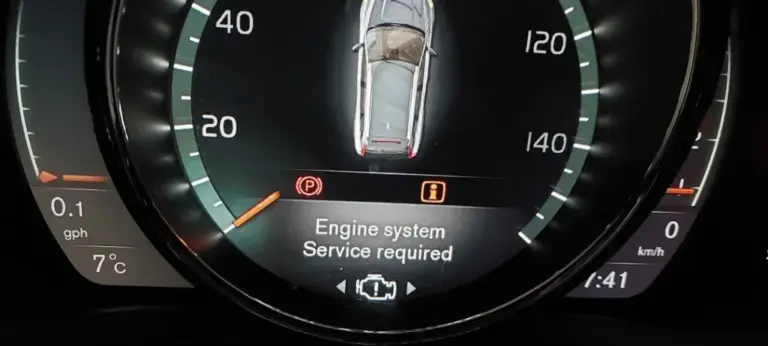
A customer rolled into our shop last Tuesday in a Volvo XC60 with his shoulders hunched up around his ears. The amber triangle had popped up in the center of his instrument cluster alongside the text “Engine System Service Required,” and he was convinced the engine was about to lock up on the highway. When I hooked up the scan tool and checked the crankcase, the culprit wasn’t a blown turbo or a cracked block. A quick-lube shop had poured half a quart too much oil into the engine the day before, and as the oil heated up on his morning commute, the ultrasonic level sensor in the oil pan flagged an overfill condition.
Volvo’s dashboard messages are famous for sounding vague and dramatic at the same time. Unlike a standard check engine light that sits over in the corner of the gauges, the Driver Information Module (DIM) puts a text banner right in front of your face without telling you whether a $25 sensor failed or the diesel particulate filter is choked with soot. You don’t need to panic when that amber message appears, but you can’t ignore it for months either.
Let’s break down what actually triggers the “Engine System Service Required” warning on both gasoline and diesel Volvos, why an overfilled crankcase or interrupted DPF regeneration sets it off so often, and how you can check the basics in your own driveway before paying a shop for diagnostics.
What the Volvo “Engine System Service Required” warning actually means
On most P2, P3, and newer SPA-platform Volvos (including the S60, S80, V60, V70, XC60, XC70, and XC90), the instrument cluster uses a tiered warning system. When the Engine Control Module (ECM) spots a sensor reading, fluid level, or emissions parameter outside its programmed window, it sends a message over the CAN network to the Driver Information Module. Instead of flashing raw fault codes at the driver, the dash displays a general service prompt accompanied by either an amber or red warning triangle.
The color of that center warning light and the exact wording on the screen tell you how urgent the problem is right now. An amber light with “Engine System Service Required” means the computer has logged a fault that needs attention soon, though the car is usually safe to drive gently to a shop or home if it sounds and feels normal. If the triangle turns red, or if the message escalates to “Engine System Service Urgent” or “Reduced Engine Performance,” the computer has detected a fault serious enough to force limp mode or risk catalyst and turbocharger damage.
| Dashboard Message & Light | How the Car Usually Drives | What the Computer Is Doing | What You Should Do Right Now |
|---|---|---|---|
| Engine System Service Required (Amber Triangle) | Often drives completely normal, or has a mild hiccup at idle or part throttle | Stored a pending or confirmed fault for oil level, a sensor, emissions, or incomplete DPF regen | Check oil level, gas cap, and basic hoses; schedule a scan within a few days |
| Engine System Service Urgent (Red Triangle or Amber + Check Engine) | Noticeable power loss, rough running, or capped RPM and boost pressure | Detected an active fault that could damage the engine, turbo, or exhaust aftertreatment | Avoid heavy throttle or highway towing; have the car scanned immediately |
| Reduced Engine Performance (Amber or Red Triangle) | Limp-home mode; sluggish throttle response and limited top speed | Cut boost and fuel delivery to protect the powertrain from a throttle, boost, or clogged DPF fault | Pull over safely to restart if in a bad spot; tow or drive slowly straight to a repair shop |
| Oil Level Service Required / Engine System Service Required after oil change | Normal performance, no misfires or odd noises | Ultrasonic oil level sensor in the sump sees oil above the maximum threshold (or below minimum) | Verify oil level via dipstick or dash menu; drain 0.3 to 0.5 quarts if overfilled |
The four main causes behind Volvo’s Engine System Service Required alert
While dozens of individual fault codes can light up the message board, roughly eighty percent of the Volvos I diagnose in the bay come down to four specific trouble spots. Two of them apply to every petrol and diesel Volvo on the road, and two of them are notorious traps on five-cylinder, four-cylinder Drive-E, and D3/D4/D5 diesel engines.
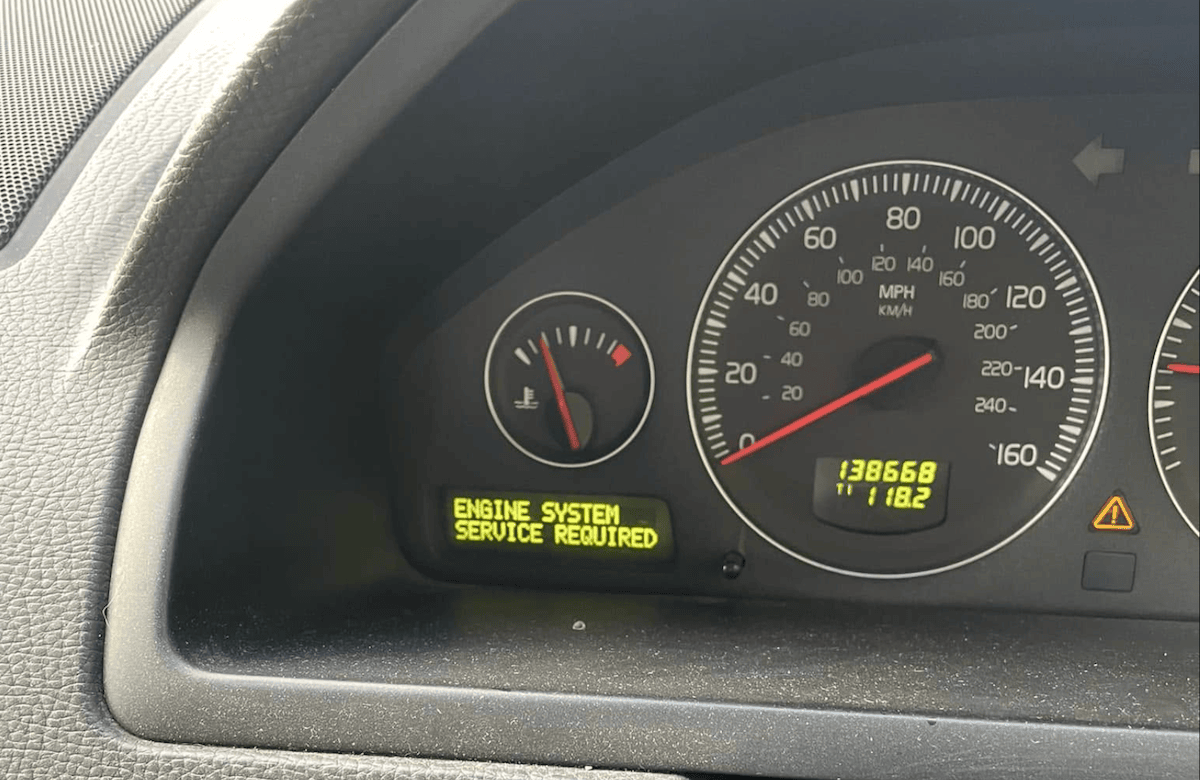
1. Excess engine oil (after an oil change or from fuel dilution)
If I had a dollar for every Volvo that showed up with “Engine System Service Required” forty-eight hours after an oil change, I could buy a nice lunch every week. Beginning in the late 2000s on many 5-cylinder, 6-cylinder, D5 diesel, and later 4-cylinder Drive-E engines, Volvo eliminated the traditional full-length yellow handle dipstick and switched to an electronic ultrasonic oil level sensor mounted in the bottom of the oil pan. Even on models that still have a tiny stubby grey technician dipstick buried deep down on the front of the engine block, most mechanics and DIYers fill the crankcase by looking up the dry capacity in a fluid chart.
Here is the trap: when you drain the oil pan on a Volvo, about 0.3 to 0.5 quarts of old oil stays trapped inside the oil cooler lines, the variable valve timing hubs, and the bottom pockets of the sump. If the spec book says 5.9 liters (6.2 quarts) and you dump the entire 5.9 liters in without holding a half-quart back, the true oil level sits right at or slightly above 100% full. Once you drive on the freeway and the oil heats up and expands in volume, the electronic sensor reads an overfill condition and fires off the “Engine System Service Required” message on your dash.
Overfilled oil is more than a sensor annoyance. When the oil level in the pan rises too high, the spinning crankshaft counterweights whip the surface of the oil like an eggbeater, aerating the oil into a bubbly foam. Foamy oil can’t maintain a strong hydraulic film inside your rod bearings or turbocharger shaft journals, and excessive crankcase mist can overwhelm the Positive Crankcase Ventilation (PCV) oil trap and foul the intake manifold.
Why diesel Volvos “make oil” even when nobody added any
If you drive a Volvo diesel (such as a D3, D4, or D5 in an S80, XC60, V70, or XC90) and the “Engine System Service Required” message pops up with a high oil level even though nobody touched the oil filler cap for months, your engine isn’t magically manufacturing motor oil. It is dumping raw diesel fuel into the crankcase during interrupted DPF regenerations.
To burn soot out of the exhaust filter, the computer injects extra diesel fuel late in the exhaust stroke so unburned fuel travels down the exhaust pipe and heats up the catalyst. When you shut the engine off halfway through that cycle on short city errands, some of that unburned diesel washes past the piston rings and drips straight into the oil pan. Over a few weeks of short trips, a half-liter of diesel fuel mixes into your motor oil, raises the fluid level past the sensor’s high limit, thins out the oil viscosity, and triggers the dashboard warning.
2. DPF regeneration failures and soot accumulation on diesel models
On diesel-powered Volvos, the Diesel Particulate Filter (DPF) is a ceramic honeycomb trap bolted into the exhaust system that catches black carbon soot before it can leave the tailpipe. Because that filter has a limited capacity, the car has to clean it out periodically through a process called regeneration, raising exhaust temperatures above 1,100 degrees Fahrenheit (600 degrees Celsius) so the trapped soot burns off into a tiny amount of ash.
Passive and active regeneration normally happen automatically in the background while you cruise at steady highway speeds. The problem starts when a diesel Volvo spends weeks doing five-mile school runs, grocery trips, and cold stop-and-go city commuting. The exhaust never stays hot long enough to finish a burn cycle, soot mass climbs past the threshold (often around 24 to 30 grams in the ECM counter), and the differential pressure sensor sees high backpressure across the filter, triggering “Engine System Service Required” or a soot filter full warning.
Don’t automatically blame the DPF filter core itself when a DPF code shows up! On a huge number of Volvo D5 and D4 engines, the real culprit is a $40 rubber differential pressure hose that cracked from exhaust heat, a failed exhaust gas temperature sensor, or a stuck EGR valve that’s feeding too much soot into the exhaust in the first place. If the computer thinks the exhaust temperature sensor or pressure sensor is lying, it cancels automatic regeneration as a safety precaution, and the filter clogs up within days.
3. Faulty engine management sensors (MAF, O2, boost, and fuel pressure)
When your oil level is spot-on and the exhaust isn’t plugged, a drifting or failed engine sensor is the next place I look. Modern Volvos rely on dozens of sensors to meter air, fuel, turbo boost, and camshaft timing, and when one sensor’s voltage falls outside its expected window, the ECM throws up the service banner.
- Mass Airflow (MAF) sensor contamination: Tucked into the intake pipe right behind the air filter box, the hot-film MAF sensor measures every gram of air entering the engine. If dust gets past a poorly seated air filter or oil mist from an aftermarket oiled air filter coats the sensing element, fuel trims drift out of range and trigger the message alongside sluggish acceleration.
- Oxygen (Lambda) sensors: Both upstream wideband air-fuel ratio sensors and downstream catalyst monitor sensors wear out with age and heat cycles (usually between 90,000 and 140,000 miles). A lazy oxygen sensor heater circuit or slow response rate sets an emissions fault and turns on the service warning even if the car still feels smooth.
- Fuel rail pressure sensor (FPS) on gasoline models: On P2 and P3 gasoline Volvos (2.5T, T5, 3.2, and T6), the Bosch fuel pressure sensor bolted to the end of the fuel rail is a classic failure item. When it starts glitching, you’ll feel a brief stumble or hesitation on the highway followed by the “Engine System Service Required” message.
- MAP / Boost pressure sensor and TCV: Turbocharged Volvos monitor boost pressure closely in the intercooler piping. A oil-fouled boost pressure sensor or a worn Turbo Control Valve (TCV) that lets boost spike or sag below target will immediately log an overboost or underboost code.
4. Emissions, EVAP leaks, and crankcase ventilation (PCV) problems
Your Volvo also runs continuous self-tests on its emissions hardware while you drive and even after you park the car for the night. On gasoline models, the Evaporative Emission Control (EVAP) system pressurizes or pulls a vacuum on the fuel tank to make sure gasoline vapors aren’t escaping into the outside air. A loose gas cap with a cracked rubber O-ring, a sticking EVAP purge valve on top of the engine, or a failed leak detection pump near the rear axle will set an emissions code and bring up the warning message.
Another signature Volvo trouble spot is the Positive Crankcase Ventilation (PCV) oil trap housing. When the rubber diaphragm inside the PCV box tears on a 5-cylinder, 6-cylinder, or Drive-E 4-cylinder engine, it creates a massive unmetered vacuum leak inside the crankcase. You’ll often hear a high-pitched tea-kettle whistle or squeal coming from under the hood at idle that disappears the instant you pull the oil dipstick or loosen the oil filler cap, and that lean vacuum leak triggers “Engine System Service Required” within a few miles.
How to troubleshoot “Engine System Service Required” in your driveway
You don’t need a hydraulic lift to do the first round of checks. Before you hand a shop $150 to $200 for diagnostic time, spend fifteen minutes going through the oil check, under-hood inspection, and code read so you know exactly what you’re dealing with.
Step 1: checking your Volvo’s oil level the right way
How you check the oil depends on whether your Volvo has a traditional dipstick, the hidden technician dipstick, or an electronic-only dashboard gauge. Never check the oil on a sloped driveway, because a five-degree tilt is enough to make an overfilled sump look normal or a normal sump look low.
- For Volvos with a physical dipstick: Park on level ground, shut off the engine, and wait 5 to 10 minutes for oil in the cylinder head to drain back into the pan. Pull the yellow, orange, or short grey dipstick at the lower front of the block, wipe it clean with a lint-free rag, push it all the way back in, and pull it out again to read the crosshatched zone between MIN and MAX.
- For Volvos with an electronic dashboard oil gauge: Sit in the car on level ground after the engine has been shut off for at least 10 to 15 minutes (or before your first cold start of the morning). Press and hold the engine Start/Stop button for two seconds without touching the brake pedal to enter Ignition Position II, then use the left turn-signal stalk thumbwheel or center Sensus/Google screen to open the Vehicle Status & Oil Level display.
- Aim for the three-quarter mark, never the very top bar: Whether you are reading a physical stick or the digital bar graph, the sweet spot on a Volvo is about two-thirds to three-quarters of the way between MIN and MAX. If the digital bar says “Overfilled” or sits pinned at the absolute top after a recent oil change, draining out roughly 0.4 to 0.5 quarts (about 400 to 500 ml) and resetting/driving the car usually clears the warning after a few drive cycles.
Step 2: checking the gas cap, air box, and PCV whistle
Pop the fuel door and twist off your gas cap. Inspect the black rubber sealing ring around the threads for deep cracks, dry rot, or grit, then screw it back on until it clicks firmly. If the message popped up a day or two after you bought gas, a loose cap is an easy win.
Next, open the hood with the engine idling in Park and listen carefully near the plastic engine cover. If you hear a loud squealing or sucking noise, carefully crack the oil filler cap loose by half a turn while the engine is running; if there is heavy suction fighting your hand and the squeal stops the moment air gets in, your PCV oil trap diaphragm is torn. While the hood is up, also check the pleated rubber intake accordion hose between the air filter box and the turbo/throttle body for splits or a loose hose clamp that could throw off the MAF sensor.
Step 3: scanning for Volvo fault codes (and why generic scanners miss things)
To stop guessing and see what the Engine Control Module actually flagged, you need to pull the stored Diagnostic Trouble Codes (DTCs) through the OBD-II port. You’ll find the 16-pin diagnostic connector tucked under the lower left side of the dashboard above the driver’s footwell pedals.
- Connect the scan tool with the ignition off: Plug your OBD-II scanner firmly into the under-dash port until it seats.
- Put the Volvo into Ignition Position II: On keyless push-button Volvos (either the dash slot fob or the twist knob), keep your foot off the brake or clutch pedal and hold the Start/Stop button for about 2 seconds until all the dashboard warning lights illuminate without starting the engine.
- Read both generic OBD-II codes and manufacturer-specific ECM codes: Wait for the scanner to establish communication, then check both Stored Codes and Pending Codes. Write down every code number before you clear anything!
One honest mechanic warning here: a $25 generic parts-store code reader only reads federally mandated emissions “P-codes” (like P0101 or P0171). Volvo computers also use proprietary hexadecimal module codes that a basic scanner sometimes won’t display unless the Check Engine light is also lit. Using a Volvo-capable scanner (such as a VIDA/DiCE setup, iCarsoft for Volvo, Foxwell NT530 with Volvo software, or Autel) lets you read the exact Volvo ECM codes, live DPF soot mass in grams, and ultrasonic oil level in millimeters.
Common Volvo error codes and dashboard numbers behind the message
When you scan a Volvo with “Engine System Service Required” on the dash, or when you check the hidden instrument cluster diagnostic menu, certain code numbers show up again and again. Knowing what those numbers mean prevents a shop from selling you the wrong part.
What Volvo ECM-6200 and boost/mount control codes mean
If a Volvo-specific scanner pulls ECM-6200, don’t let anyone tell you that you need a brand-new $1,500 Engine Control Module computer! On Volvo models, the “ECM-” prefix simply means the code is stored inside the Engine Control Module, not that the computer box itself is fried. Specifically, ECM-6200 on Volvo 5-cylinder engines points to a fault in the engine mount control solenoid valve circuit (or on certain engine variants, a boost/solenoid actuator circuit controlled by the ECM).
Many P2 and P3 Volvos (especially D5 diesels and turbo models) use vacuum-controlled hydraulic engine mounts that soften at idle to absorb vibration and stiffen up under acceleration. A small electric solenoid valve controls vacuum to those mounts, and when the solenoid coil shorts out, gets unplugged during repair work, or suffers a broken wire, the ECM logs ECM-6200. Even more common is a ruptured rubber bladder inside one of the vacuum engine mounts, which leaks vacuum away from the turbo boost control system and triggers an “Engine System Service Required” message alongside sluggish low-RPM turbo boost!
What “Code 097” on the instrument cluster actually is
You’ll often hear owners of 2007 to 2014 Volvo S80, V70, XC70, and XC60 models (especially D5 diesels) talk about pulling up Code 097 (or 042, 019, and similar three-digit numbers) by holding the trip odometer reset button while pressing the rear fog light button. Here is the truth that confuses so many forum readers: 097 is not an engine diagnostic trouble code. It is simply the internal Driver Information Module (DIM) text-message ID number that corresponds to the phrase “Engine System Service Required” on the dashboard screen!
Seeing message ID 097 confirms that the instrument cluster is displaying that specific warning banner, and it often appears when the oil level sensor detects an overfill after an oil change or when a DPF/swirl-flap fault is stored in the ECM. To see the actual mechanical or electrical fault behind message 097, you still have to read the ECM module through the OBD-II port under the steering wheel.
Common Volvo fault codes, symptoms, and realistic repair costs
| Code (Volvo / OBD-II) | System / Component Involved | Typical Symptoms You’ll Notice | Estimated Parts & Repair Cost |
|---|---|---|---|
| ECM-2580 / P252F | Engine oil level too high (ultrasonic sensor) | Message appears 1 to 3 days after an oil change, or after weeks of short diesel trips; car drives normal | $0 DIY (drain 0.4 qt oil) or $40 to $90 at a shop to adjust level and reset |
| ECM-2A30 / ECM-2A40 / P2463 / P2458 | DPF soot accumulation or regeneration duration fault | Sluggish highway passing, cooling fan runs loud after shutoff, elevated fuel consumption | $120 to $280 for sensor/hose or forced regen; $400 to $800 for off-car DPF cleaning |
| ECM-6200 / ECM-6805 / P0299 | Engine mount control valve / Turbo boost pressure control | Weak boost below 2,500 RPM, rough vibration at idle, warning pops up when climbing hills | $80 to $180 for vacuum solenoid/hoses; $250 to $550 if vacuum engine mounts are leaking |
| ECM-120D / ECM-130A / P0101 / P0171 | Mass Airflow (MAF) sensor range or intake air leak / PCV | Hesitation on acceleration, rough idle, possible whistling sound from PCV box | $15 for MAF cleaner; $140 to $280 for OEM Bosch/Denso MAF; $350 to $650 for PCV oil trap |
| ECM-2900 / P0191 / P0193 | Fuel Rail Pressure Sensor (FPS) range/performance | Brief bucking or hiccup at steady cruise, occasional long crank when warm | $70 to $140 DIY for Bosch sensor on end of fuel rail; $180 to $320 installed at a shop |
| ECM-4340 / P0442 / P0455 | EVAP system small or large leak (gas cap or purge valve) | Usually zero drivability symptoms, or slight hard start right after filling the gas tank | $20 to $45 for OEM gas cap; $90 to $240 for EVAP purge solenoid valve |
How a forced DPF regeneration works (and when driving on the highway is enough)
If your scan tool shows that the “Engine System Service Required” message came from an incomplete DPF regeneration or elevated soot load on a diesel Volvo, how you fix it depends entirely on how many grams of soot are packed into the filter right now. Catching it early saves you a lot of money.
When a 30-minute highway drive can still clear the DPF
When the soot load is moderately high (typically stage one, before the car locks itself into hard limp mode), you can often trigger a natural active regeneration by taking the car out on an open highway. Wait until the engine is fully warmed up, get onto a clear stretch of freeway where you can maintain a steady 60 to 70 mph (100 to 110 km/h), and manually select a gear that keeps engine speed between 2,200 and 2,800 RPM for 25 to 35 minutes without stopping.
Keeping the revs in that middle band generates steady exhaust heat and gas flow so the ECM can inject post-combustion fuel and burn the soot down to near zero. One critical condition people forget: make sure you have at least a quarter tank of fuel and no active glow plug, thermostat, or exhaust temperature sensor fault codes stored, because the Volvo ECM will refuse to start a highway regeneration if the coolant isn’t reaching full operating temperature (at least 175°F / 80°C) or if a sensor code is present.
When a mechanic has to run a forced service regeneration
Once soot mass climbs past the computer’s safe driving threshold (often around 30 to 40 grams), the ECM disables normal highway regeneration to prevent an uncontrolled exhaust fire and puts the car into reduced performance mode. At that point, driving up and down the motorway for two hours won’t do a thing except burn fuel.
A Volvo specialist has to connect a diagnostic tool (like VIDA), verify that the differential pressure hoses and temperature sensors work properly, park the car outdoors away from anything flammable, and initiate a stationary forced DPF regeneration. During a forced regen, the computer runs the engine at an elevated RPM for 20 to 40 minutes while baking the soot out of the filter, and we always recommend changing the engine oil and filter afterward because stationary regenerations put heavy thermal stress and fuel dilution into the crankcase oil. You can read more about how onboard diagnostic monitors track catalysts and particulate traps on the EPA On-Board Diagnostics (OBD) reference page.
Proper maintenance that keeps the Volvo warning off your dash
Almost every expensive repair tied to the “Engine System Service Required” message starts as a small maintenance detail that got stretched too far or done with the wrong fluid. Volvos are durable, high-mileage cars when maintained by the book, but their tight turbo tolerances, electronic oil level sensors, and emissions traps do not tolerate generic shortcuts. Following a smart oil change and DPF routine keeps the warning triangle dark.
Following a smart Volvo oil change schedule
On paper, Volvo’s factory maintenance schedule recommends changing the oil every 7,500 miles (or once a year) on most pre-2013 models, and every 10,000 miles (or once a year) on 2013 and newer models. You can look up the exact factory service chart and fluid specification for your model year on the official Volvo Cars owner support portal. However, as a mechanic who pulls valve covers and oil pans off high-mileage Volvos for a living, I’ll give you my honest shop advice: if you do lots of short city trips, sit in heavy commuter traffic, or drive a turbocharged or diesel Volvo, 10,000 miles is pushing your luck.
Short trips and stop-and-go driving build up condensation and unburned fuel in the oil pan long before the odometer hits 10,000 miles. On my own car and for my regular Volvo customers, I stick to a 5,000 to 7,500-mile oil change interval (or every 12 months, whichever comes first) using full-synthetic oil that meets the exact Volvo specification.
Why Volvo oil specifications and fill volumes are non-negotiable
Never let a shop pour generic bulk 5W-30 into a modern Volvo without checking the ACEA and Volvo approval code on the bottle. Many 5-cylinder and D5 engines require an ACEA A5/B5 0W-30 full synthetic, while 2015 and newer 4-cylinder Drive-E engines require a very specific low-viscosity Volvo VCC RBS0-2AE 0W-20 oil. Using the wrong viscosity can throw off variable camshaft timing solenoids (setting timing codes and the service message), and using high-ash conventional oil in a diesel will poison and plug the DPF with unburnable sulfated ash.
When you or your mechanic perform an oil change, follow this exact fill habit so the electronic sensor never throws a false overfill alarm:
- Drain thoroughly and swap the filter cartridge: Let the sump drain on a level lift or jack stands, and replace the paper filter element and rubber O-rings in the filter housing.
- Pour in 0.5 quarts LESS than the total listed capacity: If your manual lists 5.9 liters (6.2 quarts), pour in 5.3 to 5.4 liters first, then install the oil cap and start the engine for 30 seconds to fill the oil filter housing.
- Verify the level before adding the last few ounces: Let the car sit off for 10 minutes on level ground, check the physical dipstick or electronic gauge, and top up only until the level reaches roughly 75% of the bar (one notch below MAX).
- Ask the shop to reset the oil service and level adaptation if needed: On many newer Volvos, the ultrasonic oil level sensor updates its rolling average over 15 to 20 miles of driving, or immediately when reset with a scan tool after an oil change.
Keeping a Volvo diesel DPF healthy for the long haul
If you drive a D3, D4, or D5 diesel Volvo, your driving habits matter just as much as your wrenching habits. A diesel particulate filter can easily last 150,000+ miles if it gets regular heat cycles and clean combustion upstream.
- Give the car a real 25-minute highway run every week or two: If your Monday-through-Friday commute is four miles of 30 mph city streets, take the scenic highway route at least once a week so the exhaust stays hot long enough to finish passive and active regeneration.
- Notice the signs that an active regeneration is underway: If you pull into your driveway and notice the idle speed sitting slightly higher than normal (around 900 RPM), the electric radiator fan roaring at high speed, a hot metallic smell from under the car, and instantaneous fuel consumption reading higher than usual, the car is in the middle of a DPF burn. Whenever safe and practical, take a ten-minute loop around the block instead of shutting the key off mid-cycle.
- Use only low-SAPS / Volvo-approved synthetic oil: Sulfated ash, phosphorus, and sulfur (SAPS) from the wrong motor oil pass through the combustion chamber and permanently lodge inside the ceramic DPF walls where heat cannot burn them out.
- Fix thermostat, glow plug, and boost leaks promptly: A stuck-open engine thermostat that keeps coolant at 150°F (65°C) or a split intercooler boost hose that causes black smoke will prevent DPF regeneration and clog a healthy filter in weeks.
Real-world shop cases: three Volvos with the exact same dashboard warning
To show you why you should never buy parts based solely on the words “Engine System Service Required,” here are three different Volvos that rolled into our shop with the exact same amber message on the instrument panel, and three completely different fixes.
Case 1: the 2015 XC60 D5 that kept rising above the full mark
A commuter brought in his 2015 XC60 D5 after the “Engine System Service Required” message popped up twice in one month. Another garage had drained half a liter of oil out of his sump three weeks earlier and cleared the ECM-2580 high oil level code, yet the message and the high oil level returned after 400 miles. He hadn’t added a drop of oil himself.
When I pulled the live data stream on VIDA, I saw why the oil level kept climbing: the car had attempted eleven DPF regenerations over the past month and aborted every single one of them because his daily drive to the train station was only three miles long. Worse, one of the rubber tubes feeding the DPF differential pressure sensor had a small split near the metal exhaust bracket, skewing the soot calculations. We replaced the cracked pressure sensor hose, performed a full oil and filter change (filling to 75% on the electronic gauge), ran a stationary regeneration outside, and coached him to take a twenty-minute highway drive once a week.
Case 2: the 2012 S60 T5 with the highway hiccup
Another driver came in with a 2012 S60 2.5T gasoline sedan displaying “Engine System Service Required” without a check engine light on the dash. Every time he merged onto the interstate or climbed a long grade at part throttle, the engine gave one subtle buck, like someone tapped the brakes for a split second, and then drove fine the rest of the day.
A generic pocket code reader showed nothing at first, but scanning the Volvo ECM module directly revealed a stored fuel rail pressure sensor range/performance code. We checked live fuel pressure at idle and under load and watched the sensor voltage spike erratically right before the stumble. Replacing the Bosch fuel pressure sensor on the end of the fuel rail took twenty minutes with a Torx driver and a rag to catch a few drops of fuel, cost under $110 for the OEM part, and cured both the highway buck and the dashboard message permanently.
Case 3: the 2017 XC90 T6 with the tea-kettle whistle
A family brought their 2017 XC90 in because “Engine System Service Required” lit up right before a weekend road trip, accompanied by a faint squealing noise when stopped at red lights. The owner was terrified that the timing belt idler pulley or supercharger bearing was about to seize up. When I popped the hood with the engine idling and pulled the oil filler cap slightly loose, the squeal vanished instantly.
The rubber breather diaphragm inside the top of the plastic PCV oil trap box had split open, pulling heavy crankcase vacuum past the crankshaft seals and causing a lean fuel trim code (P0171). On the 4-cylinder Drive-E engine, the PCV oil trap sits right on top of the valve cover where it’s much easier to reach than on the old 5-cylinder engines buried under the intake manifold. We swapped the oil trap assembly, cleared the adaptive fuel trims, and had them back on the road the same afternoon.
Other Volvo systems that trigger “Engine System Service Required”
While oil level, DPF soot, sensors, and EVAP/PCV faults cover the majority of visits, a few model-specific Volvo quirks can also light up this exact message. If your scan tool points outside the basic four causes, check whether your engine has one of these common hardware designs.
Swirl flap linkage and actuator motor on D5 diesels
If you own a 5-cylinder Volvo D5 diesel (especially the 185 hp and 205 hp versions in the S60, V70, XC70, S80, and XC90), open the hood and look at the front left side of the cylinder head cover. You’ll see a small black plastic link arm connecting an electric stepper motor to the intake swirl flaps inside the cylinder head. That little plastic ball-socket arm wears loose and pops off all the time as oily soot builds up on the flaps.
When the plastic arm falls off or the swirl flap shaft binds up with carbon, the stepper motor moves without moving the flaps, or fails its end-stop calibration sweep when you shut the engine off. That sets a swirl actuator code in the ECM and puts “Engine System Service Required” on the dash, often accompanied by lazy low-RPM throttle response or black smoke under hard acceleration. Volvo actually sells a cheap repair clip and updated link arm kit, though heavily carboned intake flaps eventually need the valve cover/intake pulled for a proper cleaning and new swirl shaft seals.
Electronic throttle module (ETM) and throttle body carbon buildup
Whenever a Volvo’s throttle plate sticks slightly on a ridge of black carbon gum around the throttle bore, the mismatch between the commanded throttle angle and the dual potentiometer feedback sensors triggers “Engine System Service Required” (or “Reduced Engine Performance” if the plate binds badly). Early 1999 to 2002 P2 Volvos were notorious for Magneti Marelli electronic throttle module wear, while later Bosch throttle bodies are much tougher electrically but still collect oily carbon around the butterfly plate from the PCV breather hose.
If your idle speed dips too low when the AC compressor kicks on, or if the service message appears along with a throttle position correlation code, unbolting the intake boot and cleaning the throttle bore carefully with throttle body cleaner and a soft shop towel (without forcing the motorized plate open roughly with your fingers) often restores smooth idle control. Always let the car run through a 30-second ignition-on throttle calibration pause before starting the engine if you unplug or clean the throttle body.
Cooling thermostat, coolant temp sensor, and radiator fan control
Your Volvo’s Engine Control Module runs a strict timer every time you start a cold engine: it expects coolant temperature to climb at a predictable rate based on ambient air temperature and engine load. If the thermostat is stuck slightly open, the engine takes forever to warm up on a cold winter morning, the heater blows lukewarm air, and the ECM flags a thermostat rationality fault (P0128) along with the service message.
On the flip side, if the Engine Coolant Temperature (ECT) sensor reads erratically or the pulse-width-modulated (PWM) cooling fan module on the radiator shroud fails to respond to the ECM’s speed command, the computer turns on “Engine System Service Required” long before the engine actually overheats. If you ever hear your radiator fan roaring at 100% jet-engine speed the moment you turn the key on a stone-cold engine, suspect a faulty ECT sensor, an AC high-pressure sensor fault, or a failing fan control module.
Weak 12-volt battery voltage and CEM corrosion
Before you condemn an expensive engine component on a Volvo that suddenly throws three or four unrelated sensor codes at once, test your 12-volt battery and charging voltage with a digital multimeter. Volvo’s network of control modules (especially the Central Electronic Module, or CEM, tucked up under the passenger side cowl/glovebox area) is notoriously sensitive to voltage drops during cold cranking.
If an aging AGM or lead-acid battery sags below 9.8 volts while cranking the starter on a frosty morning, the ECM and TCM can log low-voltage communication glitches or false sensor reference faults that pop “Engine System Service Required” onto the dash for five seconds right after startup. Also check that the windshield cowl drains aren’t plugged with pine needles or leaves, because water overflowing onto the CEM connector on P2 and P3 Volvos can trigger bizarre phantom engine and dashboard warnings. You can check whether your specific VIN has any open factory recalls or safety campaigns covering engine management or cooling hardware on the NHTSA recall lookup database.
Step-by-step guide: how to drain excess oil without making a mess
Suppose you checked your dipstick or electronic dashboard gauge right after an oil change (or after a highway trip) and confirmed that your Volvo’s oil level is sitting above MAX. You don’t have to drain all six quarts of brand-new synthetic oil into a dirty pan and start over from scratch. You have two clean ways to remove that extra half-quart in about fifteen minutes.
Method 1: using a fluid extractor pump through the dipstick tube (cleanest DIY method)
If your Volvo has a physical dipstick tube (even the short grey technician dipstick tube at the front of the block), a $25 manual vacuum fluid extractor or large automotive syringe with a length of thin 1/4-inch clear vinyl tubing is the cleanest tool in the garage. You don’t even have to crawl under the car or remove the heavy plastic belly pan.
- Warm the engine slightly, then shut it off: Lukewarm oil (around 100°F / 40°C) sucks through a thin plastic tube ten times easier than cold, thick oil, without being hot enough to burn your hands or soften the tubing.
- Pull the dipstick and feed the clean vinyl tube down the tube: Wipe the area around the dipstick handle clean first so no grit falls in, then slide the extractor tube down until it touches the bottom of the oil pan.
- Draw out 400 ml to 500 ml (roughly half a quart) into a measured container: Pump out a half-quart first rather than guessing; it is much easier to pull a little more out than to pour oil back in.
- Reinstall the dipstick and re-check the level: Wait five minutes on level ground, check the physical stick or digital bar graph, and verify that the level now sits comfortably around the 75% mark.
Method 2: cracking the oil filter housing or drain plug from underneath
If you own a newer SPA-platform Volvo (2016+ XC90, XC60, S60, V60, S90, V90) with the 4-cylinder Drive-E engine that has no physical dipstick tube at all, you can’t use a top-side suction tube. Instead, you have to let a small amount of oil out from underneath after removing the lower splash shield.
Here is a pro mechanic trick on Volvos with a bottom-mounted cartridge oil filter housing: many Volvo plastic filter housings have a small center drain plug (or you can simply remove the filter cap housing once), which dumps roughly 0.3 to 0.4 quarts of oil cleanly into a drain pan without having to fight the main oil pan drain bolt! If you do crack the main oil pan drain bolt loose to let half a quart out, keep firm inward pressure on the bolt while unscrewing the last thread so the bolt doesn’t shoot out into your drain pan and dump all six quarts onto your driveway.
Why the warning sometimes stays on after you fix the oil level
Here is a quirk that drives Volvo owners crazy: you drain out the extra half-quart of oil, verify that the level is now dead-center in the safe zone, start the car, and “Engine System Service Required” is still staring right back at you on the dash! Even worse, on electronic-gauge Volvos, the digital bar graph on the screen might still say “Overfilled” for the next two days.
That happens because Volvo’s ultrasonic oil level sensor does not work like a bathroom scale that updates the instant you step on it. To keep oil sloshing around corners and hills from causing false alarms, the ECM calculates a long-term rolling average over roughly 15 to 25 miles (25 to 40 km) of driving, followed by a warm shut-off soak period on level ground. If you don’t have a Volvo scan tool to reset the oil level sensor adaptation counter immediately, simply drive the car normally for two or three daily commutes after fixing the physical oil level, and the warning message will clear itself once the rolling average drops back into specification.
Can you clear “Engine System Service Required” with the dashboard buttons?
A lot of blogs confuse the “Book Time for Maintenance” / “Service Regular Maintenance” oil-change reminder with the “Engine System Service Required” fault warning. They look similar on the instrument cluster, and people waste half an hour holding down the trip odometer reset button and cycling the ignition key trying to make “Engine System Service Required” disappear.
Let’s save you the thumb cramps: the trip-odometer button trick only resets the scheduled maintenance reminder timer after an oil change. It will not erase an active “Engine System Service Required” fault stored inside the Engine Control Module. You can temporarily hide the text banner from the center screen during a drive by pressing the READ or OK button on the end of your left turn-signal stalk, which tucks the alert away while leaving the small amber triangle lit, but permanently clearing the warning requires fixing the underlying fault (and either clearing the DTC with a scanner or completing enough clean drive cycles for the ECM to self-clear).
Mistakes that turn a simple Volvo warning into an expensive repair
Over the years, I’ve seen well-meaning owners turn a $0 oil-level adjustment or a $120 sensor swap into a multi-thousand-dollar shop bill. Avoid these five common mistakes whenever that amber message pops up on your dash.
- Adding a quart of oil without checking the dipstick or digital gauge first: Some drivers see “Engine System Service Required” and automatically assume the engine is low on oil. If the message was actually triggered by an overfilled crankcase or diesel fuel dilution, pouring another quart of oil on top of an already overfilled sump can aerate the oil or blow out crankshaft seals! Always read the level before opening a bottle of oil.
- Erasing fault codes with a cheap scanner before writing them down: If you hit “Erase Codes” in a parking lot without recording the exact code numbers and freeze-frame data, you wipe out the breadcrumbs your mechanic needs to find an intermittent sensor glitch, and you also reset all the OBD-II readiness monitors and DPF regeneration counters back to zero.
- Pouring random fuel additives into the tank to “fix” a clogged DPF: While a proper DPF regeneration aid has its place on a mildly sooted filter, dumping three bottles of parts-store injector cleaner into the tank won’t fix a split differential pressure hose, a broken swirl flap arm, or a thermostat stuck open at 145 degrees. Fix the hardware fault that stopped the car from regenerating first.
- Buying the cheapest no-name MAF or O2 sensor online: Volvo Bosch and Denso engine management computers are extremely picky about sensor response curves. A $28 unbranded Mass Airflow sensor or oxygen sensor almost always skews fuel trims and puts the warning message right back on the dash within a week; stick with OEM Volvo, Bosch, or Denso sensors depending on what came out of your car.
- Ignoring a rising oil level on a diesel Volvo: If your D4 or D5 oil level is climbing up the dipstick from unburned diesel fuel during aborted DPF regens, don’t just suck out half a liter of thinned-out oil every month and keep driving. Diesel fuel ruins motor oil’s lubricating film, and in severe cases on older D5 engines, extreme fuel-diluted oil overfill can get sucked through the breather system and cause diesel engine runaway; change the contaminated oil and filter completely once the DPF issue is resolved.
A mechanic’s verdict: what to do next and when to visit a shop
Seeing “Engine System Service Required” on your Volvo’s dashboard feels intimidating because the message covers everything from an extra teacup of motor oil to a soot-packed diesel particulate filter. The good news is that when the warning triangle is amber and the car still idles, accelerates, and sounds completely normal, you almost always have time to check the simple culprits before spending big money.
Start with the free five-minute checks in your driveway today. Verify your engine oil level on flat ground (especially if you just had an oil change within the last week or drive a diesel on short trips), check that your gas cap is clicked tight, and listen under the hood at idle for a torn PCV whistle or a split intake hose. Next, plug a Volvo-capable OBD-II scanner into the port under the driver’s dash in Ignition Position II and write down the exact ECM codes rather than guessing.
Draining a half-quart of overfilled oil, tightening a loose gas cap, cleaning a dusty MAF sensor, or taking a diesel Volvo on a proper 30-minute highway run at 2,400 RPM are all easy DIY wins. However, if the warning triangle turns red, if the message switches to “Engine System Service Urgent” or “Reduced Engine Performance,” or if your diesel needs a stationary forced DPF regeneration and differential pressure sensor diagnosis, skip the guesswork and take the car to an independent Volvo specialist with VIDA diagnostics. Catching a sensor, PCV, or DPF hiccup early is the single best way to keep a Volvo running past 200,000 miles without surprise breakdowns.