
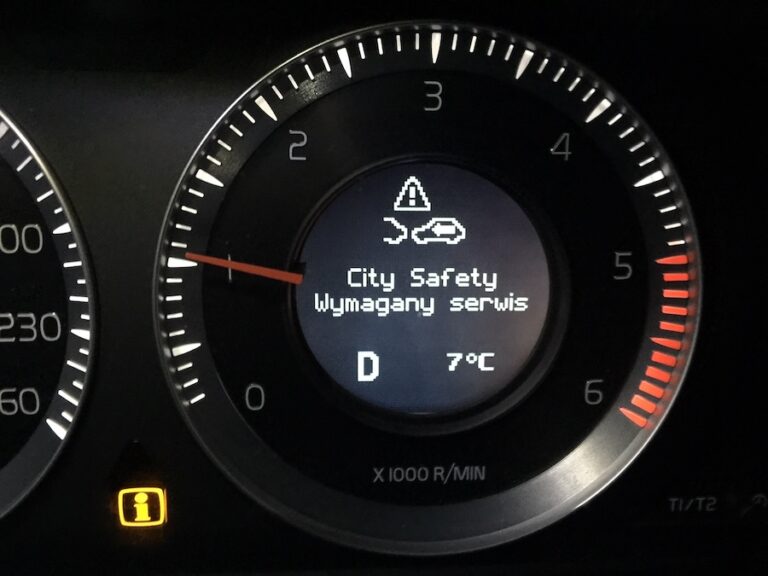
If you drive a Volvo and you have ever looked down at your dashboard to see the words “City Safety Service Required” staring back at you, you already know that sinking feeling. It is not the kind of warning you can just shrug off and forget about. This message is telling you that one of your vehicle’s most important safety features has gone offline, and that matters a lot more than most people realize.
City Safety Service Required means your Volvo’s city safety system is either offline or not functioning correctly. The causes range from dirty sensors and misaligned cameras to software glitches and electrical issues. Some of these you can address yourself. Others need a trained technician with specialized equipment to sort out properly.
In this guide, we are going to break down exactly what this warning means, what causes it, and what you need to do to fix it. By the end, you will have a clear picture of what is going on and how to handle it the right way.
What Is City Safety Service Required and Why Should You Care?
Let us start from the beginning. Volvo’s City Safety system is not just a nice-to-have feature. It is one of the core pillars of what Volvo calls Intellisafe, their comprehensive active safety platform. The system uses a combination of laser sensors, cameras, and radar to continuously scan the road ahead. It watches for vehicles, pedestrians, cyclists, and large animals, and it can detect when a collision is imminent.
When the system senses danger, it first alerts you visually and audibly. If you do not react in time, it can automatically apply the brakes to either prevent the collision entirely or at least reduce the severity of the impact. It works at low speeds in city traffic and at higher highway speeds too, depending on your model and configuration.
Here is some important context behind why Volvo built this in the first place. Data at the time of development showed that roughly 75% of traffic accidents happened at speeds of around 30 km/h or less. Think bumper-to-bumper city traffic, intersections, parking lots. Volvo responded by engineering a system that activates precisely in those conditions and triggers automatic braking when driving above 31 km/h.
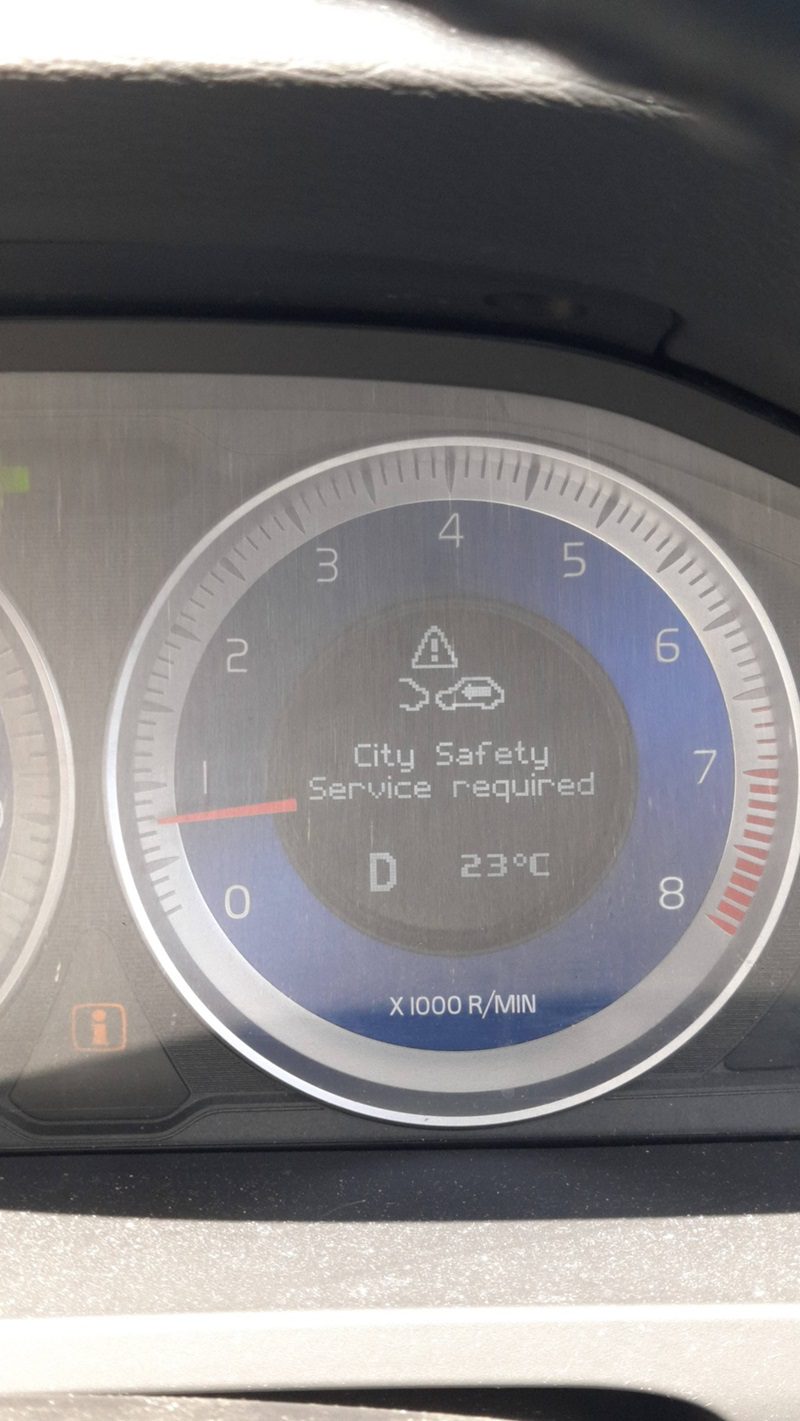
So when you see “City Safety Service Required” on your dashboard, what you are really seeing is a notification that this entire protective layer has gone dark. Your car is still drivable. You still have full control. But you have lost the automatic safety net that was working quietly in the background to protect you every time you navigated through traffic.
That is not a warning to ignore.
How the City Safety System Actually Works
Before we talk about what goes wrong, it helps to understand how the system works when everything is functioning correctly. City Safety is not a single component you can point to under the hood. It is a network of interconnected hardware and software working together in real time.
Here is the basic flow:
- Sensors and cameras continuously scan the environment around the vehicle.
- The data from those sensors is fed into the vehicle’s central processing system.
- The software analyzes the data and calculates the risk of a collision based on your speed, direction, and the movement of objects around you.
- If a threat is detected, the system issues a warning through visual and audio alerts.
- If you do not respond, the system prepares the brakes and applies them automatically to reduce or prevent the impact.
Every single step in that chain depends on the previous one. If the sensor data is corrupted, dirty, or missing, the software has nothing to work with. If the software has a glitch, the whole system shuts down as a failsafe. If the camera is misaligned, it sends incorrect positional data that makes the system unreliable and therefore non-functional.
The system is always active whenever the engine is running. It does not need to be switched on manually. It comes on with the engine and goes off when you shut the car down. So if you notice the City Safety warning while the engine is running, something in that chain has broken down.
What Causes the City Safety Service Required Warning?
There are several reasons this warning can appear, and they are not all equally serious. Some are straightforward fixes you can handle in your driveway. Others need a dealership with proper diagnostic tools. Let us go through each one.
1. Faulty or Damaged Sensors
This is the most common culprit. The City Safety system relies heavily on sensors positioned around the vehicle, particularly near the windshield and at the front of the car. These sensors are the system’s primary input devices. They are constantly sending data about what is in front of and around the vehicle.
When a sensor becomes faulty, whether from age, physical damage, or electrical failure, the entire system loses confidence in its own data. Rather than operate on incomplete or unreliable information and potentially make a dangerous decision, the system shuts itself down and throws the warning on your dash.
Sensor failure can happen gradually or suddenly. A small crack in a sensor housing, a loose connection, or a stone chip to the windshield near a camera-mounted sensor can all trigger the problem.
2. System Misalignment
The cameras and radar components in the City Safety system are calibrated to very specific angles and positions. Even a small deviation from those calibrated positions can throw off the entire system’s ability to accurately read the road ahead.
Here is how easy it is for this to happen. You drive through a pothole a little too fast. You get a minor fender-bender in a parking lot. You have your windshield replaced by a shop that does not recalibrate the camera mounted behind it. Any of those situations can shift the camera or radar unit just enough to make the system unreliable.
When the system detects that its components are not aligned to expected parameters, it cannot guarantee accurate threat detection. The safest response for the system is to go offline and alert you with the warning message rather than continue operating with potentially inaccurate data.
3. Obstruction or Dirt on Sensors and Camera Lenses
This one is actually the most straightforward and the easiest to fix. Volvo explicitly acknowledges in their documentation that the City Safety system has limitations under specific environmental conditions. These include:
- Heavy rain
- Snow
- Thick fog
- Ice buildup on sensor surfaces
- Mud or dirt covering camera lenses or radar surfaces
When any of these conditions block or degrade the sensor’s field of view, the system cannot get accurate readings. If the obstruction is bad enough, the system will shut down and display the City Safety Service Required warning rather than continue operating blindly.
The good news is that in many cases, simply cleaning the affected sensors or waiting for poor weather conditions to pass will restore normal operation. We will cover the proper way to clean these components below.
4. Software Errors and Glitches
The City Safety system runs on sophisticated software that processes enormous amounts of sensor data in real time. Like any complex software system, it is not immune to bugs and glitches. These can stem from several sources:
- Manufacturer software errors in a specific version or update
- Electrical failures that corrupt stored data
- Physical damage to control modules
- Conflicts between different software modules in the vehicle’s electronic system
When the software encounters an error it cannot resolve internally, it triggers a failsafe shutdown of the affected system. The result is the City Safety Service Required message on your dashboard.
Volvo periodically releases software updates specifically to address known glitches and improve system stability. If your vehicle is running an outdated software version that has a known bug, an update from a dealership may be all that is needed to clear the problem.
5. Electrical Connection Issues
The City Safety system depends on a reliable flow of electrical power and data between its components. Corroded terminals, loose connectors, damaged wiring, or a failing battery can all disrupt that flow and cause the system to malfunction or shut down.
Battery-related issues are worth paying particular attention to. If your Volvo’s battery is weak or failing, it may not be supplying consistent voltage to the vehicle’s electronic systems. Advanced safety systems like City Safety are sensitive to voltage fluctuations, and an underperforming battery can cause all kinds of electronic warning messages to appear, not just the City Safety one.
If you have noticed other electronic systems behaving oddly alongside the City Safety warning, a weak battery is a strong suspect.
How to Fix the City Safety Service Required Warning
Now let us get into the actual fixes. Some of these you can do at home right now. Others need professional help. Here is a breakdown of each approach.
Fix 1: Clean the Sensors and Camera Lenses
Start here. It costs you nothing but a few minutes and a clean cloth, and if this is the cause of your problem, you will have it sorted before you finish reading this article.
The main camera on most Volvo models is mounted on the windshield behind the rearview mirror. Radar sensors are typically located in the front grille area. Here is how to clean them properly:
- Use a clean, soft microfibre cloth. Avoid paper towels or rough fabrics that can scratch camera lenses or leave residue.
- If there is mud, ice, or heavy grime, use a mild car-specific cleaning solution to loosen it first. Do not use harsh chemicals.
- Wipe gently in one direction. Do not scrub in circles, as this can leave swirl marks on camera lenses that affect image clarity.
- Check the front grille area for mud or debris blocking any radar sensors. Clear this out with a soft brush or damp cloth.
- If ice is the issue, allow it to melt naturally or use a proper de-icer spray. Never use sharp tools to chip ice away from sensor areas.
After cleaning, start the vehicle and allow the system a moment to reinitialize. In many cases, if obstruction was the issue, the City Safety warning will clear on its own within a few seconds to a minute of driving.
Fix 2: Recalibrate and Realign the System
If cleaning the sensors does not resolve the warning, and especially if you recently had your windshield replaced, were involved in a minor accident, or drove through particularly rough terrain, misalignment is likely the issue. This is not something you can fix at home.
Camera and radar calibration requires specialized equipment including alignment racks, calibration targets, and Volvo’s own diagnostic software. The process can take anywhere from 15 minutes to 2 hours depending on which components need recalibration and the extent of the misalignment.
A few important points about calibration:
- Any shop performing windshield replacement on your Volvo should also recalibrate the forward-facing camera afterward. If they do not, you are likely to end up with this exact problem.
- After any front-end collision repair, even a minor one, have the radar sensors and cameras recalibrated before relying on the City Safety system again.
- Calibration must be done to Volvo’s factory specifications. Do not accept generic alignment as a substitute for proper ADAS (Advanced Driver Assistance Systems) calibration.
Take your vehicle to a Volvo-authorized dealership or a shop that specifically advertises ADAS calibration capability with the proper equipment for your vehicle brand.
Fix 3: Software Diagnosis and Update
Volvo regularly releases software updates for their vehicles, and these updates often address known bugs and system stability issues. If a software glitch is causing the City Safety warning, an update may resolve it entirely.
Here is what the process typically looks like:
- Visit a Volvo-authorized dealership and let them connect your vehicle to their diagnostic system.
- The technician will pull any stored fault codes from the vehicle’s computer. These codes will point to which module or system is reporting a failure.
- If a software update is available for the affected system, it will be applied. Some newer Volvo models can receive over-the-air updates, but safety-critical software updates are typically done at the dealership.
- After the update, the technician will clear the fault codes and verify that the City Safety system is operating correctly before handing the vehicle back.
Do not attempt to use third-party software tools to update or reprogram your Volvo’s safety systems. Using the wrong software version or an incorrect programming process can corrupt the system and create problems far worse than the original warning. Stick to a Volvo dealership for anything related to software on safety-critical systems.
Fix 4: Check the Battery
This is a step a lot of people overlook because it seems too simple. But a weak or failing battery is a surprisingly common trigger for electronic warning messages in modern vehicles, including the City Safety warning in Volvos.
Modern Volvo vehicles have complex electronic systems that require stable, consistent voltage to operate correctly. When a battery starts to fail, it can drop voltage under load, which causes sensitive electronic modules to misbehave or shut down temporarily. If your battery is more than three to four years old and you have not had it tested recently, now is a good time.
Here is what to check:
- Battery voltage at rest: A fully charged battery should read around 12.6 volts. Below 12.4 volts at rest suggests a battery that needs attention.
- Battery voltage under load: When starting the engine, voltage will drop briefly. It should not drop below 10 volts. A battery dropping significantly lower than that during cranking is one that is nearing the end of its life.
- Terminals and connections: Check for corrosion on the battery terminals. White or bluish-green buildup on the terminals creates resistance that can mimic a weak battery. Clean corroded terminals with a battery terminal cleaner or a paste of baking soda and water, then rinse and dry thoroughly.
Most auto parts stores will test your battery for free. If it comes back weak or failing, replace it before investing time and money chasing other potential causes of the City Safety warning.
One additional note here: if you replace your Volvo’s battery, some models require the new battery to be registered with the vehicle’s computer through a diagnostic tool. Failing to do this can cause charging system issues. Ask your dealer or mechanic about battery registration when replacing the battery in your Volvo.
Fix 5: Professional Diagnosis and Repair
If you have cleaned the sensors, checked the battery, and the warning is still present with no obvious external cause, it is time to hand it over to a professional. A comprehensive diagnostic scan will pull all the stored fault codes from your vehicle’s system and give a technician a clear roadmap of what is wrong.
At this stage, the technician will inspect:
- Individual sensor function and output data
- Camera condition and calibration status
- Radar module integrity
- Wiring harness and connector condition throughout the safety system
- Software version and whether an update or re-flash is needed
- Control module function and communication with the rest of the vehicle network
Given how complex and safety-critical the City Safety system is, this is genuinely a situation where an authorized Volvo dealership is your best option. They have the manufacturer-specific diagnostic tools, the latest software, and technicians who are trained specifically on Volvo systems. Independent shops can handle a lot of Volvo work very competently, but for ADAS-related diagnostics and repairs, specialized tools and access to Volvo’s technical databases make a real difference.
Can You Drive With the City Safety Service Required Warning On?
Technically, yes. The vehicle will not prevent you from driving, and you retain full manual control at all times. Volvo’s design philosophy is clear on this point: the driver is always in command, and the safety systems are there to assist, not to replace human judgment.
But here is the honest answer. You should get it fixed as soon as reasonably possible. When City Safety is offline, you are driving without automatic collision avoidance. In normal conditions on a clear day with light traffic, that may not feel significant. But in heavy city traffic, poor weather, or any situation where a sudden stop could occur, you are relying entirely on your own reaction time.
Human reaction time averages around 1 to 1.5 seconds. At 50 km/h, that means you travel roughly 14 to 21 meters before your foot even touches the brake. The City Safety system reacts in milliseconds. That gap matters in real-world emergency braking situations.
Drive with the warning active if you need to, but treat it as urgent rather than optional.
What Volvo Models Are Affected by City Safety Issues?
City Safety is available across a wide range of Volvo models, though the specific hardware and software implementation varies by generation. Here is a general overview:
| Volvo Model | City Safety Generation | Key Sensor Technology |
|---|---|---|
| XC90 (2016 and newer) | Second generation | Camera, radar, lidar |
| XC60 (2018 and newer) | Second generation | Camera, radar, lidar |
| XC40 (2018 and newer) | Second generation | Camera and radar |
| S90 / V90 (2017 and newer) | Second generation | Camera, radar, lidar |
| S60 / V60 (2019 and newer) | Second generation | Camera and radar |
| Older models (pre-2016) | First generation | Laser sensor and camera |
First-generation City Safety, found in older Volvos, used a single laser sensor mounted behind the windshield. It was effective but more limited in its range and detection capabilities compared to the second-generation system. If you drive an older Volvo, the diagnostic process for this warning may be simpler, but the replacement cost for a laser sensor unit can still be significant.
Second-generation systems are considerably more sophisticated, with multiple redundant sensors providing broader coverage and better detection of pedestrians and cyclists. But that sophistication also means more components that can potentially fail or go out of alignment.
The Real Cost of Repairing City Safety System Issues
Let us talk numbers. Depending on the cause of your City Safety warning, repair costs can vary significantly. Here is a rough guide to help set expectations:
| Repair Type | Approximate Cost Range |
|---|---|
| Sensor cleaning (DIY) | Free |
| Camera recalibration at a dealership | $150 to $400 |
| Radar sensor replacement and calibration | $500 to $1,500+ |
| Forward camera replacement | $600 to $1,200+ |
| Software update or re-flash | $100 to $300 (often covered under warranty) |
| Battery replacement | $150 to $300 |
| Wiring harness repair | $200 to $800 depending on complexity |
| Full diagnostic scan at dealership | $100 to $200 (often applied toward repair cost) |
If your Volvo is still within its warranty period, many of these repairs may be covered, particularly if the failure is related to a manufacturing defect or a software issue. Always check your warranty status before authorizing paid repairs at a dealership.
Protecting Your City Safety System Going Forward
Once you have resolved the City Safety warning, there are some practical habits that will help you avoid running into the same problem again down the road.
Keep the Windshield and Sensor Areas Clean
Make sensor and camera cleaning a regular part of your car wash routine. Pay particular attention to the area directly behind the rearview mirror on the inside of the windshield where the forward camera sits, and the front grille area where radar sensors are usually mounted. Do not let mud, snow, or ice sit on these areas for extended periods.
Always Recalibrate After Windshield Work
This is one of the most common sources of City Safety issues and one of the most preventable. Any time your windshield is replaced, insist that the shop recalibrates the forward-facing camera. Not all glass shops do this automatically, and some will skip it if you do not ask specifically. Make it a non-negotiable part of any windshield job.
Keep Up With Volvo Software Updates
Check in with your Volvo dealership periodically to find out if any software updates are available for your model. Some of these updates specifically address ADAS system stability. Keeping your software current reduces the risk of glitch-related failures in safety-critical systems.
Use Quality Replacement Parts
If any component of the City Safety system needs to be replaced, use OEM (original equipment manufacturer) parts or Volvo-approved aftermarket components. Generic or low-quality sensor replacements may not meet the precision specifications required for the system to work correctly. The City Safety system is calibrated to work with specific components, and substituting those with inferior alternatives can create ongoing alignment and accuracy issues.
Have the Battery Tested Annually
Batteries degrade gradually, and by the time they fail noticeably, they have often been causing intermittent issues for a while. Get your battery load-tested annually, especially if your Volvo is more than three years old. Catching a weakening battery early is cheap. Replacing one after it has caused a cascade of electronic warning messages is annoying and potentially more expensive.

Why an Authorized Volvo Dealership Is the Right Call for This Repair
There is a reason Volvo dealers are specifically recommended for City Safety issues rather than general repair shops. It is not just about brand loyalty. It is about capability.
The diagnostic software required to fully interrogate Volvo’s ADAS modules is proprietary. While generic OBD-II scanners can pick up basic fault codes, they often cannot access the deeper layers of data that Volvo’s own VIDA diagnostic system can read. A Volvo-trained technician using VIDA can see exactly which sensor is reporting an error, what specific fault has been logged, and whether it is a hardware failure or a software issue. That level of detail is what allows them to fix it correctly the first time.
Independent shops that specialize in European vehicles and have invested in Volvo-compatible diagnostic tools can also do excellent work here. But a general-purpose repair shop without those tools is going to be working somewhat in the dark on a City Safety diagnosis, and that increases the chance of misdiagnosis and unnecessary parts replacement.
The City Safety system is too important to your safety and too technically complex to leave in the hands of someone guessing at the problem. The investment in a proper diagnostic is worth it.
Final Thought
The City Safety system in your Volvo exists for one reason: to give you an extra layer of protection when things happen faster than human reflexes can respond. When it is working, you may never notice it doing its job. But when it is not, you are the only safety net left. Start with the simple stuff: clean those sensors, check the battery, and verify whether recent windshield work may have caused a misalignment. If the warning persists, stop delaying and get it diagnosed by someone with the right tools. Your Volvo was built around a genuine commitment to keeping you safe. Do not undermine that by driving with one of its most important safety systems switched off.